


You keep seeing integrated home espresso system, connected brewing system, and smart semi-automatic on the same product cards — then wonder which words name real hardware, and which only name an app tile. An integrated home espresso system definition that helps system buyers is a discipline test: grind, heat, measurement, and controls that work as one weekday station — not a synonym for “Wi‑Fi” or “cloud recipes.”
This Meraki page owns that definition discipline. It is not a rewrite of Integrated Espresso Machine: One System Explained (tradeoffs, TCO, who integration suits, workflow). Soft-lane drafts: A027 (all-in-one dual boiler what-included), A041 (integrated-grinder checklist), A025 (dual-boiler-with-grinder filters). Use this page when the question is still: what should “integrated home espresso system” mean — before smart marketing defines it for you?
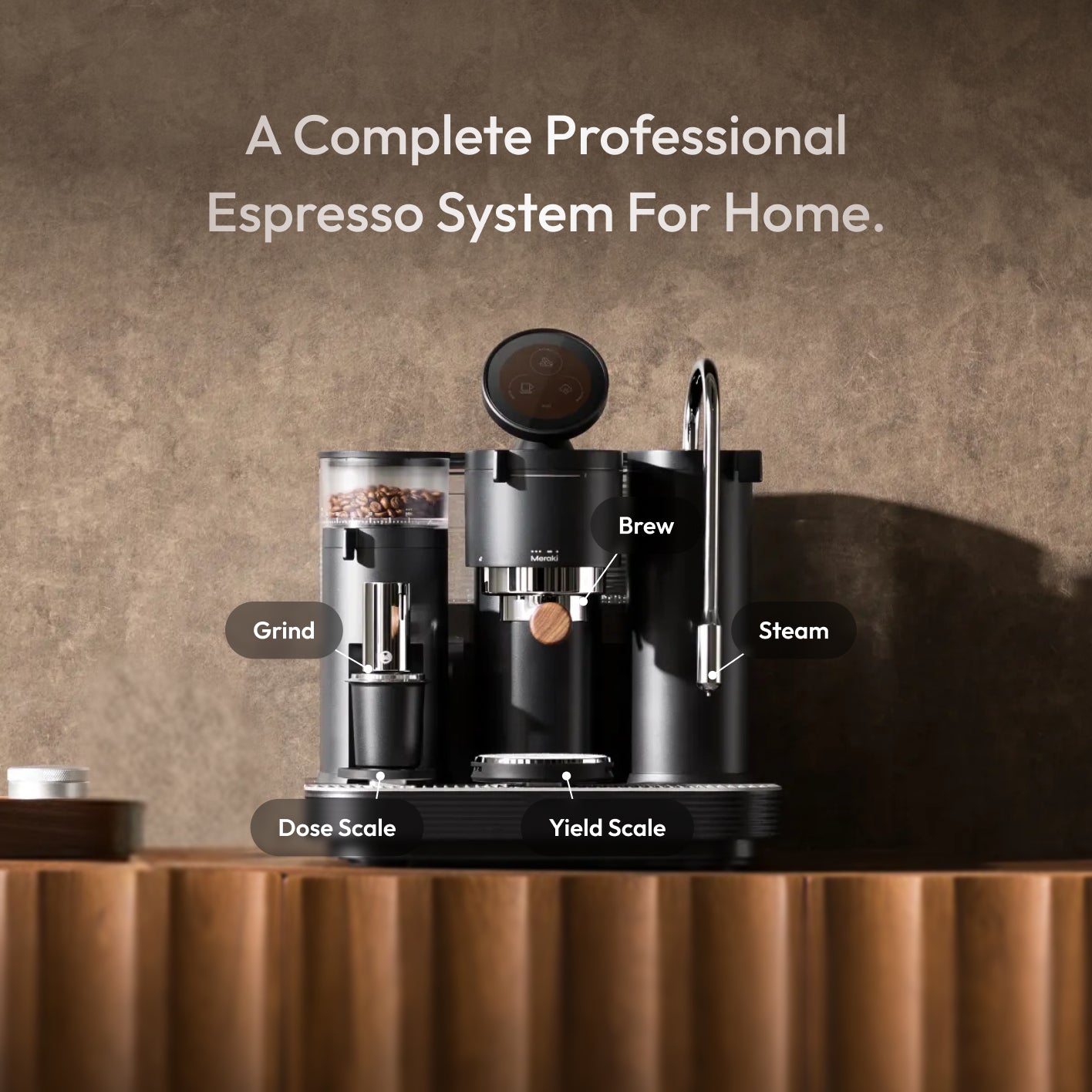
An integrated home espresso system should name grind, independent heat, measurement, and usable controls in one chassis — not only a “connected” badge.
What “integrated home espresso system definition” really means for home buyers
An integrated home espresso system definition, for home buyers, means one chassis that combines espresso-capable grinding, brew-and-steam heat you can use on a weekday schedule, a dose/yield measurement path, and controls that keep that chain honest — with or without a network.
Search for the phrase often lands on built-in cabinet machines, bean-to-cup roundups, “home vs commercial” explainers, and smart-kitchen blogs that treat “integrated” as furniture or Alexa. Those pages rarely separate system integration (parts that share a workflow) from connectivity theater (remote start, recipe clouds, companion apps). Treat the keyword as a label audit: Does the listing define the system, or only the smart story?
Who this page is for (and who should skip it)
This page is for system buyers — people shopping one station that should grind, brew, steam, and measure without assembling four brands — who need a disciplined definition before they trust “connected,” “smart,” or “all-in-one system” copy.
Skip one system explained for tradeoffs, TCO, or the integrated workflow. Soft-skip A027 for dual-boiler inclusion; soft-skip A041 / A025 for mill checklist or DB+grinder filters. Skip smart espresso machines: do they live up to the hype for a smart-feature reality check without a system definition. Come here for: what the phrase should mean — and which semi-auto “smart” features are worth using offline.
Why this is definition discipline (not another one-system tradeoff essay)
SERP for this query is mixed: commercial-vs-home primers, “which system suits your habits” shopping chips, built-in furniture espresso, and type-of-machine taxonomies. Few pages force a buyer-friendly definition that refuses to equate “integrated” with “online.”
The unique job is definition discipline: plain-language core, weekday system picture, listing checks that separate hardware from fluff, tradeoffs, mistakes, a short checklist, and a Meraki dual-boiler illustration — not the nearest one-system tradeoff essay, and not A027’s inclusion list. Disclosure: Meraki publishes this guide and sells the Meraki Espresso Machine. Live framing (2026-10-26/27 snapshot): TIMEMORE® co-developed burr grinder, dual boilers, dual scales (1 kg · ±0.2 g), guided Grind → Dose → Brew → Steam, rotary pump framed at steady 9 bar, warm-up about 3–4 minutes, 45 grind settings — vendor claims; verify live. No invented competitor smart-feature matrices, app scorecards, or street prices; no competitor outbound links. Score every brand — including ours — on the same definition.
Core idea in plain language
Integrated should mean the parts share a job, not only a cabinet or a login. A home espresso system is the chain that turns beans into a drink you repeat: grind → dose → brew → (optional) steam → serve, with enough measurement that Monday’s cup can resemble Tuesday’s.
In plain language, a buyer-friendly definition usually requires four pillars in one chassis (or an honest note when one pillar still sits on the counter):
- Espresso-capable grinding — burrs and an adjustment range you can dial, not a blade mill sold as “precision.”
- Heat that matches how you drink — for milk households, independent brew and steam heat (or a clear compromise you accept). Dual-boiler mechanism depth lives elsewhere; here you only need heat to be named and usable.
- A measurement path — grind-by-weight, built-in scales, or an explicit “bring your own mat scale” note. Vague “smart dosing” without grams is marketing.
- Controls that keep the chain honest offline — timers, auto-stop, ready-state, guided steps, or profiles you can run when Wi‑Fi is down. Connectivity may add convenience; it should not be the definition.
“Connected brewing system” and “smart semi-automatic coffee machine” are secondary labels. They can be true and useful when they mean temperature visibility, dose/yield targets, or drink tiles that shorten handoffs. They are fluff when the only proof is an app screenshot and the offline machine cannot finish a weekday espresso.
How it shows up in a weekday workflow
Definition discipline is easiest to test before coffee: power on, warm to a stated ready state, grind to a target dose, brew to a target yield, steam if the drink needs milk, wipe, and leave — without opening a phone.
On a disciplined system the weekday loop is boring on purpose: one drink habit, ready heat, zero the dose path, grind, distribute and tamp, brew to yield (scale, auto-stop, or a timer you trust), steam if milk is on the sticky note while brew heat stays usable when claimed, taste once — no cloud recipe required.
Meraki’s current language walks Grind → Dose → Brew → Steam with grind-to-scale dosing and dual scales — confirm on the live product page and espresso machine with grinder page. That is an illustration, not a universal UI map. If mornings only work when the app is online, you bought a connection story. Specialty Coffee Association literacy still beats remote-start badges that never name dose grams or heat independence.
What to verify on the machine or listing
Walk the listing like a definition quiz. Prefer sentences that name subsystems over adjectives that name lifestyles.
| Listing phrase | Weak reading (fluff) | Strong reading (system definition) |
|---|---|---|
| “Integrated system” | Looks nice as one object | Grind + brew + steam + measurement named in one chassis |
| “Connected / smart” | App required for daily drinks | Offline brew/steam still complete; app optional |
| “All-in-one” | Photo of hopper + wand | Burr type, heat independence, tools, warranty for mill and heat |
| “Precision dosing” | Glow UI | Grams, tare path, or auto-stop you can verify |
| “Café pressure” | Bare “9 bar” badge | Pump type / steady-pressure story you can re-check |
| “Dual heating” | Warm lights | Independent brew and steam jobs, or a named compromise |
| “Guided workflow” | Many tiles | A weekday path you can finish without a phone |
Verify in writing: burr language and range; how dose lands; yield weighing; independent brew/steam heat; what “ready” means; what works offline; whether trial and warranty cover mill and boilers in your country. Meraki snapshot specs (TIMEMORE® burrs, 45 settings, dual scales ±0.2 g, dual boilers, rotary framed 9 bar, warm-up ~3–4 minutes) are examples to re-check — not a “must match Meraki” rule.
Ignore vanity: award logos instead of tasting (this page omits German Design / Red Dot), bare “commercial” claims, and smart-home diagrams that skip offline espresso. Dial-in still needs honest zeros (NIST); CoffeeGeek’s guides help separate skill gaps from incomplete systems.
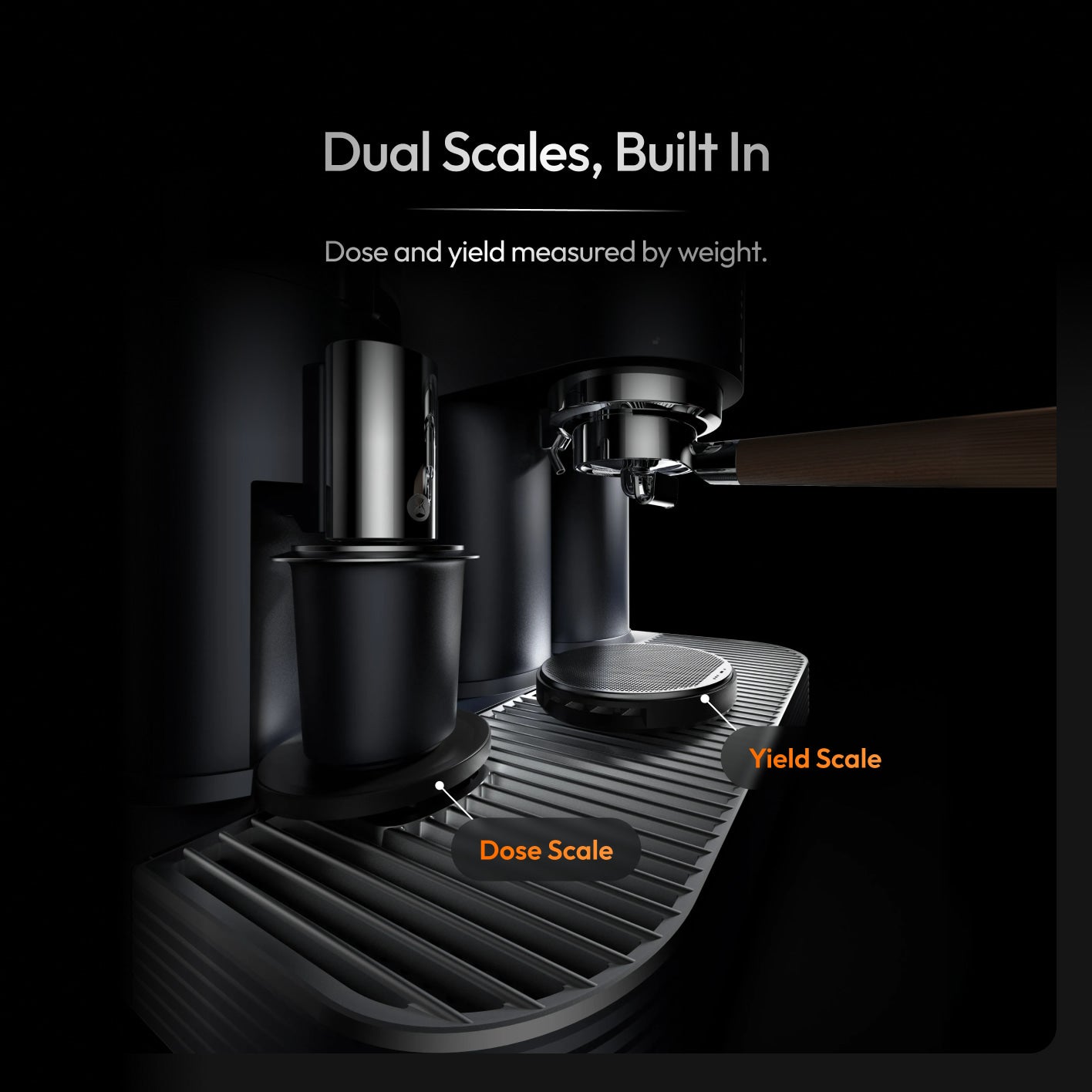
Measurement is part of a buyer-friendly system definition — if dose and yield stay undefined, “integrated” is mostly furniture language.
Tradeoffs and limits
A well-defined integrated system trades upgrade flexibility for weekday glue: one mill path, one footprint, one service story for heat and grinding — often right when counter space and handoffs hurt.
Limits: integration does not remove puck prep, bean age, or taste. Dual boilers and scales do not fix channeling; guided tiles do not replace watching the shot; a quiet rotary framing does not erase mill noise. Connectivity can save recipes or preheat — it cannot invent thermal readiness. Home espresso energy is usually modest next to beans (energy.gov); scheduled empty-boiler heat is a habit cost. If you want a forever separate mill or super-automatic push-button convenience, this category may be wrong even when the definition is perfect. Soft-read the one-system page for who integration suits; keep this page for the label.
Mistakes that waste time
Most buyer regret under this keyword is definition drift — letting marketing rename the category mid-cart.
Common time-wasters: treating cabinetry “built-in” as a brewing system; treating “smart” as proof of dual boilers or scales; price-sorting before measurement is named; assuming an app replaces a missing mill; skipping the offline test; shopping brand-vs-brand smart-feature matrices instead of verifying four pillars on your shortlist; and jumping into A027 / A025 checklists before the system phrase is defined.
Also wasteful: burning a 30-day trial on every menu tile, then returning because “it felt complicated,” when you never locked one weekday drink and dose/yield pair. Appliance safety still matters — see UL — even when the brochure sounds like software.
A simple decision or setup checklist
Answer yes/no before you accept the phrase integrated home espresso system:
- The listing names grind + brew heat + steam (if you drink milk) + a measurement path in one ownership story — not only “connected.”
- Burr type and an espresso-usable adjustment range are documented (Meraki example: 45 settings — verify live).
- Dose method is clear: time, weight, or both — and whether built-in scales are part of the claim (Meraki example: dual scales 1 kg · ±0.2 g).
- Heat language distinguishes independent brew/steam jobs from vague “dual heating.”
- “Ready” is defined for the drinks you make — not only power-on LEDs.
- A full weekday espresso (and milk drink, if relevant) works offline.
- Semi-auto “smart” features you will actually use are listed (guided steps, auto-stop, visible targets) — and optional apps are labeled optional.
- Trial, return fees, and warranty cover boilers and the grinder in your country.
- You accept integration tradeoffs (upgrade path, shared chassis noise) on purpose.
- You are not using this page as a substitute for A027 inclusion, A041 mill checklist, or A025 purchase filters once those are your real next questions.
Seven or more “yes” answers usually means the phrase is earned. Four or fewer means pause — you may still be shopping a connected slogan.
How this connects to Meraki’s dual-boiler system
Meraki is one concrete example: independent dual boilers for brew/steam overlap when ready, TIMEMORE® co-developed burrs with grind-to-scale dosing, dual built-in scales, rotary pump framed at steady 9 bar, and a guided touchscreen sequence — one system, not a pile of accessories. Confirm on the live Meraki Espresso Machine and dual boiler pages.
Illustrative, not exclusive — other brands can meet the same definition differently. What is a dual boiler owns basics; the one-system article owns tradeoffs; this page only shows how dual-boiler heat fits the system definition. Soft-link A027 for dual-boiler inclusion checklists.
As of 2026-10-26/27, Meraki promoted free shipping over $200 (typical policy language), a 30-day home trial from delivery, and a 2-year limited warranty in the purchase country — re-read shipping, refund, and warranty claim. Ownership terms are part of whether a “system” is complete after unboxing.
What is the function of an espresso machine?
It forces hot water through fine grounds under pressure. An espresso machine’s core job is pressurized extraction into a concentrated shot; grinders, scales, steam, and screens support that job — they are not substitutes for it.
At home, “function” still means a drink you can repeat: pressure and heat in a usable band, a puck you prepared, and a stop point you trust. NCA brewing basics and SCA research help literacy; they do not crown a brand. An integrated system only earns its name when those supporting parts serve the same extraction job offline.
Is it better to have a manual or automatic coffee machine?
Neither is universally better. Manual (or semi-automatic) control suits taste dial-in and milk texture practice; fuller automation suits speed and fewer variables — match the machine to your mornings, not a hierarchy.
“Manual vs automatic” PAAs often mix lever machines, pump semi-autos, and super-automatics. For system buyers reading this definition page, the sharper question is whether you want a semi-automatic integrated system (you still distribute and tamp; the machine guides grind/dose/brew/steam) or a super-automatic that hides the portafilter. Choose semi-auto integration when fresh grinding and shot control matter; choose fuller automation when convenience outranks dial-in. Soft-check Meraki’s smart-hype and one-system pages for adjacent angles — not as a manual-vs-auto trophy match.
Conclusion
A buyer-friendly integrated home espresso system definition is discipline: espresso-capable grinding, usable brew-and-steam heat, a measurement path, and offline controls that finish a weekday drink — with “connected” and “smart” as optional layers, not the noun. System buyers need that before one-system tradeoff essays, A027 inclusion lists, or mill-only checklists take over.
If that matches how you shop, review the Meraki Espresso Machine for your region, or ask Meraki Support (+1 833 854 9555, Mon–Fri 9 AM–5 PM EST). Soft-read one system explained next when you already accept the definition and need tradeoffs.
FAQ
What should “integrated home espresso system” mean on a product listing?
It should mean one ownership story that combines espresso-capable grinding, usable brew and steam heat for your drinks, a clear dose/yield measurement path, and controls you can finish offline. “Connected,” “smart,” or “app-enabled” can be extras. They should not be the only proof that a system exists. Ask the listing to name those pillars in writing before you trust the phrase.
Which semi-automatic smart features are actually worth using?
Features that shorten honest handoffs: ready-state clarity, grind-to-weight or auto-dose, brew-to-yield / auto-stop, visible temperature or heat status, and a short guided weekday path. App libraries, remote start, and social recipe feeds are optional. Prefer tools that still work when Wi‑Fi drops over features that only look smart in a screenshot.
Does a connected brewing system need Wi‑Fi every morning?
It should not. If espresso and milk drinks require a live connection to finish, you bought a dependency, not a resilient home system. Connectivity may add convenience for preheat schedules or saving recipes, but the core grind → dose → brew → steam chain should remain usable offline. Test that claim in a home trial before you treat “connected” as a benefit.
How is this different from Meraki’s “one system explained” article?
That page owns integration tradeoffs: what integration changes and gives up, who it suits, measurement advantages, TCO, misconceptions, and the integrated workflow. This page owns definition discipline for the phrase “integrated home espresso system,” including how to separate system hardware from smart/connected marketing. Soft-link the one-system article once you accept the definition and need the tradeoff story.
How is this different from an all-in-one dual boiler “what should be included” checklist?
An all-in-one dual-boiler inclusion page (Meraki draft A027) asks which subsystems earn that specific label — independent heat, mill, steam, measurement, tools, warranty. This page defines the broader “integrated home espresso system” phrase for system buyers, with extra weight on offline reliability versus connected promises. Use both without rewriting either: definition of the system phrase here; dual-boiler inclusion boundaries there.


