


Decision path: list your weekday drinks → if brew and steam overlap often, shortlist dual boiler → compare vs HX on flush skill tolerance → confirm grind plan → measure counter and warm-up patience. Counterintuitive engineering note: a dual boiler espresso machine will not rescue channeling from a bad grind; it only stops the temperature tug-of-war between shot and steam.
This rewrite deepens dual boiler espresso machine ownership beyond a definition page. Hub link for basics: what is a dual boiler espresso machine. High-end ROI angle lives on the companion high-end guide; here we stay technical and operational.
Who should buy a dual boiler
Milk-drink households, small offices serving back-to-back guests, and learners who refuse brew-then-wait sequencing.
Skip dual boiler spend if you pull rare straight shots and never steam.
Engineers who hate temperature surfing on HX machines often prefer dual boilers for mental overhead reduction. Literacy: SCA, NCA.
What dual boiler means (brew + steam stability)
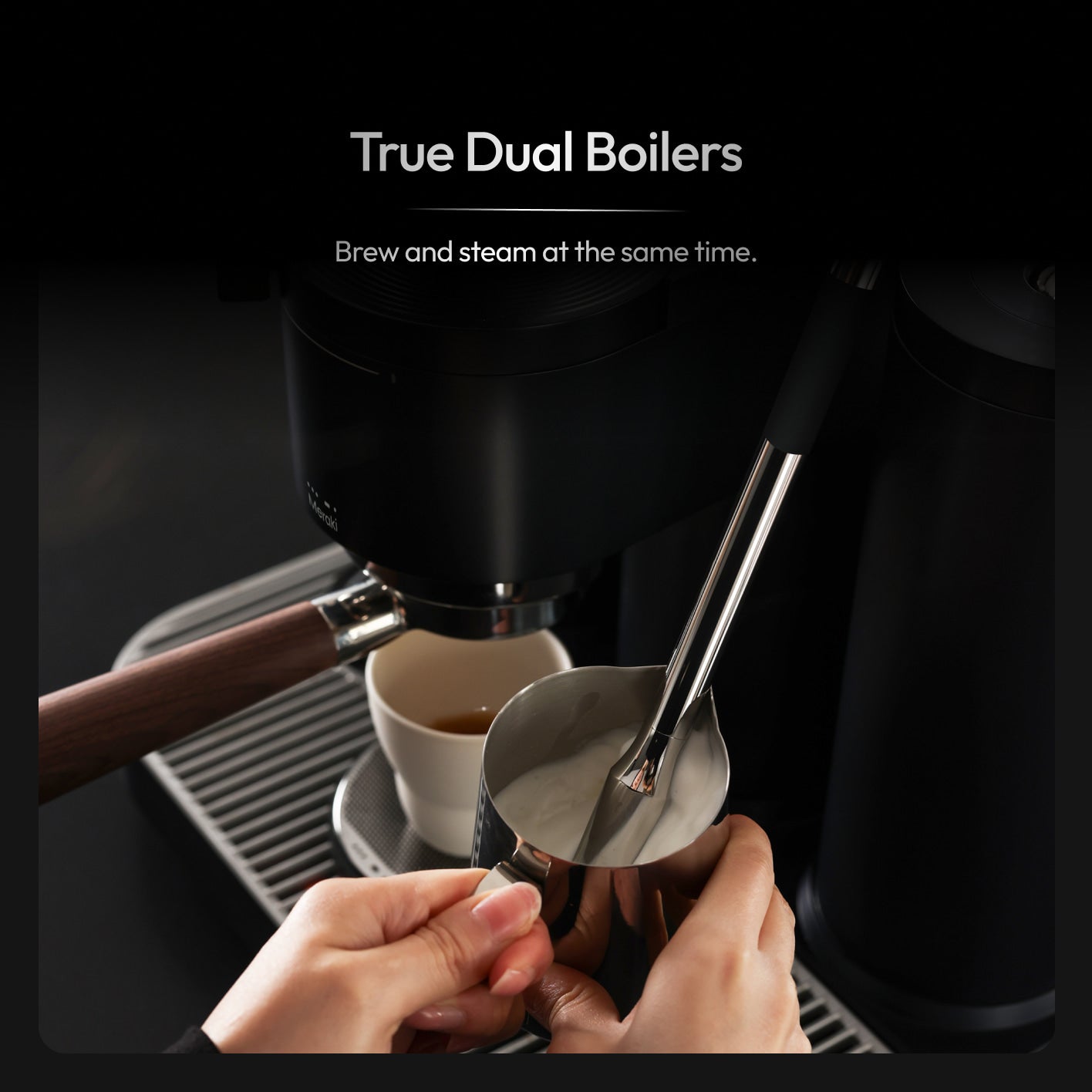
Two dedicated boilers (or boiler vessels) hold brew water and steam at independent setpoints so you can extract and texture without stealing heat from one job to feed the other. That is the stability story. Education: SCA education.
PID control on the brew boiler is common in modern dual boilers and helps keep the brew setpoint honest shot after shot.
Dual boiler vs heat exchanger vs single boiler
| System | Simultaneous brew+steam | Temp workflow | Complexity |
|---|---|---|---|
| Dual boiler | Yes | Independent setpoints | Higher cost/energy |
| Heat exchanger | Usually yes for steam priority | Cooling flushes / balancing | Medium |
| Single boiler | No (sequence) | Switch modes | Lower |
| Thermoblock variants | Varies | Fast heat, different stability | Varies |
Heat-up time and energy
Dual boilers take minutes, not seconds. Leaving them on all day costs energy; timed warm-ups save it. Meraki typically heats dual boilers in about 3–4 minutes with a guided path toward milk drinks in about five—verify live. Water quality still decides scale rate: CDC, EPA WaterSense.
Grind / steam tradeoffs still matter
Steam power is useless on a blond, fast shot. Dial grind first. Dual boiler dual-espresso-maker shoppers sometimes forget the grinder entirely—do not. Sensory: Coffee Review.
Budget tiers / ownership
Entry dual boilers exist; premium units add build and service. Ownership: descaling both paths, wand care, gaskets, electricity. Habit: Harvard on coffee. Beans: beans collection.
Where Meraki fits
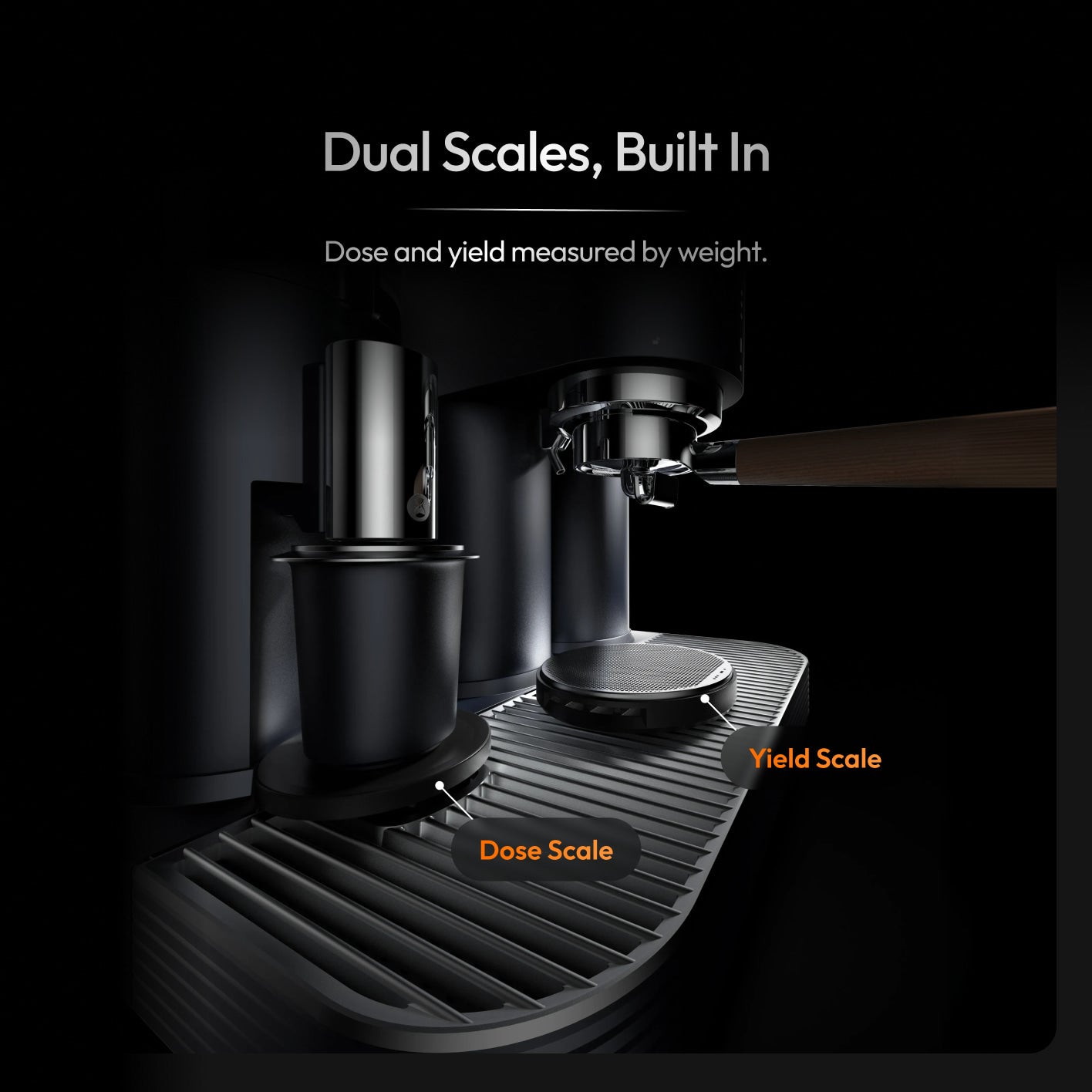
Meraki pairs dual boilers with a commercial rotary pump (~9 bar steady), TIMEMORE co-developed grinder, built-in dual scales (±0.2 g), and guided touchscreen steps so stability includes dose and yield, not only boiler setpoints. Disclosure: Meraki product configuration, not a multi-brand lab ranking. View the Meraki espresso machine. Accessories: collection. Guides: machine guides. Composition: Coffee & Health; craft: Perfect Daily Grind; caffeine: NCA caffeine.
Mistakes to avoid
Buying dual boiler to fix grind. Skipping steam-side descaling. Expecting instant heat. Ignoring counter depth for larger chassis. Fast Q: worth it at home? When overlap is real. Vs HX? Independence vs flush skill. Heat-up? Minutes. Replace grinder? Never. Maintenance? Two paths.
Depth: workflow minutes
Script a two-cappuccino morning on single boiler vs dual boiler. The dual boiler script removes the mode switch and the guesswork about when steam is ready. That is the product. If your script never includes steam, stop reading dual boiler ads.
Cliff-style warnings still apply: dual boilers do not fix stale beans, poor water, or dirty groups. Keep cleaning non-negotiable.
HX vs dual boiler decision drill
If you dislike cooling flushes and want set-and-forget brew temps while steaming, dual boiler wins. If you like the craft of balancing an HX and want strong steam with one boiler system, HX can win. If you never steam, neither debate matters as much as grind.
Write a two-column card: “minutes I will practice flush skill” vs “minutes I will wait on single boiler.” The larger pain column tells you what to buy.
Maintenance drill: schedule descaling reminders for brew and steam paths separately if your manual suggests different attention. Wand purge every milk drink. Backflush or clean group on the oil schedule. Dual boilers punish neglect with more places for scale to hide—schedule is the antidote.
Meraki’s addition to the dual boiler category is measurement: dose and yield on built-in scales while boilers stay ready. That does not change the vs HX physics; it changes how quickly you learn recipes. Inspect the live machine at Meraki.
Energy footnote: heat exchangers and dual boilers both use meaningful power. Timed warm-ups and insulated idle policies are adult ownership, not stinginess.
When blogs say dual boiler is “worth it,” translate to your overlap minutes. Worth is personal workflow math.
Stability, explained without romance
Brew stability means the water hitting the puck sits near the temperature you set, shot after shot. Steam stability means you can texture milk without collapsing brew readiness. Dual boilers pursue both by separation. HX pursues strong steam with clever heat exchange and asks more operator skill on brew flushes. Single boilers pursue simplicity and ask you to wait.
None of these systems invent sweetness. Sweetness comes from grind, dose, yield, bean freshness, and decent water. Keep that hierarchy taped inside the cupboard.
Warm-up discipline: if you start shots on a cold group, you are testing metal mass, not recipes. Give dual boilers their minutes. Meraki’s roughly 3–4 minute boiler heat and ~5 minute guided latte path is a reference point—confirm live—not a challenge to skip.
Maintenance separation: clean organics (oils, milk) on a short clock; descale minerals on a hardness clock. Dual boiler owners who confuse the two either under-clean or over-acidify. Follow chemistry matched to the job.
If you came from the high-end ROI article, use this page for the vs HX table and workflow physics; use that page for spend justification. Do not merge them into one generic dual boiler essay.
Simultaneous brew and steam: minute-by-minute
0:00 power on. 3–4:00 boilers near ready on many dual-boiler homes (Meraki reference range—verify live). Grind and distribute while heating finishes. Pull the shot. Steam milk while a second shot can already be heating on the brew side for the next drink. Wipe wand. Serve. Compare that to a single-boiler sequence that inserts a mode switch and a wait between espresso and milk.
Those recovered minutes are the dual boiler product. Everything else—chrome, badges, limited editions—is optional packaging around that timeline.
HX users can approximate overlap with skill; they pay in attention. Dual boiler users pay in energy and cost; they save attention. Pick the currency you have.
Do not let dual boiler confidence skip group cleaning. Oils still bake onto screens. Keep a blind basket and cleaner in the accessories drawer so stability includes hygiene.
Conclusion
Choose dual boiler for independent brew and steam stability when overlap is daily; compare HX if you accept flush skill; never skip the grind plan.
See dual boilers with scales on the Meraki espresso machine, and keep the definition hub at what is a dual boiler.
FAQ
Is a dual boiler worth it at home?
Yes when you regularly brew and steam in the same session and want independent temperatures. Less critical for occasional straight shots. Worth is about workflow overlap, not prestige.
Dual boiler vs heat exchanger?
Dual boilers give separate brew and steam vessels for true simultaneous use and simpler temperature independence. Heat exchangers use one boiler with a tube for brew water and usually need cooling-flush skill for brew temp.
How long to heat up?
Expect several minutes for most dual boilers. Meraki dual boilers typically heat in about 3–4 minutes, with guided latte workflow around five minutes from power-on—confirm live product details.
Does dual boiler replace a good grinder?
No. Dual boilers stabilize water temperature and steam availability; they do not create even particles. Fund grinding first or alongside.
What maintenance is different?
You must care for two heated vessels and more plumbing: descaling paths for brew and steam, gasket/screen care, and wand hygiene. Skipping steam-side descaling shows up in milk drinks.


