


You want to make your own coffee, but reaching the reservoir or handling a loaded portafilter may matter more than the machine's headline features. An accessible espresso setup starts with the tasks you want to do and the conditions in which you will do them.
Use this as a planning framework, not a medical assessment or a product certification. The right arrangement depends on your reach, movement, grip, preferred assistance, and the actual equipment. No single counter height or machine category fits everyone.
Define what your accessible espresso setup must let you do
List the tasks you want to perform independently, those you are happy to share, and those that need a different method. Include preparation and care, not just starting a shot. This keeps your own goals at the center of the decision.
Describe a requirement concretely: reach the control from your seated position, move a filled cup, or refill without lifting a particular container. A general request for an easy machine is less informative. You do not need to disclose a diagnosis to ask a seller about an equipment interaction.
The American Occupational Therapy Association discusses occupational therapy's role in home modifications. If you need an individualized assessment of equipment use or changes to your kitchen, an occupational therapist can help evaluate the person, task, and environment together. Decide the desired outcome before choosing accessories or assuming more automation is the answer.
Check the approach before measuring reach
A control can look close on a photograph while remaining difficult to reach from your actual position. Check how you approach the station, where you stop, and whether you can leave it comfortably. If you use a mobility aid, include its occupied space and turning needs.
The US Access Board's clear-space guide separates approach and maneuvering space from the element being used. That is a useful design distinction. Its ADA requirements are not a certification of a countertop espresso appliance or a universal prescription for your private kitchen.
Map the actual route to the counter and the sink, with doors and drawers in the positions used during preparation. Check whether a cabinet blocks the intended approach. Do not judge access solely by the empty countertop footprint. For a seated routine, space beneath and beside the surface may matter as much as the space holding the machine.

Test the actual control interaction, not just its height
Reaching a control and operating it are separate checks. Ask whether the action involves pressing, turning, pinching, holding, or simultaneous movements. Include seeing the relevant information from your intended position, rather than assuming a visible screen is readable from every angle.
The Access Board's operable-parts guide considers reach alongside operation characteristics such as grasping and wrist twisting. Those are useful questions to bring to a demonstration. Do not apply them as an unsupported claim that a particular coffee machine complies with the ADA.
Request a demonstration of the exact action you need to evaluate. A presenter tapping a setting while standing may not answer your seated-use question. Ask what remains possible if a particular movement is difficult, and distinguish documented alternatives from improvised modifications. If a control cannot be demonstrated in your intended conditions, keep that requirement unresolved rather than counting a feature name as proof.
Separate grip, support, and hot-liquid handling
Inspect each item while it is held, moved, and put down. An empty pitcher is not the same task as a filled one. A comfortable handle does not establish that you can manage every transfer or operate another control at the same time.
CCOHS guidance on hand-tool design discusses grip and handle characteristics. Use those general principles to ask better equipment questions, not to adopt an unrelated tool's dimensions or claim that an accessory prevents injury.
Where you need support or an adapted tool, confirm the arrangement with appropriate professional advice and the equipment's instructions. Do not brace against hot parts or use unapproved fixtures to force an interaction. Begin a movement assessment with cool, empty equipment, but recognize that this does not verify handling a hot drink. If that task remains uncertain, arrange an appropriate demonstration or choose assistance rather than treating the dry rehearsal as sufficient.
Does automation make the whole routine accessible?
Automation can help without completing every task.
A feature may remove a measurement or setting step while leaving lifting, loading and cleaning unchanged; assess the entire routine against your requirements rather than counting automated functions as proof.
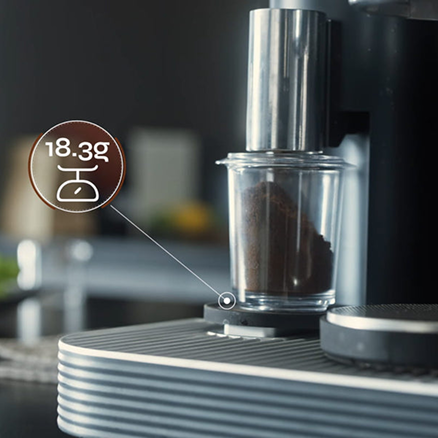
The Meraki Espresso Machine brings grinding, dose and yield measurement, and a guided touchscreen workflow into one system. Those features describe its workflow, not an accessibility certification. They do not establish that every person can load coffee, prepare a portafilter, steam milk, or maintain the equipment independently.
For the ordinary preparation sequence, the Meraki workflow guide provides context. Make your own task list from that sequence, then ask which interactions can be demonstrated under your conditions. A simpler drink or a different preparation method may also fit your goals. Choose the level of hands-on work you actually want, rather than assuming espresso must involve every available manual step.
Include refilling and cleaning in the demonstration
Ask to see how the water supply is accessed, how waste is removed, and which parts must be carried to a sink. Record the required grip, lift, and reach for those actions. A machine that is easy to start may still have care tasks that do not fit your intended routine.
For seated use, CCOHS's sitting-work guidance emphasizes workstation and task design, including placing tasks within reach. Apply that principle to care as well as preparation. Do not solve a difficult refill by moving hot equipment or by routing water through an undocumented connection.
Ask about the real maintenance procedure and decide how it will be completed. If assistance is part of the arrangement, include its availability in the purchase decision. For unresolved model-specific interactions, Meraki's contact page offers a route for asking precise questions. Do not interpret the existence of support as confirmation that the proposed adaptation is approved.
Choose from demonstrated fit, not accessibility adjectives
Before purchasing, record the task, the conditions of its demonstration, and any remaining help required. Do not mark a task demonstrated merely because a presenter completed it. A useful record might say: "Tray removal: presenter standing; seated reach not yet demonstrated; further evidence needed."
Preserve the appliance's installation requirements while considering changes to furniture or tool placement. Do not infer suitable support, electrical arrangements, or clearance from this article. Where your plan involves structural changes or individualized movement support, obtain the appropriate advice before committing to them.
Choose a setup when the complete preparation and care routine fits your goals in the intended environment, with any chosen assistance explicitly planned. If it does not, consider a different arrangement or preparation method without treating that as a loss of coffee enjoyment. Your useful outcome is a routine you want and can use, not a collection of features carrying an unverified accessible label.
If Meraki is on your shortlist, review the Meraki Espresso Machine against your task requirements before deciding.
FAQ
Can someone else handle maintenance while I make the drinks?
Yes, shared tasks can be part of the arrangement if that is what you want and the help is reliably available. Agree on who refills, cleans, and restores the equipment, and what happens when assistance is unavailable. Do not assume a helper will notice every unfinished care task. Keep the machine's required procedures intact and make the handoff explicit. An accessible routine can include chosen assistance; it does not have to mean completing every task alone to be worthwhile.
Should I buy an app-controlled machine to avoid reaching controls?
Only after verifying which specific actions the app supports and which still require physical handling. An app may help with some settings without placing a cup, moving a portafilter, pouring milk, or cleaning equipment for you. Also check what happens if the connection or device is unavailable. Ask for a demonstration of your intended routine rather than relying on the phrase app-controlled. Remote settings are one possible feature, not proof that the complete preparation and care process meets your requirements.
Can a showroom demonstration replace trying the setup at home?
A demonstration can answer important questions, but its counter, floor space, and equipment placement may differ from your home. Record those conditions and compare them with the proposed location before deciding. If you need a particular seated position or mobility aid, include that requirement in the demonstration request. Check the seller's actual trial and return terms separately rather than assuming a home test is available. A successful showroom task is useful evidence, but it does not verify a different installation automatically.


