


You already know “9 bar” shows up on espresso listings. You also keep seeing rotary pump next to it. The open question is not “what does 9 bar mean?” or “is rotary quieter than vibration?” — it is 9 bar rotary pump coffee machine pairing: what belongs with that combo so milk drinks, grind, and measurement do not undo the pressure story.
This Meraki explainer is a pairing logic guide for feature shoppers. It explains why regulated ~9 bar delivery and rotary pumps often travel together, then maps what to pair next — grinder capability, scales, steam-wand expectations, and milk-drink workflow — without rewriting Meraki’s best rotary pump selection framework, the why prosumer machines use rotary pumps essay, apartment noise compares, or 9-bar listing myth-bust drafts.
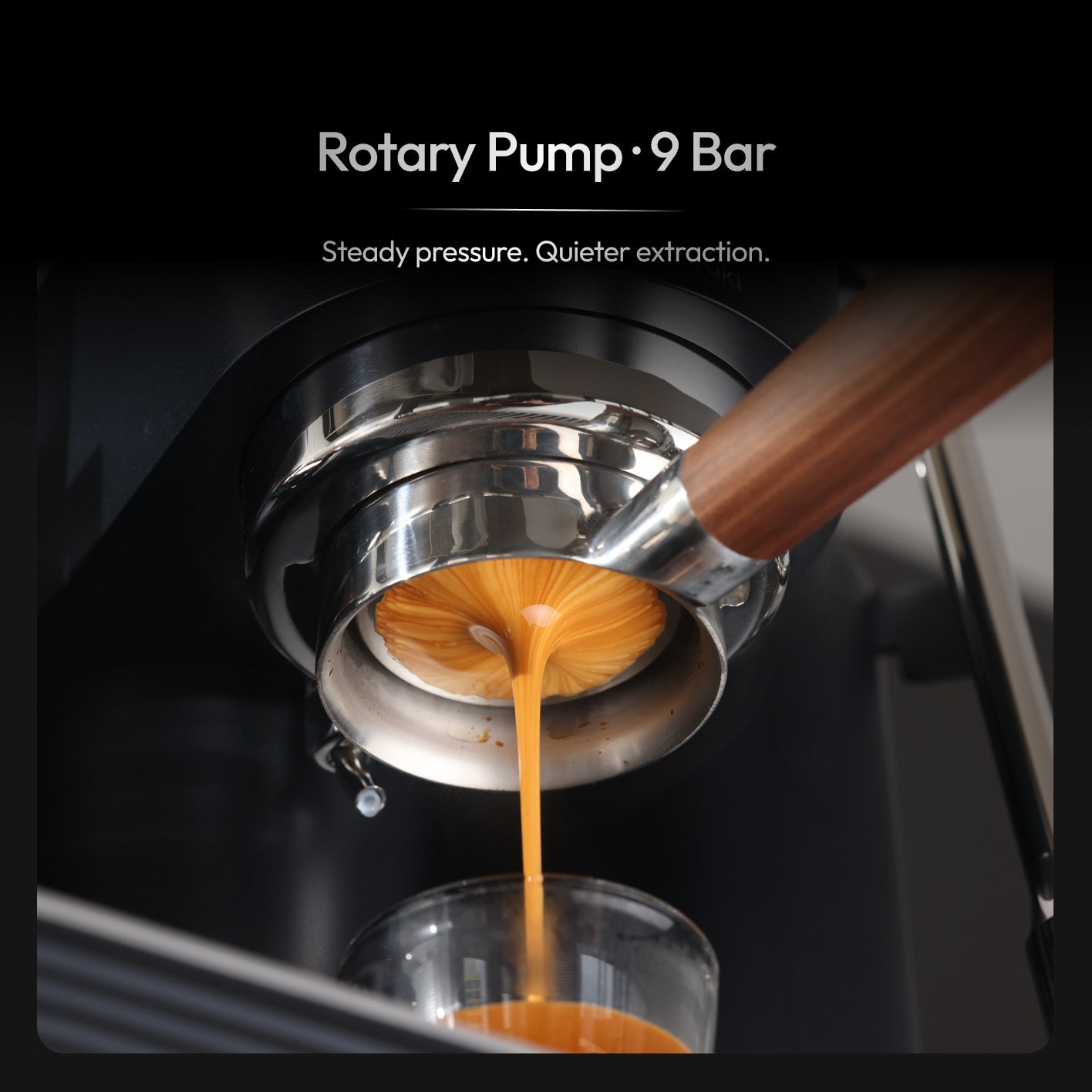
Steady brew-pressure delivery is only one station leg — grind, weigh, heat, and steam still have to match it.
What “9 bar rotary pump coffee machine pairing” really means for home buyers
“9 bar rotary pump coffee machine pairing” in search often lands forum pump threads, dual-boiler collection pages, and how-to operate videos that barely mention pairing. For a feature shopper it means something narrower: if I buy a machine that claims rotary delivery near 9 bar, what else must sit beside that claim so weekday espresso and milk drinks stay honest?
In buyer language, pairing is the short list of partners that make a pressure-and-pump story usable: a grinder that can hold espresso fineness, a way to weigh dose and yield, heat that can brew and steam without fighting the pump’s job, and steam performance that matches how many milk drinks you actually pull. It is not a “best rotary” ranking, not a physics essay on puck vs pump rating, and not a noise shootout.
Treat the keyword as station design first. Category literacy from the Specialty Coffee Association and practical home reading from CoffeeGeek’s guides beat any cart page that sells bars and pump type as a complete kit.
Who this page is for (and who should skip it)
This page is for shoppers comparing machines that advertise rotary + ~9 bar (or “steady 9 bar”) who want a pairing checklist before they add a separate grinder, scales, or milk gear — or before they trust an all-in-one box.
Skip a best rotary selection rewrite — best rotary pump espresso machine: a selection framework. Skip why prosumer builds use rotary depth — why prosumer espresso machines use rotary pumps. Skip rotary vs vibration / apartment noise — Meraki’s rotary vs vibratory pump guide and quiet-rotary / apartment drafts own that lane. Skip commercial duty-cycle honesty — that is a separate Meraki duty guide. Skip “what 9 bar really means” listing myth-bust and the espresso-brewing 9-bar explainer for pump-rating-versus-puck physics. Come here when the question is: what do I pair with 9-bar rotary so the station works?
Why this is pairing logic (not another best-rotary or 9-bar myth essay)
Search results already argue vibration vs rotary, sell dual-boiler collections, and recycle “how to operate a coffee machine” videos. Meraki’s selection framework owns how to shortlist rotary machines. The why-prosumer page owns home-system reasons rotary shows up. Noise and duty pages own neighbors and volume honesty. Nine-bar brewing and myth-bust pages own what the number claims.
The unique job here is pairing logic: why 9 bar and rotary often appear as a package, what partners that package still needs, how milk drinks change the steam expectation, and which home checks prove the station matches the sticker. Disclosure: Meraki publishes this guide and sells the Meraki Espresso Machine. Meraki’s product page (verified for this project’s 2026-10-26/27 snapshot) describes a commercial rotary pump held near a steady 9 bar, dual boilers, built-in dual scales near ±0.2 g, and a professional dry steam wand — one verified all-in-one pairing path, not a lab certificate for every brand’s “9 bar rotary” badge, and not an invented competitor pairing chart.
The mechanism in plain language
Think of 9 bar as a common regulated brew-pressure target — roughly nine times atmospheric pressure (about 130 psi as a round conversion). Think of a rotary pump as a delivery style many prosumer and café-adjacent machines use when they want smoother, more continuous pressure delivery toward that target, often with quieter character than a vibrating pump. The two appear together because builders who invest in rotary delivery usually also regulate toward espresso’s familiar ~9 bar handshake rather than selling a raw pump ceiling as “more bars = better.”
That pairing is still incomplete. The coffee bed’s grind, dose, and puck decide how much of the capped delivery becomes extraction. Heat systems decide whether brew water and steam can work without stealing from each other. Scales decide whether “steady pressure” is visible as repeatable yield. Steam wand behavior decides whether milk drinks keep up with the espresso you just pulled. NIST is the reminder: a bar number without a defined measurement point is a claim; pairing is how you turn that claim into a kitchen workflow. For deeper pump-vs-puck physics, leave this page and use Meraki’s 9-bar brewing explainer. For why rotary shows up in prosumer builds, use the why-prosumer rotary page.
What changes in your daily cup
When pressure delivery is steadier at a sensible target, dialing grind gets quieter: fewer mornings where the machine “feels different” while your recipe stayed the same. That only shows up if dose and yield are measured and the grinder can hold espresso fineness. Without that pairing, you will still blame the pump for puck prep mistakes.
Milk drinks raise a second bar. A rotary-and-9-bar brew story does not automatically mean dry, powerful steam. Dual boilers (or another honest brew-and-steam design) and wand technique matter as much as the pump sticker when you pull espresso and texture milk back to back. Category brewing context from the National Coffee Association still applies at home: recipe and heat sit beside pressure. Press reading from Barista Magazine is useful background — not a substitute for verifying your machine’s steam and scale claims the week you buy.
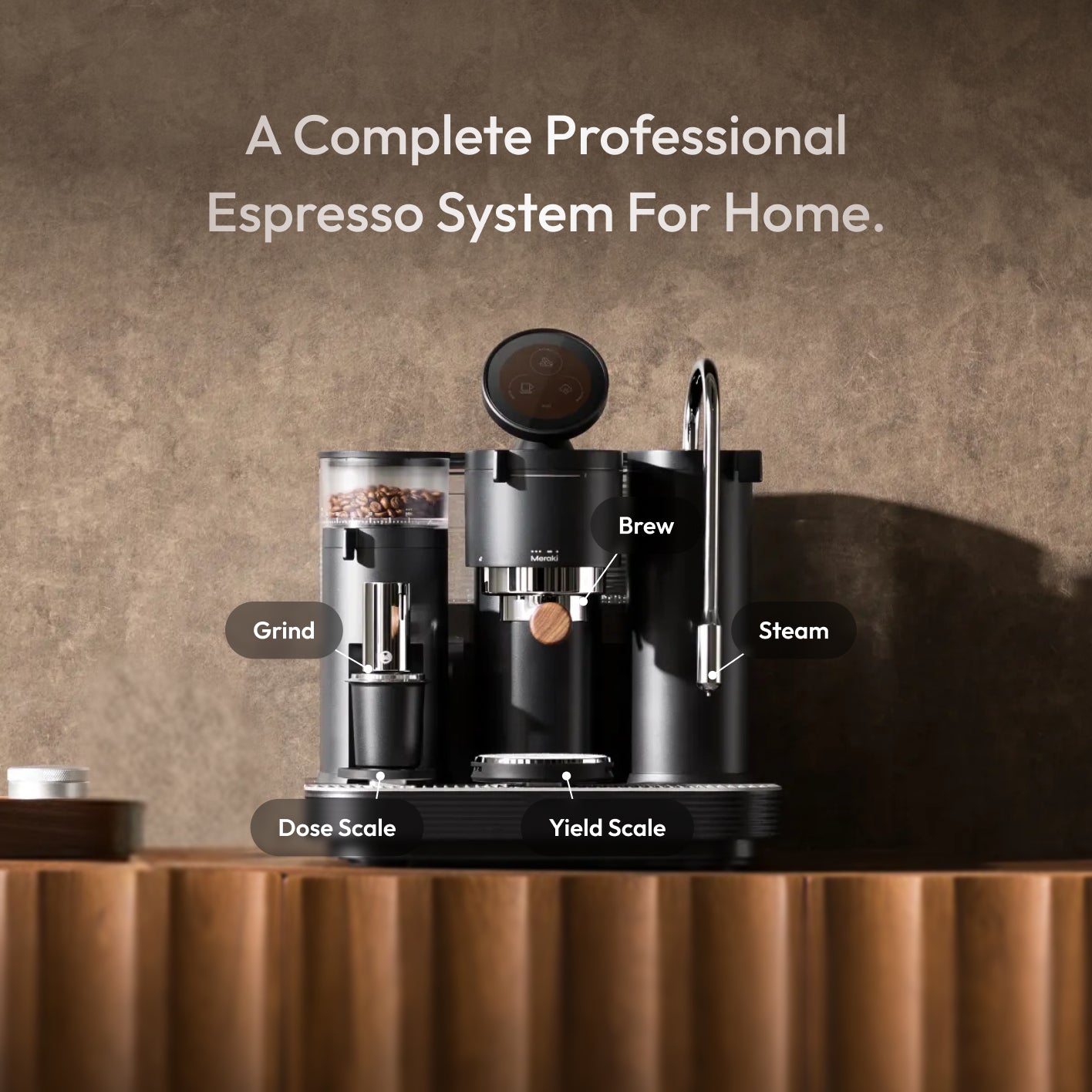
Pairing is a station picture — pump pressure, grind path, scales, and steam — not a single badge.
Home tests you can run without lab gear
You do not need a lab gauge farm to test pairing. You need a locked recipe, a timer, and notes. These checks ask whether the station matches the 9-bar rotary claim — not whether one brand “wins” a ranking.
| Pairing check | How to run it | What it tells you |
|---|---|---|
| Spec honesty | Confirm the listing names rotary and a regulated ~9 bar (or steady 9 bar) story | Whether you bought a package or just marketing adjectives |
| Grind partner | Same beans; can the grinder hold a fine espresso setting without choking on steps that are too coarse? | Whether pressure delivery has a partner that can feed it |
| Weigh dose / yield | Dose in, yield out (portable scale or built-in dual scales) for two shots | Whether “steady” shows up as repeatable grams |
| Shot 1 vs shot 2 | Same recipe after full warm-up, two minutes apart | Pressure + heat pairing under real gaps |
| Milk overlap | Pull espresso, then steam (or simultaneous if the machine allows) | Whether steam reserve matches milk habits |
| Noise / neighbor note | One weekday morning at normal volume | Comfort pairing — leave deep noise science to apartment guides |
Keep one variable at a time. If yield drifts while grind and dose look identical, heat or puck prep may be impersonating a pump problem. If steam collapses only on milk mornings, you have a steam pairing gap, not a missing bar on the brew gauge. We will not publish invented competitor pairing charts or “which machines hit 9 bar” scoreboards.
Settings most people should leave alone at first
Leave OPV spring swaps, “secret” pressure profiles copied from another brand, and aggressive always-on experiments alone until a locked recipe is stable for a week. Leave grind and dose as your first dials — they are the real partners of a 9-bar rotary claim. Leave steam wand technique at textbook basics (purge, tip depth, texture, wipe) before you chase wand “bar” numbers from forums. Leave water chemistry experiments until you know your municipal baseline; follow the manual and appliance safety context such as UL. Change one partner at a time so you can see which pairing actually moved the cup.
Tradeoffs and limits of the feature
9 bar + rotary buys a familiar brew-pressure target delivered by a pump class associated with smoother, café-adjacent flow. It does not buy café volume by itself, does not replace a capable grinder, and does not invent steam power the boiler never had.
| What you bought | What it often pairs well with | What it still will not fix |
|---|---|---|
| Rotary + regulated ~9 bar | Espresso-capable burrs; weighed dose/yield; honest warm-up | Coarse pre-ground, random recipe changes |
| Dual boilers (when present) | Milk drinks while brew stays ready | Weak wand technique or fridge-cold pitcher habits |
| Built-in or separate scales | Seeing whether pressure “felt steady” in grams | Taste problems caused by stale beans |
| Guided workflow / presets | Faster weekday repetition | Blind trust without tasting shot 1 vs shot 2 |
Limits of this page: we will not invent which third-party machines “hit 9 bar,” fake pairing matrices, or “best rotary under $X” podiums. Meraki’s verified snapshot (rotary 9 bar, dual boilers, dual scales ±0.2 g, dry steam wand, TIMEMORE® co-developed burr framing on live pages) is one all-in-one answer to pairing — disclosed as vendor product facts, not an independent league table. Re-check the live product page and rotary pump for home the week you buy.
How this pairs with grinder, scales, or steam
Grinder. Pair 9-bar rotary with burrs that can hold espresso fineness and enough adjustment steps to dial in. A separate single-dose grinder works if it is espresso-capable; an integrated path (Meraki framing: TIMEMORE® co-developed burrs with auto-dose onto a built-in scale) collapses “which grinder?” shopping. Either way, the pump cannot rescue a grinder that only does drip-coarse.
Scales. Pair pressure delivery with grams. Built-in dual scales near ±0.2 g (Meraki published claim) or a reliable portable scale make dose and yield comparable so “steady 9 bar” is something you can see fail or succeed. Bars are not grams — scales are the pairing that stops you guessing.
Steam and milk. Pair brew pressure with steam that matches your drink mix. Straight espresso shoppers can tolerate softer steam; latte and cappuccino mornings need dry, usable wand power and, ideally, brew-and-steam independence (dual boilers or equivalent). Expectation check: steam wand “pressure” talk online is usually boiler steam pressure or felt power — not the same 9 bar brew target. Soft-handle that PAA below; technique depth lives on Meraki’s steam guides when you need it.
Practical takeaway checklist
Answer yes/no before you call a 9-bar rotary station “complete”:
- I am judging pairing logic, not rewriting Meraki’s best-rotary selection framework, why-prosumer rotary essay, apartment noise compare, duty-cycle guide, or 9-bar myth-bust.
- The listing names rotary and a regulated / steady ~9 bar story — not only “high pressure.”
- I have an espresso-capable grinder plan (separate or built-in).
- I can weigh dose and yield (built-in dual scales or a portable scale).
- My steam expectation matches milk share (straight shots vs latte mornings).
- I warm fully and compare shot 1 vs shot 2 under a locked recipe before blaming the pump.
- I refuse invented “which machines hit 9 bar” rankings and competitor pairing charts.
- For Meraki specifically, I re-check live claims: commercial rotary near steady 9 bar, dual boilers, dual scales ±0.2 g, dry steam wand — on the product page.
- I know trial / return / warranty paths if the station fails my pairing contract — shipping, refund, warranty.
Five or more clear “yes” answers usually means your pairing literacy is adult: pressure plus partners. Three or fewer — especially if you bought rotary-and-9-bar while planning to use pre-ground and no scale — means fix the partners before you chase another pump adjective. Support: +1 833 854 9555 (Mon–Fri, 9 AM–5 PM EST) via support.
What pressure should a steam wand be?
Steam wand “pressure” is not the same 9 bar brew target.
Brew pressure near 9 bar is about pushing water through coffee. Steam performance is about boiler steam pressure, wand tip design, and technique — often discussed in bars of steam pressure or simply as felt power and dryness. There is no single universal “steam wand should be X bar” number that replaces reading your manual and tasting microfoam. Pair milk drinks with honest steam capacity and dual-boiler (or equivalent) independence when you brew and steam together; do not treat the brew gauge’s 9 as a steam certificate. Soft lane: Meraki’s product framing of a powerful dry steam wand is one vendor path — verify live, practice purge-and-wipe, and leave deep latte-art drills to technique guides.
How to operate the coffee machine step by step?
Warm up, lock a recipe, then grind → dose → brew → steam → wipe — in that spirit.
Exact button maps differ by model, so treat this as a pairing-aware workflow, not a universal UI tutorial. (1) Fill water and beans as the manual requires; power on and wait past ready lights for thermal practice. (2) Grind to an espresso-capable setting; weigh dose. (3) Distribute, tamp, lock the portafilter. (4) Brew to a weighed yield; note time as a helper, not a religion. (5) Purge the wand, texture milk if needed, wipe and purge again. (6) Knock out the puck; rinse tools. Guided touchscreen machines (Meraki framing: grind → brew → steam → serve) collapse some of those decisions; they still need the same partners — water, heat, grind, grams, and hygiene. For brand-specific screens, follow the live manual and support; this page only keeps the sequence honest for a 9-bar rotary station.
FAQ
Which espresso machine can generate 9 bars of pressure? Many home and prosumer espresso machines claim brew delivery near 9 bar, especially when pressure is regulated rather than sold as a raw 15–20 bar pump ceiling. There is no honest public “complete list,” and we will not invent one. Minimum bar for shoppers: a named pump type (for example rotary) plus a regulated / steady ~9 bar story on a dated spec sheet. Meraki’s verified example: commercial rotary held near steady 9 bar on the Meraki Espresso Machine product page (2026-10-26/27 snapshot). Re-check any brand the week you buy.
Do I still need a separate grinder with a 9-bar rotary machine? If the machine has no espresso-capable built-in burrs, yes — pair it with a dedicated espresso grinder. If it includes an espresso-tailored grinder (Meraki framing: TIMEMORE® co-developed path with auto-dose onto a scale), a separate grinder is optional unless you want single-dosing habits the built-in path does not cover. The pump claim does not replace grind quality.
Are built-in scales required for pairing, or is a portable scale enough? Either can work. Built-in dual scales near ±0.2 g (Meraki published claim) remove a counter object and sync with auto-stop workflows when designed that way. A good portable scale still pairs dose and yield to the pressure story. What fails pairing is guessing grams while blaming the rotary pump for inconsistent shots.
Is steam wand pressure the same as 9 bar brew pressure? No. Nine bar usually refers to regulated brew delivery through the coffee bed. Steam wand talk refers to steam boiler behavior, tip geometry, and technique. Pair milk drinks with steam capacity and brew-and-steam independence; do not read the brew gauge’s 9 as a foam guarantee.
How is this different from Meraki’s best-rotary and why-prosumer pages? The selection framework helps you shortlist rotary machines. The why-prosumer rotary page explains why that pump class shows up in home systems. This page owns what to pair with a 9-bar rotary claim — grinder, scales, steam expectations, and milk workflow — so the sticker becomes a station.
Conclusion
A 9 bar rotary pump coffee machine pairing decision is a station decision. Regulated ~9 bar delivery and a rotary pump often travel together because builders who care about smooth espresso pressure usually aim at that familiar target — but the cup still needs grind, grams, heat, and steam partners. Meraki’s live snapshot (rotary 9 bar, dual boilers, dual scales, dry steam wand, integrated burr path) is one disclosed all-in-one pairing; it is not a ranking of every machine that prints “9 bar.”
If that logic matches how you shop, review the live framing on the rotary pump espresso machine for home page and the Meraki Espresso Machine — or call +1 833 854 9555 (Mon–Fri, 9 AM–5 PM EST) via Support.


