


You are on a product page that shouts “15 bar!” — or quietly says “9 bar professional pressure.” Both numbers look decisive. Neither one tells you whether the shot in your kitchen will taste like espresso you want to drink.
This Meraki guide answers 9 bar espresso machine what it really means for shoppers: a buyer myth-busting decoder for listing claims — pump rating vs line pressure vs gauge vs puck, why “more bars” marketing is not a quality score, and what a steady 9-bar claim does not guarantee. It is not a republish of Meraki’s existing physics explainer — that job already lives on 9 Bar Espresso Machine: What the Number Really Means in the espresso-brewing channel. Use that page for pump-rating-versus-puck-pressure depth; use this page when you are shopping and need to sort listing language before checkout.
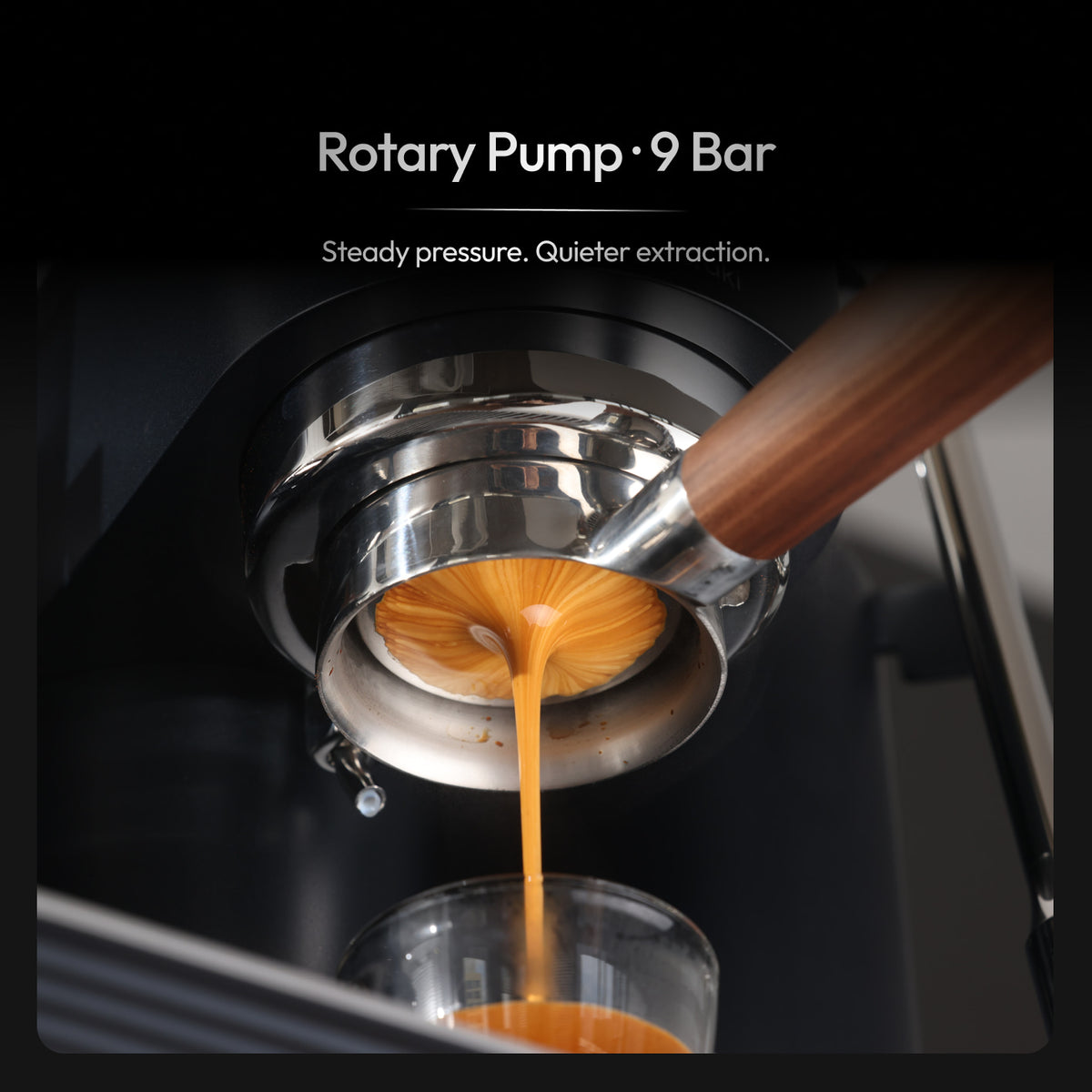
A listing “9 bar” claim is a delivery rating — your grind, dose, and puck still decide what the coffee bed experiences.
What “9 bar espresso machine what it really means” really means for home buyers
“9 bar espresso machine what it really means” in search usually shows community threads, taste videos, and pressure explainers. For a feature shopper it means something narrower: can I trust the bar number on this cart page, or am I buying a marketing ceiling?
In plain buyer language, 9 bar is a common reference for the brew pressure many espresso machines aim to deliver and regulate — roughly nine times normal atmospheric pressure (about 130 psi as a round conversion). It is a useful industry handshake, not a scoreboard. A listing that says “9 bar” is usually talking about pump / regulated delivery capability, not a promise that every shot will sit at nine bars at the coffee bed, and not a promise that fifteen is somehow “better.”
Treat the keyword as claim literacy first. The physics of how the bed resists that delivery already has a home on Meraki’s espresso-brewing 9-bar page. This page owns the cart-page myths that make people pay for the wrong number.
Who this page is for (and who should skip it)
This page is for home buyers comparing dual-boiler or semi-auto machines online who keep seeing 9 bar, 15 bar, 19 bar, or “professional pressure” and want a checklist before they click Buy.
Skip it if you need the full pump rating vs puck pressure teaching essay — start with the espresso-brewing 9-bar explainer. Skip a broader “what pressure actually does / stability / profiling intro” read — that is 9 Bar and Beyond. Skip how to read a needle during a shot — use espresso machine pressure gauges. Skip rotary vs vibratory hardware trade-offs — Meraki’s rotary vs vibratory pump guide owns that. Skip pressure profiling without expensive gear — that is the pressure profiling at home guide. Come here when the question is: what does this listing’s bar claim actually buy me?
Why this is listing myth-busting (not another pressure physics essay)
Meraki already publishes a near-identical title in /blogs/espresso-brewing/… that owns the mechanism: the pump delivers and caps; the bed sets the real operating point; flow is your home signal. Search results for this query also lean community experience (“9 at the pump or 8 at the puck?”), taste demos, and short 6-vs-9-vs-12 guides.
The unique job here is buyer myth-busting: a claim decoder for product pages, a table of listing phrases that mislead, a clear list of what “steady 9 bar” does not guarantee, and a pre-checkout checklist. Disclosure: Meraki publishes this guide and sells the Meraki Espresso Machine, which Meraki’s product page (verified for this project’s 2026-10-26 snapshot) describes with a commercial rotary pump held near a steady 9 bar. Meraki examples illustrate one verified path — they are not a lab certificate for every brand’s “9 bar” badge.
The mechanism in plain language (then stop and link)
You only need three sentences of mechanism here so the myths have a floor — then leave the deep explainer alone.
A pump pushes water toward the group. A pressure-regulating setup (often an OPV or similar limit) is what keeps many home machines from dumping their raw pump ceiling into the puck. The coffee bed’s resistance — grind, dose, distribution, tamp — then decides how much of that capped delivery shows up as extraction behavior. That is why two machines both labeled “9 bar” can still pull different shots with the same beans.
For the full pump-rating-versus-puck-pressure table, flow-as-signal reading, and the three-shot grind experiment, use Meraki’s existing 9-bar brewing page. For what pressure does during extraction and why stability beats a higher marketing maximum, use 9 Bar and Beyond. Category literacy from the Specialty Coffee Association and practical home reading from CoffeeGeek’s guides beat any listing that treats bars like horsepower.
Listing myths: how to read 9-bar claims on product pages
Most shopping confusion is not physics — it is copy. Sellers compress a system into one number because one number fits a bullet. Your job is to expand that bullet back into questions.
| Listing claim you see | What it usually means | What it does not prove | Buyer question to ask |
|---|---|---|---|
| “15 bar / 19 bar / 20 bar pump” | Often a peak / unregulated pump ceiling used as marketing | Better taste than a regulated ~9 bar machine | Is brew pressure regulated toward ~9 bar during extraction? |
| “9 bar professional pressure” | A target / regulated delivery claim (if honest) | Café quality, temperature stability, or dial-in skill | Pump type? OPV / regulation mentioned? Or just the number? |
| “Pressure gauge included” | A display of pressure somewhere in the brew path | That the needle equals puck pressure, or that the machine profiles pressure | Does the page say regulated pressure — or only “has a gauge”? |
| “High pressure extraction” | Vague emphasis language | Any measurable setpoint | Can they name bar target + pump type? |
| “Works with home water pressure” / plumbed language | May refer to inlet / line supply for plumbed machines | That city water pressure replaces a brew pump’s job | Is this inlet pressure or brew pressure? |
| “Same 9 bar as cafés” | Marketing parallel | Identical cups without grind, dose, beans, and heat control | What else is specified — boilers, scales, steam, warm-up? |
Myth 1 — More bars = better espresso. False as a buying rule. A higher printed maximum often describes what a vibration pump can shove before regulation, not a tastier extraction target. Meraki’s own 9 Bar and Beyond page already flags the “more bar is better” myth; here the shopping takeaway is simpler: do not rank carts by the biggest bar number.
Myth 2 — The gauge is the puck. A faceplate needle is a useful health check when you already own the machine — Meraki’s gauge guide covers that diagnostic job. On a listing, “includes pressure gauge” only proves there is a display. It does not prove the coffee bed sees nine bars, and it does not prove pressure profiling.
Myth 3 — Line pressure is the same conversation as pump pressure. On plumbed machines, inlet / line pressure is about how water enters the machine. Brew pressure is about what the pump and regulation deliver toward the group. Mixing those phrases on a product page is a classic listing trap. If the copy will not say which pressure it means, treat the bar claim as incomplete.
Myth 4 — “9 bar” alone buys café results. A steady regulated delivery helps repeatability. It does not replace fresh beans, a competent grinder, even distribution, heat stability, or milk skill. Bars are one variable in a system — not a trophy.
What 9 bar does — and does not — change in your daily cup
When delivery is steady and capped near the classic reference, dialing in gets quieter: a fast or slow shot points harder at grind and dose, not at a surging pump. That is the practical win behind a serious espresso machine with steady 9 bar pressure claim — not a magic crema button.
What the number does not change by itself: temperature architecture (dual boiler vs thermoblock), dose/yield discipline, steam skill, channeling from an uneven puck, or stale beans. Meraki lists built-in dual scales to ±0.2 g on the product page (2026-10-26 snapshot) as measurement support — grams answer a different question than bars. When a listing leads with pressure and stays silent on grind, heat, and measurement, you are reading one spec wearing a cape, not a complete system story.
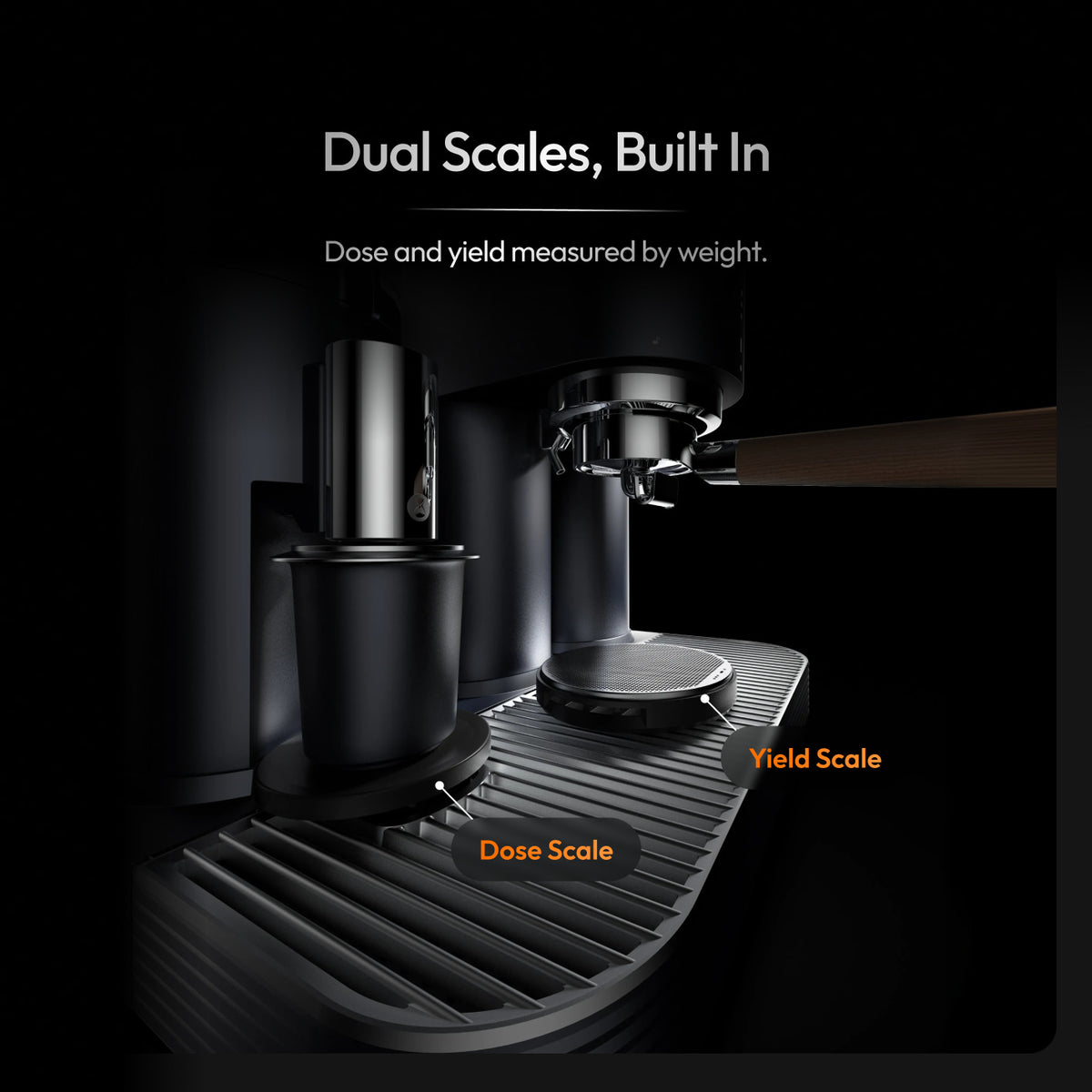
Pressure claims do not replace dose and yield measurement — bars and grams answer different questions on the same shot.
Home tests you can run without lab gear (before or after you buy)
You do not need a lab transducer — you need honesty about what a home check can show.
Before you buy: Search the page and manual for pump type (rotary vs vibratory), regulation / OPV / bypass, and whether “15 bar” lives only in marketing while “9 bar” appears in brew specs. A high ceiling with no regulation story is a ceiling, not a brew target. Prefer copy that pairs steady / regulated ~9 bar with pump type — see Meraki’s rotary pump espresso machine for home hub as one framing example.
After you own it: Lock one recipe; change grind only; watch flow and taste. Coarse gushes and fine chokes with the same delivery claim mean you felt the bed — not a new pump rating. The three-shot version lives on the espresso-brewing 9-bar page. A phone timer is a workflow aid, not a calibrated sensor (NIST is the reminder that methods matter). Blame the pump only after grind, dose, and distribution are boringly consistent — NCA brewing basics and SCA research keep bars beside ratio, not above it.
Settings most people should leave alone at first
If the machine offers an OPV screw, “bar” menus, or profiling hardware, do not start there on week one.
Keep the manufacturer’s default near the classic reference until a simple 1:2-ish recipe repeats by taste. Change grind and dose first. Leave profiling for later — Meraki’s pressure profiling guide is that chapter, not this shopping decoder. Glance at a gauge for health if you have one; do not treat every needle twitch as a score. For most buyers, espresso machine pressure control first means stable delivery plus bed control — not a private pressure religion before breakfast.
Tradeoffs and limits of trusting the 9-bar feature
A clear, regulated ~9 bar claim is useful — and limited.
An honest rotary claim (Meraki specs table: Rotary, 9 bar) speaks to brew delivery steadiness. It does not tell you counter fit, noise tolerance, steam habit, or whether you will weigh shots. Some enthusiasts later try lower average pressures for certain light roasts; that is a post-baseline taste experiment, not a reason to reject every 9-bar listing or to trust bare “6 bar” marketing without regulation detail. We will not invent pressure curves — if a brand publishes a profile, read their docs.
Same number, different pumps: rotary and vibratory can both target ~9 bar and still differ in noise and pulsation — compare hardware on Meraki’s rotary vs vibratory guide. Meraki’s live product page claim of a commercial rotary pump holding café-steady pressure is a vendor-verified product claim, not a third-party lab graph. Brands that will not name pump type and regulation are selling a thinner “9 bar.”
How this pairs with grinder, scales, or steam
Pressure is one leg of a stool. The grinder is still your main practical “pressure control” through particle size and distribution — a steady pump makes grind changes readable. Scales turn dose and yield into a recipe; bars without grams are half a notebook. Steam for milk drinks needs wand skill and heat capacity, not “extra espresso bars.” When a listing leads with pressure and hides the grinder story, ask whether you are buying a system or one impressive noun.
Practical takeaway checklist (read the listing like this)
Use this as a cart-page pass/fail — not as a physics exam.
- Find the number and the noun. Does it say 9 bar, 15 bar, or both? Which is called brew pressure?
- Find pump type. Rotary, vibratory / vibration, or unnamed? Unnamed + huge bar number = skepticism.
- Find regulation language. OPV, bypass, “regulated to ~9 bar,” or silence?
- Separate gauge from control. Display ≠ profiling ≠ puck truth.
- Separate inlet/line from brew. Plumbed supply language is not espresso extraction pressure.
- List what bars do not cover. Heat, scales, steam, grinder, warranty/trial — still required reading.
- Prefer steadiness language over maximums. “Steady / held near 9 bar” beats “up to 20 bar.”
- Link out for depth, don’t re-buy the same article. Mechanism → espresso-brewing 9-bar page; stability & myths context → 9 Bar and Beyond; pump hardware → rotary hub / rotary vs vibratory.
If the listing fails steps 2–3, the bar number is decoration.
How many bars to make espresso?
Around 9 bar is the classic home and café reference — not a law that every good shot must hit exactly.
Most traditional espresso recipes assume brew pressure near that reference after the bed is saturated. Some modern workflows explore lower averages or shaped profiles for specific beans. “How many bars” is therefore answered as a starting target plus regulation, not as “buy the machine with the biggest integer.” If a FAQ or ad says you need 15–20 bar to make real espresso, you are reading marketing ceilings, not extraction practice. For brewing-variable literacy beyond pressure alone, skim SCA materials via sca.coffee and keep grind/ratio in the conversation.
Which espresso machine can generate 9 bars of pressure?
Many consumer espresso machines can reach or regulate near 9 bar — the better question is how steadily, and with what regulation story.
Vibratory-pump machines often advertise high peak pressures and may regulate down for brewing; rotary-pump machines are frequently marketed for smoother, steadier delivery near the classic target. Meraki’s product page states a commercial rotary pump at steady 9 bar (specs line: Rotary, 9 bar, checked on the 2026-10-26 project snapshot). That is one verified example inside Meraki’s catalog — not a claim that only Meraki can hit nine bars, and not a comparative lab ranking of every brand. Choose machines that document pump type + regulated brew target, then judge the rest of the system (heat, grind, measurement, steam, support). Independent press context exists in places like Barista Magazine; still verify specs on the seller’s own page the day you buy.
FAQ
Is 15 bar better than 9 bar on a product listing? No — not as a quality ranking. A 15-bar (or higher) figure is often a pump’s peak capability used in marketing, while many machines aim to brew nearer a regulated ~9 bar. Compare regulation language and pump type, not which thumbnail printed the bigger integer.
Does a pressure gauge prove my puck is at 9 bar? No. A gauge shows pressure somewhere in the brew path and can help you spot unhealthy spikes or sags once you own the machine. It does not automatically equal puck pressure, and “gauge included” on a listing is not proof of pressure profiling or café results.
What does a 9-bar claim not guarantee? It does not guarantee temperature stability, channeling-free shots, good milk texture, fresh beans, or a dialed grind. It also does not replace scales, a competent workflow, or warranty/trial terms. Treat 9 bar as one delivery claim inside a larger system.
Is line pressure the same as espresso brew pressure? No. Inlet or municipal line pressure (for plumbed setups) is about water entering the machine. Brew pressure is what the pump and regulation deliver toward extraction. If a listing blurs those phrases, ask which number is which before you trust the bar badge.
Should I adjust pressure settings on day one? Usually no. Keep the manufacturer’s default regulated brew behavior, lock one recipe, and change grind/dose first. Explore profiling or intentional lower-pressure experiments only after baseline shots are repeatable — and read a profiling guide rather than inventing curves from forum screenshots.
Conclusion
9 bar on a listing helps when it means regulated, steady brew delivery near the classic reference — and misleads when it is only a ceiling, a gauge badge, or the word “professional.” Rank pump type and regulation first, not the largest integer, and remember what bars do not buy: heat, grind, grams, and skill.
For mechanism depth, use Meraki’s espresso-brewing 9-bar explainer. To see how Meraki documents a commercial rotary pump held near steady 9 bar inside a full grind–brew–steam system, open the Meraki Espresso Machine page, or call +1 833 854 9555 (Mon–Fri, 9 AM–5 PM EST) via Support.


