


You bought a specialty bag for the notes — citrus, florals, “best as espresso” — and the first home shot tasted thin, sharp, or somehow both. Searching espresso machine for specialty coffee bean handling mostly surfaces shopping carousels, commercial gear, and “best machine” roundups. Those pages sell hardware. They rarely teach calm bean-led dial-in when the roast is lighter, bags change often, and your dual boiler with an integrated grinder is already on the counter.
This Meraki how-to owns that bean-led lane: one-variable changes, taste-first stop rules, light-roast starting habits, and a weekday path that keeps dose/yield honest (with optional CoffeeSense™ suggestions on compatible Meraki bags) without turning breakfast into a lab. Soft-link the live home dual boiler coffee machine complete guide for capacity, heat-up, and logistics — not a second dual-boiler essay. Soft-link espresso machine for specialty coffee: a buyer’s guide when you are still choosing hardware. Soft-name Simple Espresso Brew Ratio Targets for Home for sticky ratio bands (not a ratio textbook here). Soft-name Meraki CoffeeSense: What It Does for Home Extraction when suggestions vs magic is open. Soft-name Guided Espresso Machines: A First 30 Days Plan for month-one curriculum. Soft-name Espresso Upgrade Path for Coffee Enthusiasts for pre-purchase verification — this page assumes you already brew and the drama is the bag.
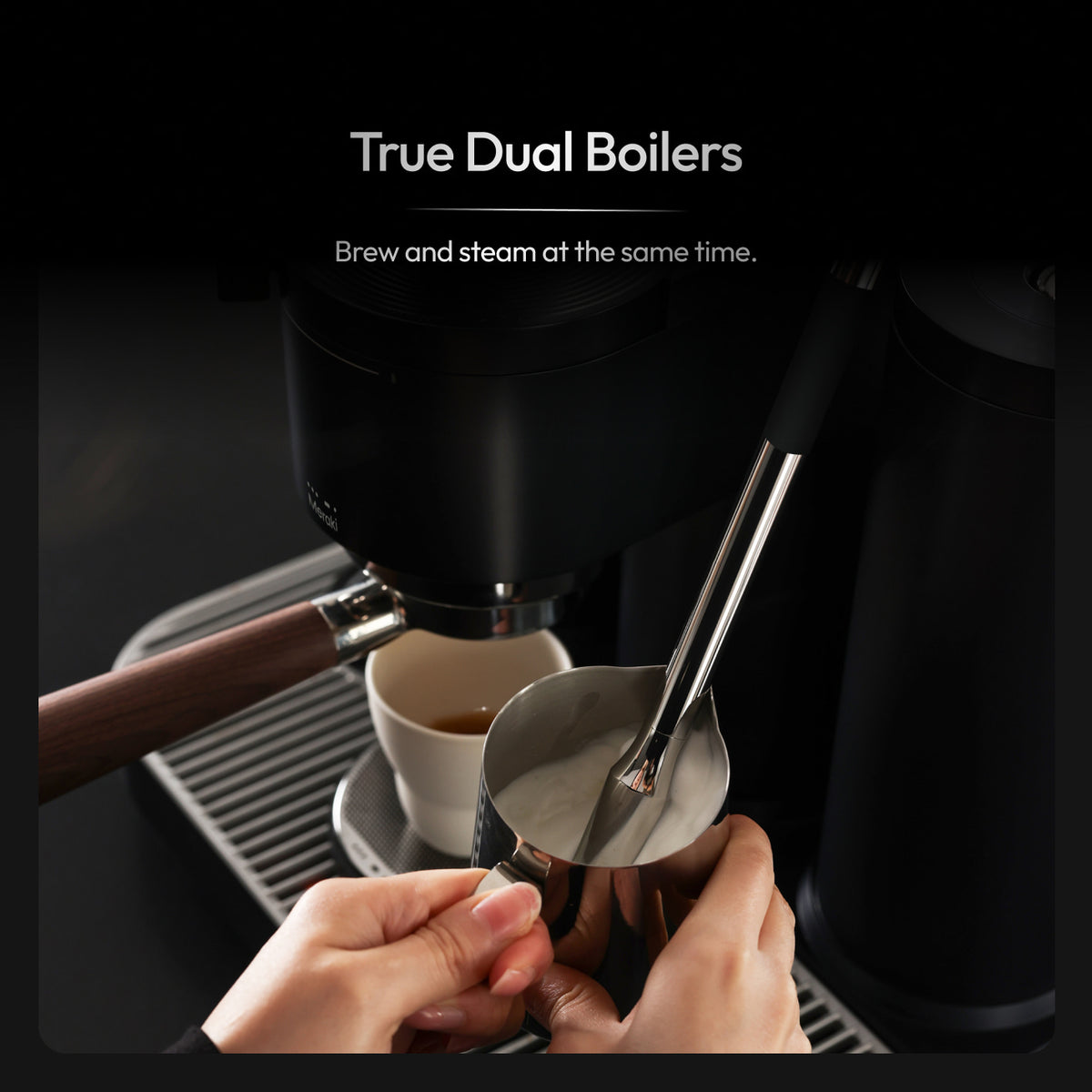
Specialty dial-in on a home dual boiler is bean-led: change one variable, taste, stop — dual boilers buy thermal calm, not a free pass to tweak three settings at once.
What “espresso machine for specialty coffee bean handling” really means for home buyers
Espresso machine for specialty coffee bean handling, for home buyers, means a calm weekday path to extract specialty (often lighter) bags on a dual boiler — grind → dose → brew with measured stops — without treating every new bag as a crisis. It does not mean a commercial multi-group, a “bean handling” gadget name, or another best-of shopping list.
SERP for this phrase leans product carousels (with-grinder filters, commercial listings, super-automatics) and opinion roundups. Useful literacy still sits with the Specialty Coffee Association, CoffeeGeek guides, and NCA brewing basics: fresh beans, honest grind, measured dose and yield, and one change at a time. An espresso machine for specialty coffee only “handles” bags when you give it a repeatable workflow — not when the UI flashes a roast emoji.
On Meraki’s current framing (confirm live on the product page and FAQ): dual boilers, commercial rotary pump framed at steady 9 bar, true burr grinder co-developed with TIMEMORE®, dual scales (1 kg · ±0.2 g — vendor claim), guided touchscreen Grind → Dose → Brew → Steam, warm-up about 3–4 minutes, and optional CoffeeSense™ NFC suggestions on compatible Meraki bags — suggestions, not adaptive mid-shot magic. Keep TIMEMORE® co-engineering and CoffeeSense as separate stories.
Who this page is for (and who should skip it)
This page is for specialty buyers and home dual-boiler owners who rotate specialty bags (especially lighter roasts), already pull espresso some mornings, and want dial-in without drama — one variable, taste, stop — on an integrated-grinder station.
Skip capacity / heat-up / plumbing logistics — soft-link the home dual boiler complete guide. Skip specialty hardware shopping — soft-link the specialty coffee buyer’s guide. Soft-name Espresso Upgrade Path for Coffee Enthusiasts if the question is whether to buy another machine. Soft-name Guided Espresso Machines: A First 30 Days Plan for month-one onboarding. Soft-name Simple Espresso Brew Ratio Targets for Home for sticky ratio bands without light-roast workflow. Soft-name Meraki CoffeeSense: What It Does for Home Extraction (soft-link live CoffeeSense NFC / CoffeeSense workflow) for feature honesty or swipe steps. Cafe buyers: size duty cycle elsewhere — this page is home. Wrong Meraki (networking)? This site is Meraki Tech home espresso.
Why this is bean-led (not a dual-boiler capacity essay)
SERP already sells machines. Meraki’s live dual-boiler guide already owns capacity, heat-up, and logistics. The specialty buyer’s guide already owns what to evaluate before you buy. Ratio, CoffeeSense extraction honesty, first-30-days curriculum, and upgrade verification each own their lanes (soft-name those drafts; soft-link the live pages above).
What stays thin for espresso-brewing is a how-to that treats the specialty bag as the product: open a new roast without thrashing grind + dose + yield together, start light-roast espresso calmly on an integrated grinder, and stop at “good enough.” Disclosure: Meraki publishes this guide and sells the Meraki Espresso Machine; CTA is the curated beans collection. Specs follow a 2026-10-26/27 live snapshot — re-check product and FAQ before treating numbers as permanent. German Design / Red Dot / iF omitted on purpose. Channel: espresso-brewing.
Tools and settings to prepare first
Drama starts when the bag is open, the grinder still holds yesterday’s dark roast, and three settings change before the first taste. Stage tools while dual boilers warm (~3–4 minutes on Meraki’s FAQ framing — confirm live).
You need: a fresh specialty bag with roast date visible, a clean portafilter and basket, a clear cup on the yield scale (or mat), a sticky note with four lines — bean name / roast date, dose grams, yield grams (or ratio), one taste word — and a purge cloth. Empty or flush the hopper when you switch roast levels so dark leftovers do not “ghost” a light bag. Soft-link espresso dose and yield dial-in for method depth; soft-name simple ratio targets when you only need sticky bands.
If you bought compatible Meraki NFC bags, know where the NFC area is. CoffeeSense loads suggested grind and extraction parameters after a swipe (FAQ: How do I use CoffeeSense™?) — treat that as a first guess, not a guarantee. Soft-name CoffeeSense extraction honesty rather than inventing any-bag recognition or mid-shot adaptation. TIMEMORE® co-developed burrs grind; CoffeeSense suggests — keep the verbs separate. Station context: Meraki The Espresso Lab.
Step-by-step workflow (bean-led dial-in on a dual boiler)
The weekday order is boring on purpose. Dual boilers buy thermal overlap and recovery calm — they do not authorize changing grind, dose, and yield in one panicked shot.
- Warm fully. Confirm brew (and steam, if you milk) ready before grinding “to save time.” Soft-link the dual boiler complete guide for heat-up literacy; stay here for bean decisions.
- Name the bag on the sticky. Roast date, origin or blend nickname, and whether the roast reads light / medium / dark to you. Specialty bags move; your notes should move with them.
- Optional CoffeeSense swipe (compatible Meraki NFC bags only). Load suggestions, then look at the numbers before you accept them. Soft-link CoffeeSense workflow; soft-name extraction honesty. No NFC bag? Skip — start from your last successful dose/yield band.
- Grind to a locked dose. Same in-mass as your sticky until taste says otherwise. Integrated grind-to-scale (Meraki live framing) helps you stop guessing hopper time.
- Distribute and tamp honestly. Light roasts punish channeling: a pretty early stream that collapses into sour bitterness is usually puck prep, not “the dual boiler failed specialty.”
- Pull to a locked yield — change nothing else on shot one. Prefer mass stop when you have dual scales. Soft-name simple ratio targets; soft-link ratio explained for taste language — do not open a calculator rabbit hole here.
- Taste before you touch grind. Write one word: sharp / hollow / harsh / sweet / muted. Then change one variable for shot two (usually grind finer if sharp/sour and fast; coarser if harsh/bitter and slow).
- Stop after two deliberate shots. Drink the third as coffee, not as an experiment. Save milk drinks until the straight shot is “good enough,” or you will chase foam for espresso problems.
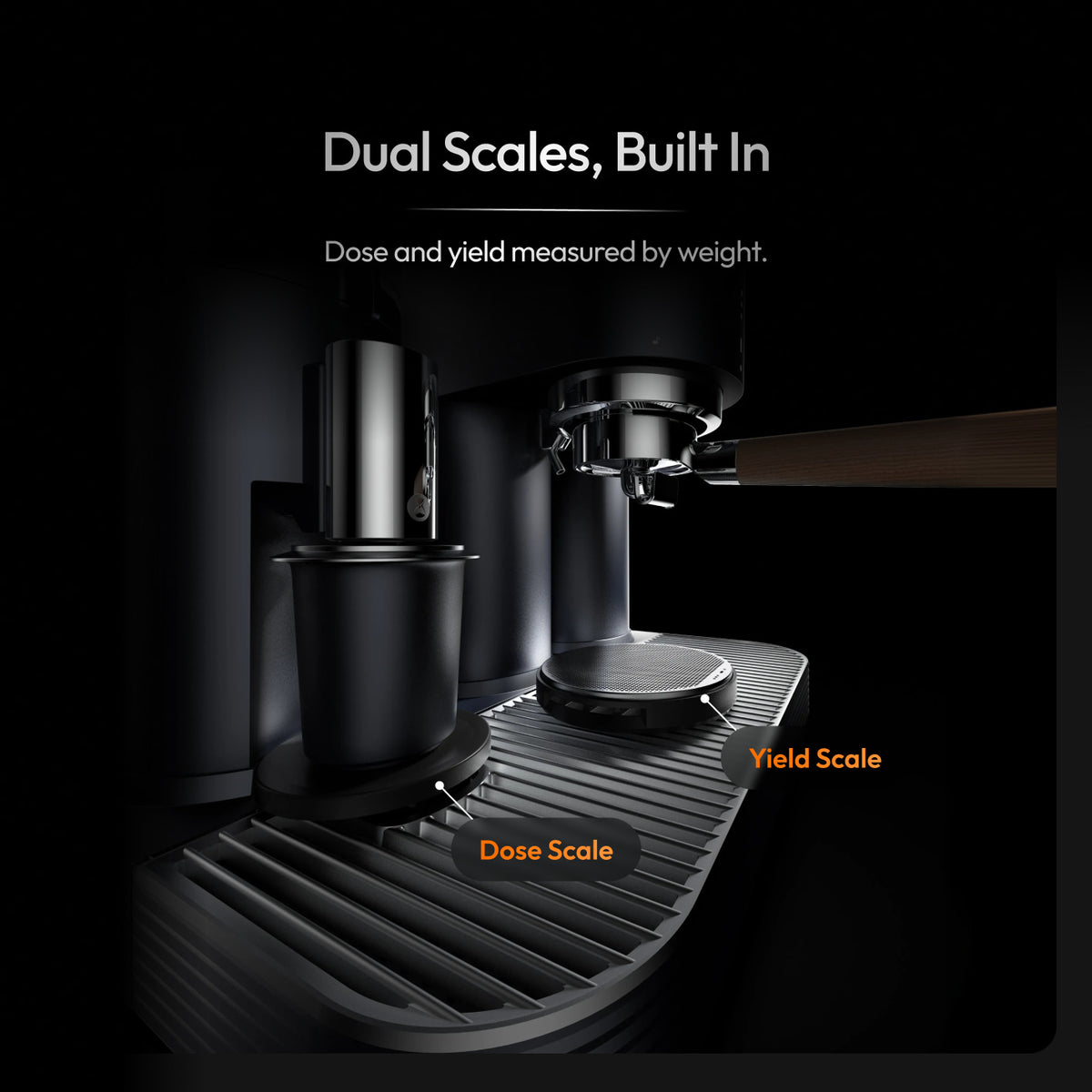
Bean-led handling starts with grams you can see — dose and yield locked — then one grind change, not a simultaneous settings party.
Targets and ranges that keep you out of rabbit holes
Ranges below are starting points for home specialty espresso on a dual boiler with measured dose/yield — not café competition recipes and not a promise that every light roast wants the same stop.
| Target | Starting band (home specialty / often lighter) | What “good enough” feels like | What not to chase today |
|---|---|---|---|
| Dose | Hold yesterday’s successful in-mass until taste demands a change | Same basket feels consistent; no dosing roulette | New dose and new grind on shot one of a new bag |
| Brew ratio (dose:yield) | Near 1:2 starting; many light bags need a slightly longer yield later | Coffee tastes like the bag notes, not only acid or ash | Soft-name ratio textbook depth; one sticky band wins breakfast |
| Shot time (context only) | Roughly 25–35 s as a rough home cue after a short pre-infusion — not a law | Flow looks even; cup is drinkable | Stopping the clock instead of tasting |
| Grind first move | Finer if sharp + fast; coarser if harsh + slow | One click/step at a time on the integrated grinder | Three clicks because a forum said “light roast = turbo” |
| Temperature / boiler | Dual-boiler stability first; leave advanced PID hunting for later | Back-to-back shots taste closer than chaotic | Soft-link dual-boiler guide for capacity — do not re-essay boilers here |
| CoffeeSense suggestions | Accept as first guess on compatible Meraki NFC bags | Suggestion + your taste note | Inventing any-grocery-bag NFC or mid-shot “adaptive” magic |
| Milk | After the straight shot is good enough | Specialty notes still readable under milk | Steaming over a sour base and blaming the bean |
SCA research, About Coffee brewing, and Barista Magazine’s Meraki × TIMEMORE test drive are useful context; your sticky still outranks a viral “light roast only” chart. Prefer curated fresh bags from Meraki’s beans collection or another roaster with a clear roast date when the drama is stale inventory, not the dual boiler.
Common mistakes and quick fixes
Most “this specialty bag hates my machine” mornings are multi-variable thrashing, hopper contamination, or tasting milk foam for espresso faults.
| Mistake | What you feel | Quick fix |
|---|---|---|
| Changing grind + dose + yield together | No causal lesson; panic | Lock two; change one; taste |
| Dark-roast leftovers in the hopper | Muddy / ashy on a light bag | Empty / purge hopper; flush a few grams |
| Treating CoffeeSense as auto-perfect | “Smart failed specialty” blame | Soft-name extraction honesty; override grind after tasting |
| Chasing time instead of taste | Stopwatch wins; cup loses | Soft-link ratio / dose-yield literacy; drink first |
| Dialing under milk first | Foam hides sour or hollow | Two straight shots before any pitcher |
| Opening three bags in one week | Permanent “almost” | Soft-name first-30-days curriculum: one bag per practice week early on |
| Buying a new machine mid-bag | Soft-name upgrade verification | Finish the bag with one-variable discipline first |
| Ignoring distribution on light roasts | Channeling: sour then bitter | WDT / distribute; even tamp; then grind |
How to taste and decide what to change next
Taste is the decision engine. Ask three questions once, then write one next change on the sticky.
- Is it sharp / sour and thin? Often under-extracted or channeling. Check puck prep first; then grind finer one step at the same dose and yield. Soft-link dose and yield dial-in.
- Is it harsh / bitter / drying? Often over-extracted or too fine. Grind coarser one step, or (only if grind is already sane) try a slightly shorter yield — not both.
- Is it muted / hollow with pretty bag notes? Freshness, dose consistency, or water/scale honesty may matter more than another dual-boiler myth. Soft-name simple ratio targets; check roast date and hopper purge.
If CoffeeSense suggested the starting numbers, keep the suggestion on the sticky as “NFC start,” then note your override. Soft-name CoffeeSense honesty so “intelligent coffee bean adjustment” stays suggestion + your taste, not invented AI palate learning. CPSC is a reminder to treat a hot, high-draw appliance as a kitchen appliance — dial-in does not require improvising unsafe hacks.
A one-week practice or habit plan
Keep the week bean-led and small. One specialty bag. Two deliberate dial-in shots on Days 1–2. Drinkable shots the rest of the week.
| Day | Focus | Done when… |
|---|---|---|
| 1 | Open bag; sticky; hopper purge; shot 1 locked dose/yield; taste word | One note exists; no second variable |
| 2 | One grind change only; shot 2; decide “good enough” | Sticky updated; third shot is for drinking |
| 3–4 | Repeat the winning recipe; optional milk after a straight shot | Same bag, same numbers feel boring |
| 5 | If still sharp/harsh, one more single change — then stop | No three-click revenge grind |
| 6–7 | Just drink; note if the bag is fading (roast age), not if the UI is “wrong” | Soft-name 30-day curriculum if month-one chaos returns |
Soft-name the first-30-days plan when you need a full onboarding curriculum; this week is only specialty bag calm on a dual boiler you already run.
When to stop tweaking and just drink
Stop when the cup is good enough to finish gladly — not when a forum stopwatch matches a chart. Specialty coffee on a home dual boiler succeeds when bag notes are recognizable, bitterness is not the whole story, and tomorrow’s sticky looks like today’s.
Stop also when you are changing settings to avoid drinking a miss. Pour it out, write the lesson, keep the next shot locked. Soft-name upgrade verification only when a named hardware limit (not this bag) is the blocker. Soft-link dual-boiler logistics only when heat-up or capacity is the real pain. Then go back to coffee.
FAQ
Do light-roast specialty beans need a different espresso machine? Not always. They need fresher inventory, finer attention to distribution, and one-variable dial-in more often than a darker house blend. A home dual boiler with stable brew temperature and measured dose/yield helps; it does not invent flavor from a stale bag. Soft-link the specialty buyer’s guide when you are still shopping; stay here for handling the bag you have.
What does CoffeeSense change for specialty bags? On compatible Meraki NFC bags, CoffeeSense loads suggested grind and extraction parameters after a swipe, then dual scales can stop at the quantities you accept (FAQ). It does not taste the cup, recognize every grocery bag, or adapt mid-shot. Soft-name CoffeeSense extraction honesty; soft-link live NFC / workflow pages for swipe steps.
Should I change grind or ratio first on a new specialty bag? Usually grind first, with dose and yield locked from your last successful sticky band. Soft-name simple ratio targets when you need starting bands; change yield later only if grind moves stop helping. One change per shot keeps specialty dial-in drama-free.
Is an integrated grinder enough for specialty espresso? Often yes for home, if the burr set can hold a fine setting and you purge when roast levels change. TIMEMORE® co-development is a grinder story on Meraki’s framing — separate from CoffeeSense. Soft-name upgrade verification if the grinder — not dial-in discipline — is the named limit.
How is this different from Meraki’s dual-boiler complete guide? That live guide owns capacity, heat-up, and dual-boiler logistics. This page owns bean-led specialty dial-in on a home dual boiler you already use — workflow, taste rules, and stop habits — in the espresso-brewing channel.
Conclusion / next step
Specialty coffee on a home dual boiler gets easier when the bag leads and the machine stays boring: warm fully, lock dose and yield, taste, change one variable, stop. Dual boilers and scales buy calm; CoffeeSense (compatible Meraki NFC bags) buys a starting suggestion — neither replaces your tongue. Soft-link dual-boiler logistics and specialty shopping when those tabs are open; soft-name ratio, CoffeeSense honesty, 30-day curriculum, and upgrade verification for their jobs.
For curated bags with roast dates you can trust next week, browse Meraki’s coffee beans collection and keep the sticky by the machine.


