


What “calibrated” and “impact” describe on a tamper
Those words describe a mechanism and a cue, not a guaranteed shot.
A calibrated impact tamper is built so that a repeated motion ends with a tactile or audible cue — often a click — when the tool reaches the point its designer intended. The live Calibrated Impact Tamper product page, checked on 23 November 2026 (Asia/Shanghai), describes a calibrated impact mechanism intended to help you apply a repeatable tamp, in an aluminium-alloy and 304 stainless-steel construction. Recheck that page. It does not publish a force number, and this article will not invent one.
Meraki publishes this guide and discloses that product as ours. A conventional espresso tamper without that cue can still make excellent espresso if your motion is level and consistent. The click is a training aid and a repeatability aid, not a substitute for dose and grind.
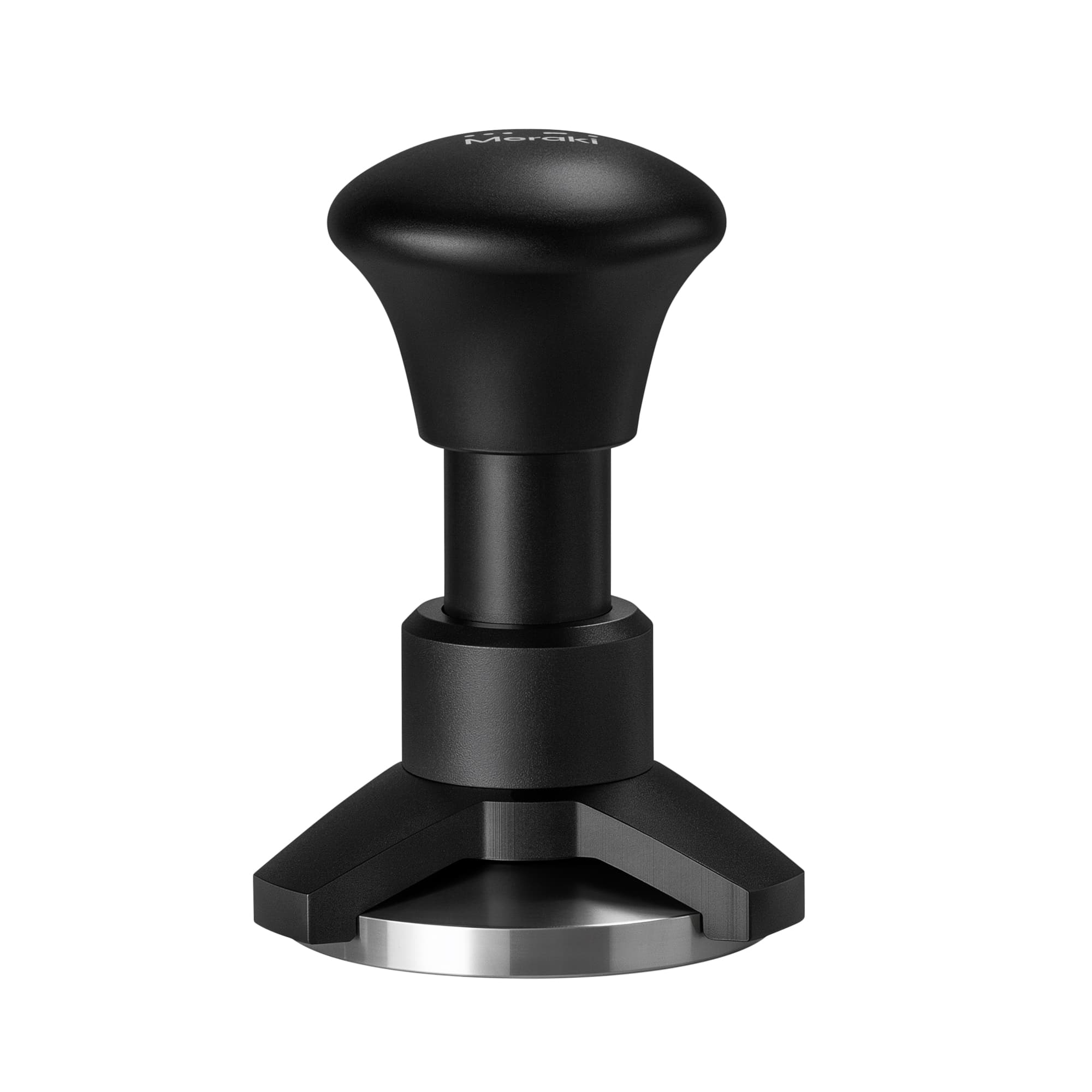
The repeatability the click can give you
The useful job is ending the tamp at a similar point, day after day.
If you sometimes lean harder on Monday than on Wednesday, a clear endpoint can reduce that scatter. You still have to place the base flat, keep your wrist level, and start from an even bed of coffee. The click cannot see whether the dose was short or the grind was too coarse.
That is why a week of the same dose and the same grind setting tells you more than a single click-perfect shot. If the cue is consistent but the pour still swings, the scatter is coming from somewhere else. If the cue itself changes from day to day — a weaker click, a harsher bottom-out, a new rattle — stop and inspect the tool rather than pressing through it.
Treat the cue as one repeatable step in a routine, alongside a scale and a consistent grind. Independent brewing overviews such as the Specialty Coffee Association education hub and the National Coffee Association’s brewing overview are useful reminders that espresso is a set of variables, not a single tool.
What the click cannot fix: dose, grind, and a tilted basket
A perfect-sounding click on an uneven puck is still an uneven puck.
If the basket is tilted, the dose is mounded, or the grind is far off, the tool will still “complete.” That is the most common disappointment with calibrated tampers: the cue feels professional, and the shot still channels. Fix distribution and dose first. A coffee distributor can help level a surface before you tamp; it does not replace the need for a sensible grind.
If your shots wander, change one variable at a time. Do not chase a new force fantasy. The product page does not give a kilogram or pound rating to aim at, and forum numbers for other brands are not a Meraki specification.
Force numbers circulate because they sound precise. Unless a figure is printed on the official listing for the tool in your hand, it is not a target you can be graded on. Other brands publish different ratings, and home-barista threads often mix those numbers together. Leave them there. Your job is a level, repeatable endpoint on your basket, judged by the shot, not by a remembered kilogram claim.
| The click can help with | The click will not fix |
|---|---|
| Ending a tamp at a more repeatable point | A dose that is too high or too low for the basket |
| Reducing day-to-day variation in hand pressure | A grind that is clearly too fine or too coarse |
| Giving a beginner a clearer “I’m done” cue | A tilted basket or a mounded, unleveled bed |
How this differs from a spring-loaded tamper
A spring can also give a cue. It is not automatically the same mechanism.
Spring-loaded tampers use spring travel or resistance as part of the feel. An impact-style calibrated tool is built around a release or click at a designed point. Some products blend ideas; read the official description for the tool in your hand. This page will not rewrite a spring-versus-manual comparison. The practical test is still whether the cue helps you repeat a level tamp, not whether a spring is present in the marketing photo.
How this differs from a self-leveling tamper
Self-leveling tools try to reference the basket rim so the base lands flatter.
That is a geometry job. A calibrated impact tool is a repeatability-of-endpoint job. You can care about both, but they are not the same purchase question. If your current fault is a tilted tamp, a click alone may not be the first fix. If your fault is inconsistent pressure with an already-level base, a calibrated cue may be the more relevant change.
Fit still comes first for either style. A base that is too small for a 58mm portafilter basket will leave a dirty ring, cue or no cue. Recheck the live product dimensions rather than assuming every “58 mm” accessory shares one exact diameter.

A first-week technique that stays gentle on the basket
Let the tool complete its motion. Do not hammer the basket after the click.
Place the portafilter on a sturdy surface, set the base flat on the coffee, and press along the axis of the basket until the cue happens. Then stop. Extra downward force after the click is not “more calibration.” It is just more load on the basket and your wrist. Wipe the base, check that the puck looks level, and brew.
If the puck is very shallow or very high, the cue can still happen while the bed is a poor match for the basket. Check the dose weight and the basket’s intended range before you blame the tamper. A first week is also a wrist-habit week: keep the portafilter supported, and do not stand over it with all of your weight after the tool has already completed its motion.
If the tool feels harsh or the basket rim shows new marks, stop and check fit. Measurement references such as NIST are not coffee manuals; they are only a reminder to trust a documented dimension over a guessed squeeze.
Fit: 58mm baskets and a flat, even bed
The base has to match the basket you actually use, including on a Meraki.
Confirm the diameter against your basket, not against a nickname. A 58 mm class basket still varies slightly by brand. After dosing, the bed should be even enough that the base does not rock. If you use a Meraki espresso machine, verify current basket and accessory fit on the live product pages rather than from an old photo.
Household energy or appliance pages such as Energy.gov will not size a tamper. Your eyes, a ruler, and the official listing will.
Care, storage, and keeping the base clean
Coffee oils on the base become the next puck’s defect.
Wipe the base after each use, dry it, and store it so the face does not sit in a wet tray. Do not run undocumented chemicals through the mechanism. If the cue changes after weeks of use — a weaker click, a gritty feel — stop and inspect rather than forcing it. This article does not offer a repair procedure.
Keep the base from picking up a wet ring of coffee in the drip tray. A crust on the face becomes a tilted tamp on the next shot, click or no click. If you travel with the tool, cap or wrap the base so it does not dent. A damaged face will not be saved by a calibrated mechanism.

Who will notice the difference, and who should start simpler
The people who notice are the ones whose last variable was inconsistent hand pressure.
If you are still changing grind every day, or you do not yet dose by weight, start with a well-fitting conventional tamper and a scale. If your routine is already stable and you want a clearer endpoint, a calibrated impact tamper is a reasonable next tool. It is not a requirement for good espresso, and it is not a trophy.
Official coffee-education material from the National Coffee Association’s About Coffee site is broader context, not a tamper review. Let your shots, not the sound of the click, decide whether the tool stays on the tray.
Conclusion
A calibrated impact tamper is for repeating a level endpoint, not for curing grind or dose problems. Meraki’s live product page describes a repeatable-tamp mechanism and its materials; it does not publish a force rating, and this article does not invent one. Verify fit on your basket, keep the base clean, and compare results over a week against a conventional tamper if you already have one.
FAQ
What is a calibrated tamper?
It is a tamper designed to give a repeatable endpoint, often with a click or similar cue, when the tool reaches the point its designer intended. It does not, by itself, fix grind, dose, or a tilted basket.
Does the click mean I used the correct tamping force?
It means the tool reached its intended cue. It does not prove a published force number unless the official product page states one. Meraki’s live listing, when we checked, did not publish a force rating.
Is a calibrated impact tamper the same as a spring-loaded or self-leveling tamper?
Not necessarily. Spring-loaded tools use spring travel or resistance; self-leveling tools emphasize rim reference and a flatter landing. Read the official description of the tool you are buying.
Do I still need to level the coffee before I tamp?
Yes. The click cannot flatten a mounded or poorly distributed dose. Level the bed first, then tamp.
Will a calibrated tamper fit a 58mm basket?
Only if the actual diameters match. “58 mm” is a class, not a guarantee. Check the live product dimensions against your basket before you rely on the cue.


