


You are staring at a product page that names CoffeeSense™ — and the next question is not “how does NFC work,” but what Meraki CoffeeSense actually changes in the cup when you extract espresso at home.
This Meraki guide answers Meraki CoffeeSense what it does for extraction in plain language: guidance versus automated extraction magic, how the weekday swipe-and-brew loop actually runs, what to verify on the listing, where the feature stops, and when to override suggestions. It is not a rewrite of CoffeeSense: How Meraki’s NFC Bean Recognition Works, the near-duplicate NFC Bean Recognition page, Sensing and Guidance Explained, CoffeeSense Espresso Workflow, or NFC Coffee Machine: What the Technology Does. Those pages own recognition mechanics, sensing framing, and NFC literacy. This page owns extraction-outcome honesty.
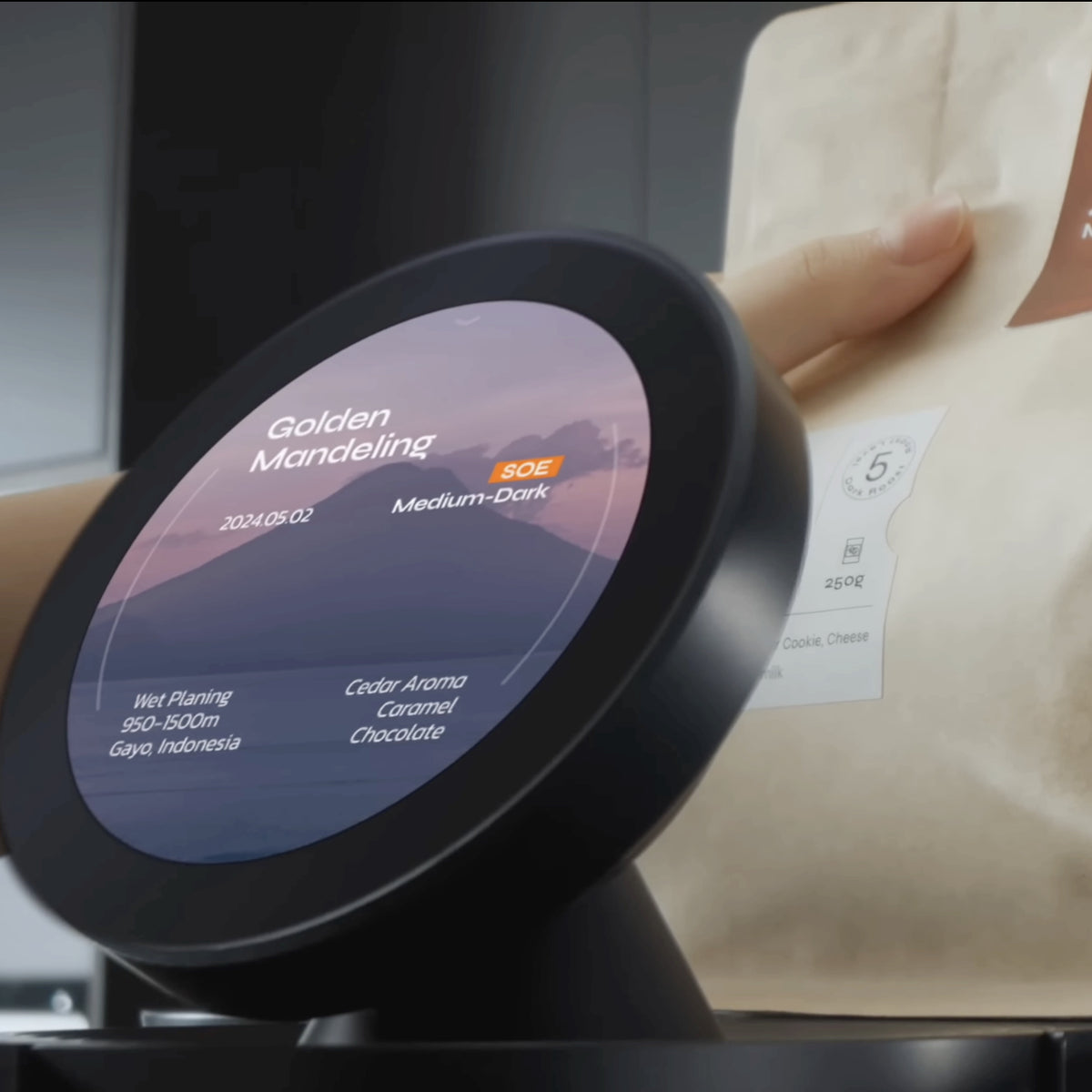
CoffeeSense is useful when you treat it as a starting recipe from a compatible bag — not as a promise that extraction will “fix itself.”
What “Meraki CoffeeSense what it does for extraction” really means for home buyers
“Meraki CoffeeSense what it does for extraction” in search often mixes Meraki’s own NFC explainers, general extraction primers, forum threads about fast or sour shots, and marketing phrases like “adaptive extraction.” For a home buyer comparing smart features, the phrase means something narrower: Will CoffeeSense pull a better espresso for me, or is it a convenience layer around the same grind-dose-yield physics everyone else still faces?
In verified Meraki language (product listing Extras line and FAQ checked for this project’s 2026-10-26 snapshot), CoffeeSense™ is an NFC workflow: you swipe a Meraki coffee bean bag equipped with an NFC chip on the machine’s NFC area; the machine recognizes that bag and provides suggested grinding and extraction parameters; you tap the touchscreen to start grind and extraction; and the built-in dual scales stop grind and extraction once the desired quantity is reached. That is the claim set this article holds to. It does not invent mid-shot “adaptive” pressure magic, AI taste learning, or automatic fixes for channeling.
Treat the keyword as extraction-outcome literacy. Use Meraki’s NFC how-it-works pages when you need chip mechanics. Use this page when you need to know what CoffeeSense does — and does not do — for the shot in your kitchen.
Who this page is for (and who should skip it)
This page is for Meraki shoppers, second-machine upgraders, and careful gift buyers who saw CoffeeSense™ (or “smart extraction”) on a listing and want feature honesty before they treat it as the reason to buy.
Skip it if you need the NFC chip walkthrough, supported-bag story, or step-by-step swipe tutorial — start with How Meraki’s NFC Bean Recognition Works or the near-duplicate NFC Bean Recognition page. Skip broader sensing-and-guidance framing — that is Sensing and Guidance Explained. Skip “what NFC technology does” as a category — use NFC Coffee Machine: What the Technology Does. Skip the workflow-first NFC dial-in narrative — that is CoffeeSense Espresso Workflow. Skip dual-scale hardware depth — Meraki’s grind-by-weight and brew-by-weight dual scales page owns that. Come here when the question is: what does CoffeeSense actually change about home extraction outcomes?
Why this is feature honesty (not another NFC how-it-works essay)
Meraki already publishes multiple CoffeeSense / NFC near-duplicates that explain recognition, swipe steps, sensing language, and NFC limits. Search for CoffeeSense + extraction also surfaces community dial-in threads and generic extraction science.
The unique job of this page is feature honesty for extraction outcomes: separate guidance from automated extraction magic, show the weekday loop without reinventing NFC physics, give a listing verification checklist, name override moments, and answer pressure / “10-second rule” questions without inventing Meraki-specific bar claims that contradict the live steady 9 bar rotary framing. Disclosure: Meraki publishes this guide and sells the Meraki Espresso Machine. Meraki examples illustrate verified product and FAQ claims only. We will not invent adaptive mid-shot behavior, third-party bag recognition, TIMEMORE® co-development as a CoffeeSense claim, or taste guarantees.
Core idea in plain language
CoffeeSense, in honest product language, loads a suggested starting recipe for a compatible Meraki NFC bean bag, then hands execution to you and to the machine’s scales and brew system. Coffee extraction itself still means dissolving soluble compounds from ground coffee into water under pressure, heat, and time — the same category physics specialty coffee education (see the Specialty Coffee Association and NCA brewing basics) has taught for years. A chip does not redefine extraction; it shortens the first guess.
When the bag is compatible and the suggestion is sane, CoffeeSense helps extraction outcomes in three practical ways: it shortens cold-start uncertainty with proposed grind and extraction parameters; it pairs those suggestions with touchscreen starts and dual-scale auto-stop at the quantity you accept (FAQ wording); and it still leaves taste judgment to you. If the shot is sour, bitter, or thin, you adjust grind, dose, or distribution — CoffeeSense does not taste the cup.
What it does not mean: mid-shot “adaptive” pressure magic based on puck resistance; recognition of every grocery bag without an NFC chip; fixing stale storage or channeling; or treating TIMEMORE® grinder co-development as a CoffeeSense claim. Meraki’s product framing lists CoffeeSense™ beside pre-infusion and hot water as Extras — keep mill co-engineering and NFC guidance as separate stories.
How it shows up in a weekday workflow
On a weekday, CoffeeSense shows up as fewer blank-slate decisions — not as a story that the machine “figured out your palate overnight.”
A practical Meraki loop (aligned with live FAQ language, not invented automation):
- Warm up (Meraki FAQ framing often cites roughly 3–4 minutes for dual-boiler heat; confirm live).
- Swipe a compatible Meraki NFC bag so suggested grind and extraction parameters load.
- Confirm the touchscreen, then tap to grind; the grind scale path stops at the target dose once set.
- Prepare the puck — distribution and tamp still matter; NFC does not level grounds.
- Start extraction; the yield scale path can auto-stop at the target quantity once set.
- Taste. If the cup is off, change one variable — usually grind — rather than blaming “smart extraction.”
That is guidance plus measured execution. Dual boilers and a rotary pump framed at steady 9 bar still supply brew and steam; CoffeeSense does not replace them. For dose/yield habit depth, use Meraki’s dual scales guide. For time-vs-taste after the shot, use espresso extraction time. Non-NFC local-roaster bags simply dial in the old way — that is normal, not a feature failure.
What to verify on the machine or listing
Open the live product page and FAQ and treat every smart-extraction sentence as a claim to check.
Verify these lines before you treat CoffeeSense as extraction insurance:
- Named feature + role — Meraki lists CoffeeSense™ NFC (and Extras copy: Pre-infusion · CoffeeSense™ · hot water). Prefer “NFC / suggested parameters” language over vague “AI extracts for you” copy that Meraki’s FAQ does not use.
- Suggestion, not guarantee — FAQ wording is suggested grinding and extraction parameters. If marketing somewhere implies perfect shots without taste, downgrade that sentence in your head.
- Compatible bags — FAQ specifies swiping a Meraki coffee bean bag with an NFC chip. Do not assume every third-party bag works unless Meraki publishes that.
- Scales as execution — FAQ pairs CoffeeSense with two built-in scales that stop grind and extraction at the desired quantity. Specs snapshots for this project also list dual scales 1 kg · ±0.2 g — re-read live. Scales measure; they do not taste.
- Touchscreen start — you still tap to start grind/extraction. Guidance is not a hands-free capsule cycle.
- What is not claimed — do not invent adaptive pressure profiling, automatic channeling repair, or TIMEMORE® authorship of CoffeeSense unless the listing says so.
- Exit and support — confirm trial / refund language on Meraki’s refund policy and know support (+1 833 854 9555, Mon–Fri 9 AM–5 PM EST) exists when a bag will not read.
Cross-check the FAQ answer “How do I use CoffeeSense™?” the day you buy. Software and copy can change; your memory of a blog post should not outrank the live FAQ.
Tradeoffs and limits
CoffeeSense buys a shorter first dial-in on compatible Meraki bags. It also creates expectations that can waste mornings if you treat suggestions as laws.
Tradeoffs to accept honestly:
- Guidance ≠ automated extraction magic. The chip proposes; the bed, water, and your taste decide. Category guides from CoffeeGeek still matter after the swipe.
- Compatible bags only (as published). NFC value concentrates on Meraki NFC bags. Rotating unmarked specialty bags returns you to manual dial-in — which Meraki’s own NFC technology page already frames as a limit, not a bug.
- Suggestions age with reality. Roast date, storage, humidity, and basket prep can make yesterday’s suggestion wrong today. Override is a feature of good espresso practice, not a failure of CoffeeSense.
- Scales can stop at the wrong target if the target is wrong. Auto-stop at quantity is only as smart as the grams you accepted. NIST is a reminder that measurement discipline matters; a logo does not.
- Search phrase trap: “adaptive extraction espresso machine.” People type that hoping for mid-shot intelligence. Meraki’s verified CoffeeSense story is NFC suggestions + scale stops — not a published claim that the machine rewrites pressure live based on puck feedback. Do not buy Meraki for an unstated adaptive engine.
Limits of this article: we will not invent CoffeeSense sensor lists beyond the FAQ/product framing used here, will not claim third-party NFC compatibility, and will not attach TIMEMORE® co-development to CoffeeSense.
Mistakes that waste time
These mistakes burn beans and patience:
- Expecting CoffeeSense to fix channeling. NFC does not redistribute grounds.
- Never tasting after a swipe. Bitter or sour still needs a grind change — trust your tongue over the chip.
- Blaming CoffeeSense on a non-NFC bag. No chip, no recognition story; dial in manually.
- Merging CoffeeSense with TIMEMORE® co-development. Mill pedigree ≠ bag-linked suggestions.
- Merging CoffeeSense with dual-boiler or 9-bar performance. Those are hardware stories — see dual-boiler temperature control and 9-bar meaning. CoffeeSense does not rewrite them.
- Refusing to override. When taste says so, change a setting. That is adult espresso.
- Skipping trial because the feature name sounded magical. Confirm Meraki’s live refund policy and test your bags and water.
A simple decision or setup checklist
Use this table before you treat CoffeeSense as a reason to buy — or before you trust a suggestion on Monday morning.
| Check | Pass looks like | Fail looks like |
|---|---|---|
| Feature named honestly | CoffeeSense™ NFC / suggested grind & extraction parameters (FAQ-aligned) | “AI perfect espresso” with no NFC/suggestion wording |
| Bag compatibility understood | You know Meraki NFC bags are the published path | You assumed every grocery bag swipes |
| Outcome expectation | Shorter first dial-in + scale stops | Mid-shot adaptive magic / taste guarantee |
| Scales story present | Dual scales with quantity auto-stop; precision re-checked live (Meraki snapshot: ±0.2 g) | Smart label, no measurement story |
| Override plan | You will change grind after tasting | You refuse to touch settings because “CoffeeSense set it” |
| Separated claims | CoffeeSense ≠ TIMEMORE® mill ≠ dual-boiler ≠ 9 bar | One logo blamed for every cup problem |
| Exit plan | Trial / refund / support numbers read | Feature hype as only risk plan |
Five or more clear passes usually means CoffeeSense is operationally ready to evaluate as guidance. Two or fewer means pause — you are buying a vibe word, not a verified extraction helper.
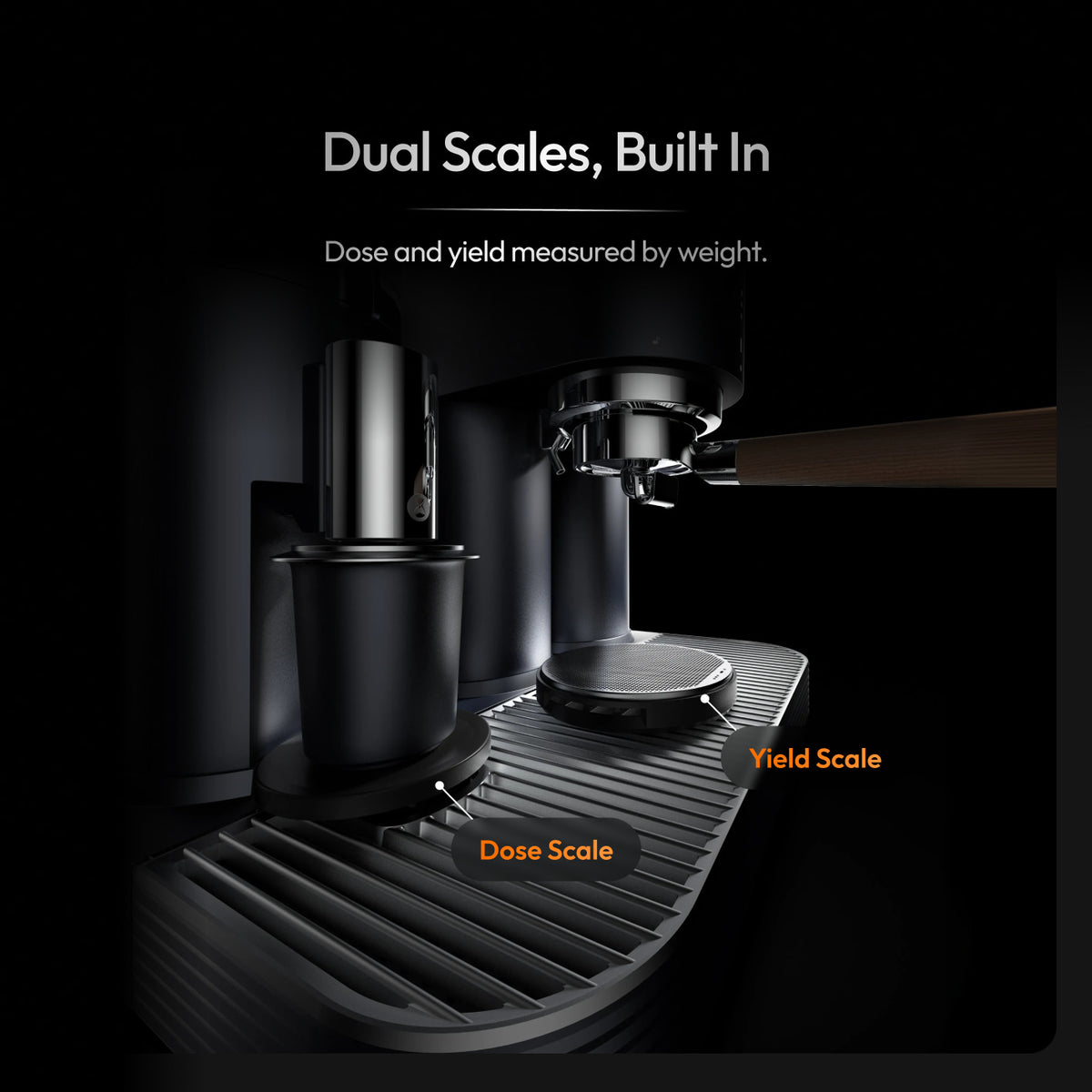
CoffeeSense suggests; dual scales help you hit the grams you accepted — verify both stories on the live product page, not only the feature name.
How this connects to Meraki’s dual-boiler system
CoffeeSense and dual boilers answer different mornings. CoffeeSense is about starting parameters from a compatible bag. Dual boilers are about brew temperature stability and simultaneous steam so milk drinks do not wait on single-boiler recovery.
They connect in workflow, not in branding: a suggestion loads; you grind and extract by weight; dual boilers keep brew and steam ready while you stay in one guided station. Meraki’s product framing pairs dual boilers, a rotary pump held near steady 9 bar, dual scales, and CoffeeSense™ as parts of one chassis — see the live product page. Do not collapse that into “CoffeeSense runs the boilers.” Keep credit where the listing puts it. For why dual-boiler temperature control matters on milk days, use Meraki’s dual-boiler guide.
What is the 10-second rule for espresso?
It is a home heuristic, not a Meraki CoffeeSense law.
In community espresso talk, a “10-second rule” usually means something like: after you start the pump, you often want first drops or a steady flow to appear in a rough early window (people quote ~5–10 seconds depending on pre-infusion and recipe) — and if nothing comes for far longer, the grind may be too fine or the puck too resistant; if coffee gushes instantly, the grind may be too coarse. It is a traffic-light habit, not a laboratory standard and not a CoffeeSense setting.
Meraki does not publish a CoffeeSense-specific “10-second rule” as a product claim in the FAQ language used here. Use the heuristic as a quick sanity check after a swipe, then trust taste and yield. For deeper time-vs-taste reading, Meraki’s extraction time and extraction overview pages already own that education. SCA research keeps time beside ratio and sensory judgment — not above them.
Is 15 or 20 bar better for espresso?
Neither, as a shopping scoreboard.
Higher printed maxima like 15 bar or 20 bar on many home listings often describe a pump ceiling used in marketing, not a tastier brew target. Specialty espresso practice commonly aims near a regulated ~9 bar delivery at the brew path; Meraki’s product framing (2026-10-26 snapshot) describes a commercial rotary pump held near a steady 9 bar. That is a delivery claim to verify — not proof that fifteen beats nine, and not a CoffeeSense-adjusted pressure profile.
CoffeeSense does not change Meraki’s published bar story into a 15- or 20-bar contest. If a page sells CoffeeSense and brags about huge bar numbers without regulation language, read both claims separately. For listing myth-busting on bar numbers, Meraki’s 9-bar meaning page is the mechanism home; this page only needs the honest buyer answer: do not rank carts by the biggest bar digit, and do not invent Meraki CoffeeSense bar claims that contradict the live 9-bar rotary framing.
FAQ
FAQ
Does CoffeeSense automatically fix under- or over-extracted espresso?
No. Meraki's verified CoffeeSense story loads suggested grind and extraction parameters from a compatible Meraki NFC bean bag, then you start grind/extraction on the touchscreen while dual scales can stop at the quantities you accept. It does not taste the cup or rewrite a bad puck mid-shot. If the shot is sour, bitter, or thin, change grind or dose and override the suggestion.
What is coffee extraction, in one plain sentence?
Coffee extraction is dissolving flavor compounds from ground coffee into water using contact time, temperature, pressure, and particle size. Espresso is a pressurized, short-contact version of that process. CoffeeSense can suggest starting parameters for a compatible bag; it does not redefine what extraction is. For a fuller Meraki primer, see the espresso-brewing extraction guides linked above.
Do I need Meraki NFC bags for CoffeeSense to matter?
For the published swipe-and-suggest path, yes — Meraki's FAQ describes swiping a Meraki coffee bean bag with an NFC chip. Without a compatible chip, you dial in manually like any other espresso workflow. That limit is honesty, not a hidden defect. Confirm current bag compatibility on the live product and FAQ pages before you buy for CoffeeSense alone.
When should I override CoffeeSense suggestions?
Override when taste says the cup is off, when the bag has aged past how it behaved last week, when you changed baskets or drink style, or when flow is obviously choking or gushing despite the suggestion. Treat the chip as a informed first draft. Your tongue and a one-variable grind change remain the adult tools.
Is CoffeeSense the same thing as Meraki's TIMEMORE® grinder collaboration?
No. CoffeeSense™ is Meraki's NFC bean-guidance feature (suggested parameters from a compatible bag). TIMEMORE® co-development, in Meraki's public framing, refers to the integrated burr grinder / grind-to-scale story. Keep those claims separate when you read a listing so one logo does not get blamed — or credited — for the other's job.
Conclusion
Buy CoffeeSense for what Meraki actually documents: a shorter, bag-linked starting point for grind and extraction parameters on compatible Meraki NFC bags, executed with dual-scale quantity stops — not for invented adaptive extraction magic. If that guidance-plus-measurement loop matches how you rotate Meraki bags on weekdays, the feature earns its place on the checklist. If you mostly brew unmarked third-party beans and dislike touching settings after a bad cup, weigh CoffeeSense as a nice extra, not the whole machine.
When you are ready to verify the live wording yourself, read CoffeeSense™ NFC, dual scales, dual boilers, and the rotary 9 bar lines on the Meraki Espresso Machine product page — one calm pass beats another round of feature mythology. Questions after you own it: support at +1 833 854 9555 (Mon–Fri 9 AM–5 PM EST).
More on this topic: Smart Espresso Machines & Apps.


