


You searched coffee bean recognition technology buyer questions and Google served industrial sorting papers, multispectral cameras, and computer-vision datasets. That is not the decision you are making in a kitchen cart.
This Meraki buyer Q&A owns skeptical shopping questions about bean-recognition tech on home espresso machines: what the phrase usually means at retail, what Meraki’s CoffeeSense™ NFC path actually claims, what to verify on a listing, and which marketing sentences to distrust. Soft-lane CoffeeSense: How Meraki’s NFC Bean Recognition Works and Sensing and Guidance Explained for chip and sensing walkthroughs. Soft-name A061 when you want extraction-outcome honesty for CoffeeSense. Soft-lane the live coffee bean guides hub for bean education — not recognition tech. Soft-name A045 (TIMEMORE® separation), A064 (guided first 30 days), and A067 (NFC practical — unpublished) so those jobs stay elsewhere.
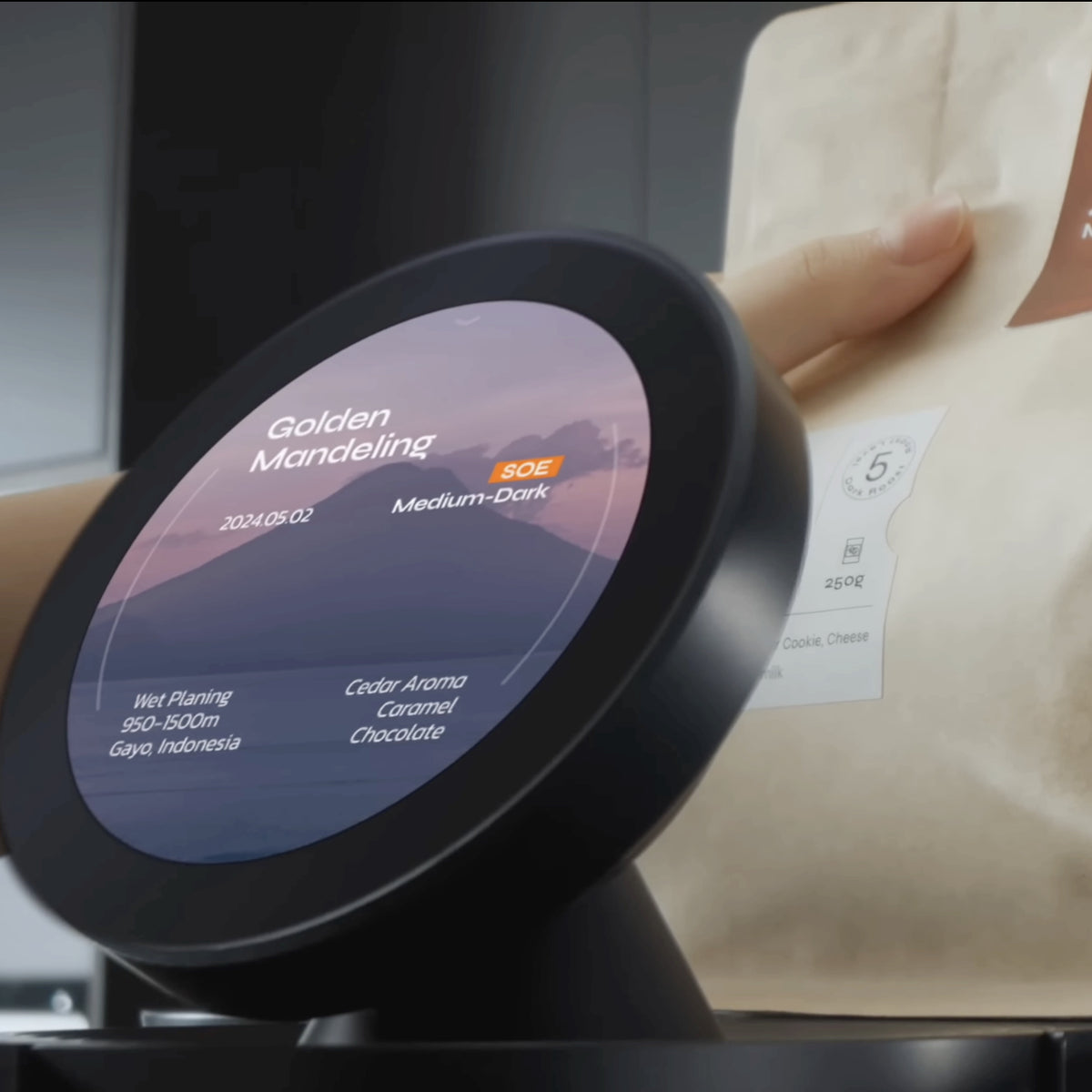
Home “bean recognition” on Meraki is NFC bag guidance — not a factory sorting camera. Verify the claim language before you buy the buzzword.
What “coffee bean recognition technology buyer questions” really means for home buyers
Coffee bean recognition technology buyer questions, for home shoppers, means the skeptical checklist you run before paying for a “smart bean” feature on an espresso machine — not a research brief on green-bean defect AI.
Search for this phrase is polluted. Page-one results mix multispectral / AI sorting for mills and exporters, Roboflow-style detection models, ResearchGate defect classifiers, and lifestyle “AI picks your beans” essays. Those systems identify or grade beans on a line or in a photo. A home espresso machine that talks about bean recognition usually means something narrower: the machine reads a compatible identifier (on Meraki: an NFC chip on a Meraki coffee bean bag) and loads suggested grinding and extraction parameters, then you start the shot and scales can stop at the quantities you accept. That is retail guidance, not industrial inspection.
Treat the keyword as buyer skepticism literacy. If a listing implies camera sorting of every grocery bag, or “AI that tastes for you,” downgrade the claim until the product page says so in plain verbs.
Who this page is for (and who should skip it)
This page is for tech shoppers and careful gift buyers comparing smart espresso features who want honest answers before they treat “bean recognition” as the reason to buy.
Skip it if you need the NFC swipe physics, supported-bag story, or step tutorial — use How Meraki’s NFC Bean Recognition Works. Skip sensing-language framing — that is Sensing and Guidance Explained. Soft-name A061 when the question is what CoffeeSense changes in the cup / extraction outcomes. Soft-lane coffee bean guides for roast and bean education. Soft-name A064 for a guided first-month habit plan, and A067 for unpublished NFC practical depth. Come here when the job is: I am skeptical — which buyer questions about bean-recognition tech actually matter?
Why this is skeptical Q&A (not sorting science or another NFC how-it-works)
SERP for this query does not serve home-machine buyer FAQs. It serves factory vision, academic classifiers, and vague “AI coffee” posts. Meraki already publishes NFC how-it-works and sensing explainers. Soft-name A061 owns CoffeeSense extraction honesty.
The unique job of this page is skeptical Q&A for home buyers: disambiguate industrial recognition from kitchen NFC/recipe suggestions early; answer the questions that decide a cart (any bag? AI taste? fixes channeling?); give a listing verification table; and keep CoffeeSense™ separate from TIMEMORE® mill claims. Disclosure: Meraki publishes this guide and sells the Meraki Espresso Machine. Meraki examples illustrate verified product and FAQ claims only (snapshot framing for this project: 2026-10-26/27). We will not invent multispectral sorting on Meraki, adaptive mid-shot extraction, AI taste learning, any-bag NFC, CoffeeSense fixing channeling, or milk-temperature-as-CoffeeSense.
Core idea in plain language
On a home espresso machine, “bean recognition” worth paying for is usually identity → suggestion → measured start, not a camera that grades your breakfast beans.
Meraki’s verified CoffeeSense™ path (product CoffeeSense™ NFC; FAQ “How do I use CoffeeSense™?” checked for this project’s live snapshot) is: swipe a Meraki coffee bean bag with an NFC chip on the machine’s NFC area → the machine recognizes that bag and provides suggested grinding and extraction parameters → you tap the touchscreen to start grind and extraction → two built-in scales can automatically stop grind and extraction once the desired quantity is reached. That is the claim set this article holds to.
That is different from industrial coffee bean recognition that sorts defects with multispectral imaging or convolutional models — work you will see cited on ResearchGate or trade press, and useful for mills, not for your 7 a.m. latte. Specialty coffee education from the Specialty Coffee Association still treats grind, dose, yield, time, and taste as the dial-in craft. A chip shortens the first guess on a compatible bag; it does not replace that craft, and Meraki does not claim to run a sorting line on your counter.
How it shows up in a weekday workflow
On a weekday, bean recognition shows up as fewer blank-slate decisions on compatible Meraki bags — not as a story that the machine “learned your palate overnight.”
A practical Meraki loop (FAQ-aligned, not invented automation):
- Warm up (Meraki FAQ framing often cites about 3–4 minutes for dual-boiler heat — confirm live).
- Swipe a compatible Meraki NFC bag so suggested grind and extraction parameters load.
- Confirm the touchscreen, then tap to grind; the dose-scale path can stop at the target once set.
- Prep the puck — distribution and tamp still matter; recognition does not level grounds.
- Start extraction; the yield-scale path can auto-stop at the quantity you accepted.
- Taste. Sour, bitter, or thin? Change one variable — usually grind — rather than waiting for “smart recognition” to apologize.
Non-NFC local-roaster bags dial in the old way. That is normal, not a feature failure. Soft-name A064 if you want a structured first-month habit around guided workflows; stay here for the buyer questions that decide whether recognition belongs on your checklist at all.
What to verify on the machine or listing
Open the live product page and FAQ and treat every “bean recognition / AI / smart bean” sentence as a claim to check.
Verify these lines before you treat recognition as purchase insurance:
- Named mechanism — Prefer NFC / chip / suggested parameters wording. Meraki lists CoffeeSense™ NFC (Extras framing: Pre-infusion · CoffeeSense™ · hot water). Vague “AI recognizes any beans” without a mechanism is a red flag.
- Suggestion language — FAQ wording is suggested grinding and extraction parameters. If copy elsewhere implies perfect shots without taste, mentally downgrade it.
- Bag compatibility — FAQ specifies a Meraki coffee bean bag with an NFC chip. Do not assume grocery or café bags work unless Meraki publishes that.
- You still start the shot — Touchscreen tap to grind/extract. Guidance is not a hands-free capsule cycle.
- Scales as execution — FAQ pairs CoffeeSense with two built-in scales that stop at desired quantity. Specs snapshots for this project also list dual scales 1 kg · ±0.2 g — re-read live. Scales measure; they do not taste. NIST is a reminder that a stop is only as honest as the zero and target you give it.
- What is not claimed — Do not invent camera sorting, adaptive mid-shot pressure magic, AI taste learning, automatic channeling repair, or TIMEMORE® authorship of CoffeeSense unless the listing says so.
- Exit and support — Confirm trial / refund language on Meraki’s refund policy and know support (+1 833 854 9555, Mon–Fri 9 AM–5 PM EST) exists when a bag will not read.
Cross-check the FAQ answer “How do I use CoffeeSense™?” the day you buy. Software and copy can change; a blog memory should not outrank the live FAQ.
Tradeoffs and limits
Bean recognition buys a shorter first dial-in on compatible Meraki NFC bags. It also creates expectations that waste mornings if you confuse kitchen NFC with industrial sorting — or with tasting AI.
Tradeoffs to accept honestly:
- Home recognition ≠ factory vision. Multispectral sorting and defect models answer mill QC. Meraki’s published path answers which Meraki bag suggestion to load. Do not fake that Meraki does multispectral sorting.
- Compatible bags only (as published). NFC value concentrates on Meraki NFC bags. Rotating unmarked specialty bags returns you to manual dial-in.
- Suggestions age with reality. Roast date, storage, humidity, and basket prep can make yesterday’s suggestion wrong today. Override is adult espresso practice.
- Intelligent adjustment vs tasting your shots. “Intelligent coffee bean adjustment” in marketing often means parameter suggestion, not a tongue. Taste still wins — literacy from SCA research and CoffeeGeek guides still applies after the swipe.
- Scales can stop at the wrong target if the target is wrong. Auto-stop at quantity is only as smart as the grams you accepted.
- Search-phrase trap. People type bean-recognition queries hoping for AI that grades any bag or learns preference. Meraki’s verified CoffeeSense story is NFC suggestions + scale stops — not a published claim of any-bag vision or taste learning.
Limits of this article: we will not rewrite NFC chip physics, will not claim third-party bag recognition, will not attach TIMEMORE® co-development to CoffeeSense, and will not invent adaptive mid-shot behavior.
Mistakes that waste time
These mistakes burn research time and patience before the machine even ships:
- Confusing Roboflow / ResearchGate sorting with a kitchen feature. Different problem, different hardware.
- Expecting any grocery bag to “recognize.” No published Meraki NFC chip, no Meraki recognition story.
- Expecting CoffeeSense to fix channeling. Recognition does not redistribute grounds.
- Expecting AI taste learning. Meraki’s FAQ does not describe a palate model that rewrites recipes from your mood.
- Never tasting after a swipe. Bitter or sour still needs a grind change.
- Merging CoffeeSense with TIMEMORE® co-development. Soft-name A045 for mill-collaboration meaning; mill pedigree ≠ bag-linked suggestions.
- Merging CoffeeSense with dual-boiler or 9-bar performance. Those are hardware stories. Soft-name A061 for extraction-outcome honesty; keep boilers and pump claims on the listing, not inside the NFC label.
- Skipping trial because the feature name sounded magical. Confirm Meraki’s live refund policy and test your bags and water.
A simple decision or setup checklist
Use this table before you treat bean-recognition tech as a reason to buy — or before you trust a suggestion on Monday morning.
| Buyer question | Pass looks like | Fail looks like |
|---|---|---|
| What kind of “recognition”? | NFC / chip / suggested grind & extraction (FAQ-aligned) | “AI sorts your beans” with no home mechanism |
| Industrial vs home? | You know kitchen NFC ≠ multispectral mill sorting | You bought a buzzword from a ResearchGate SERP |
| Bag compatibility | You know Meraki NFC bags are the published path | You assumed every grocery bag swipes |
| Outcome expectation | Shorter first dial-in + scale stops | Taste guarantee / mid-shot adaptive magic |
| Scales story | Dual scales with quantity auto-stop; precision re-checked live (Meraki snapshot: ±0.2 g) | Smart label, no measurement story |
| Override plan | You will change grind after tasting | You refuse to touch settings because “it recognized the bag” |
| Separated claims | CoffeeSense ≠ TIMEMORE® mill ≠ dual-boiler ≠ 9 bar | One logo blamed for every cup problem |
| Exit plan | Trial / refund / support numbers read | Feature hype as only risk plan |
Five or more clear passes usually means recognition is operationally ready to evaluate as guidance. Two or fewer means pause — you are buying a SERP category word, not a verified home workflow.
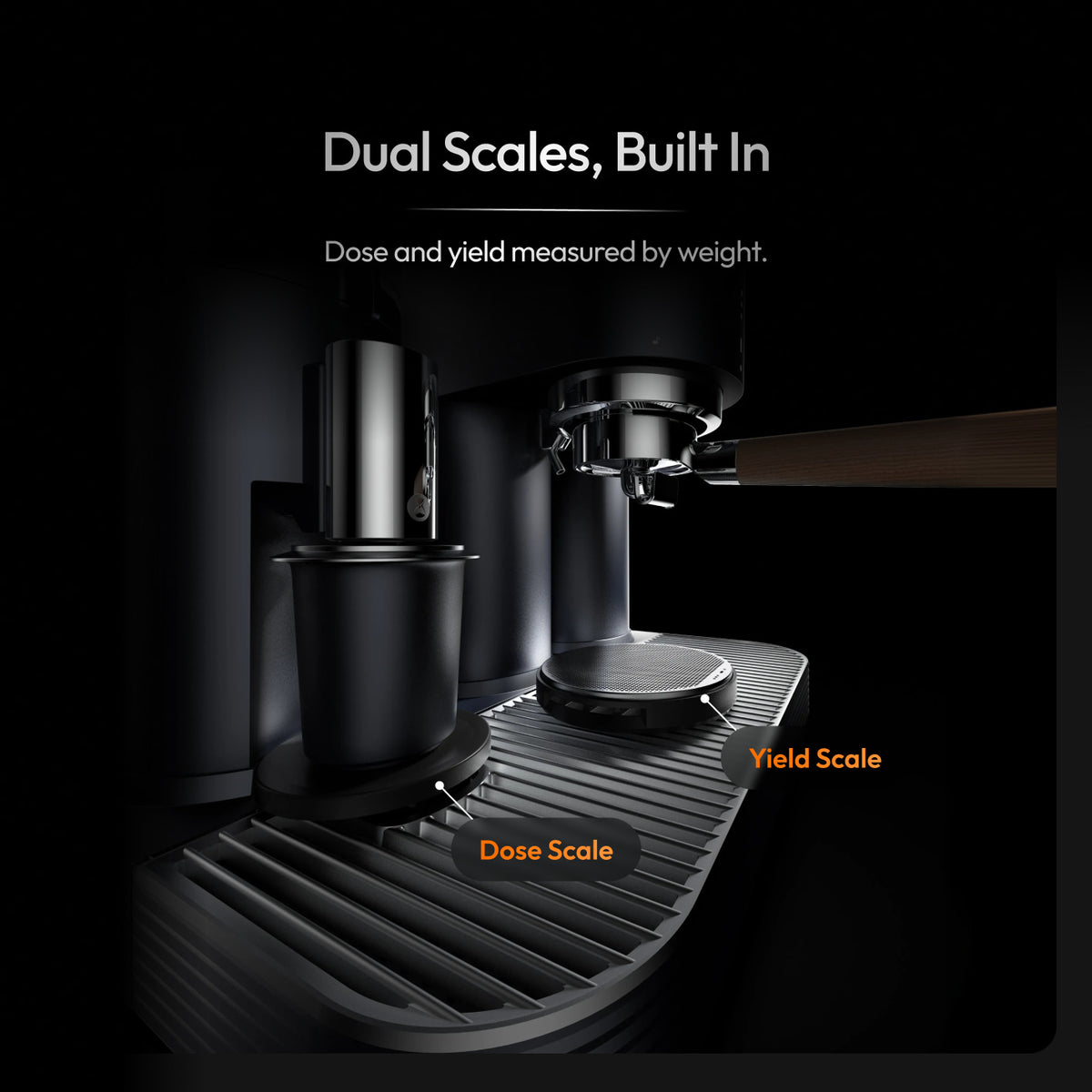
Recognition suggests; dual scales help you hit the grams you accepted — verify both stories on the live product page, not only the feature name.
How this connects to Meraki’s dual-boiler system
Bean recognition and dual boilers answer different shopping fears. Recognition is about starting parameters from a compatible bag. Dual boilers are about brew temperature stability and simultaneous steam so milk drinks do not wait on single-boiler recovery.
They connect in workflow, not in branding: a suggestion loads; you grind and extract by weight; dual boilers keep brew and steam ready while you stay in one guided station. Meraki’s product framing pairs dual boilers, a rotary pump held near steady 9 bar, dual scales, and CoffeeSense™ as parts of one chassis — see the live product page. Do not collapse that into “bean recognition runs the boilers.” Keep credit where the listing puts it. Soft-name A061 when you need the extraction-results angle rather than this buyer-question angle. NCA brewing basics still start from measured coffee and water; recognition only shortens how you pick the first numbers.
FAQ
Is Meraki coffee bean recognition the same as industrial AI bean sorting?
No. Industrial systems use cameras, multispectral imaging, or classifiers to grade or sort beans on a production line. Meraki's published CoffeeSense™ path uses an NFC chip on a Meraki coffee bean bag to load suggested grind and extraction parameters, then you start on the touchscreen while dual scales can stop at target quantities. Do not buy Meraki expecting a factory sorting camera on your counter.
Will bean recognition work with any bag from the grocery store?
Not on Meraki's published FAQ path. The live FAQ describes swiping a Meraki coffee bean bag equipped with an NFC chip. Without a compatible chip, you dial in manually. Confirm current bag compatibility on the product and FAQ pages before you buy for recognition alone.
Does CoffeeSense use AI to learn my taste over time?
Meraki's FAQ language for CoffeeSense does not describe a taste-learning AI that rewrites recipes from your preferences. It describes recognition of a Meraki NFC bag, suggested grinding and extraction parameters, touchscreen start, and dual-scale quantity stops. Treat "intelligent adjustment" marketing elsewhere as a claim to verify — not as a documented palate model.
Can bean recognition fix channeling or a bad puck?
No. Recognition loads starting parameters; it does not redistribute grounds or repair an uneven bed. Channeling is still a prep and grind problem. Soft-name A061 for what CoffeeSense does and does not change about extraction outcomes, and keep puck craft in your hands.
Is CoffeeSense the same as Meraki's TIMEMORE® grinder collaboration?
No. CoffeeSense™ is Meraki's NFC bean-guidance feature. TIMEMORE® co-development, in Meraki's public framing, refers to the integrated burr grinder / grind-to-scale story. Soft-name A045 for collaboration meaning. Keep those claims separate so one logo is not blamed — or credited — for the other's job.
Conclusion
Ask coffee bean recognition technology buyer questions that match home retail reality: Is this NFC guidance or factory vision? Which bags? Suggestion or taste AI? What stops the shot — and what still needs your tongue? Meraki’s documented CoffeeSense™ answer is a compatible Meraki NFC bag, suggested grind and extraction parameters, your touchscreen start, and dual-scale quantity stops — not multispectral sorting, not adaptive mid-shot magic, and not TIMEMORE®-as-CoffeeSense.
If that skeptical checklist matches how you shop smart features, recognition earns a line on the comparison sheet. If you mostly brew unmarked third-party beans and already love dialing in by taste, weigh it as a nice extra, not the whole machine.
When you are ready to verify the live wording yourself, read CoffeeSense™ NFC, dual scales, dual boilers, and the rotary 9 bar lines on the Meraki Espresso Machine product page — one calm pass beats another round of SERP mythology. Questions after you own it: support at +1 833 854 9555 (Mon–Fri 9 AM–5 PM EST).


