


You are staring at a product card that says ±0.2 g — and wondering whether that number is café lab theater or something you will taste on a Tuesday. An espresso machine with 0.2g scale accuracy reality page for spec readers is a spec-translation job: turn the tolerance into cup-level change, into real-time weight feedback you can act on, and into the line between scale accuracy and technique limits.
This Meraki guide owns that translation. Soft-lane A053 for dose vs yield role clarity; A051 / A052 / A046 for setup, auto-stop habits, and workflow. Soft-lane how Meraki’s dual scales work, why weighing changes everything, and espresso ratio explained. Use this page for: what does ±0.2 g actually change in the cup?
Nearest published “scale” URL is water hardness and managing scale — mineral scale, not gram accuracy. Different word, different job.
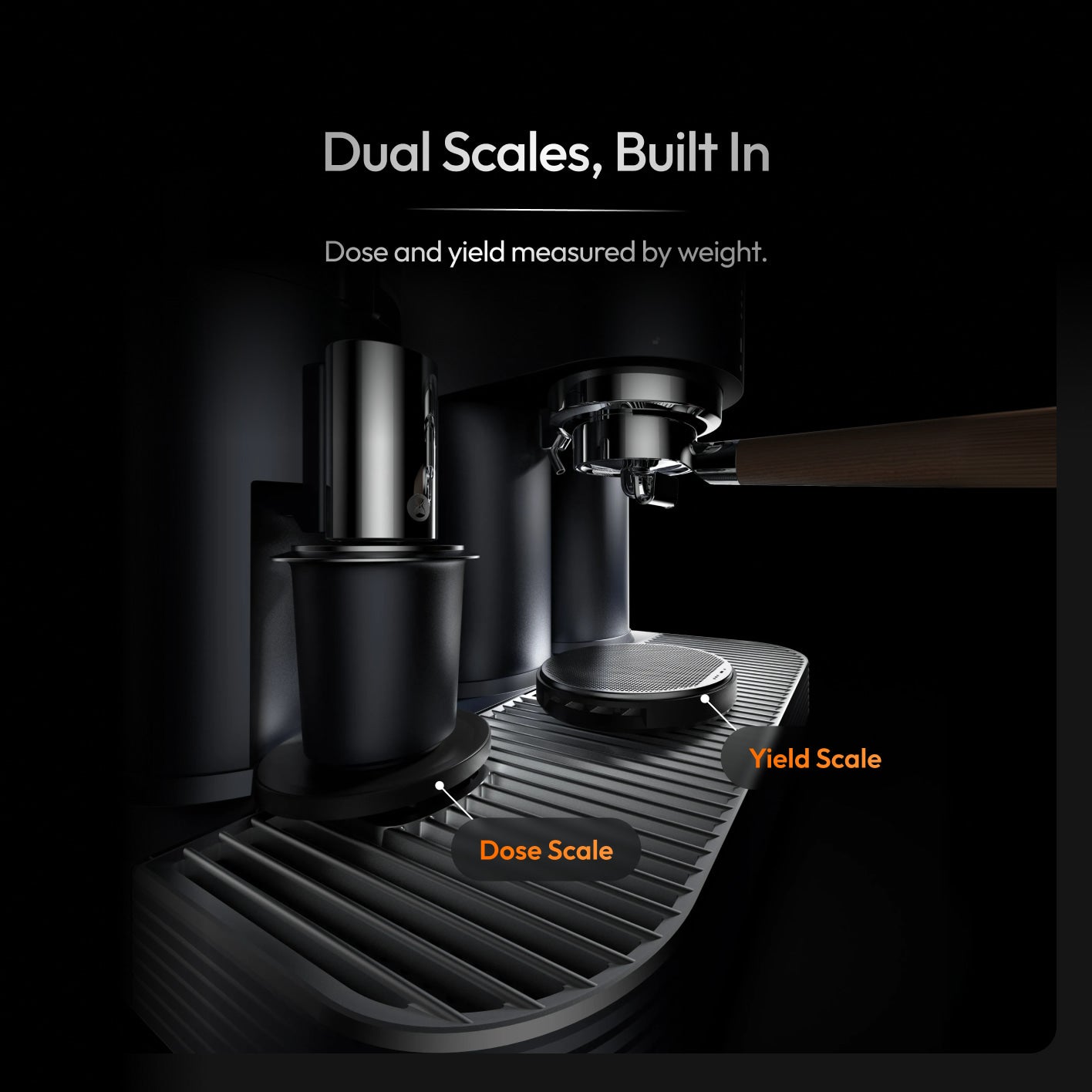
A published ±0.2 g claim only earns cup value when the number updates fast enough to change what you do next — not when it sits as brochure jewelry.
What “espresso machine with 0.2g scale accuracy reality” really means for home buyers
Espresso machine with 0.2g scale accuracy reality, for home buyers, means a vendor tolerance (often ±0.2 g) honest enough for weekday dial-in — paired with feedback you can read while grinding or extracting — not a promise that every messy puck tastes identical.
Search often lands on Reddit gear threads, Instagram ratio posts, 0.1 g mat listings, and “precision matters” essays that never translate the number into a cup decision. Treat the keyword as a spec audit: Does ±0.2 g name a stated tolerance plus capacity you can re-check? Does the UI update in time to stop, nudge, or accept?
0.2 g scale accuracy should mean the display tracks small mass changes in the dose/yield range you use, within a published tolerance, under clean tare. Reality here means what that does — and does not — change once coffee hits water. Literacy from the Specialty Coffee Association and CoffeeGeek’s guides beats any brochure that flashes ±0.1 g or ±0.2 g without saying when. NIST reminds: an accuracy claim without a method is marketing, not metrology. Soft-lane Meraki’s espresso machine with grinder page when the wider station is next.
Who this page is for (and who should skip it)
This page is for spec readers comparing ±0.2 g, 0.1 g mats, “precise dose measurement,” or “real-time weight” claims — who need cup translation before they buy or blame the scale.
Soft-skip A053 if you cannot name which scale is dose vs yield. Soft-skip A051 / A052 / A046 for rituals, auto-stop habits, and workflow. Soft-skip how Meraki’s dual scales work for hardware walkthrough; why weighing changes everything for the “why weigh” essay; dose and yield dial-in for dial-in method; water hardness / mineral scale for limescale. Come here for: ±0.2 g → cup reality, actionable real-time weight, and accuracy vs technique limits.
Why this is spec translation (not a dual-scales role map)
SERP for this query is noisy and thin: gear debates, accessory scales, and consistency roundups that rarely open ±0.2 g into weekday cup change. Soft-lane A053 already owns role clarity. What stays thin for machine-guides spec readers is spec translation: what ±0.2 g may mean in the cup, what real-time feedback lets you do, and where technique still owns the shot — without inventing competitor accuracy shootouts. Few pages answer: If the box says ±0.2 g, what actually changes in the cup — and what never will?
The unique job is spec translation — not a role rewrite (A053), grind ritual (A051), auto-stop habit week (A052), or full workflow (A046). Disclosure: Meraki publishes this guide and sells the Meraki Espresso Machine. Live framing (2026-10-26/27): dual built-in scales, 1 kg · ±0.2 g, grind-to-scale dosing with TIMEMORE® co-developed burrs, auto-stop at target yield, dual boilers, rotary framed at steady 9 bar, warm-up ~3–4 minutes, 45 grind settings — vendor claims; verify live. No invented competitor accuracy charts or street prices; no competitor outbound links. Channel: machine-guides; soft-link A053 for roles.
The mechanism in plain language
A coffee scale reports mass after tare. ±0.2 g on a product card is a stated tolerance — vendor language about how close a reading should stay to true mass under defined conditions (often with a capacity such as 1 kg). It is not a third-party certificate and not a taste guarantee.
| Moment | What the scale watches | What ±0.2 g-class honesty helps | What it cannot fix |
|---|---|---|---|
| Dose | Ground coffee mass in | Same grams Monday vs Tuesday | Channeling, distribution, retention after stop |
| Yield | Liquid espresso mass out | Same stop grams without eyeballing | Grind, cold group, stale beans |
| Real-time feedback | Updating display during grind/brew | Stop, nudge, or accept before the cup is ruined | A decision you never look at |
Real-time weight feedback you can act on means the number moves while coffee is still falling or liquid is still flowing — fast enough that you (or firmware auto-stop) can change the outcome. A ±0.2 g reading that only appears after the shot is a logbook, not a control loop. Soft-lane A053 if roles are still unclear; stay here for what the tolerance buys once roles are clear.
Load cells flex under mass; firmware tares the portafilter or cup, then tracks delta. Resolution (display steps) and accuracy (closeness to truth) differ — a display can show 0.1 g steps and still wander if tare, vibration, or a wet platform interfere. Treat Meraki’s published ±0.2 g / 1 kg as a home-usable tolerance class to re-check live, not a license to invent competitor shootouts. NCA brewing basics still start from measured coffee and water; espresso presses that discipline into a short, high-pressure window.
What changes in your daily cup
When ±0.2 g-class weighing is honest and visible in time, the cup usually gets quieter in one way: fewer simultaneous unknowns. Dose that held within a couple of tenths removes “maybe I under-dosed” as the first excuse. Yield that stopped near target removes “maybe I ran long.” Taste then points at grind, distribution, temperature, or beans — variables scales do not replace.
In straight espresso, sour/thin and bitter/hollow become diagnosable faster because in and out grams are not sliding together. In milk drinks, stable espresso out keeps pitcher ratios familiar (soft-lane ratio explained for taste language).
What ±0.2 g does not change: a channeled puck, a cold machine, a stale bag, a dirty basket. The tolerance buys repeatable inputs and stop points; technique still owns extraction — literacy SCA research communities care about, applied to a home product card.
| What you locked | Cup-level change you can expect | What still belongs to technique |
|---|---|---|
| Dose within ±0.2 g-class honesty | Fewer “mystery under/over dose” mornings | WDT, distribution, tamp levelness |
| Yield stop near target | Fewer “ran long by feel” swings | Grind, puck prep, heat readiness |
| Real-time read during brew | Chance to stop early or trust auto-stop | Looking away until the end |
Meraki’s framing pairs dual scales with grind-to-scale dosing and auto-stop at target yield — vendor claims to re-check live — so the weekday story can stay “honest grams I can act on,” not “a prettier number than the forum’s mat scale.”
Home tests you can run without lab gear
You do not need a metrology lab. Run these on a demo, return window, or after unpacking — then decide whether the ±0.2 g claim is cup-useful.
Tare-and-settle. Zero with the portafilter (or cup) in place. Add a small known mass or a pinch of grounds; watch whether the display settles near a repeatable reading. Flighty zeros or wandering numbers with nothing added are feedback failures even if the brochure says ±0.2 g. Follow appliance safety and manuals (UL); do not disassemble load cells.
Real-time act test. During grind or brew, watch whether the number updates soon enough that you could stop or accept before the cup is finished. If the only honest reading appears after the shot, you have a log, not control. Soft-lane A052 for auto-stop habits once feedback is proven.
One-variable morning. Lock dose and yield for three weekday shots. Change only grind (or only beans) on day two. If taste moved while grams held, you learned something real. If you hopped targets by 0.2–0.4 g every shot and moved the grind, you learned anxiety — not scale truth.
Mat-scale sanity (optional). Compare a trusted mat under the cup directionally to the built-in yield reading — to catch a dead cell or bad habit, not to invent a competitor shootout. Press context helps literacy (Barista Magazine); it does not replace your own zeros. Skip turning these into A053 / A051 / A046 how-tos. Pass/fail: does ±0.2 g-class feedback change what I can do — and taste — on a weekday?
Settings most people should leave alone at first
Leave micro-offsets on dose targets (18.0 → 18.2 → 17.8), exotic pre-infusion tours, and forum “my scale is 0.05 g better” wars alone until tare is boring and one locked recipe tastes familiar. Tiny target hopping usually teaches anxiety faster than flavor.
Home value from a ±0.2 g claim is weekday honesty plus feedback you can act on, not winning a tenth-of-a-gram contest. Meraki’s ±0.2 g / 1 kg is an example to re-check live — not a requirement every brand must match, and not permission to invent competitor tables. Also leave alone at first: steam experiments that steal attention from yield honesty, and “ratio shopping” that changes dose and yield every shot. Soft-lane A051 / A052 for rituals or auto-stop habits; A053 if roles are fuzzy. If warm-up confuses you, re-check the live FAQ (~3–4 minutes) rather than blaming the scale for a cold first shot.
Tradeoffs and limits of the feature
A tight tolerance claim solves measurement noise — and creates new failure modes. Built-in platforms need wiping, careful cup placement, and trust in firmware tare. Vibration, a wet grate, or an overhanging cup can make an honest cell look dishonest. Capacity limits (Meraki example: 1 kg class) matter more for odd pitcher tricks than for espresso cups — still, read the live number before you assume the yield platform is a kitchen scale for everything.
| Spec phrase | Strong cup reading | Weak / fluff reading |
|---|---|---|
| “±0.2 g” | Stated tolerance + capacity you can re-check | Lab brag without tare instructions |
| “Precise dose measurement” | Dose stop in grams you can verify | Timed grind sold as precision |
| “Real-time weight” | Updating number you can act on mid-shot | Post-shot log only |
| “0.1 g resolution” | Display steps — still check accuracy & habits | Automatically “twice as good as 0.2 g” |
| “Built-in coffee scale” | Which job + what tolerance? | A photo of digits |
Other limits: scales do not replace water quality, basket choice, or distribution, and they do not make a cold machine thermally ready. Warm-up energy is usually modest next to beans (energy.gov). Limits of this page: no invented competitor accuracy charts; no German Design / Red Dot padding; no Related-product block; no rewrite of A053 / A051 / A052 / A046.
How this pairs with grinder, scales, or steam
Grinder. A ±0.2 g dose reading is only as useful as espresso-capable grinding and low enough retention that the pile after the stop still matches the display. Meraki’s framing pairs TIMEMORE® co-developed burrs with grind-to-scale dosing — an illustration, not a universal law. Soft-lane A051 for the weekday dose ritual.
Separate mat scales. Still valid; built-in dual scales mainly remove the mid-shot move. Soft-lane built-in scales value. Keeping a mat for pour-over does not mean the ±0.2 g claim failed.
Steam. Milk work does not replace yield measurement. Perfect microfoam with a wandering espresso yield still tastes inconsistent once milk meets shot.
Heat and pump. Dual boilers and a steady rotary framing (Meraki: dual boilers, rotary near 9 bar) stabilize the extraction environment; they do not weigh coffee. Soft-lane A046 for weekday glue; A053 when the blocker is still “which scale is which.”
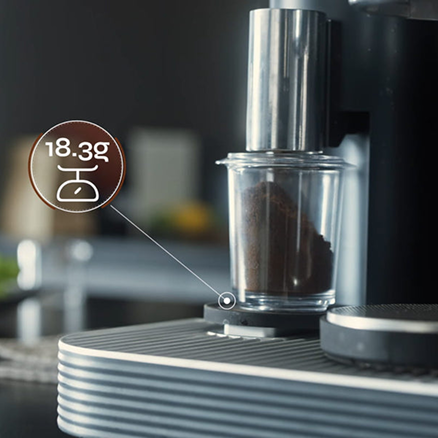
Real-time dose feedback earns the ±0.2 g claim when the grams you see still match the puck you tamp — not when the number only looks precise in a still photo.
Practical takeaway checklist
Answer yes/no before you trust “0.2 g accuracy” copy:
- I am judging spec → cup translation, not rewriting A053’s dose vs yield role map.
- ±0.2 g (or similar) names a stated tolerance + capacity I can re-check live — not a lab certificate.
- The weight display updates in time for me (or auto-stop) to act during grind or brew.
- I lock one dose and one yield before blaming the scale for taste.
- I can separate accuracy limits from technique limits (channeling, distribution, heat, beans).
- Soft-lane A053 for roles; A051 / A052 / A046 for rituals, auto-stop habits, and workflow; ratio explained for taste; how dual scales work for Meraki hardware.
- Mineral scale → water hardness guide; trial / shipping / warranty on policy pages.
Seven or more “yes” answers usually means the claim is earned for weekday use. Four or fewer means pause — you may still be shopping a brochure number.
What is the bar rating on an espresso machine?
Bar rating is pump pressure, not scale accuracy. A “15 bar” or “9 bar” badge does not translate ±0.2 g into the cup.
Many home machines advertise peak pump ratings that are not the same as pressure at the puck during a calm shot. Specialty practice often aims near ~9 bar at the group — Meraki’s live framing uses a commercial rotary pump at steady 9 bar (vendor claim; re-check). Soft-handle only: do not use bar rating as a proxy for scale honesty.
What is the best espresso machine for beginners?
No single “best” — match workflow to how you learn. Beginners usually need clear feedback (including weight) and fewer simultaneous levers — not the loudest accuracy brag.
Honest dose/yield weighing can shorten the learning loop if you look at the numbers and change one variable at a time. Soft-handle only: for path choice (capsule vs super-auto vs all-in-one), use beginner guides and the espresso machine with grinder overview after this translation. This page only owns what ±0.2 g changes once you are already shopping weight-based claims.
FAQ
Does ±0.2 g accuracy change espresso taste by itself? No. It makes dose and yield repeatable enough that taste differences point at grind, puck prep, heat, or beans. Without looking at the number — or with a channeled puck — the tolerance does little. Soft-lane ratio explained for taste language after grams are honest.
Is ±0.2 g “worse” than a 0.1 g mat scale? Not automatically. Resolution and accuracy are different; habits, tare, and real-time feedback matter more than a tenth-of-a-gram forum war. Treat Meraki’s ±0.2 g / 1 kg as a vendor claim to re-check live — we do not invent competitor shootouts. Confirm today’s specs on the Meraki Espresso Machine page.
What is “real-time weight feedback you can act on”? A display (or auto-stop) that updates while grinding or extracting so you can stop, nudge, or accept before the cup is finished. A number that only appears after the shot is a log, not control. Soft-lane A052 for auto-stop habits once feedback is proven.
How is this different from dual-scales role clarity (A053) or grind/brew how-tos? Soft-lane A053 owns which scale does which job. Soft-lane A051 / A052 / A046 own rituals, auto-stop habits, and workflow. This page owns spec translation: ±0.2 g → cup reality, actionable feedback, and accuracy vs technique limits.
Where do I verify Meraki’s ±0.2 g claims and ownership terms? On the live product page and support materials for dual scales, ±0.2 g, 1 kg capacity, and auto-stop framing. For shipping, returns, and warranty, use shipping policy, refund policy, and warranty claim. Press context: Barista Magazine’s Meraki × TIMEMORE test-drive.
If your checklist still points to honest, actionable ±0.2 g-class feedback — and Meraki’s published dual-scale path fits how you shop specs — confirm today’s numbers and terms on the Meraki Espresso Machine product page, then judge the claim by weekday zeros and one locked recipe in your kitchen, not by a silent accuracy brag.


