


Two people, one kitchen, one leave-time — and the second drink is always late. That is what most people mean when they search dual boiler vs single boiler for two drinks. Skip another boiler encyclopedia. Run a stopwatch-style two-drink morning test: one straight espresso plus one milk drink back-to-back, and decide whether the single-boiler wait is tolerable or whether simultaneous brew and steam actually changes who drinks first.
This Meraki comparison owns the scenario test lane for couples and hosts. Soft-link Single Boiler vs Dual Boiler: Which Espresso Machine Fits Your Morning for the broader morning-fit decision; Do You Actually Need a Dual Boiler for the buyer essay; what dual boilers do and which to choose for category framing; single vs thermoblock vs dual for the three-way heat map; why brew-and-steam temperature control matters for heat architecture; and steam power for milk drinks for wand feel. Soft-name a weekday morning routine clock when the open question is one-cup timing — not two-drink sequencing.
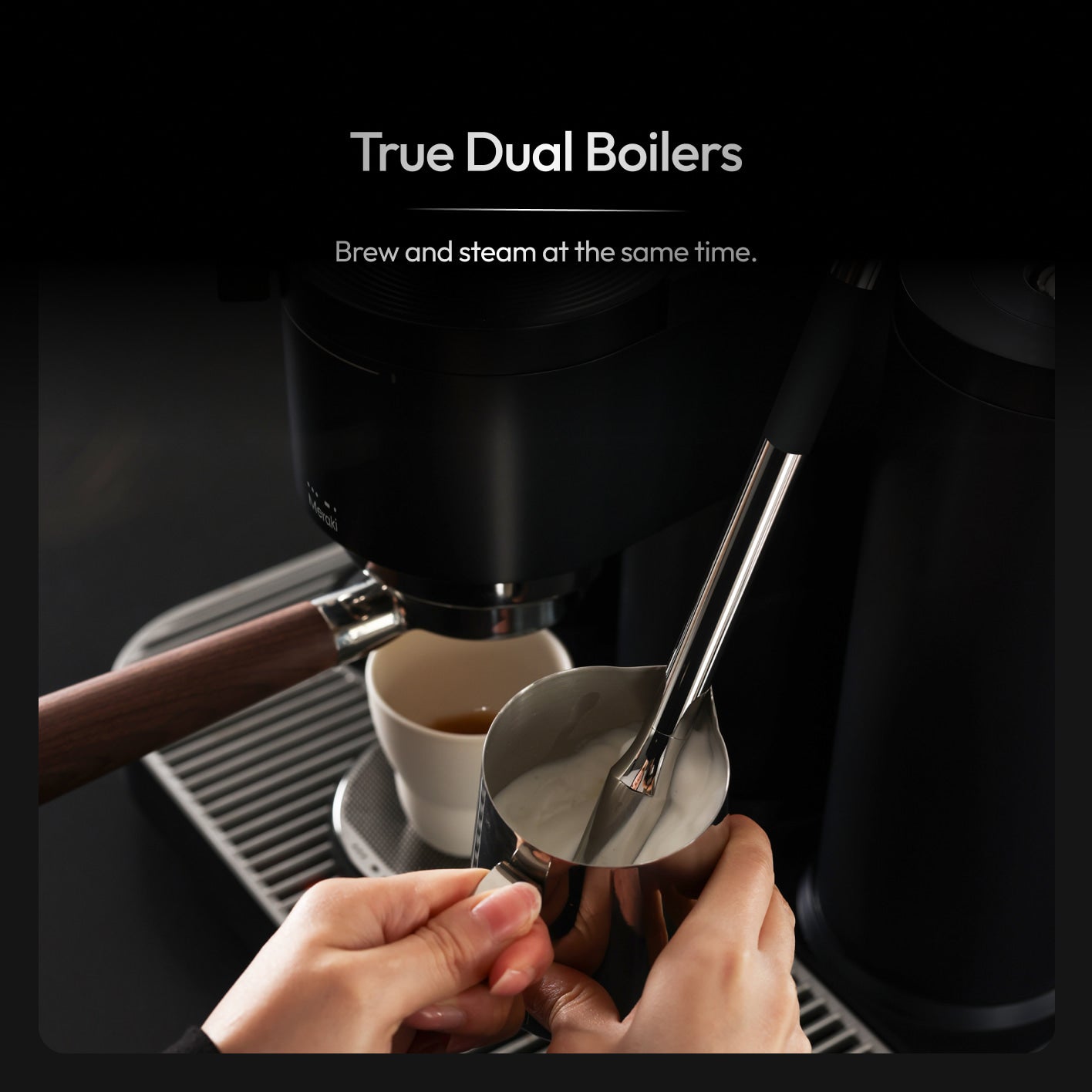
The two-drink morning test is about who waits and who drinks first — not a textbook list of boiler counts.
What “dual boiler vs single boiler for two drinks” really means for home buyers
Dual boiler vs single boiler for two drinks, for couples and hosts, means a timed back-to-back morning — espresso plus milk drink — and whether the second person (or guest) waits on heat recovery, not a glossary of boiler types.
SERP mixes boiler-type explainers, “is dual boiler worth it” essays, Reddit threads about flat whites, and three-way single/HX/dual charts. Useful searchers already know roughly that dual boilers can brew and steam together. What they still lack is a scenario card: who drinks first, who holds an empty mug, how long the single-boiler swing costs, and when that wait is fine.
Category literacy from the Specialty Coffee Association and CoffeeGeek guides still starts with dose, grind, and tasting. Soft-link Meraki’s boiler hubs for architecture; stay here for two drinks on a weekday clock.
Who this page is for (and who should skip it)
This page is for couples and hosts who regularly make two morning drinks — typically one espresso or americano and one latte/cappuccino/flat white — and need to know whether a single-boiler wait fits their leave window.
Skip the morning-fit single vs dual for a general fit essay; do you actually need a dual boiler for buyer psychology; and the three-way heat map, temperature-control, or milk-steam power guides when those lanes own the next click. Soft-name a weekday one-cup routine clock when only one person drinks before work. Come here for: stopwatch two-drink sequencing — who waits, who drinks first, heat recovery.
Why this is a scenario test (not a boiler textbook)
This article is published by Meraki. The unique job is a scenario test: time one espresso + one milk drink back-to-back on a realistic weekday, then decide when single-boiler wait is acceptable versus when simultaneous brew/steam changes household peace.
That is not a boiler encyclopedia, not a “do you need dual” buyer essay, not a thermoblock three-way, and not a temperature-stability lab. Soft-link those live Meraki posts when their lane owns the next question; keep this page for the two-drink morning card.
Disclosure: Meraki sells the Meraki Espresso Machine — dual boilers, rotary pump framed near steady 9 bar, built-in dual scales (±0.2 g), TIMEMORE® co-developed grinder, guided touchscreen. Live framing (2026-10-26/27): heat-up about 3–4 minutes; brew and steam together. Re-check the dual-boiler page before treating numbers as permanent. No invented German Design / Red Dot claims here.
Decision criteria that change the outcome
Five criteria decide most dual boiler vs single boiler for two drinks outcomes. Brochure boiler counts only help after these are honest.
| Criterion | What to ask on a two-drink morning | Why it changes the call |
|---|---|---|
| Drink mix | Espresso + milk, two milks, or two black drinks? | Milk is where single-boiler waits hurt most |
| Leave window | How many minutes after “machine ready” until someone must walk out? | A 90-second swing is fine at 8:00, fatal at 7:52 |
| Who drinks first | Can one person accept a cooler or later cup? | Household fairness beats brochure simultaneity |
| Heat recovery | After brew→steam (or steam→brew), how long until the next brew-ready state? | Recovery is the hidden tax on drink two |
| Host load | Weekday couple only, or weekend guests too? | Host mornings multiply the same wait |
If both drinks are black and a one-minute stagger is fine, dual boilers are often overkill for two drinks alone. If one latte and one espresso must share a tight leave window — and someone will not wait every Tuesday — simultaneous brew and steam wins. Soft-link do you need a dual boiler when the doubt is still “is dual ever worth it”; stay here when two drinks already constrain the clock. Timing both cups is a measurement habit as much as a hardware habit — NIST is a reminder that trust grows when you can re-check a result (here: a phone stopwatch), not when a brochure asserts “faster mornings.”
Side-by-side: the stopwatch two-drink morning card
Run the same card on paper once. Times below are illustrative home ranges, not lab certificates — water, milk volume, and skill move the needle. The point is relative sequencing, not a promise that every kitchen matches the clock.
Scenario card — Couple / host morning
- Drink A: double espresso (or americano built on it)
- Drink B: one milk drink (latte / cappuccino / flat white)
- Goal: both drinks drinkable before leave time
- Constraint: one machine, one operator (or one person prepping while the other dresses)
| Phase | Single-boiler path (typical) | Dual-boiler path (typical) | Who waits? |
|---|---|---|---|
| Heat to ready | One boiler to brew temp | Brew + steam sides to ready (~3–4 min on Meraki’s live FAQ) | Both paths: use heat window for non-coffee tasks |
| Drink A brew | Pull espresso | Pull espresso | — |
| Switch / recovery | Raise to steam temp (often ~30–90+ s depending on machine and volume) | Steam side already ready — no brew→steam flip | Single: milk drinker waits; dual: overlap possible |
| Drink B milk | Steam after recovery | Steam while Drink A finishes or immediately after | Dual: overlap; single: serial |
| Optional second brew | Cool/return toward brew temp before another shot | Brew boiler stays near brew range | Single: second espresso waits; dual: shorter gap |
| Serve | Drink A may sit cooling while you steam | Cups can land closer together | Fairness gap shows up here |
On a single boiler, the honest story is serial work: brew, wait for steam, steam, then often wait again before a second brew. On a dual boiler, the story is overlap: brew and steam can share the clock. Soft-link what dual boilers do for architecture; soft-link temperature control when the doubt is heat stability, not sequencing. NCA brewing basics and About Coffee brewing still assume a clean, repeatable method — the two-drink test adds fairness: does Drink A cool while Drink B’s milk heats?
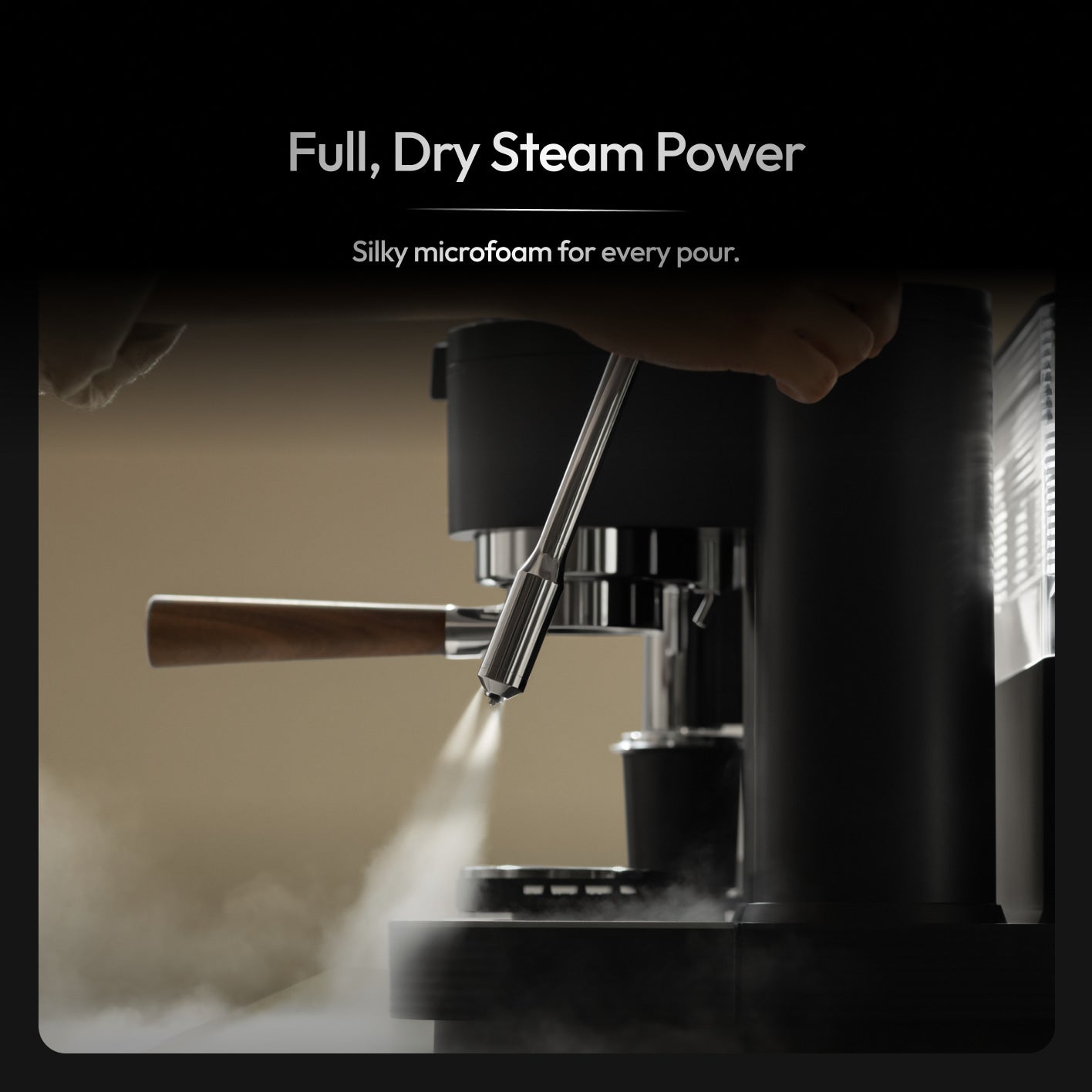
Milk is where the two-drink clock breaks — dual boilers remove the brew-to-steam handoff wait.
Milk drinks, noise, and heat-up: daily-life differences
Milk drinks expose dual boiler vs single boiler for two drinks faster than two black espressos. One boiler must flip from brew to steam; two boilers keep both jobs ready. Soft-link steam power for milk drinks for wand feel — this section only asks whether the handoff wait fits your leave window.
Heat-up is separate from recovery. Meraki’s live FAQ frames dual-boiler heat-up around 3–4 minutes. Many single boilers hit first brew faster on paper, then charge you when steam mode arrives. Optimize time to two cups in hand, not time-to-first-drip. Soft-name a weekday one-cup routine clock when only Drink A matters on workdays. Noise varies by pump, steam, and grinder SKU — Meraki frames a commercial rotary pump as relatively quiet in marketing; treat that as directional and judge in a trial. Barista Magazine still treats consistency under time pressure as the busy-service skill; at home that means both cups before the bag is zipped.
Space, maintenance, and learning curve
Dual boilers usually mean more mass and a bigger footprint than a compact single boiler. Soft-link Meraki’s dual-boiler page for the all-in-one framing; a modular dual-boiler bar with a separate grinder can grow wider. If the counter cannot hold the station, the stopwatch test never starts.
Maintenance scales with milk: wand purge, wipe, and periodic deeper cleans either way. Dual boilers add a second heat system to keep healthy; they do not invent a new cleaning religion. FDA safe food-handling habits still apply around hot groups and leftover milk. Learning curve is sequencing: single-boiler owners learn mode flips; dual-boiler owners learn mise en place so overlap is not “espresso dying while you hunt the pitcher.” Soft-link the three-way heat map if you still need single vs thermoblock vs dual before timing two drinks.
When Meraki (dual boiler) is the better fit
Choose a dual-boiler path — and Meraki’s guided station when an all-in-one fits — when the stopwatch card fails on fairness or leave time.
Typical yes signals: milk most weekdays; Drink A cools during steam wait; a partner or guest expects two drinks in one short window; you want brew and steam without mode flipping; you want built-in dose/yield weighing so drink two is not a guess. Meraki’s framing: dual boilers, simultaneous brew/steam, ~3–4 minute heat-up, ±0.2 g dual scales, TIMEMORE® co-developed grinder on one guided path — confirm on the live product and dual-boiler pages. Score Meraki on the same card as any dual boiler after a fair trial. Soft-link do you need a dual boiler if you still need permission to buy dual; use this page when two drinks already proved the wait.
When the single-boiler alternative is enough
A single boiler is often enough when the two-drink morning is flexible: both drinks black, or milk weekend-only; one person drinks first while the other accepts a short wait; the leave window has a few quiet minutes after brew; budget and counter favor a smaller chassis; you are not hosting back-to-back milk drinks. Community advice for 1–2 coffees with occasional milk can still be right.
“Enough” is not forever. If a roommate, schedule, or guest habit turns every morning into two milks, re-run the stopwatch card before you blame the beans. Soft-link morning-fit single vs dual for the broader fit essay; soft-link steam power if texture — not wait time — is the complaint.
A practical choose-in-10-minutes checklist
Answer yes/no in your own words before you upgrade boilers for two drinks:
- We regularly need two drinks in one weekday leave window — not just on Sundays.
- At least one drink is a milk drink most days.
- On a phone timer, Drink A sits more than about a minute while we wait for steam (or the second brew).
- Someone in the household cares who drinks first — fairness matters.
- Our counter and budget can hold a dual-boiler station we will actually clean.
- We already checked trial / warranty / voltage for the market we buy in.
- We soft-linked Meraki’s boiler hubs instead of re-reading every architecture essay.
Three or more “yes” on the first five rows usually push toward dual boilers. Mostly “no” means keep a capable single boiler and protect the leave window with staging — water filled, pitcher ready, one known recipe — the habit soft-named in a weekday one-cup routine clock.
What are the key differences between single boiler and double boiler espresso machines?
Single boilers use one heat system for brew and steam in turn; dual (double) boilers keep separate brew and steam heat so you can overlap drinks.
In the two-drink test, that shows up as wait vs overlap: single-boiler paths serialize brew→steam→(optional) brew again; dual-boiler paths can pull espresso while steaming. Soft-link what dual boilers do and the three-way heat map for architecture; this page only needs the sequencing consequence.
What is a dual purpose boiler?
A “dual purpose” (or dual-use) boiler usually means one boiler that handles both brewing and steaming by changing temperature or mode — not two separate boilers.
Marketing language sometimes blurs “dual purpose” with “dual boiler.” For your stopwatch card, ask whether brew and steam can run at the same time. If the machine must flip modes, treat it like a single-boiler path for two-drink timing — even if the brochure says dual-purpose. Soft-link temperature control when you need the heat-engineering story behind true dual boilers.
Conclusion
Run the two-drink morning test once with a phone timer. If espresso plus milk lands fairly inside your leave window on a single boiler, keep the simpler path. If Drink A cools while steam recovers — or a partner/guest always waits — dual boilers earn keep through overlap, not a longer brochure. Soft-link Meraki’s boiler hubs for architecture; soft-name a weekday one-cup routine when only one drink is on the clock. Decide with the stopwatch.
For Meraki’s dual-boiler, brew-and-steam path, start at the dual-boiler espresso machine page — then confirm heat-up, trial, and warranty the day you buy. Support: +1 833 854 9555, Mon–Fri 9 AM–5 PM EST, or support.
FAQ
Do I need a dual boiler if we only make two drinks on weekends? Usually no. If weekday mornings are one cup (or staggered black drinks) and weekend milk drinks have a relaxed clock, a capable single boiler plus good staging is often enough. Re-run the stopwatch card if weekends become every-morning two milks or guests expect café pace. Soft-link Meraki’s “do you need dual” essay when the doubt is still philosophical; use this page when timing already failed once.
Can a single boiler make a latte and an espresso back-to-back? Yes — in series. Brew the espresso, wait for steam temperature, steam milk, then optionally return toward brew temp for a second shot. The cups can taste fine; the question is whether Drink A sits too long and whether your leave window survives the recovery gaps.
Does dual boiler always mean both drinks finish at the same second? No. Dual boilers make overlap possible; mise en place and skill decide whether cups land together. Empty pitcher drawers and cold groups still waste dual-boiler hardware. Soft-link Meraki’s steam-power guide when texture — not boiler count — is the miss.
Is a heat exchanger the same as a dual boiler for this test? No. Heat-exchanger machines can often brew and steam together via a different heat design, but they are not two independent boilers. This article compares single-boiler serial waits to dual-boiler overlap. Soft-link the three-way single/thermoblock/dual map when HX is still on your shortlist — do not treat HX as identical to dual for temperature behavior.
What should we time on the phone, exactly? From “machine ready” to “both drinks in hand,” including any brew→steam wait and any second-brew recovery. Ignore time-to-first-drip alone. Note who drank first and whether either cup sat cooling. That single card decides dual boiler vs single boiler for two drinks better than another feature table.
More on this topic: Espresso Machine Boilers, Pumps & Controls.


