


You are staring at a four-figure home espresso machine and asking a sharper question than “is it luxury”: what does a high end espresso machine for home budgets actually buy — thermal stability, usable steam, durable build, serviceability, and measurement — versus chrome, menu names, and brochure pressure numbers.
This Meraki guide defines value components for premium home espresso. It is not a “best high-end” ranking, and it is not a Meraki-only worth-it rewrite. For model selection framing, use what is the best high-end espresso machine. For Meraki-specific buy/don’t-buy filters, use our draft-era companion worth-it decision guide and the itemized value breakdown. Use this page to decide whether the premium band is even the right band.

Black Meraki Espresso Machine — a premium all-in-one example; judge the category by cup-relevant systems, not chrome.
What “high end espresso machine for home budgets” really means for home buyers
“High end” on a shopping tab rarely means the same thing as “high end” in a kitchen. For home buyers, the phrase usually collapses five different purchases: a more stable brew path, stronger and more consistent steam, a grinder that can hold espresso settings, a way to measure dose and yield, and ownership terms that make a four-figure mistake recoverable.
A machine can look expensive and still miss the systems that change the cup. Polished panels, a long drink menu, and a loud “15 bar” badge do not stabilize temperature, dry steam, or shot weight. Specialty coffee training materials from the Specialty Coffee Association keep returning to extraction control — grind, dose, yield, time, and temperature — not to vanity finish.
Treat the keyword as a budget definition problem. A high-end home budget should buy fewer wasted mornings and clearer ownership risk — not a prettier box that still needs a separate grinder, scale, and guesswork.
Who this page is for (and who should skip it)
This page is for premium shoppers who already suspect they are in the dual-boiler / prosumer neighborhood and want a plain list of what the money should purchase before they compare stickers. Gift buyers who need language for “why this costs more than a capsule machine” belong here too.
Skip it — and probably skip the high-end band — if you want one-button capsule convenience, brew espresso twice a month, or cannot protect a bean and water-care budget after checkout. Also skip if you still need a definition of prosumer hardware; start with what is a prosumer espresso machine, then return. For sticker bands under roughly $2,000 framed as total cost, use the under $2,000 total-cost guide and the espresso machine under $2000 landing page.
Why this page defines high-end value (not another “best luxury” list)
Search results for “high end espresso machine for home budgets” skew toward best-of roundups, lifestyle luxury lists, and store collection pages. Those pages sell winners. This page sells a vocabulary for paying correctly.
The unique job here is value definition versus vague luxury: name the systems that justify a premium at home, separate them from vanity spend, show when the premium is overkill, and give a short checklist you can reuse on any brand — including Meraki. Disclosure: Meraki publishes this guide and sells the Meraki Espresso Machine. We will use Meraki as one all-in-one example of integrated systems. We will not invent competitor prices or publish a ranked “top 10 luxury” list.
If you wanted itemized Meraki-versus-separate-station math, that lives on the value breakdown. If you wanted smart-feature premium reality checks, use is a smart espresso machine worth the premium. If you wanted the dial-in tax of traditional modular prosumer stations, use hidden costs of traditional prosumer espresso. Stay here for the category definition of what high-end money should buy.
Must-have checks before you compare prices
Price comparison without a value map produces fake savings. A bare dual-boiler chassis can look cheaper than an all-in-one until you add a capable grinder, a tenth-gram scale, week-one tools, and the time tax of juggling them.
Before you compare dollar amounts, lock six items: (1) brew and steam architecture for your drink profile; (2) pressure story that names pump type and regulation intent, not only a peak bar number; (3) how you will weigh dose and yield; (4) whether grinding is in the box or still on your shopping list; (5) service path and warranty geography; (6) trial or return terms if fit is wrong. Meraki’s current framing includes free shipping on orders over $200, a 30-day home trial from delivery, and a 2-year limited warranty — re-read live shipping, refund, and warranty pages before treating those as locked.
Promotional kits change. As of October 26–27, 2026, Meraki was promoting a current ~$210 upgrader / gift kit with the machine (current offer, not permanent pricing). Confirm the live product page. Compare cost per drinkable morning for your cup count, not cost per chrome highlight.
Specs that matter in the cup (and vanity specs to ignore)
In the cup, a short list beats brochure length. High-end money that earns its keep usually buys five systems: thermal stability you can feel across back-to-back shots, steam that textures milk without a long single-boiler wait, a pump path held near a steady espresso pressure rather than a marketing peak, measurement tight enough that dose and yield errors shrink, and a build / service story that keeps the machine usable years later.
| Value component | What you are paying for | Vanity twin to discount |
|---|---|---|
| Thermal path | Stable brew temperature; separate steam when milk is daily | “Café look” panels with no heat story |
| Steam | Usable texture and recovery for your household volume | Wand count or “powerful” with no workflow |
| Pressure control | Steady espresso-range pressure (often ~9 bar intent) | Highest “15 bar” badge without regulation |
| Measurement | Repeatable dose and yield (scales near ±0.1–0.2 g help) | Fancy menus that never weigh the shot |
| Integration / service | Grinder fit, parts path, warranty geography, trial | Award logos used instead of tasting |
For mornings: dual boilers mean espresso and milk in one sequence for milk-drink homes — see Meraki’s dual boiler hub for architecture context. A rotary pump held near a steady 9 bar is about pressure stability, not a higher bragging number. Dual scales near ±0.2 g matter because small dose errors turn good beans sour or bitter fast — NIST is a reminder that measurement earns trust; you need kitchen repeatability, not a metrology lab. Category education from SCA research beats any single badge.
Discount vanity pressure peaks, endless drink-name lists that do not change extraction, and award logos used instead of tasting. Meraki’s iF Gold Design Award 2025 claim (site claim) signals design intent, not day-one dial-in. Broader iF program context: ifawards.com.
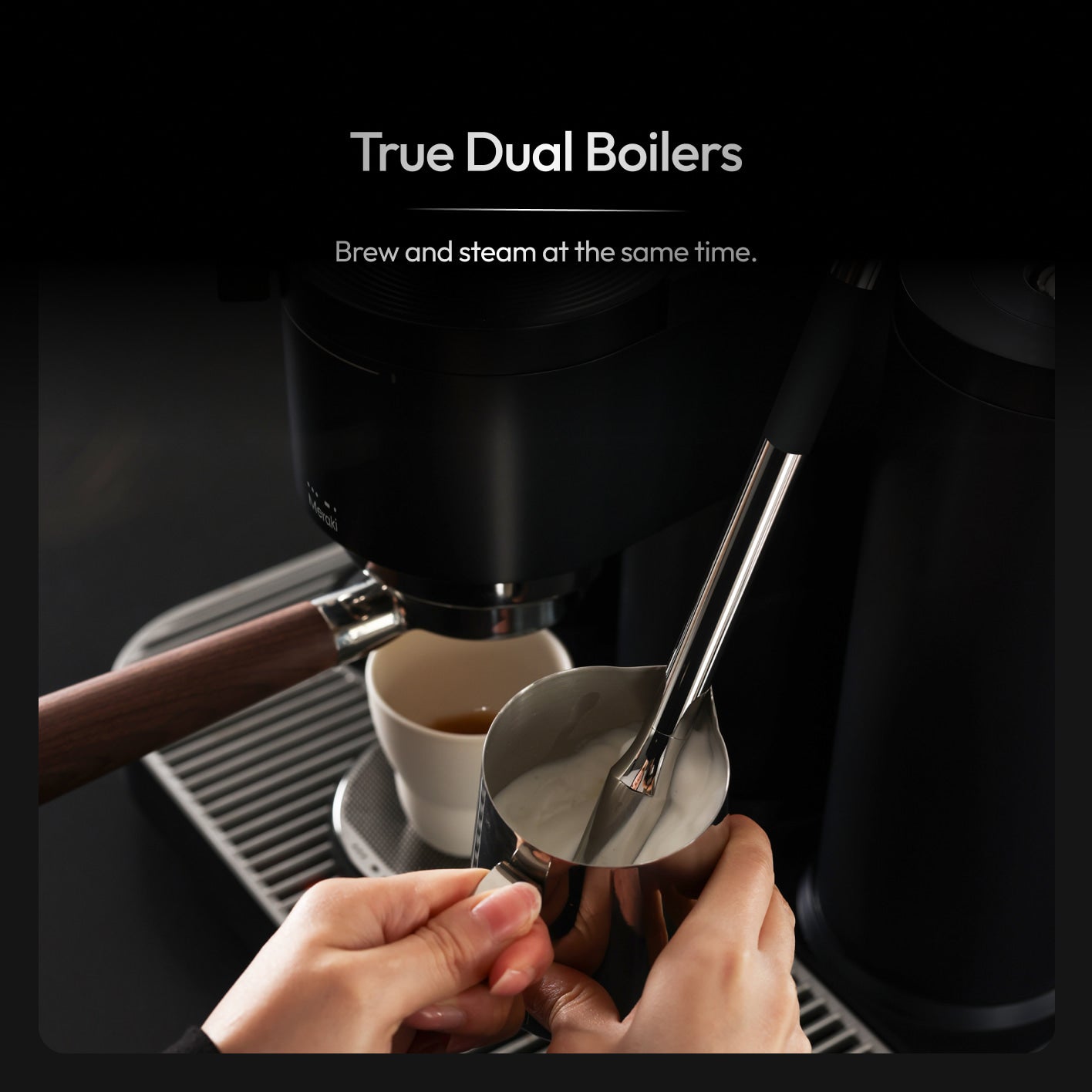
Dual boilers — a cup-relevant high-end spend for milk-drink households; confirm architecture on the live listing.
When high-end spending is overkill at home
High-end is overkill when the systems you would pay for never meet your real week. If you mostly want a fast hot milk drink and will not weigh shots, a simpler machine plus good beans often beats a financed flagship. If you already own a premium grinder you refuse to replace, an all-in-one that forces a second grinder can be waste — modular may fit better. If espresso is a weekend hobby, the premium amortizes slowly; a mid-band station can be the honest buy.
Overkill also shows up as duplicate spend: buying “pro” chrome and still needing every accessory the listing quietly excluded; or paying for smart menus you will ignore while skipping the scale that would have saved beans. For smart-feature premiums specifically, use the smart premium reality check. For price-tier orientation without a luxury list, skim espresso machine price tiers explained.
The test is blunt: name the weekday morning that improves if you pay more. If you cannot name one, the high-end band is advertising, not a need.
Setup, shipping, trial, and warranty questions to ask
Ask ownership questions marketing pages bury. A high-end purchase without a clean exit or service path carries a hidden risk premium even when day-three espresso tastes good.
Meraki’s shipping policy states orders are typically processed within about three business days, with free shipping on orders over $200 except where remote surcharges apply — confirm your address. The 30-day home trial starts on delivery; returns need approval, cleaning, original accessories, and packaging. For approved non-DOA U.S. returns, the refund policy lists a return shipping fee deducted from the refund (U.S. fee listed at $100 when checked October 26–27, 2026 — confirm the live table). That fee is part of total cost if you reverse the decision.
Meraki describes a 2-year limited warranty from delivery in the country of original purchase, with prepaid return shipping for approved claims — see warranty claim. Support: +1 833 854 9555 (Mon–Fri, 9 AM–5 PM EST) via support. Electrical safety and listing credibility matter at this price — appliance safety context from UL and consumer product safety basics from the CPSC are worth a glance before you trust a no-name import with no service map.
Budget and total cost of ownership
Sticker price is a down payment on a coffee habit. High-end TCO usually includes the machine and missing tools; beans; water filtration if your tap is hard; cleaner; electricity (modest next to beans — see energy.gov); dial-in time; and the exit cost if you reverse the purchase.
| Cost bucket | What to include | Why it changes “high end” value |
|---|---|---|
| Machine + missing tools | Current offer price; grinder/scale/tools still required | Incomplete stations look cheaper until week two |
| Consumables / year | Beans × your drink count; filters; cleaner | High-use homes amortize premiums faster |
| Risk / exit | Trial return shipping fee; service downtime | Lowers value if fit is uncertain |
| Time | Dial-in; wipe-down; descaling | Busy households pay in minutes |
As of October 26–27, 2026, Meraki listed $1,999 with a $1,799 offer on the U.S. product page — re-check the product page before you treat those numbers as live. Same-window on-site signals: ~530 verified reviews, 4.9/5 on key pages, 20,000+ machines / users messaging. Useful proof, not a substitute for your mornings. Independent press context includes Barista Magazine’s Meraki × TIMEMORE test-drive. Practical gear writing on CoffeeGeek’s guides helps separate skill problems from hardware gaps.
Daily brewing spreads the premium; twice-monthly use keeps it large per cup. Paying “high end” only for finish while underfunding beans is the classic inverted budget.
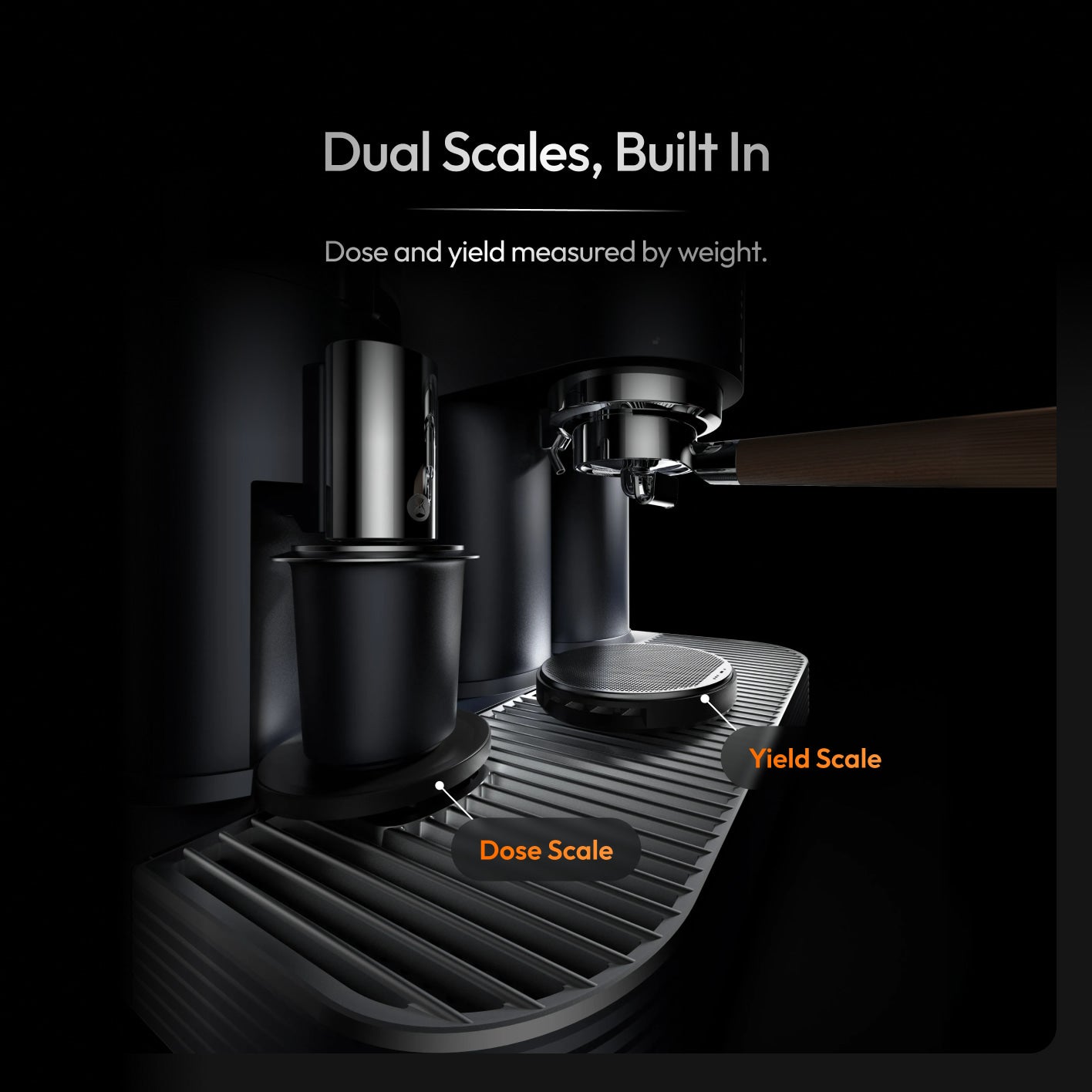
Built-in dual scales — measurement is a high-end spend that changes every cup when you use it.
Red flags in product listings and reviews
Watch for all-in-one prices compared to bare dual boilers without grinder and scale; “commercial pressure” claims with no pump or regulation story; luxury adjectives with no thermal or steam detail; and roundups that hide affiliates or recycle uncredited copy.
Prefer review patterns over single glowing or furious posts — steaming, workflow friction, support response, and whether owners still weigh after week one. Meraki collects feedback on the reviews page; read primary sources when blogs summarize forums, and remember forums amplify extremes.
Be wary of no-name machines with no service path at four-figure prices. If a page hides return fees, warranty exclusions, or what is not in the box, assume the missing line is your surprise cost. “Luxury” without a parts and warranty geography story is branding, not value.
A short buyer checklist you can save
Answer yes/no in your own words before you treat a machine as high-end for you:
- I can name the weekday morning that improves if I pay more (milk waits, shot consistency, or footprint clutter).
- Dual boilers or equivalent brew+steam capacity would change my drink profile — not just look impressive.
- I will weigh dose and yield, or the machine forces that habit.
- Grinding is solved in the purchase or I already own a grinder I will keep — I am not pretending otherwise.
- My budget still has room for beans, water care, and cleaner after the machine.
- I have read live shipping, refund, and warranty pages, including any return shipping fee.
- I compared complete stations (machine + grinder + scale + tools), not chrome versus chrome.
- I know who services the machine where I live and what proof of purchase to keep.
- If this is a gift, the recipient wants to learn espresso — not press one button forever.
- I am not buying awards, menu names, or peak bar numbers as substitutes for the systems above.
Six or more clear “yes” answers usually means the high-end band can be rational. Three or fewer means stay mid-band, go modular carefully, or wait.
Next step: verify on the product page
Open the espresso machine under $2000 page for Meraki’s current under-$2,000 framing, then confirm today’s price, tools, gift offer, trial language, and warranty highlights on the live Meraki Espresso Machine product page. Re-check fee tables on the policy pages above. Use the value-component table in this article on any competing listing the same day — same criteria both ways.

White Meraki Espresso Machine — confirm current finishes, inclusions, and terms on the live product page.
What is the best value-for-money espresso machine?
The best value is the complete station that fits your week.
Value-for-money is not the cheapest chassis and not the most expensive badge. It is the setup — machine, grinder path, measurement, and ownership terms — that produces drinks you will actually make, at a total cost you can sustain, with an exit ramp if fit is wrong.
For many milk-drink homes that want one footprint, an integrated dual-boiler with scales can beat a “cheaper” bare machine plus forgotten tools. For tinkerers who already own a great grinder, modular can win. Re-run the value-component table with your mornings before you trust any roundup’s #1.
How long do coffee makers typically last?
Often several years with care; espresso wear varies.
Consumer drip makers and capsule machines often last multiple years with descaling and normal use; failure modes differ by brand and water hardness. Semi-automatic and prosumer espresso machines are more sensitive to scale, gasket wear, and pump stress — lifespan tracks maintenance and water quality more than the word “high end” on the box.
Treat manufacturer warranty length as a minimum service commitment, not a predicted lifespan. Keep proof of purchase, follow water guidance, and budget cleaner. A premium machine neglected on hard water can fail sooner than a simpler machine that is descaled on schedule.
Are more expensive espresso machines worth it?
Only when they buy systems you will use.
More expensive is worth it when the premium purchases thermal stability, steam capacity, measurement, grinding, or service terms that change your real mornings. It is not worth it when the premium buys finish, menu theater, or a peak pressure number you cannot taste. Run the overkill test and the checklist above; expensive without a named weekday benefit is just expensive.
FAQ
What makes an espresso machine “high end” at home? At home, high end should mean cup-relevant systems: stable brew temperature, usable steam for your milk volume, controlled espresso-range pressure, a path to weigh dose and yield, and a serviceable build with clear warranty geography. Finish and drink-name lists are optional. If a listing cannot explain those systems in plain language, treat “luxury” as marketing until proven otherwise.
Is a luxury espresso machine the same as a prosumer machine? Not always. “Luxury” is a marketing and price-band word. “Prosumer” usually points at home machines with café-inspired architecture — dual boilers or strong heat-exchange designs, serious steam, and manual or semi-automatic control. Some luxury products are prosumer; some are expensive automatics. Match architecture to your drinks, then read what is a prosumer espresso machine if you need the category map.
What is the best professional home espresso machine? There is no single best. “Professional home” usually means commercial-inspired heat and steam in a kitchen footprint. The right pick depends on milk frequency, whether you want integrated grinding and scales, counter space, and service access where you live. Use the value-component checklist on this page, then verify live listings — including Meraki’s under $2000 framing if that band matches your budget.
How should I budget beans after a high-end machine? Protect the bean line before you stretch the machine line. A common failure mode is spending the monthly coffee budget on hardware finance while buying stale supermarket beans that hide what the machine can do. After you know the machine’s all-in number (including any return-risk fee), set a realistic weekly bean spend you will keep for at least the trial window.
Where do Meraki’s current price and offers fit this framework? As of October 26–27, 2026, Meraki’s U.S. product page showed a $1,999 reference price and a $1,799 offer, plus a current promotional gift / upgrader kit framed around roughly $210 in value. Offers change; confirm the live page. Score Meraki on the same value components as any other brand: dual boilers, rotary-pump espresso near steady 9 bar, ±0.2 g dual scales, TIMEMORE® co-developed grinder, trial and 2-year limited warranty — then decide with your mornings, not our adjectives.
If your checklist still points to premium systems rather than vanity finish, confirm today’s inclusions and terms on the Meraki Espresso Machine product page — then spend high-end money only on what you will taste and use.
More on this topic: Espresso Machine Types & Upgrades.


