


You left a café with a flat white that tasted dialed — and now you are shopping for a cafe quality espresso machine at home that promises the same cup without the line. The hard question is not “can home gear look café-like?” It is which cafe quality espresso machine at home tradeoffs you will actually live with: taste ceiling versus counter space, noise, heat-up time, learning curve, milk volume, and bean freshness.
This Meraki guide is a tradeoff matrix, not hype. It is for café-to-home converters who need an honest expectation contract before checkout. It is not a recipe page (see Meraki’s Café Cubano guide if that is what you wanted). It is not a product landing rewrite of café-quality home espresso. It is not a “commercial-grade” label decoder — that job lives on what commercial-grade really means and the commercial-grade home guide. And it is not another high-end budget definition (see our companion draft on what premium money buys) or a Meraki-only worth-it scorecard.

A café-looking machine on a home counter still trades space, noise, heat-up, and habit for the cup you want — judge the whole morning, not the brochure.
What “cafe quality espresso machine at home tradeoffs” really means for home buyers
“Cafe quality espresso machine at home tradeoffs” in search usually surfaces best-of lists, lifestyle coffee-bar galleries, and budget roundups that treat “café quality” as a badge you can buy in one click. For a café-to-home converter, the phrase means something narrower: which daily costs — space, sound, time, skill, milk throughput, and bean discipline — am I accepting in exchange for espresso that feels café-close on a weekday?
In plain buyer language, “café quality at home” is a system outcome, not a sticker. Specialty coffee training materials from the Specialty Coffee Association keep returning to extraction control — grind, dose, yield, time, and temperature — plus milk skill when drinks are milk-based. A machine can host that system. It cannot erase thin floors, stale beans, or a household that will not weigh shots.
Treat the keyword as an expectation contract. Hardware that looks commercial-adjacent can raise your ceiling. Your kitchen still sets the floor.
Who this page is for (and who should skip it)
This page is for people who already like café espresso (or milk drinks) and are deciding whether a serious home station will fit their real mornings — not only their Pinterest counter.
Skip it if you want a home-vs-café capability map (what pro gear still does that home gear cannot) — start with home vs café espresso machines. Skip a definition of home barista machines — use what a home barista espresso machine is. Skip apartment noise depth — Meraki’s realistic noise expectations owns that chapter. Skip commercial-grade label literacy — use the commercial-grade pages linked above. Skip high-end value components (thermal path, vanity specs, TCO buckets) if that is your only question — that is a different buying-guide job. Come here when the question is: what am I trading away to chase café-close cups at home?
Why this is a tradeoff matrix (not another cafe-quality hype page)
Search results for café-quality home espresso skew toward winner lists, beautiful coffee-bar aesthetics, and landing pages that promise café results without naming the household costs. Meraki’s own café-quality landing page already sells the integrated system story. That page’s job is product framing. This page’s job is buyer honesty.
The unique contribution here is a tradeoff matrix: taste ceiling versus space, noise, heat-up, learning, milk volume, and bean freshness — plus weekday workflow, listing checks, mistakes, and a go/no-go checklist. Disclosure: Meraki publishes this guide and sells the Meraki Espresso Machine. We will use Meraki as one verified all-in-one example (dual boilers, commercial rotary pump held near steady 9 bar, built-in dual scales near ±0.2 g, guided workflow — product claims checked against Meraki’s live pages for this project’s 2026-10-26/27 snapshot). We will not invent lab taste scores, competitor rankings, or “café quality guaranteed” language.
Core idea in plain language
Café-close espresso at home is realistic when three things line up: hardware that can hold brew and steam with weekday stability, a measurement habit (dose and yield), and beans fresh enough that the machine is not chasing a ghost.
It is not realistic as a guarantee printed on a box. A café has a trained barista, a commercial duty cycle, often a dedicated grinder station, and a bean program refreshed on purpose. Your kitchen has neighbors, a shared counter, a commute, and a fridge full of yesterday’s open bag. Home gear can close much of the gap on control — dual boilers for milk mornings, a steadier pump path, scales that make recipes repeatable — while the café still wins on throughput, service cadence, and someone else cleaning the steam tip.
Think in ceilings and floors. Hardware raises the ceiling when thermal stability, regulated brew pressure near ~9 bar, and weighable recipes cut random sour/bitter swings. Your floor is habits the brochure cannot ship: distribution, a clean steam tip, roast dates, and a counter that does not send vibration into a shared wall. The Specialty Coffee Association treats espresso as controlled extraction — not a logo on stainless steel.
So the honest core idea is conditional: café quality at home is a ceiling you can approach on good days, not a floor you buy once. When Meraki’s café-quality framing says café hardware in a home footprint, read it as capability plus workflow support — then run the matrix below against your mornings.
How it shows up in a weekday workflow
Tradeoffs are not abstract. They show up between the alarm and the first sip.
A café morning for you used to be: order, wait, leave. A home café morning is: warm-up, grind, dose, distribute, tamp, brew, steam, wipe, knock out the puck. Dual-boiler machines shrink the “wait for steam” tax that single-boiler homes feel hardest — Meraki’s dual boiler hub frames that architecture. Meraki’s product story also describes a guided path from power-on toward a latte in about five minutes, with dual boilers heating in roughly three to four minutes (site claim; confirm the live product page). That helps. It does not delete grinder noise, steam hiss, or the two minutes you spend cleaning if you want the wand ready tomorrow.
Map the minutes honestly: warm-up is waiting (fine if boilers start while you prep elsewhere; painful if you expected capsule speed); grinding is usually the loudest short burst; extraction is where an honest rotary claim can feel calmer than a harsh vibratory buzz; steaming is hiss plus technique; cleanup is the unpaid barista shift. Electricity for warm-up is usually modest next to beans (energy.gov is a sizing reminder, not a scare).
Weekday reality also includes who else is awake. Meraki’s noise expectations map pump vs grind vs steam; if your café habit was two milk drinks before 7 a.m., the tradeoff is household tolerance for the full sequence — thin floors included — not whether the wand can steam.
Measurement changes the weekday too. Built-in dual scales near ±0.2 g (Meraki product claim, 2026-10-26/27 snapshot) turn “a bit more / a bit less” into a repeatable recipe — and ask you to care about grams before caffeine. CoffeeGeek’s guides and SCA research beat any morning that treats the machine as a magic button. If you will skip weighing forever, buy for convenience — not café-close extraction control.
What to verify on the machine or listing
Before you trust “café quality,” expand the brochure into checks you can fail.
Verify architecture for your drink: dual boilers (or another honest simultaneous brew-and-steam story) if milk drinks are daily; a single heat path if you mostly drink straight espresso and accept waits. Verify pressure language: regulated / steady near ~9 bar with a named pump type beats a lonely “15 bar” peak — Meraki lists a commercial rotary pump held near steady 9 bar on the product page (snapshot). Verify measurement: built-in or required separate scales; if the listing never mentions weighing, your café-close cup depends on luck. Verify grinding: integrated burr path or a separate grinder still on your bill. Verify footprint and weight against a measured counter pad, including clearance for the portafilter and steam wand. Verify ownership exits: trial start date, return shipping, warranty geography — Meraki frames a 30-day home trial from delivery, a 2-year limited warranty, and free shipping on orders over $200 (confirm live shipping, refund, and warranty pages). As of the 2026-10-26/27 snapshot, approved non-DOA U.S. returns listed a $100 return-shipping deduction — price that if fit is uncertain.
Also verify beans and water even when the cart page stays silent — café-close cups assume freshness and water that will not wreck boilers; neither is free. As of the 2026-10-26/27 snapshot, Meraki’s U.S. product framing showed $1,999 list / $1,799 offer and a current ~$210 upgrader / gift kit (current offer; gifts may ship separately) — re-check the live product page. Same-window on-site signals (~530 verified reviews, 4.9/5, 20,000+ machines / users framing) are social proof, not a matrix substitute.
Ignore vanity twins: café menu names without dose/yield control, chrome without a heat story, and “commercial” adjectives with no pump, boiler, or service map. UL and CPSC literacy helps filter no-name imports with no service path. If a listing shouts “quiet” without naming grind vs brew vs steam, treat the claim as incomplete.
Tradeoffs and limits
This is the section that should decide your cart — not the prettiest lifestyle photo.
| What you want from “café quality” | What you usually gain at home | What you usually trade away | When the tradeoff is worth it |
|---|---|---|---|
| Taste ceiling / shot consistency | Stable heat path, steadier brew pressure, weighable dose & yield | Time to dial in; attention to grind and freshness | You drink espresso most weekdays and will keep one recipe |
| Milk drinks like the café | Dual boilers + usable steam wand; brew and steam in one sequence | Steam noise, jug skill, longer wipe-down | Milk drinks are the default order, not a weekend novelty |
| Counter “home café” look | One integrated station or a tidy modular pad | Counter depth/width; visual bulk; heat near cabinets | You measured the pad and still have prep space |
| Quieter mornings than a harsh vibe pump | Rotary pump character during extraction (when claimed honestly) | Grinder + steam still audible; vibration on thin floors | Neighbors/early hours matter — and you read a full noise map, not a “whisper quiet” bullet |
| Fast café pace | Shorter waits on dual-boiler warm-up vs single-boiler waits | Still not café throughput; still your cleanup | You accept “minutes, not seconds” as the home contract |
| Learning curve | Guided workflows and scales shrink early chaos | You still own distribution, tamp, taste, and milk texture | You will practice one week before judging the machine |
| Bean freshness program | Control over roast date and storage | Cost and discipline; stale beans waste “café” hardware | You already buy fresh coffee or will start |
| Milk volume / guests | Strong steam for back-to-back drinks on capable machines | Heat, noise, and recovery still have limits vs a café bar | Weekend hosting is occasional, not a 40-drink rush |
Limits matter as much as gains. Home machines are not sized for café peak hours — that gap belongs to home vs café. Guidance does not replace tasting; a rotary pump does not erase thin-floor vibration; scales do not freshen a three-week-old bag; “café quality” is not a commercial lunch-rush duty cycle. Barista Magazine’s Meraki × TIMEMORE test-drive illustrates one real system — not a guarantee for your kitchen.
Read the matrix left to right, then bottom-up: café memory → home contract → honesty filter. If no “worth it” row matches your week, you are shopping nostalgia. If three rows match and two fail, you can still buy — knowing which café habits will not transfer. That is the opposite of hype: a smaller promise you can keep.
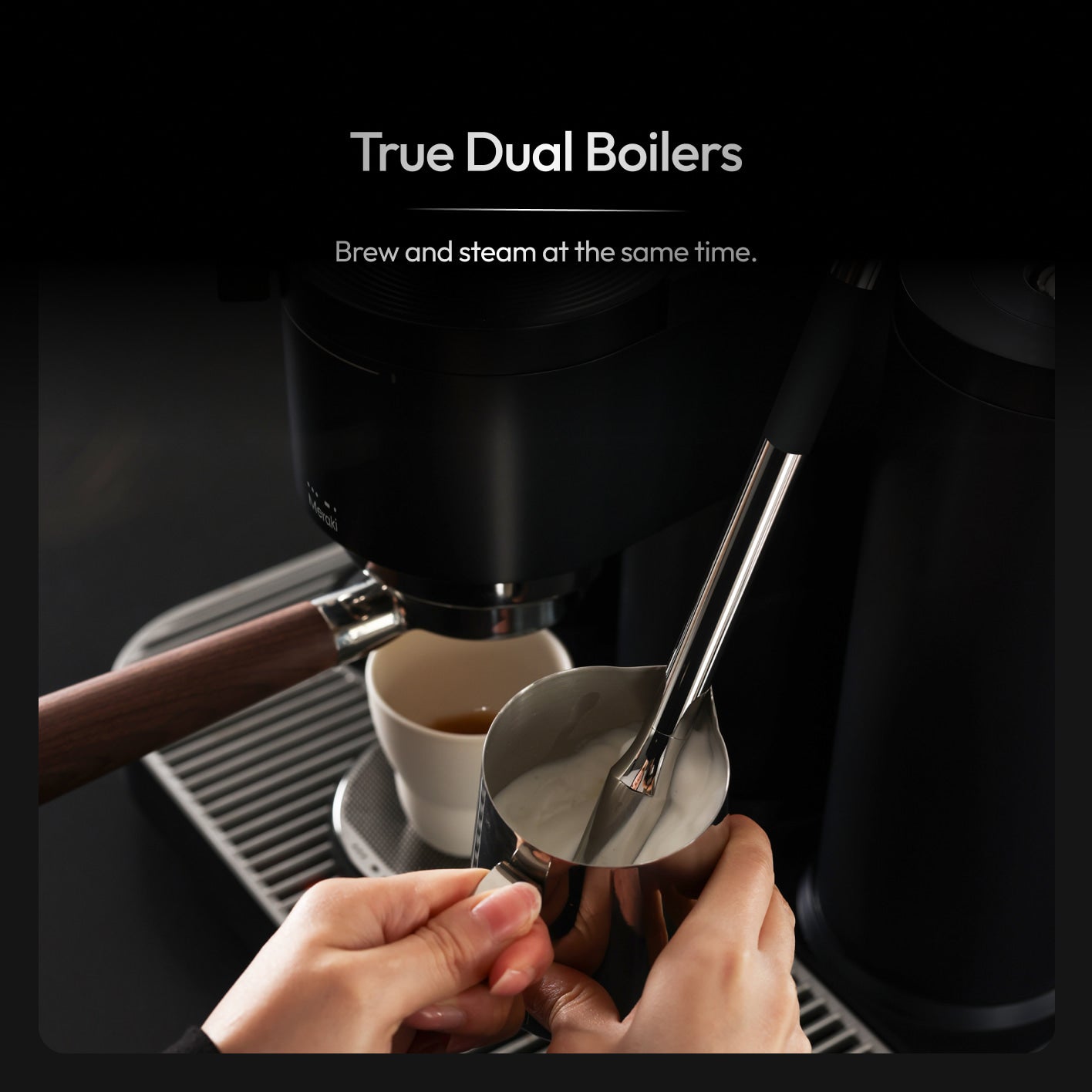
Dual boilers raise the milk-drink ceiling at home — they do not remove steam noise, jug skill, or the cleanup that cafés hire someone else to do.
Mistakes that waste time
Most expensive mistakes are expectation mistakes, not “wrong chrome.”
Mistake 1 — Buying the café adjective, skipping the matrix. If you cannot name which row in the table above you are optimizing, you are shopping for a feeling. Pause and write the weekday constraint that actually hurts (space, noise, time, milk, or freshness).
Mistake 2 — Comparing a complete home station to a bare café-looking chassis. An incomplete cart that still needs a grinder and scale is not “cheaper café quality.” It is a deferred bill.
Mistake 3 — Judging day-one shots as the machine’s ceiling. Café baristas dial beans for a living. Give yourself a locked recipe and a few mornings before you declare the hardware a failure — or a miracle.
Mistake 4 — Ignoring bean age while upgrading hardware. Brewing literacy still puts coffee freshness near the center — stale beans waste café-adjacent hardware. A stale bag makes dual boilers look average.
Mistake 5 — Treating noise as only the pump. Early grind and late steam often dominate apartment politics. Read a noise explainer before you pay for “quiet” as a single word.
Mistake 6 — Skipping the exit math. A 30-day trial helps only if you schedule real weekday tests — including the morning your partner sleeps in — and you know the return-shipping number on the live refund table.
A simple decision or setup checklist
Use this as a go / no-go pass before prices, then again after unboxing.
- Name the café cup you are chasing. Straight espresso, flat white, or both? Milk volume per morning?
- Name the household constraints. Counter pad size; shared walls/floors; earliest brew time; who cleans.
- Circle three matrix rows you will not sacrifice. Example: milk consistency, neighbor noise, and bean budget.
- Verify listing systems for those rows. Dual boilers / steam story; pump + ~9 bar regulation language; scales; grinder path; footprint.
- Price the full station. Machine + anything missing + beans + cleaner + possible return shipping.
- Plan a one-week dial-in. Same beans, same dose target, change grind first; weigh yield when the machine allows.
- Schedule ownership tests inside the trial window. Workday rush and quiet-hour morning if noise matters.
- Decide your “good enough” taste bar. Café-close most days beats café-identical every day for most homes.
- Confirm policies live. Trial start, warranty country, shipping exceptions — not screenshots from a blog.
- Only then compare brands. Same matrix rows, same drink profile — not who used the word “café” more times.
If you fail steps 2–4, you are not ready to buy “café quality.” You are ready to measure your kitchen.
How this connects to Meraki’s dual-boiler system
Meraki’s dual-boiler design is one concrete answer to a specific row in the matrix: milk-drink households that refuse the single-boiler wait between espresso and steam. Brew and steam can run as a connected morning sequence, which is why Meraki’s café-quality and dual-boiler pages lead with simultaneous workflow rather than with “more bars.”
That connection has boundaries. Dual boilers help taste consistency and pace for milk drinks; they do not invent portafilter skill, and they do not replace bean freshness. Meraki pairs the thermal path with other café-adjacent claims on the same machine — rotary pump near steady 9 bar, dual scales near ±0.2 g, integrated grinding, guided touchscreen — so the tradeoff shifts from “buy five boxes” toward “learn one system.” Independent category literacy still matters: SCA materials via sca.coffee, practical gear writing on CoffeeGeek, and measurement humility from contexts like NIST remind you that tools only help when you use them.
On the matrix, dual boilers mainly lift milk-drink and weekday-pace rows; they barely touch bean freshness; they help noise only indirectly if fewer waits mean fewer early retries. They still need a real counter pad, and guidance shortens week one without deleting taste work. Meraki’s TIMEMORE® co-developed grinder claim (site claim) belongs to grinding consistency — keep it separate from “café quality” as a slogan.
Read Meraki’s dual-boiler story as matrix support for milk-first homes, not proof that every café habit transfers. After this expectation contract, open the café-quality home espresso page and the dual boiler hub — then judge your circled rows. Support: +1 833 854 9555 (Mon–Fri, 9 AM–5 PM EST) via support.
FAQ
Can a home machine really taste like café espresso? Sometimes — on good beans, with a locked recipe, and hardware that can hold heat and brew pressure while you weigh dose and yield. It will not match a café on every variable every day, especially throughput and a barista who dials for a living. Aim for café-close consistency at home, not a courtroom standard of identical cups.
What are the biggest cafe quality at home space and noise tradeoffs? Space usually means a deeper, heavier pad plus clearance for portafilter and steam. Noise usually means the whole morning — grind, brew, steam, knock-out — not only the pump. Thin floors and early hours make vibration and shared-wall etiquette part of the purchase. Read a dedicated noise guide if apartments are your constraint.
When is cafe quality home espresso realistic? It is realistic when you drink espresso or milk drinks most weekdays, will keep beans fresh, will measure at least dose and yield, and have already accepted counter and cleanup costs. It is less realistic if you want one-button capsule convenience, brew twice a month, or need café-level guest volume without café staffing.
Is “commercial grade” the same as café quality at home? No. “Commercial-grade” on a home listing is a hardware-label conversation (pump, boilers, steam character, duty expectations). “Café quality at home” is an outcome conversation that also includes your space, noise, skill, and beans. Decode the label on Meraki’s commercial-grade guides; use this page for the lifestyle tradeoffs.
Do I need dual boilers for café-style milk drinks at home? If milk drinks are your default weekday order, dual boilers (or another honest simultaneous brew-and-steam design) remove a painful wait that makes home feel unlike a café. If you mostly drink straight espresso, other architectures can still make excellent cups — you are optimizing a different matrix row.
Conclusion
Café quality at home is a tradeoff bundle, not a guaranteed upgrade sticker. Taste ceiling rises when heat, pressure regulation, measurement, and fresh beans work together — and it costs counter space, sound, warm-up minutes, learning time, milk discipline, and a real bean budget.
If your circled rows still look acceptable after the matrix and checklist, continue on Meraki’s café-quality home espresso page and verify live specs on the Meraki Espresso Machine product page — or call +1 833 854 9555 (Mon–Fri, 9 AM–5 PM EST) via Support. If the matrix fails your household, that is a successful decision too: you saved a café-shaped machine from a kitchen that did not want one.
More on this topic: Espresso Machine Types & Upgrades.


