


You are reading a product card that says dual scales, grind by weight, and brew by weight in the same breath — then wondering which number is dose, which is yield, and whether ±0.2 g means café lab or weekday honesty. A weight based espresso machine dual scales explained page that helps feature shoppers is a role-clarity job: what each scale measures, what it does not measure, and what built-in accuracy claims should mean before you buy.
This Meraki guide owns that dose-scale vs yield-scale map. It is not a rewrite of Espresso Ratio Explained: Dose, Yield, and Your Taste (ratio language for taste). Soft-lane drafts: A051 (grind-by-weight daily setup), A052 (brew-by-weight auto-stop habits), A046 (grinder + scale end-to-end workflow). Soft-lane live hardware pages: how Meraki’s dual scales work and why weighing changes everything. Use this page when the question is still: what do dual scales measure — and which role is which?
Feature shoppers usually need that answer before they buy accessories, rewrite a dial-in notebook, or trust auto-stop marketing. If you already live in ratios and taste notes, stay on the brewing-channel essay. If you already know the two jobs and only need a morning ritual, soft-lane the how-to drafts. If you are still decoding the product card, stay here.
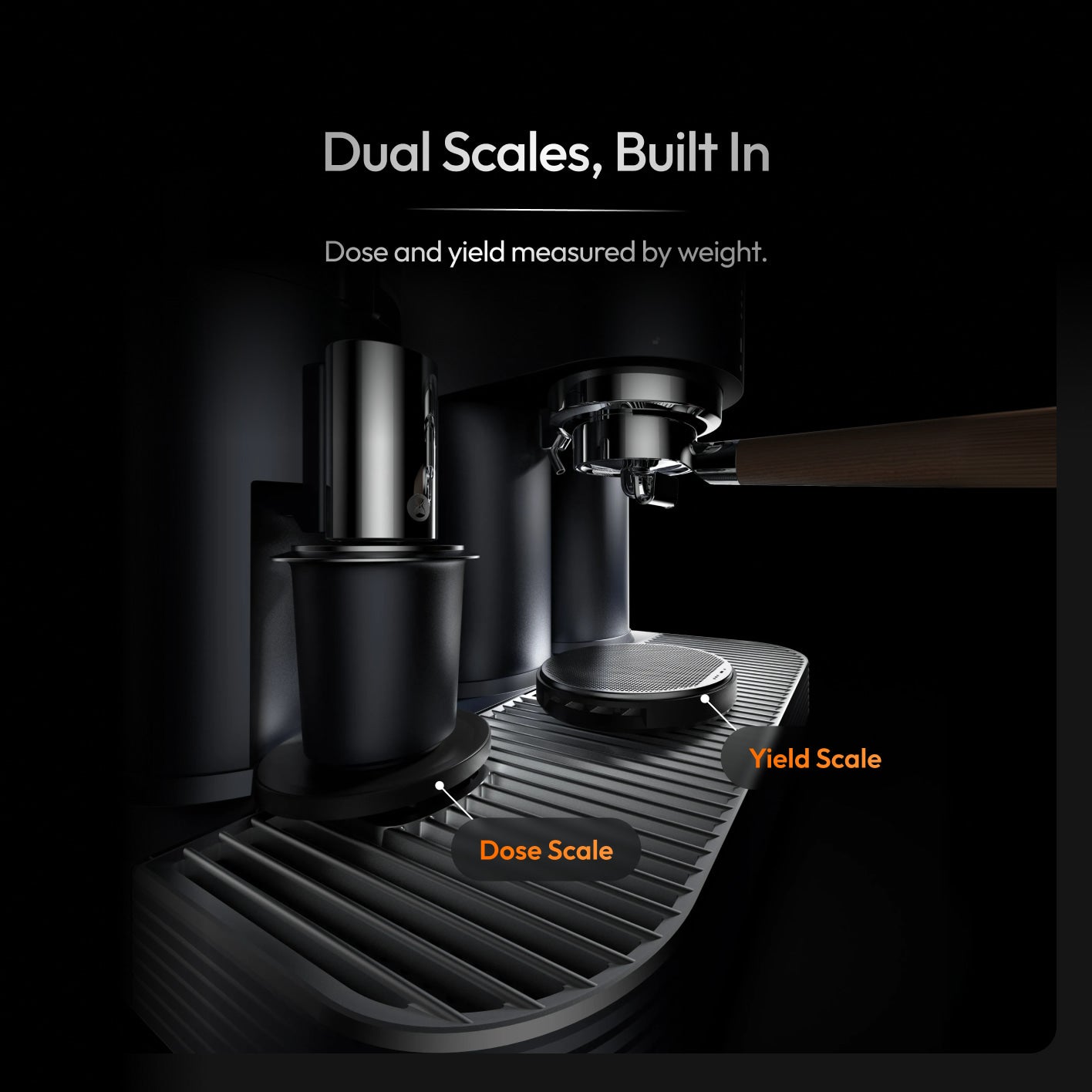
Dual scales earn their name when dose and yield are separate jobs — not when one tray number is asked to mean both.
What “weight based espresso machine dual scales explained” really means for home buyers
Weight based espresso machine dual scales explained, for home buyers, means two weighing jobs on one machine: a dose scale that measures ground coffee in (or onto the portafilter path), and a yield scale that measures liquid espresso out — with enough honesty that Monday’s grams can resemble Tuesday’s.
Search for the phrase often lands on Reddit grind-by-weight debates, “buy a coffee scale” buying guides, smart-scale unboxings, and ratio essays that jump straight to 1:2 taste language. Those pages rarely separate two roles from one mat scale you move around. Treat the keyword as a role audit: Does the listing name two measurement jobs — or only “built-in scale” as a lifestyle badge?
In shopping language, weight-based should mean grams decide the stop — grind stops at a dose target, brew stops at a yield target — not that a timer was renamed “smart dosing.” Dual scales should mean those two jobs have homes on the machine (or an honest note when one job still sits on the counter). Explained — for this page — means role clarity before ritual: which platform owns grounds, which owns liquid, and what a published tolerance such as ±0.2 g is allowed to promise.
Category literacy from the Specialty Coffee Association and practical home reading from CoffeeGeek’s guides beat any glow UI that never says which grams are dose and which are yield. NIST is a reminder that an accuracy claim without a defined method is marketing, not metrology — useful when a card flashes ±0.1 g or ±0.2 g without telling you when. Soft-lane Meraki’s espresso machine with grinder page when the wider all-in-one station is your next question after roles are clear.
Who this page is for (and who should skip it)
This page is for feature shoppers — people comparing machines that advertise dual scales, built-in coffee scales, or weight-based dosing — who need role clarity before they trust “precision” copy. You may already own a mat scale and still want to know whether a chassis truly splits dose and yield jobs.
Skip espresso ratio explained when you already know the two numbers and want taste/ratio language in the espresso-brewing channel. Soft-skip A051 for a grind-by-weight daily setup ritual; soft-skip A052 for auto-stop habits; soft-skip A046 for the full grind→dose→yield workflow glue. Soft-skip how Meraki’s dual scales work for Meraki-specific hardware walkthrough and dial-in tips; soft-skip built-in scales: why weighing changes everything for the broader “weighing vs eyeballing” value essay. Soft-skip dose and yield dial-in when you need a full dial-in method rather than a role map. Come here for: dose scale vs yield scale roles, and what built-in accuracy expectations should mean.
Why this is role clarity (not a ratio-for-taste essay)
SERP for this query is community- and accessory-led: scale reviews, grind-by-weight grinder threads, and “why precision matters” posts that treat one coffee scale as the whole story. Meraki’s nearest published ratio page already owns dose/yield as taste language in the espresso-brewing channel. What stays thin for machine-guides feature shoppers is a plain role map: which sensor (or platform) owns grounds, which owns liquid, what “dual” must mean, and how to read vendor accuracy claims without inventing competitor lab charts.
Competitor-shaped gaps on the open web include “precision matters” essays and dial-in pep talks that never force a dose-vs-yield table. Forums argue grind-by-weight grinders vs tray scales. Few pages answer the feature-shopper question in one place: If the box says dual scales, what are the two jobs — and what should ±0.2 g mean before checkout?
The unique job is role clarity: two jobs, two failure modes, weekday cup changes, kitchen tests, settings to leave alone, tradeoffs, pairing notes, and a checklist — not a ratio-for-taste rewrite, not a morning tare ritual, not an auto-stop habit week, and not a full station workflow. Disclosure: Meraki publishes this guide and sells the Meraki Espresso Machine. Live framing (2026-10-26/27 snapshot): dual built-in scales that weigh dose and yield, published as 1 kg capacity · ±0.2 g, grind-to-scale dosing with TIMEMORE® co-developed burrs, auto-stop at target yield, dual boilers, rotary pump framed at steady 9 bar, warm-up about 3–4 minutes, 45 grind settings — vendor claims; verify live. No invented competitor accuracy charts, fake resolution tables, or street prices; no competitor outbound links. Score every brand — including ours — on the same role questions.
Channel note: this article ships in machine-guides on purpose. The nearest ratio essay stays in espresso-brewing. That lane split is the Differentiate action — same dose/yield words, different reader job.
The mechanism in plain language
Dose is the mass of ground coffee you intend to extract. Yield is the mass of liquid espresso in the cup (or on the tray path) when you stop. A ratio such as 1:2 is simply yield ÷ dose — owned on Meraki’s ratio explained page in the espresso-brewing channel. This machine-guides page only needs the measurement roles that make a ratio honest.
On a dual-scale espresso machine, those roles are usually split:
| Role | What it measures | Typical job on a dual-scale machine | Confusable with |
|---|---|---|---|
| Dose scale | Ground coffee mass (in) | Grind-by-weight / stop grinding at target grams | Basket volume, timed grind, “eyeball mound” |
| Yield scale | Liquid espresso mass (out) | Brew-by-weight / stop extraction at target grams | Shot time alone, cup volume marks, “looks full” |
| Ratio (derived) | Yield ÷ dose | Taste language after both numbers exist | A single scale reading with no tare discipline |
Dual should mean two jobs, not two marketing adjectives. A machine with one drip-tray scale still helps yield; it does not automatically dose-weigh grounds under the grinder. A grind-by-weight grinder with no brew scale still needs something under the cup. Feature shoppers should ask: Where does dose get zeroed? Where does yield get zeroed? Can both run without moving one mat scale mid-shot?
Failure modes track the roles. A dose-scale failure looks like: timed grind sold as weight, a portafilter that never gets zeroed, retention that changes the pile after the display stops, or a “precision” claim with no grams. A yield-scale failure looks like: timer-only stop, a cup that never tares, a platform blocked by a drip tray grate, or auto-stop that ignores a moved cup. A marketing failure looks like calling one platform “dual” because the UI can show two numbers in sequence on the same sensor.
Mechanically, each path is a load cell (or equivalent) that reports mass after tare. The dose path cares about portafilter or dosing-cup mass plus grounds. The yield path cares about cup mass plus liquid. Firmware may auto-stop grinding or brewing at a target — that is control layered on the role, not a third scale. Soft-lane Meraki’s how dual scales work for product-specific walkthrough; stay here for the buyer map.
Built-in accuracy expectations (Meraki example: ±0.2 g at 1 kg capacity on the product specs) are vendor claims about resolution and stated tolerance — not a promise that every messy weekday will land inside ±0.2 g without tare, clean platforms, and a locked recipe. Treat ±0.2 g as “honest enough for home dial-in when you use the scale correctly,” not as a lab certificate or a license to invent competitor accuracy matrices. NCA brewing basics still start from measured coffee and water; espresso just splits “water in the cup” into pressurized yield.
What changes in your daily cup
When dual-scale roles are clear, weekday coffee gets quieter in a specific way: you stop arguing with two different unknowns at once. If dose drifted and yield drifted, taste blame is noise. If dose held and yield held, grind, distribution, temperature, and beans become the honest suspects.
In the cup that usually means: sour or thin shots get fewer “maybe I under-dosed” excuses when the dose scale already stopped at target; bitter or hollow shots get fewer “maybe I ran long” excuses when the yield scale already stopped at target. Milk drinks benefit when espresso out is stable enough that pitcher ratios stay familiar — without turning this page into a ratio tasting essay. Straight espresso drinkers feel the same calm differently: shot time becomes a check, not the only stop rule, because mass out is already named.
A useful weekday picture looks boring on purpose. You set one dose target and one yield target that match how you actually drink. The dose scale owns the grind stop. The yield scale owns the brew stop. You taste once, then change one thing tomorrow — grind a notch, a fresher bag, a warmer cup — instead of rewriting both grams and the grind every morning. That is the daily-cup gift of role clarity: fewer simultaneous levers.
What does not change: dual scales do not fix channeling, stale beans, a cold group, or a dirty basket. They do not replace puck prep. They make the inputs and stop point measurable so you can change one variable at a time — the same literacy SCA research communities care about, applied to home feature shopping. Meraki’s product framing pairs dual scales with auto-stop at target yield and grind-to-scale dosing — vendor claims to re-check live — so the weekday story can stay “two honest numbers,” not “two glowing badges.”
| Drink habit | Dose-scale job | Yield-scale job | What usually improves first |
|---|---|---|---|
| Straight espresso | Same grams in each morning | Same grams out each morning | Cleaner “grind vs heat vs beans” diagnosis |
| Milk drinks (latte / cappuccino style) | Stable espresso in | Stable espresso out before milk | Pitcher ratios feel familiar without rewriting espresso every day |
| Switching beans mid-week | Re-lock dose after the new bag | Keep yield fixed while you move grind | Fewer “everything changed” mornings |
Those rows are habit sketches, not taste commandments — ratio and menu language still belong on brewing-channel pages.
Home tests you can run without lab gear
You do not need a metrology lab. Run these kitchen checks on a demo, return window, or after unpacking — then decide whether the roles are real before you trust marketing adjectives.
Two-platform check. Confirm there is a clear dose path (under the grinder / portafilter dosing path) and a clear yield path (under the cup / drip tray). If the listing only shows one platform, ask what the second “dual” word means. Photos of a hopper plus a wand are not dual scales.
Tare honesty. Zero the dose path with the portafilter (or dosing cup) in place, grind to a target, and note whether the display settles. Zero the yield path with the cup in place, pull to a target, and note stop behavior. Flighty zeros, cups that tip the platform, or stop points that ignore the cup tare are role failures even when the brochure says ±0.2 g.
One-variable morning. Lock dose and yield for three weekday shots. Change only grind (or only beans) on day two. If taste changed while both scale roles held, you learned something real. If you moved both targets and the grind, you learned nothing — and dual scales did not get a fair test.
Mat-scale sanity (if you own one). Place a trusted mat scale under the cup once and compare directionally to the built-in yield reading — not to invent a competitor accuracy chart, only to catch a dead cell, a wet platform, or a bad tare habit. Follow appliance safety and manuals (UL); do not disassemble load cells. Press context on measured home workflows can help literacy (Barista Magazine), but it does not replace your own zeros.
Skip list for this test block. Do not turn these checks into a grind-by-weight ritual course (soft-lane A051), an auto-stop habit week (soft-lane A052), or a full station choreography (soft-lane A046). The only pass/fail here is: can I name which scale did which job?
If you cannot name the two roles after five minutes with the machine (or a clear listing diagram), treat “dual scales” as unproven marketing until support or the manual shows both paths. If both roles are obvious and zeros settle, you are ready for rituals and habits — soft-lane A051 / A052 — without re-reading this map every morning.
Settings most people should leave alone at first
Leave exotic pre-infusion profiles, micro-offsets on dose targets, and “secret” flush rituals alone until both scale roles are boring for a few mornings. Lock one dose target and one yield target that match how you actually drink — then stop inventing new numbers every day. If the machine offers drink tiles, pick the one habit you will keep before you tour every menu.
Do not chase forum accuracy wars (“my mat scale says 0.05 g better”). Home dual-scale value is role separation and weekday repeatability, not winning a resolution contest. Meraki’s published ±0.2 g / 1 kg framing is an example to re-check live — not a requirement that every brand must match Meraki, and not permission to invent competitor tolerance tables. Tiny target hopping (18.0 → 18.2 → 17.8) usually teaches anxiety faster than taste.
Also leave alone at first: steam-temperature experiments that steal attention from yield honesty, and “ratio shopping” that changes dose and yield every shot without a locked baseline. Soft-lane A051 / A052 when you are ready for dose rituals or auto-stop habits; keep this page for which scale is which. If warm-up is still confusing, re-check the live product FAQ (~3–4 minutes on Meraki’s current framing) rather than blaming the scales for a cold first shot.
Tradeoffs and limits of the feature
Dual scales solve measurement handoffs — and create new ones. Built-in platforms can need wiping, careful cup placement, and trust in firmware tare. Integration reduces counter clutter; it can also couple mill and machine service stories into one ownership path. Capacity limits (Meraki example: 1 kg class scale capacity on the product specs) matter more for odd accessories than for espresso cups — still, read the live number before you assume a heavy pitcher trick belongs on the yield platform.
| Claim you will see | Strong role reading | Weak / fluff reading |
|---|---|---|
| “Dual scales” | Separate dose and yield paths named | One tray scale + marketing adjective |
| “Weight-based / grind by weight” | Dose stop in grams | Timed grind sold as “precision” |
| “Brew by weight / auto-stop” | Yield stop in grams | Timer stop only |
| “±0.2 g” (or similar) | Stated tolerance + capacity you can re-check | Lab brag without tare instructions |
| “Built-in coffee scale” | Which job — dose, yield, or both? | Photo of a number with no role |
Other limits: dual scales do not replace water quality, basket choice, or distribution. They do not make a cold machine thermally ready. They do not invent café consistency when beans are a week past their best window. Warm-up energy is usually modest next to beans (energy.gov); wasted shots from unmeasured dose/yield usually cost more attention than electricity.
Limits of this page: no invented competitor accuracy charts; no German Design / Red Dot award padding; no Related-product block; no rewrite of ratio taste language, A051 setup, A052 auto-stop habits, or A046 full workflow. Scales do not make espresso “healthier” — they make grams honest. If you only want taste language for 1:2 vs 1:2.5, stay on the ratio explained page and skip this role map.
How this pairs with grinder, scales, or steam
Grinder. Dose-scale role is only as useful as espresso-capable grinding. Timed grinders can still produce excellent coffee when you weigh separately; grind-by-weight simply moves the dose stop into the mill path. Meraki’s framing pairs TIMEMORE® co-developed burrs with grind-to-scale dosing onto the built-in dose path — an illustration, not a universal law. Soft-lane A051 when you need the weekday dose ritual; soft-lane retention / static articles when mess is the real pain.
Separate mat scales. Still valid. Many excellent home bars use one mat scale for dose or yield and move it between jobs. Dual built-in scales mainly remove that move and the “where did I put the scale” weekday tax. Soft-lane built-in scales value for the broader “why weigh” case. If you keep a mat scale for pour-over, that does not mean the espresso dual-scale roles failed.
Steam. Milk work does not replace yield measurement. Steam temperature sensors (when present) are a third measurement family — not a dose or yield scale. A perfect microfoam pitcher with a wandering espresso yield still tastes inconsistent once milk meets shot. Soft-lane milk-sensor or steam-technique pages when that is your real question; keep dose/yield roles here.
Heat and pump. Dual boilers and a steady rotary framing (Meraki: dual boilers, rotary near 9 bar) stabilize the extraction environment; they do not weigh coffee. Role clarity still matters on single-boiler machines that use an external scale. Do not let architecture marketing erase the dose/yield map.
Put simply: grind quality feeds the dose role; heat and pump quality feed extraction while the yield role watches the stop; steam quality feeds milk after espresso out is already honest. Soft-lane A046 when you need those pieces as one weekday chain. Soft-lane brew-by-weight complete guide when yield weighing itself is the deep dive. Keep this page short and stubborn about roles.
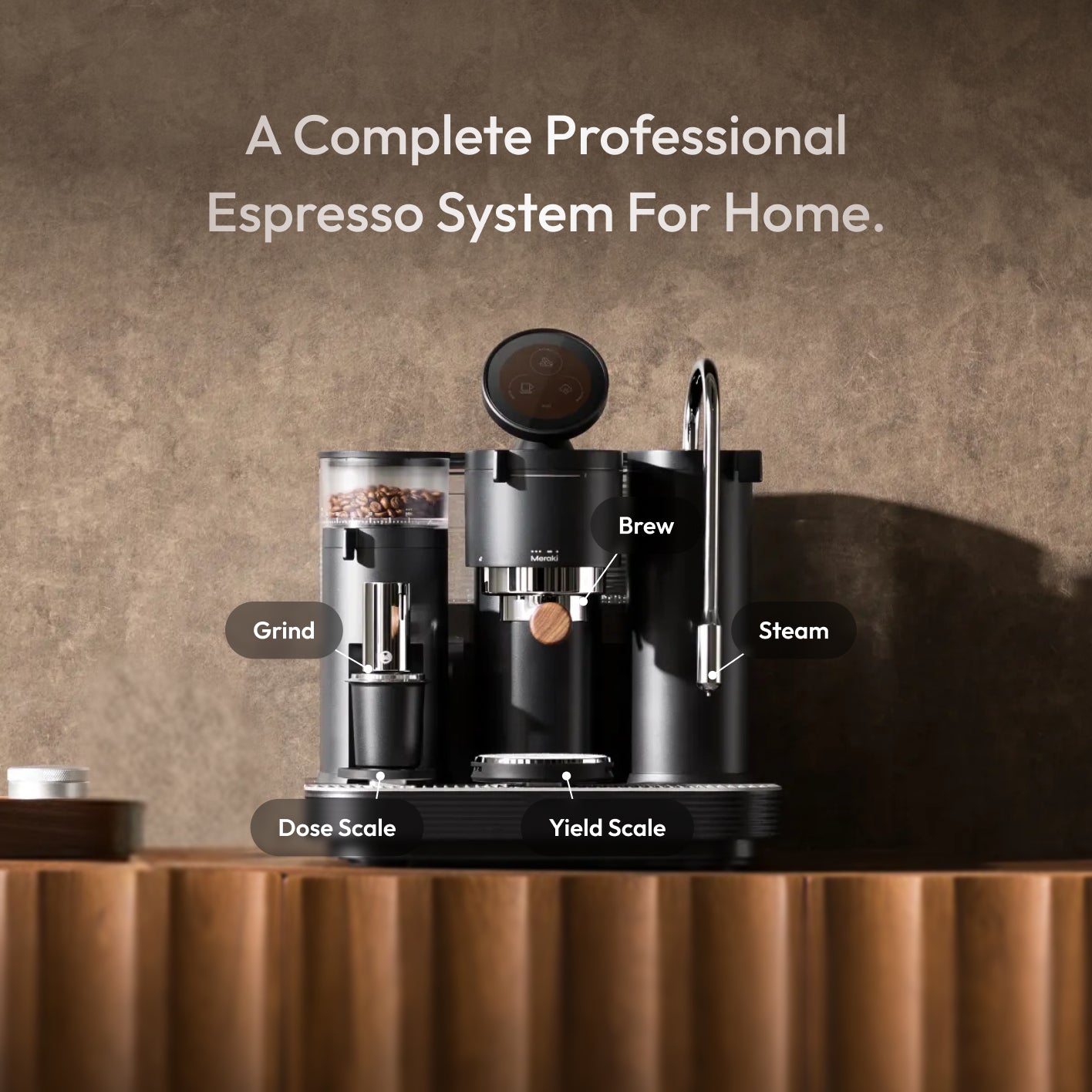
Role clarity stays useful on an all-in-one station: grind and brew heat matter, but dose grams and yield grams remain separate jobs.
Practical takeaway checklist
Answer yes/no before you accept “dual scales” or “weight-based” copy:
- I am judging dose vs yield roles, not rewriting Meraki’s ratio-for-taste essay.
- “Dual scales” names two measurement jobs — grounds in and liquid out — not one glowing number.
- I know where dose is tared and where yield is tared without moving a mat mid-shot (or I accept a one-scale workflow on purpose).
- Built-in accuracy claims (Meraki example: 1 kg · ±0.2 g) are vendor specs to re-check, not a lab certificate or a competitor chart I invent.
- I lock one dose and one yield before blaming scales for taste.
- I can name what changed when a shot failed: dose path, yield path, grind/puck, or heat — instead of “the machine is inconsistent.”
- Ratio language → espresso ratio explained; Meraki hardware walkthrough → how dual scales work; soft-lane A051 / A052 / A046 for rituals, auto-stop habits, and full workflow.
- Trial / shipping / warranty terms live on policy pages — not inside a scale brochure.
Seven or more “yes” answers usually means the feature language is earned. Four or fewer means pause — you may still be shopping a single number with dual adjectives.
FAQ
What do dual scales measure on an espresso machine? Usually two jobs: dose (ground coffee in) and yield (liquid espresso out). Some machines only build in one path and still say “scale” — read which role exists. Ratio is derived after both numbers are honest; taste language for ratios lives on Meraki’s ratio explained page.
Is ±0.2 g “lab accurate” for home espresso? Treat published tolerances such as Meraki’s ±0.2 g (with 1 kg capacity on the live product specs) as vendor claims for home dial-in — useful when tare and placement are clean, not as a third-party certificate. We do not invent competitor accuracy charts. Re-check the live Meraki Espresso Machine specs before you buy.
Do I still need a separate coffee scale if the machine has dual scales? Often no for weekday espresso, if both dose and yield paths work as claimed. A separate mat scale can still help for pour-over, calibration sanity checks, or travel. Soft-read why weighing changes everything for the broader case; soft-lane A046 when you want the full station chain.
How is this different from grind-by-weight setup or brew-by-weight auto-stop habits? Those soft-lane drafts (A051 / A052) own rituals and habits once you already know which scale is which. Soft-lane A046 owns end-to-end weekday glue. This page owns role clarity for feature shoppers — dose scale vs yield scale — before those how-tos.
Where do I verify Meraki’s dual-scale claims and ownership terms? On the live product page and support materials for dual scales, ±0.2 g, capacity, and auto-stop framing. For shipping, returns, and warranty, use shipping policy, refund policy, and warranty claim. Press context on measured workflow: Barista Magazine’s Meraki × TIMEMORE test-drive.
Can dual scales replace learning espresso? No. They replace guessing grams — not puck prep, grind skill, or tasting. Role clarity just keeps your learning loop honest: when dose and yield hold, the next change you try is more likely the right one.
If your checklist still points to clear dose and yield roles — and Meraki’s published dual-scale path fits how you shop features — confirm today’s specs and terms on the Meraki Espresso Machine product page, then judge the scales by two honest weekday zeros in your kitchen, not by a silent accuracy brag.


