


You set a dose target, hit grind — and the machine stops near the grams you asked for. That is automatic dosing. It is not a fully automatic “push one button, drink appears” machine. An automatic dosing espresso machine when it helps page for beginners is a boundaries job: when dose control removes chaos, when it fails, and which settings to lock first so the feature does not fight you.
This Meraki guide owns those boundaries. Soft-lane A051 for a grind-by-weight daily setup ritual; A053 for dose vs yield role clarity; A052 / A046 / A054 for auto-stop habits, full workflow, and ±0.2 g cup translation. Soft-lane how Meraki’s dual scales work and why weighing changes everything. Use this page for: when automatic dosing helps — and when it does not.
Nearest published URL in the plan cluster is how to backflush an espresso machine — cleaning, not dose control. Weak topical neighbor; different job.
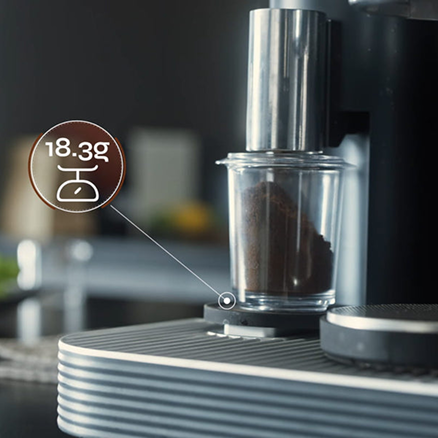
Automatic dosing earns its keep when a locked dose target stops grinding near the grams you chose — not when “auto” means a super-automatic that hides the portafilter.
What “automatic dosing espresso machine when it helps” really means for home buyers
Automatic dosing espresso machine when it helps, for home buyers, means a machine (often with a built-in grinder) that stops grinding at a dose target you set — usually by weight — so Monday’s grounds mass can resemble Tuesday’s without scooping by eye.
Search for the phrase often lands on super-automatic roundups, capsule “auto” lists, and forum threads about grinders that over-dose. Those pages blur three different ideas: automatic dose control, fully automatic bean-to-cup, and timed grind sold as “smart.” Treat the keyword as a boundaries audit: Does “automatic dosing” mean the grinder stops at a grams target you can lock — or a one-button drink menu that never shows a portafilter?
In shopping language, an auto dose espresso machine with grinder should mean the grind path can hit a dose without you babysitting a timer. Dose control should mean you can set, lock, and re-check that target. When it helps means the feature removes one variable early — dose mass — so beginners can diagnose grind, distribution, or yield next. Category literacy from the Specialty Coffee Association and CoffeeGeek’s guides beats any glow UI that never says what stopped the grind. Soft-lane Meraki’s espresso machine with grinder overview when the wider station is next.
Who this page is for (and who should skip it)
This page is for beginners — and upgraders who still feel dose chaos — who need clear help vs failure-mode boundaries before they trust “automatic dosing” copy or buy another scoop.
Soft-skip A051 if you already know dose control exists and only need a weekday grind-by-weight setup ritual. Soft-skip A053 if you still cannot name which scale is dose vs yield. Soft-skip A052 / A046 / A054 for yield auto-stop habits, end-to-end workflow, and ±0.2 g cup translation. Soft-skip how Meraki’s dual scales work for hardware walkthrough; why weighing changes everything for the broader weighing essay; espresso ratio explained for taste language. Soft-skip semi-automatic how it works when you need machine-type taxonomy, not dose-feature boundaries. Come here for: when automatic dosing helps beginners, when it does not, and which dose-control settings to lock first.
Why this is boundaries (not a grind-by-weight how-to)
SERP for this query is mixed and often wrong-category: super-automatic buyer guides, “manual vs auto vs super-auto” explainers, and product cards that use “automatic” for volume stop or milk menus. Soft-lane A051 already owns the daily setup that makes grind-by-weight stick. Soft-lane A053 owns dose vs yield roles. What stays thin for machine-guides beginners is a plain boundaries map: when automatic dosing helps, which failure modes look like “the machine is broken,” and which settings to lock before you chase grind.
Competitor-shaped gaps include feature lists that never say when not to trust auto-dose, and forums that confuse timed grind with weight stop. Few pages answer in one place: If the box says automatic dosing, when does that help a beginner — and when should you ignore the hype?
The unique job is boundaries — help cases, failure modes, lock-first settings, kitchen tests, tradeoffs, pairing notes — not a step-by-step grind ritual (A051), not a dual-scale role rewrite (A053), not yield auto-stop habits (A052). Disclosure: Meraki publishes this guide and sells the Meraki Espresso Machine. Live framing (2026-10-26/27): grind-to-scale dosing with TIMEMORE® co-developed burrs, dual built-in scales (1 kg · ±0.2 g), auto-stop at target yield, dual boilers, rotary framed at steady 9 bar, warm-up about 3–4 minutes, 45 grind settings — vendor claims; verify live. No invented competitor auto-dose matrices or street prices; no competitor outbound links. Channel: machine-guides.
The mechanism in plain language
Automatic dosing (on a machine with a grinder and a dose path) usually means: you set a target mass of ground coffee, the grinder runs, a scale (or equivalent) watches the grounds, and firmware stops the motor near that target. That is dose control. It is not the same as a fully automatic machine that grinds, tamps, and brews inside a closed brew group with no portafilter craft.
| Phrase on the box | What it often means | Beginner help? | Confusable with |
|---|---|---|---|
| Automatic dosing / dose control | Grind stops at a set dose (ideally by weight) | High — locks in grams | Timed grind, “smart” scoops |
| Grind-by-weight | Dose stop is driven by mass, not seconds | High when tare is honest | Time-based auto-dose |
| Fully / super automatic | Bean-to-cup automation; limited portafilter craft | Different product job | “Automatic dosing” on a semi-auto |
| Volumetric / timed brew stop | Water volume or time stops the shot | Helps yield side, not dose | Dose auto-stop |
Mechanically, a load cell (or similar) tares the portafilter or dosing cup, then tracks mass while burrs spin. Firmware cuts the motor when the reading nears target. Retention in the chute can still add a little after the motor stops — that is a common failure mode, not proof the scale is “lying.” Soft-lane A053 if you need which platform owns dose vs yield; stay here for when the dose stop helps. NIST is a reminder: a stop without a defined measurement method is marketing, not metrology. Terminology chaos is real — CoffeeGeek’s manual vs automatic vs super-auto essay shows how loosely “automatic” gets used.
What changes in your daily cup
When automatic dosing is honest and you leave the target alone for a few days, the cup usually gets quieter in one way: dose stops being the first mystery. Sour/thin and bitter/hollow become easier to read because “maybe I under-dosed” is off the table. You can change grind or distribution and actually learn from the next shot.
In milk drinks, a stable espresso in grams keeps the base steadier before steam — so the pitcher is not masking a chaotic dose. What automatic dosing does not change by itself: channeling, a cold group, stale beans, or a yield you never weighed. Soft-lane ratio explained once both in and out grams exist; soft-lane A054 if you are shopping ±0.2 g claims rather than help/fail boundaries.
| Situation | When auto-dosing helps | When it does not |
|---|---|---|
| New bean bag | Same dose target while you move grind | Changing dose and grind every shot |
| Weekday rush | One locked dose; fewer scoops | Re-programming dose mid-routine |
| Taste diagnosis | Dose fixed → blame grind/puck/yield | Dose drifting while you chase flavor |
| Guest drinks | Repeatable base for milk drinks | Expecting auto-dose to fix foam skill |
NCA brewing basics still start from measured coffee and water; automatic dosing is just that discipline applied to the grind path.
Home tests you can run without lab gear
You do not need a café lab to test whether automatic dosing helps you. Run these on a warm machine with a clean, dry portafilter path.
Three-shot same-target check. Lock one dose (for example a weekday medium dose your basket likes). Pull three consecutive grinds without changing the target. Note the displayed stop grams (and, if you have a mat, a rough check). Pass: stops cluster tightly enough that you trust the next shot. Fail: wild swings → check tare, basket seating, chute mess, or retention before blaming “the algorithm.”
Bag change, dose held. Change only the bag. Keep the same dose target for two mornings while you nudge grind. Pass: you can taste grind moves without re-learning scoop size. Fail: you keep editing dose instead of grind — auto-dosing is not helping yet because you will not leave the lock alone.
Soft-stop / retention sniff test. After the motor stops, wait two seconds, then look at the pile. A little extra from the chute is normal on many grinders; a large “after-spill” means you should not chase tenth-of-a-gram drama until the path is clean. Soft-lane A051 for a full weekday setup once the feature passes these boundaries tests — do not turn this section into that ritual.
Pass/fail question for the whole page: Does locking dose remove chaos — or am I still fighting timed grind, bad tare, or a fully automatic product I never wanted?
Settings most people should leave alone at first
Beginners lose automatic dosing’s benefit when they treat every menu as a playground. Lock a short list first; leave the rest alone for a week.
Lock first (dose-control core):
- Dose target (grams) — one weekday number for your basket; do not change it while diagnosing taste.
- Tare / portafilter seating — same dry basket path every morning so the stop sees real grounds mass.
- Grind setting — the next lever after dose is stable (Meraki’s live framing lists 45 settings — vendor claim; re-check).
- Yield target — once dose is boring, lock a yield stop too (soft-lane A052 for habits).
Leave alone at first: micro-profiles, novelty drink macros, aggressive pre-infusion experiments, and daily dose “optimization” spreadsheets. SCA research culture cares about controlled variables; home practice means fewer simultaneous knobs. Soft-lane A051 when you want the ritual that keeps these locks boring in a good way.
Tradeoffs and limits of the feature
Automatic dosing helps when dose mass was your loudest source of chaos. It has real limits.
It does not replace puck prep. Even grams into a poorly distributed basket still channel. It does not equal a fully automatic machine. You still lock, tamp, and start the shot on a portafilter workflow — see Meraki’s semi-automatic explainer for type literacy, not as a second dose essay. Retention and chute mess can make “auto” feel wrong after the motor stops. Timed grind sold as auto-dose fails when beans age or humidity shifts — seconds stay fixed while mass drifts. Over-trust is a beginner failure mode: assuming any sour cup means “raise dose” instead of fixing grind or distribution.
Café automation can improve barista workflow (Perfect Daily Grind on espresso automation), but home boundaries differ: you are not serving a rush line — you are trying to learn one cup. Soft-lane cleaning pages such as backflushing when the issue is hygiene, not dose control.
How this pairs with grinder, scales, or steam
Automatic dosing lives or dies by the grind path and the dose scale job. A built-in grinder that doses onto a scale (Meraki’s live framing: grind-to-scale with TIMEMORE® co-developed burrs — vendor claim) pairs naturally with dose control. Dual scales then let yield stop on its own platform — soft-lane A053 for roles, A054 for what ±0.2 g changes in the cup.
Steam does not replace dose discipline. Dual boilers (Meraki live framing: brew and steam heat together; warm-up about 3–4 minutes — vendor claims) help milk drinks after the espresso base is stable. A rotary pump framed at steady 9 bar (live vendor claim) does not dose for you. Soft-lane A046 when you need the full grind→dose→yield→steam glue; stay here for whether dose automation belongs in your beginner week at all.
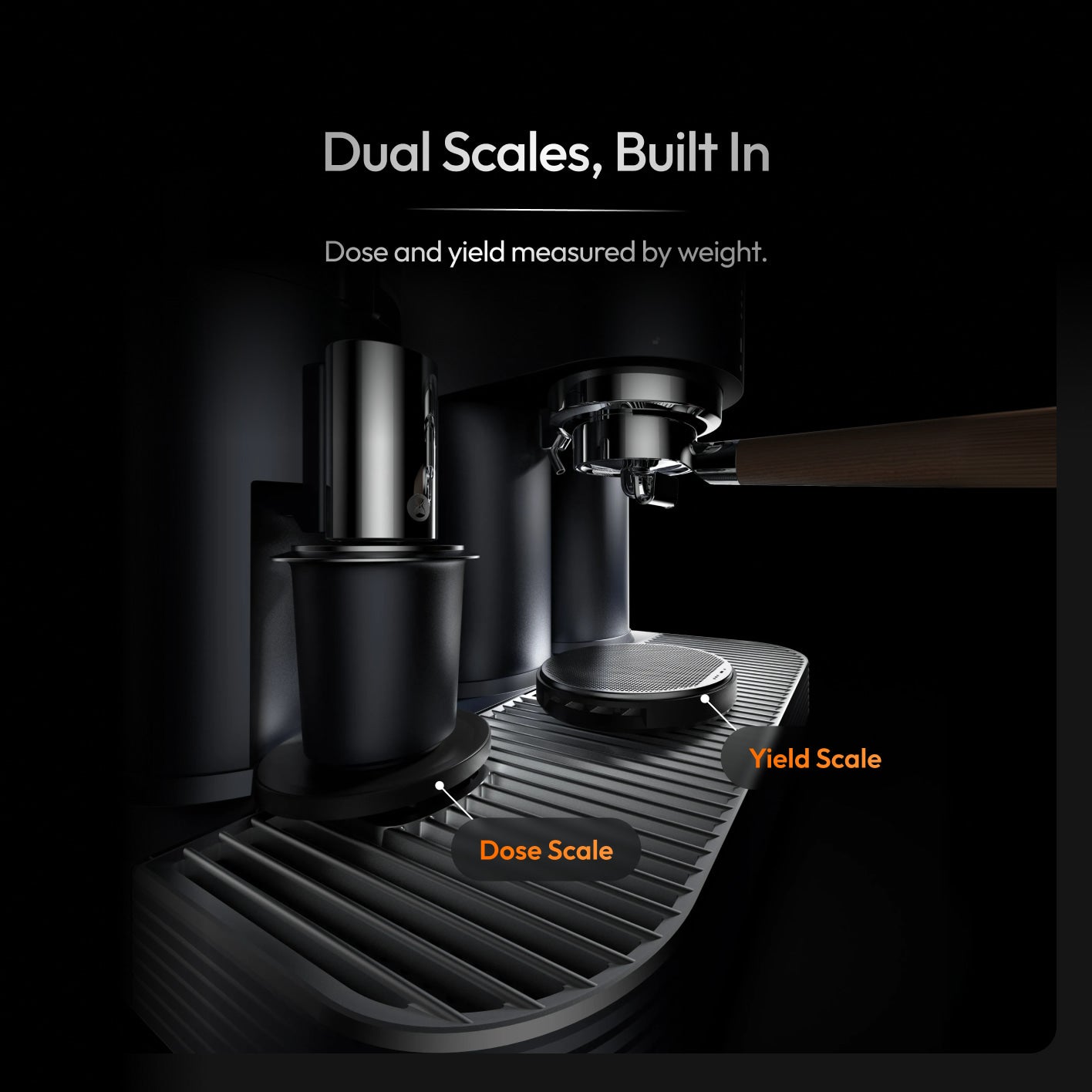
Dose control pairs with a scale that watches grounds; yield and steam are separate jobs — do not ask “automatic dosing” to mean the whole café.
Practical takeaway checklist
Answer yes/no before you trust “automatic dosing” marketing:
- I am judging help vs failure boundaries, not rewriting A051’s grind-by-weight how-to.
- “Automatic dosing” here means dose stop / dose control — not a fully automatic bean-to-cup machine.
- I can lock a dose target (grams) and leave it alone while I change grind.
- Tare and basket seating are consistent enough that the stop sees real mass.
- I know common failure modes: timed grind sold as weight, retention after stop, editing dose every shot.
- Soft-lane A053 for dose vs yield roles; A051 for daily setup; A052 / A046 / A054 for yield habits, workflow, and ±0.2 g translation.
- Cleaning issues → backflush guide; trial / shipping / warranty on policy pages.
Seven or more “yes” answers usually means automatic dosing can help your beginner week. Four or fewer means pause — you may still be shopping the wrong “automatic.”
What is the 30 second rule for espresso?
It is a rough shot-time heuristic — not a dose rule. Many home guides aim for roughly 25–30 seconds of extraction as a starting window, not a law.
Shot time without locked dose and yield is easy to misread: a fast shot can mean grind too coarse or dose too low. Soft-handle only on this page: use time as a clue after dose is locked, not as a substitute for grams. Soft-lane dose and yield dial-in for method once boundaries are clear.
Is a fully automatic espresso machine worth it?
It depends on the job — convenience vs craft feedback. Fully / super automatic machines help when you want bean-to-cup with minimal portafilter work.
That is a different purchase from an auto dose espresso machine with grinder that still expects you to prep a puck. Soft-handle only: if you want hidden automation, shop super-automatic guides; if you want dose control inside a learning workflow, stay on boundaries here and soft-lane the espresso machine with grinder page for station fit. This page does not rank fully automatic models.
FAQ
Is automatic dosing the same as a fully automatic espresso machine? No. Automatic dosing usually means the grinder stops at a dose target you set. A fully / super automatic machine grinds, doses, and brews with far less portafilter craft. Soft-lane CoffeeGeek’s type essay for terminology; soft-lane Meraki’s semi-automatic guide for how portafilter machines still work.
When does automatic dosing help beginners most? When dose mass was chaotic and you are willing to lock one target while you learn grind and puck prep. It helps least when you change dose every shot, confuse timed grind with weight stop, or expected a one-button latte machine.
Which dose-control settings should I lock first? Lock dose grams, consistent tare/basket seating, then grind; add a yield target once dose is boring. Leave novelty profiles alone in week one. Soft-lane A051 when you want the full weekday setup ritual that keeps those locks sticky.
What are common automatic dosing failure modes? Timed grind sold as “auto dose,” dirty or poorly seated portafilter paths, chute retention after the motor stops, and editing the dose target instead of grind when taste shifts. None of those prove you need a different brand matrix — they prove the boundary was missed.
Where do I verify Meraki’s dose / scale claims and ownership terms? On the live product page and support materials for grind-to-scale dosing, dual scales (±0.2 g · 1 kg), and auto-stop framing. For shipping, returns, and warranty, use shipping policy, refund policy, and warranty claim. Press context: Barista Magazine’s Meraki × TIMEMORE test-drive. Electrical / safety literacy for appliances generally sits with labs such as UL — not a substitute for reading your manual.
If your checklist still says automatic dosing can help — and Meraki’s published grind-to-scale path fits how you want to learn — confirm today’s specs and terms on the Meraki Espresso Machine product page, then judge the feature by a locked dose and quieter diagnosis in your kitchen, not by “automatic” alone on a product card.
More on this topic: Espresso Ratios, Dose, Yield & Measurement.


