


You already have automatic shot stop — yet the saved grams still feel wrong for this drink, this bag, or the latte you pull after a straight espresso. An espresso machine with automatic shot stop tuning only helps when you know which stop grams to set, when to change them, and when to disable auto-stop for a planned experiment.
This Meraki how-to owns tuning: calibrate automatic yield stop for your recipes, choose straight-shot vs milk-drink stop targets, and know when to turn auto-stop off. Soft-lane A052 for weekday auto-stop habits; A056 for milk-drink yields; A059 for simple brew-ratio sticky targets. Soft-lane Brew by Weight: The Complete Guide and dual scales for literacy/hardware. Soft-lane semi-automatic sweet spot for category positioning — not rewritten here. Use this page when the job is tuning the stop itself.
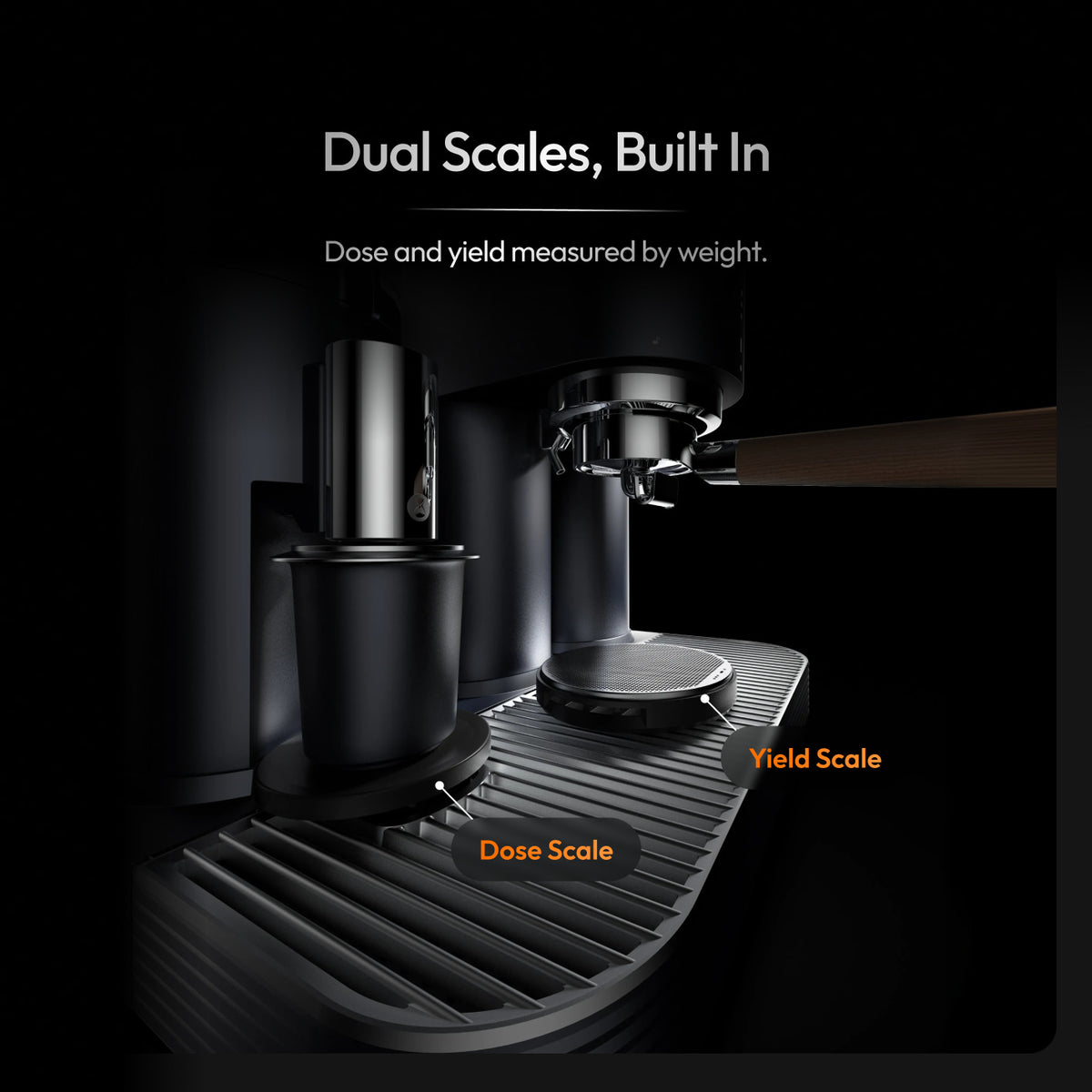
Automatic shot stop is only as useful as the grams you tune — dual scales make the stop honest; your recipe decides the number.
What “espresso machine with automatic shot stop tuning” really means for home buyers
Espresso machine with automatic shot stop tuning, for home buyers, means a brew path that ends the shot at a set out-mass you can change per recipe — not a one-time “auto” button you never touch again.
Search often lands on super-automatic shopping cards, shot-timer forums, volumetric “automatic” explainers, and listicles that never separate having a stop from calibrating it. Those pages sell features. This page sells tuning discipline: pick a baseline stop, taste against it, move stop grams only with a named reason, keep straight and milk stops in separate slots, and disable auto-stop only for experiments you write down first.
Automatic yield stop (brew-by-weight / shot-by-weight) ends extraction when the brew scale hits your target. Tuning means choosing and revising that target for the drink you actually drink. Literacy from the Specialty Coffee Association and CoffeeGeek’s guides beats any UI that flashes “Auto” without saying which grams you froze.
Who this page is for (and who should skip it)
This page is for new owners and precision beginners who already have (or are about to have) automatic yield stop and need a calibration workflow — not another habit pep talk or ratio textbook.
Soft-skip A052 for weekday trust habits; A056 for milk-drink yield narrative; A059 for simple ratio sticky bands. Soft-skip ratio explained, grams out, and dose and yield dial-in for literacy/method. Soft-skip A061 / A063 / A066 for CoffeeSense, control balance, or family profiles. Soft-skip semi-automatic sweet spot when you are still choosing category. Come here for: tuning stop grams, straight vs milk stop choices, and when to disable auto-stop.
Why this is a tuning guide (not habit design or milk-yield control)
SERP leans community threads, timers, super-automatic roundups, and volumetric explainers. Soft-lane A052 for habit design; A056 for milk-drink yields; A059 for simple ratio targets. What stays thin for machine-guides is stop calibration: which grams to set, when to change stop vs grind, how straight and milk stops differ, and when to disable auto-stop on purpose.
The unique job is tuning — baseline → taste → change stop or grind → re-lock → optional disable for experiments. Disclosure: Meraki publishes this guide and sells the Meraki Espresso Machine. Live framing (2026-10-26/27): dual scales (1 kg · ±0.2 g — vendor claim), auto-stop at target yield, TIMEMORE® co-developed burrs, dual boilers, rotary framed at steady 9 bar, warm-up about 3–4 minutes, café-menu latte ~1:3, cappuccino/flat white ~1:2 — vendor claims / starting points; confirm live. No invented lab-true stop charts. Channel: machine-guides.
Tools and settings to prepare first
Tuning fails when the station is half-awake and the sticky note is blank. Stage tools while the machine warms: clean portafilter and basket, a clear cup on the brew/yield scale, a dry cloth, and a sticky with two lines — straight-shot stop grams and milk-drink stop grams (or one line if you only drink one style).
On Meraki’s current framing, dual boilers heat in about 3–4 minutes and the guided path runs grind → brew → steam → serve — confirm on the live product page. Soft-lane A052 if tare/hands-off is still chaotic; stay here for which stop numbers you edit. You need locked dose, a writable stop, and one taste word. NCA brewing basics start from measured coffee and water; NIST reminds that a stop is only as honest as the zero you give the scale.
Step-by-step workflow: tuning automatic shot stop
The weekday win is a stop you chose on purpose — then edited only with a named reason. Use this order until calibration feels boring in a good way.
- Warm fully, then seat a dry cup on the yield scale. Do not brew into a cold group “to save time,” then blame the stop grams for a harsh first shot.
- Confirm dose is already locked. Tuning the stop cannot fix scooping by eye. Soft-lane dose rituals if dose still drifts; soft-lane A053 if you mix dose and yield scale roles.
- Write a baseline stop — not five candidates. Example starting habit for straight espresso: yield near a ~1:2 brew-ratio band for your dose (for example 18 g in → about 36 g out). Mark it as a starting point, not a certificate. Soft-lane A059 for sticky-ratio literacy; soft-lane ratio explained for taste language.
- Enter that stop on the auto-stop / brew-by-weight control. Confirm yield-stop mode (not a forgotten timed shot) if your UI offers both.
- Tare / zero the brew scale. Empty cup, clear zero (or the machine’s ready state). Skipping tare makes every “tuning” session fake.
- Brew — hands off until the stop. Watch for gross failures (gusher, choke). Do not abort for curiosity mid-pour.
- Taste once; decide with the table below. Change one variable: usually grind first if flow is wrong at an honest stop; change stop grams only when recipe length is wrong.
- Re-lock and name the recipe. Save or rewrite the sticky: drink name, dose, stop grams, bean. Soft-lane A066 if household profiles/slots store named recipes.
- Disable auto-stop only for a written experiment. Manual stop for one planned tasting session is fine; leaving stop disabled all week returns chaos. Soft-lane A063 for “smart without losing control.”
- Thirty-second reset. Knock the puck, wipe the group area, clear the brew scale.
Rotating straight espresso and milk drinks? Keep two stop families — soft-lane A056 for milk-drink yield detail — not one number that stretches into a guest lungo every morning.
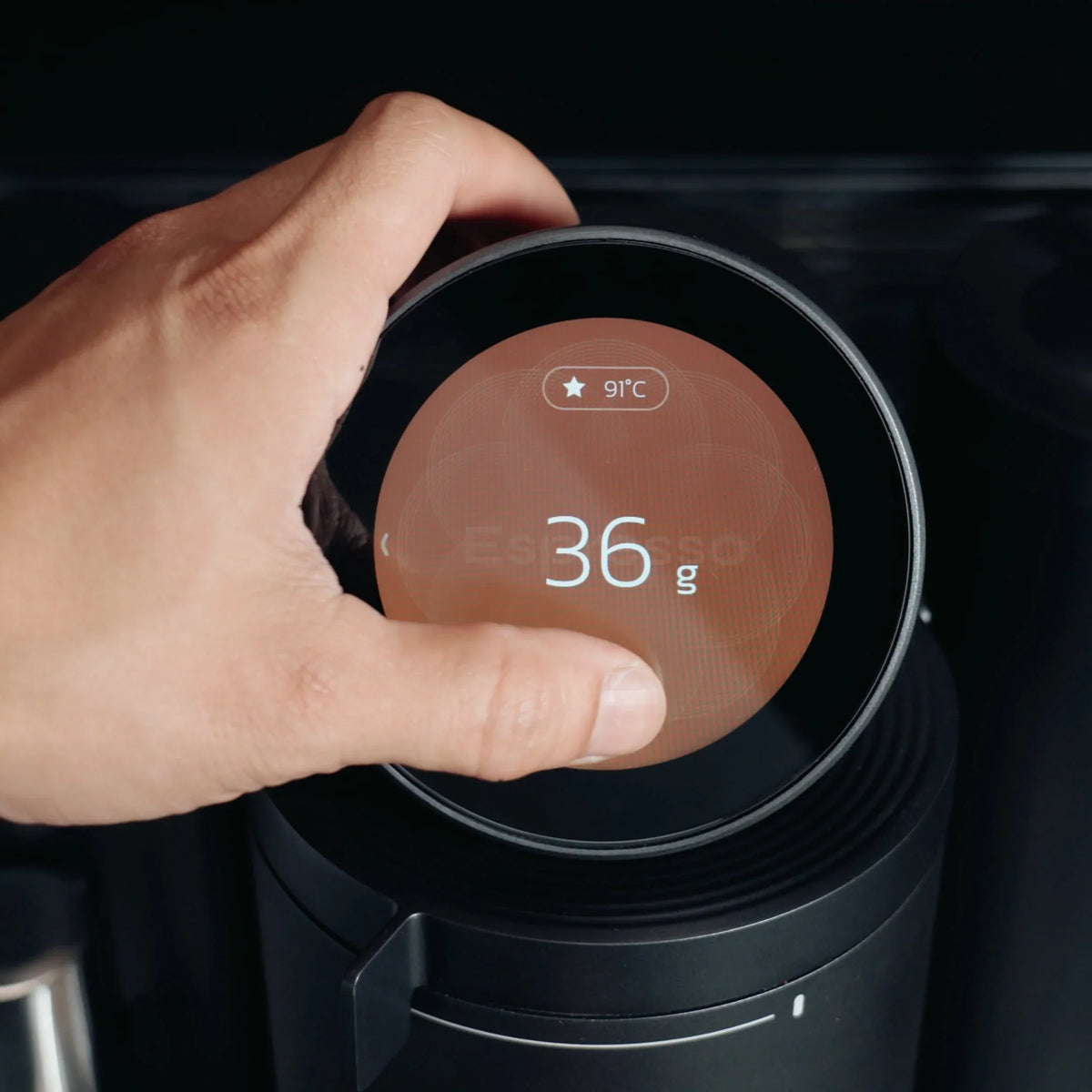
Auto-stops at your target yield — tuning means choosing that target, editing it with a named reason, and knowing when to turn it off for experiments.
Targets and ranges that keep you out of rabbit holes
Targets exist so calibration does not become a career. Prefer practical starting ranges, labeled as starting points — never invented “lab truth” stop charts.
Many homes begin straight espresso near a classic ~1:2 habit (dose → about twice that mass out). That band is café-culture shorthand from SCA research and CoffeeGeek — not a law. Meraki café-menu framing (latte ~1:3, cappuccino/flat white ~1:2) is a drink starting point — confirm on the product page. Soft-lane A056 for milk bases; A059 for sticky ratio bands. Here the job is editing the stop.
| Situation | What to tune | What not to do |
|---|---|---|
| New machine / first week | Set one straight stop + optional milk stop; leave them alone for several days | Hopping ±1–2 g every morning “just to see” |
| Straight espresso tastes short / thin at honest dose | Confirm grind/flow first; then raise stop only if you want a longer recipe | Stretching stop to hide a grind that is too coarse |
| Straight espresso tastes long / harsh at honest dose | Confirm grind/flow first; then lower stop only if the drink should be shorter | Chasing blonding mid-shot with random aborts |
| Milk drinks most mornings | Separate milk-drink stop (soft-lane A056) | Using one stretched “lungo latte” stop for everything |
| Guest “a little longer” | Override once, write it, return to sticky tomorrow | Letting guests permanently rewrite your tuned stop |
| Planned experiment weekend | Disable auto-stop or use a Lab/Guest slot (soft-lane A066); one variable | Leaving stop off all week with no notes |
| New bag | Keep stop; reconfirm grind after 1–2 shots | Rewriting stop, dose, and grind in one panic pull |
Dual scales to ±0.2 g (1 kg) are vendor claims that support honest auto-stop — not hundredths-chasing. Soft-lane La Marzocco USA’s brew-by-weight intro for mass-over-clock mindset. Time is a traffic light: mid-twenties into low thirties of seconds is a common band — sweet cup outside it at a locked stop? Keep the taste.
Common mistakes and quick fixes
Most “auto-stop never feels right” complaints are tuning errors, not broken scales.
| Mistake | What you feel | Quick fix |
|---|---|---|
| Editing stop every shot | No baseline, endless anxiety | Freeze stop for several days; change grind first |
| One stop for straight and milk | Washed lattes or harsh straight shots | Two sticky families; soft-lane A056 for milk detail |
| Skipping tare while “tuning” | Same setting, different cups | Zero every shot; seat the cup the same way |
| Changing grind and stop together | No idea what fixed the cup | One variable per session |
| Timed shot left on by accident | Stop grams ignored | Confirm yield-stop mode before blaming the recipe |
| Disable forever “for freedom” | Hover-and-guess returns | Disable only for named experiments; re-enable after |
| Treating ±0.2 g as cup destiny | Obsessing over tenths | Taste first; vendor accuracy supports honesty, not theater |
| Treating café-menu ratios as law | Pretty number, wrong cup | Mark every chart as a starting point; soft-lane A059 |
If the cup still disagrees after dose and stop are honest, soft-lane dose and yield dial-in — do not invent a second dial-in encyclopedia here.
How to taste and decide what to change next
Taste answers one question first: did the stop land at the grams you set? Missed grams? Fix tare, cup seating, or mode (yield vs time) before grind. Honest stop and a wrong cup? Name the defect once.
Sour-thin / fast flow at a locked stop → finer grind (usually before you raise stop). Harsh-bitter / syrupy crawl → coarser (usually before you lower stop). Cup feels “too short for this drink” or “too long for this drink” after flow is sane → that is when you tune stop grams. Flat with “perfect” grams → beans, distribution, or temperature — not a third spreadsheet column. One-sided blonding → puck prep; a weighing path cannot fix an uneven basket.
Change one variable. Note: date, bean, dose, stop grams, hit?, one taste word, next change. Barista Magazine’s Meraki test drive covers a measured path; still judge your cup. Soft-lane A061 if CoffeeSense suggestions start a bag — suggestions still need your stop tuning and a tap to start.
A one-week practice or habit plan
A week installs tuning muscle memory without turning coffee into homework. Keep the same beans for Days 1–5 if you can. Soft-lane A052 if the hard part is still weekday trust; this week is about editing rules.
- Day 1 — Write two stop lines. Straight stop and optional milk stop. Confirm tare → brew → auto-stop twice.
- Day 2–3 — Freeze the stops. Same numbers; no mid-shot curiosity aborts.
- Day 4 — Grind-only correction (if needed). If taste is clearly off at locked stop, move grind one notch — not the sticky yield.
- Day 5 — One intentional stop edit or none. If drink length is wrong after grind is sane, move stop by a small, named amount (for example 1–2 g), taste twice, re-lock. If the cup was already fine, skip the edit.
- Day 6 — Disable drill. Pull one planned experiment with auto-stop off (or a Lab/Guest slot). Write what you learned. Re-enable the tuned stop afterward.
- Day 7 — Lock and drink. Refuse guest permanent rewrites. Soft-lane A056 if milk drinks still need their own locked bases; soft-lane A066 if household names/slots help keep stops apart.
Do not skip warm-up and blame stop tuning for a cold first shot.
When to stop tweaking and just drink
Stop tweaking when tare is automatic, the tuned stop finishes without hovering, and further gram edits would only serve curiosity.
One roast for weeks? Protect the stop; re-check grind on a new bag before you rewrite yield. Rotate often? Train fast reconfirmation, not a museum of stops. Soft-lane A052 / A056 / A059 for habit, milk yields, and ratio stickies; dual scales and brew-by-weight complete guide for hardware/literacy; semi-automatic sweet spot for category context.
How do lever espresso machines work?
Lever machines use a spring or manual lever for pressure — not a pump auto-stop.
This page skips a lever deep dive. Automatic shot-stop tuning here applies to machines that can end at a set out-mass. Soft-lane semi-automatic sweet spot if you are still choosing machine type.
Is 40 seconds too long for espresso?
Not automatically — time is a traffic light, not a law. Forty seconds can be fine if taste is sweet at your locked dose and tuned stop; it is a warning if the cup is harsh, hollow, or choking.
Mid-twenties into low thirties of seconds is a common home band, not a certificate. Long clock + good taste at honest grams → keep the recipe. Long clock + wrong taste → change grind or puck prep before panic-editing the stop. Soft-lane dose and yield dial-in; soft-lane A052 if early aborts are the weekday habit problem.
FAQ
When should I change automatic shot stop grams vs grind? Change grind first when flow or extraction taste is wrong at an honest, locked stop. Change stop grams when the drink length is wrong after flow is sane — too short or too long for the recipe you want. Do not move both in the same session. Soft-lane A052 for weekday hands-off trust; soft-lane A059 if you need simple ratio sticky bands before you edit.
Should straight shots and milk drinks share one auto-stop target? Usually no. Keep a straight-shot stop and a separate milk-drink stop so foam does not push you into a permanent home lungo. Soft-lane A056 for latte/cappuccino yield detail and lungo pitfalls; use this page for the tuning rule that keeps those stops apart and editable on purpose.
When should I disable automatic shot stop? Disable for a named experiment — tasting a bag without a freeze, teaching someone to watch the pour, or a Lab/Guest session (soft-lane A066). Re-enable the tuned stop afterward. Leaving auto-stop off all week usually returns hover-and-guess. Soft-lane A063 for keeping smart features without losing manual control.
Does ±0.2 g scale accuracy mean my stop must be perfect to the tenth? No. Meraki’s current dual-scale framing (1 kg · ±0.2 g) is a vendor claim that supports honest auto-stop — confirm live on the product page. Taste and recipe length matter more than chasing hundredths. Soft-lane A054 when you want cup-reality context for that accuracy class; soft-lane A053 for dose vs yield roles.
Is automatic shot stop the same as a shot timer or volumetric dosing? No. A timer ends by seconds; volumetric dosing ends by water volume through the machine; brew-by-weight / automatic yield stop ends by cup mass on a scale. Tuning here means editing that mass target. Soft-lane complete brew-by-weight guide for why mass beats clock for many home recipes.
If your goal is calmer home espresso, run baseline stop → tare → hands-off auto-stop → one taste word → grind-or-stop decision → re-lock → optional disable-for-experiment — and confirm today’s dual scales (1 kg · ±0.2 g), target-yield auto-stop, and TIMEMORE® co-developed grinder framing on the Meraki Espresso Machine product page. Support: Meraki Support (+1 833 854 9555, Mon–Fri 9 AM–5 PM EST). Policies: shipping, refund, warranty claim.


