


Troubleshooting the wrong purchase: if every shot tastes random, the failure is often undefined control boundaries—people buy a semi-automatic espresso machine expecting super-auto buttons, or they buy chrome without a grinder plan. Counterintuitive fix: add clarity about what you control before adding more boilers.
This rewrite owns semi automatic espresso machine (and semi auto spelling) as a control map plus buying checklist. Existing Meraki angle: best semi-automatic espresso machine for home, type contrast in semi vs super vs all-in-one.
Who should buy a semi-automatic
Learners who want café skills—grind, tamp, shot timing—without going full lever.
Skip semi-auto if you refuse to dial grind or clean a portafilter after milk days.
Engineers who like feedback loops usually prefer semi or measured all-in-one over opaque super-autos. Couples who split drinks—one straight shot, one latte—feel dual-boiler semis quickly. Literacy: NCA, SCA.
What “semi-automatic” actually means
You prepare the puck and start/stop the shot; the machine heats water and runs the pump. It is not “manual lever only,” and it is not “one-touch latte.” Naming drift confuses shoppers—read the control boundary, not the badge. Education: SCA education. Broader types: automatic vs manual.
Some marketing blurs “automatic” for anything with a pump. Hold the line: if you still grind, dose, and decide when to cut the shot, you are in semi-automatic territory even when a touchscreen guides the sequence.
Must-have specs vs nice-to-haves
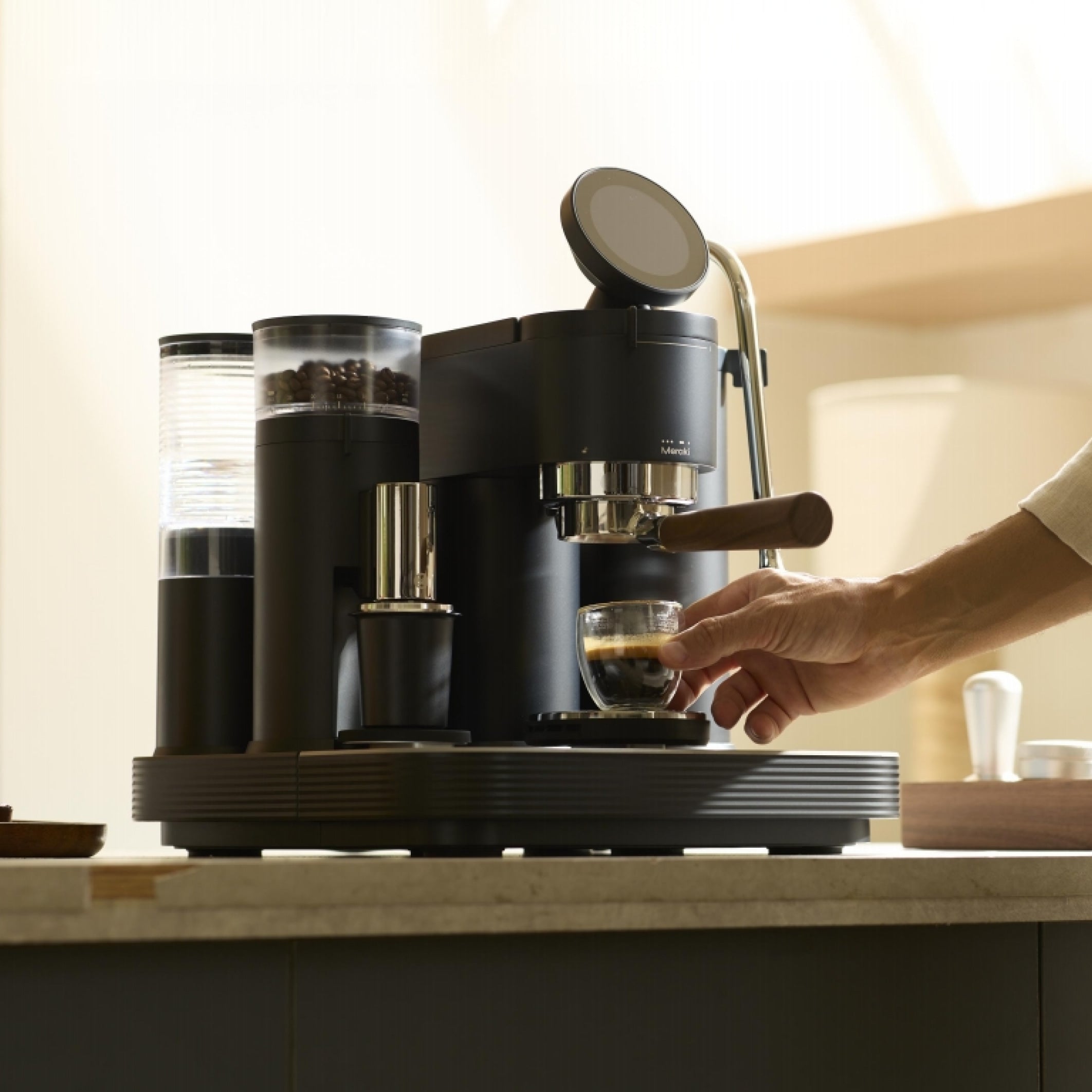
Must: stable brew temperature for your drink pace, espresso-capable grind path, usable portafilter workflow, and steam that matches your milk volume. Nice: vanity lights, giant drip trays, novelty baskets. Process steps beat feature lists: weigh → grind → distribute → tamp → extract → steam → wipe.
A bottomless portafilter is a learning tool, not a requirement on day one. A scale is closer to mandatory if you want repeatable semis. Accessories: accessories collection.
Dual boiler / grind / steam tradeoffs
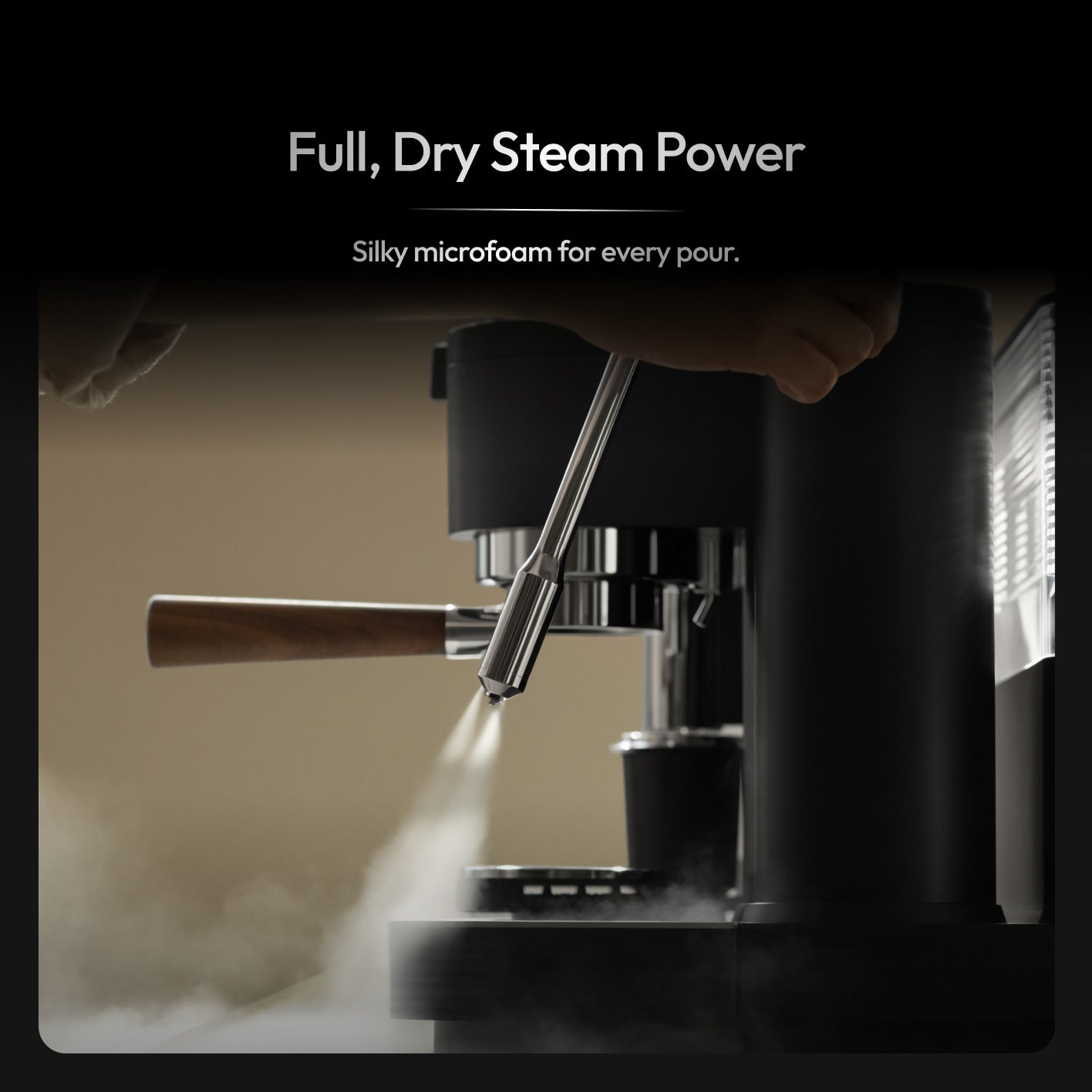
On a semi-auto, dual boilers remove the brew-then-wait-then-steam shuffle. Grind quality still dominates taste. Vibratory vs rotary pumps feel different; Meraki uses a commercial rotary pump for steady ~9 bar. Water care: CDC, EPA WaterSense.
Steam without technique still makes hot milk. Budget practice time the same way you budget for baskets. Dual boiler without grind skill is an expensive kettle with a portafilter.
Semi vs super-automatic vs all-in-one
| Type | Control | Convenience | Watch-outs |
|---|---|---|---|
| Semi-automatic | High | Medium | Needs grind skill |
| Super-automatic | Low–medium | High | Milk-path cleaning; flavor ceiling debates |
| Measured all-in-one | Guided high | High for footprint | Evaluate integrated grinder quality |
Pick the column that matches weekday mornings, not vacation-brain optimism. If you will not tamp, do not buy a bare semi to look serious.
Budget tiers and ownership cost
Entry semis tempt with low stickers—budget a grinder. Mid tiers add PID, better steam, or dual boilers. Ownership includes baskets, cleaning tablets, descaling, and beans from a real roaster rotation (beans collection). Habit context: Harvard on coffee. Time cost: five careful minutes beats fifteen dumped shots.
Buyer checklist
Want puck prep? Grind plan ready? Dual boiler needed for milk overlap? Counter depth OK? Wand wipe habit realistic? Warranty/support path clear? If any answer is fuzzy, pause before checkout.
Where Meraki fits
Meraki fits as a guided semi-style all-in-one: burr grinding to built-in scales, dual boilers, rotary pump, professional steam wand, touchscreen steps. Disclosure: Meraki product path, not a secret independent bake-off. View the Meraki espresso machine. Guides: machine guides. Sensory: Coffee Review; composition: Coffee & Health; craft: Perfect Daily Grind; caffeine: Harvard caffeine.
Mistakes to avoid
Ignoring the grinder. Expecting super-auto convenience from a bare semi. Skipping distribution and blaming the PID. Never purging the wand. Buying dual boiler “for later” when you only drink Americanos. Learning curve denial—plan practice bags of beans.
Learning-curve timeline (realistic)
Day 1–3: learn weigh, grind, tamp, and a classic time window without milk. Day 4–7: introduce steam while dual boilers (if you have them) keep brew ready. Week 2: change one bean and re-dial. Month 1: set a cleaning and descaling reminder. That timeline is kinder than expecting café muscle memory overnight.
Common semi-auto support tickets are really grind tickets: blond fast shots, choking, channeling jets. Fix particles and distribution before rewriting temperature myths. Keep a WDT tool and a brush beside the machine so the fix is physical, not theoretical.
If your household needs button simplicity for guests, consider a super-auto for them and keep semi-auto for yourself—or choose a guided all-in-one that still teaches weighing. Hybrid social setups beat forcing one personality on everyone.
Continue with Meraki’s semi-automatic home guide for adjacent angles without duplicating this control-boundary page.
Semi-auto daily script
Power on. Wait for brew-ready (and steam-ready on dual boilers). Weigh dose. Grind. Distribute. Tamp. Pull to yield. Steam if needed. Wipe wand. Knock puck. Rinse portafilter. That script is the product. Features only help if they shorten or stabilize steps inside it.
Single-boiler semis can still succeed for Americano-first homes: brew, then switch to steam, accept the wait, or batch milk differently. Dual boiler semis shine when the script includes overlapping steam. Name your script before naming your boiler count.
For accessories that make the script less messy—knock boxes, WDT, brushes—use the accessories collection. For category literacy, stay inside machine guides rather than retailer PLPs that only sort by price.
Semi-auto myths to retire
Myth: PID alone makes café espresso. Reality: grind and distribution dominate. Myth: dual boiler is required for beginners. Reality: helpful for milk overlap, optional for straight shots. Myth: bottomless portafilters are mandatory. Reality: they are diagnostic tools. Myth: more pressure is always better. Reality: stable ~9 bar class performance beats uncontrolled spikes.
Replace myths with a weekly review: three tasted shots logged, wand wiped every milk drink, hopper or dosing cup cleaned, water topped with care. That review beats forum arguments.
If you outgrow a single-boiler semi, upgrade boilers or move to a measured dual-boiler all-in-one—do not first buy exotic baskets while the grind remains chaotic.
Control map in practice
On a semi-automatic, you own four dials even when the machine hides them behind good design: grind size, dose mass, distribution quality, and shot cut-off. Temperature and pressure are mostly the machine’s job once warmed. People who feel overwhelmed are usually changing all four dials plus steam technique in the same morning. Freeze three, move one.
A weekday template helps. Power on while you drink water. Weigh beans. Grind. Distribute with a few needle stirs if you channel. Tamp level. Start the shot when boilers are ready. Cut near your yield. Steam only after the espresso tastes intentional. Wipe. That template is the curriculum; dual boilers simply remove waiting inside it.
Compared with super-automatics, you gain the ability to rescue a shot mid-stream and to adapt to a new bag by Friday. Compared with levers, you gain pump consistency and usually better steam for milk households. Compared with capsules, you gain freshness and less packaging—at the cost of skills.
Meraki’s guided all-in-one keeps those four dials visible via scales and grind settings while dual boilers and a rotary pump hold the machine side steady. It is still semi-style responsibility with less chaos. Evaluate it on control clarity, not on novelty screens alone: Meraki espresso machine.
Support reality: keep brushes and a knock box within arm’s reach (accessories). A semi-auto that is annoying to clean becomes a monument. If your counter cannot hold the workflow tools, the machine choice is already wrong.
Conclusion
Semi-automatic means you own the puck and the shot timer while the machine owns heat and pressure. Buy it for control—and solve grinding on day one.
See guided semi-style control on the Meraki espresso machine or compare categories in semi vs super vs all-in-one.
FAQ
What is a semi-automatic espresso machine?
A semi-automatic lets you control grind, dose, distribution, tamp, and when the shot starts and stops, while the machine provides heated water and pump pressure. It sits between manual levers and fully automatic button workflows.
Semi-automatic vs fully automatic?
Semi-automatics keep you in the loop on preparation and shot timing. Fully automatic / super-automatic machines grind and brew with minimal intervention and often automate milk. Choose based on control versus convenience.
Do I need a separate grinder?
You need espresso-capable burr grinding. Some semi-autos include a built-in grinder; others expect a separate unit. Blade grinders remain a poor match.
Is dual boiler necessary on a semi-auto?
Not mandatory for straight shots, but dual boilers shine when you make milk drinks often and want brew and steam together. Single-boiler semis require waits or careful sequencing.
How hard is the learning curve?
Expect days to weeks of dial-in practice, not a single perfect morning. Distribution and grind changes are the main skills. Guided all-in-one semis can shorten early mistakes without removing taste decisions.
More on this topic: Espresso Machine Types & Upgrades.


