


Field question from a weekday kitchen: “If I set the timer for 6:45, why does the pot still taste tired by the second cup?” Case A loads yesterday’s pre-ground into a glass carafe on a keep-warm plate and blames the beans. Case B treats the programmable coffee maker as a workflow tool—fresh grind timing, carafe choice, auto-off—and only then decides whether drip is even the right lane versus espresso.
This guide owns timers, presets, and morning logistics. It is not a cloned drip roundup and not a glass-vs-thermal deep dive (that lives next door). Related Meraki reading: what is a programmable espresso machine, machine guides.
Who should buy a programmable coffee maker
Households that drink drip or filter coffee on a fixed schedule and want water heating to start without standing at the counter.
Skip delay-start obsession if you already grind-to-order in two minutes, or if your real craving is espresso milk drinks.
Gift buyers should confirm the recipient finishes pots quickly enough for glass, or prefers thermal. Literacy: NCA, SCA.
What the timer actually changes in morning workflow
A timer mainly changes when heat and water start, not extraction chemistry. If grounds sit uncovered for hours, volatile aromatics fade before brew begins—so delay start with overnight pre-ground is a convenience trade, not a flavor upgrade. Better morning workflows: weigh beans the night before, grind at wake-up, or accept flatter coffee for the sleep you gain. Education: SCA education; sensory language at Coffee Review.
Must-have specs vs nice-to-haves
Must-haves: a carafe that matches sip pace (glass + plate vs thermal), clear water-level marks, brew temperature competence, and auto-off so a keep-warm plate cannot cook coffee for hours. Nice-to-haves: app schedules, fancy presets, oversized carafes you never finish. Filter paper cost and descaling rhythm belong in ownership math, not after the return window. Water: CDC water quality, EPA WaterSense.
Budget tiers and ownership cost
Entry timers add clocks to basic drip machines. Mid tiers improve shower screens, temperature stability, and thermal options. High-end drip can earn specialty attention—still a different job from espresso. Ownership cost includes filters, descaling solution, electricity for keep-warm plates, and wasted beans when delay-start coffee goes unfinished. Habit context: Harvard on coffee, composition notes at Coffee & Health.
When a drip timer is wrong and espresso or all-in-one is right
| Need | Programmable drip | Espresso / all-in-one |
|---|---|---|
| Batch black coffee at 7:00 | Strong fit | Overkill unless you also want shots |
| Latte / cappuccino microfoam | Not the method | Steam wand + espresso required |
| Fresh grind every cup | Possible, but timer often fights it | Built-in or separate burrs shine |
| One footprint, guided milk drinks | No | All-in-one lane |
| Lowest ritual on weekdays | Often yes | Only if workflow is guided |
Engineer take: do not buy dual-boiler dreams to fix a drip keep-warm plate problem—and do not buy a drip timer hoping it will foam oat milk.
Kitchen constraints
Measure height under cabinets for thermal carafes, confirm outlet access for early-morning starts, and plan where the filter basket lives so delay-start loading is not a midnight scavenger hunt. Noise is usually mild versus grinders. Accessories that support espresso stations live in the accessories collection.
Buyer checklist
Carafe type matched to hold time? Auto-off present? Water marks readable at 6 a.m.? Filter supply planned? Descale path clear? Honest drink list (black drip vs milk drinks)? Beans plan from a real roaster—browse the beans collection if you need a shortlist.
Where Meraki fits (honest bridge)
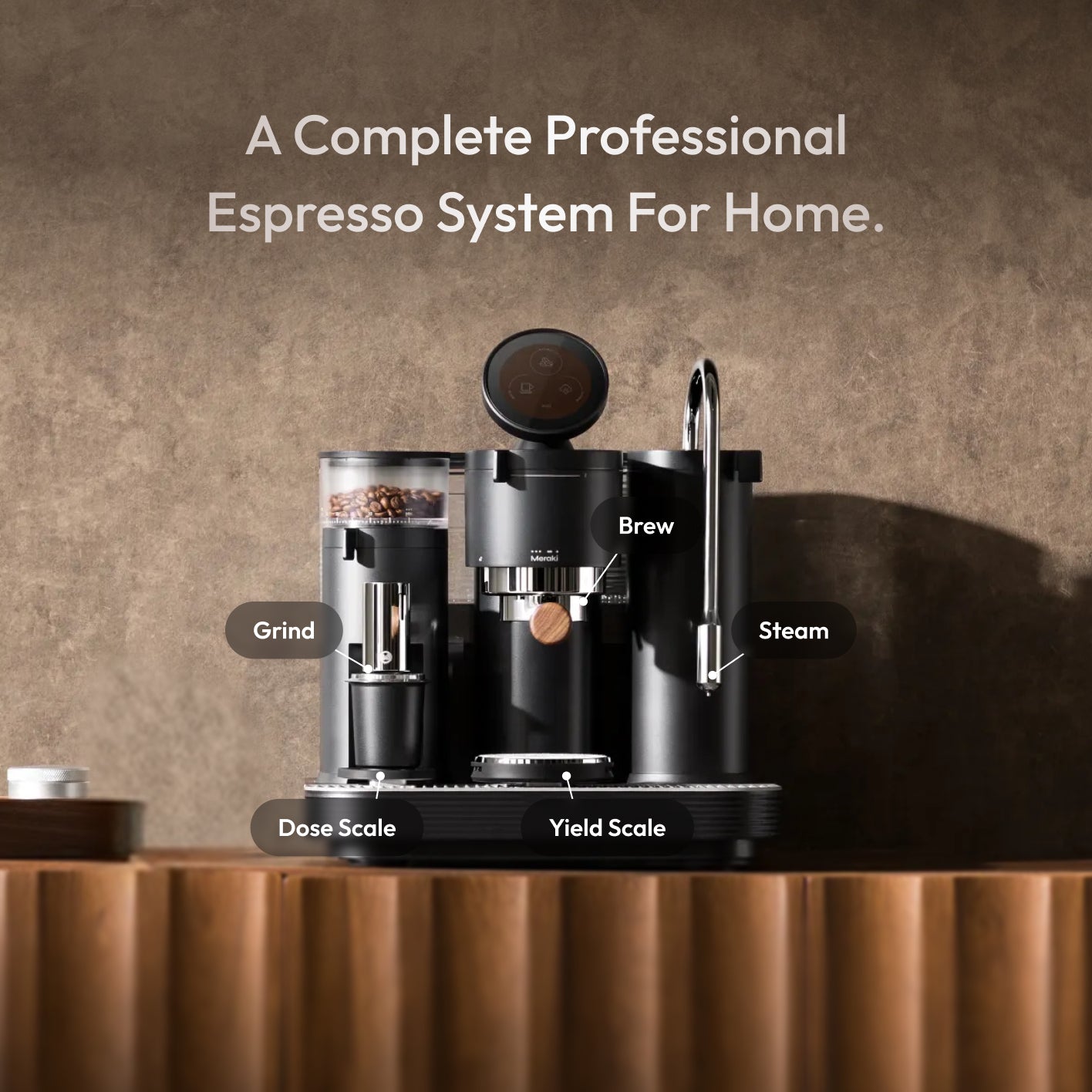
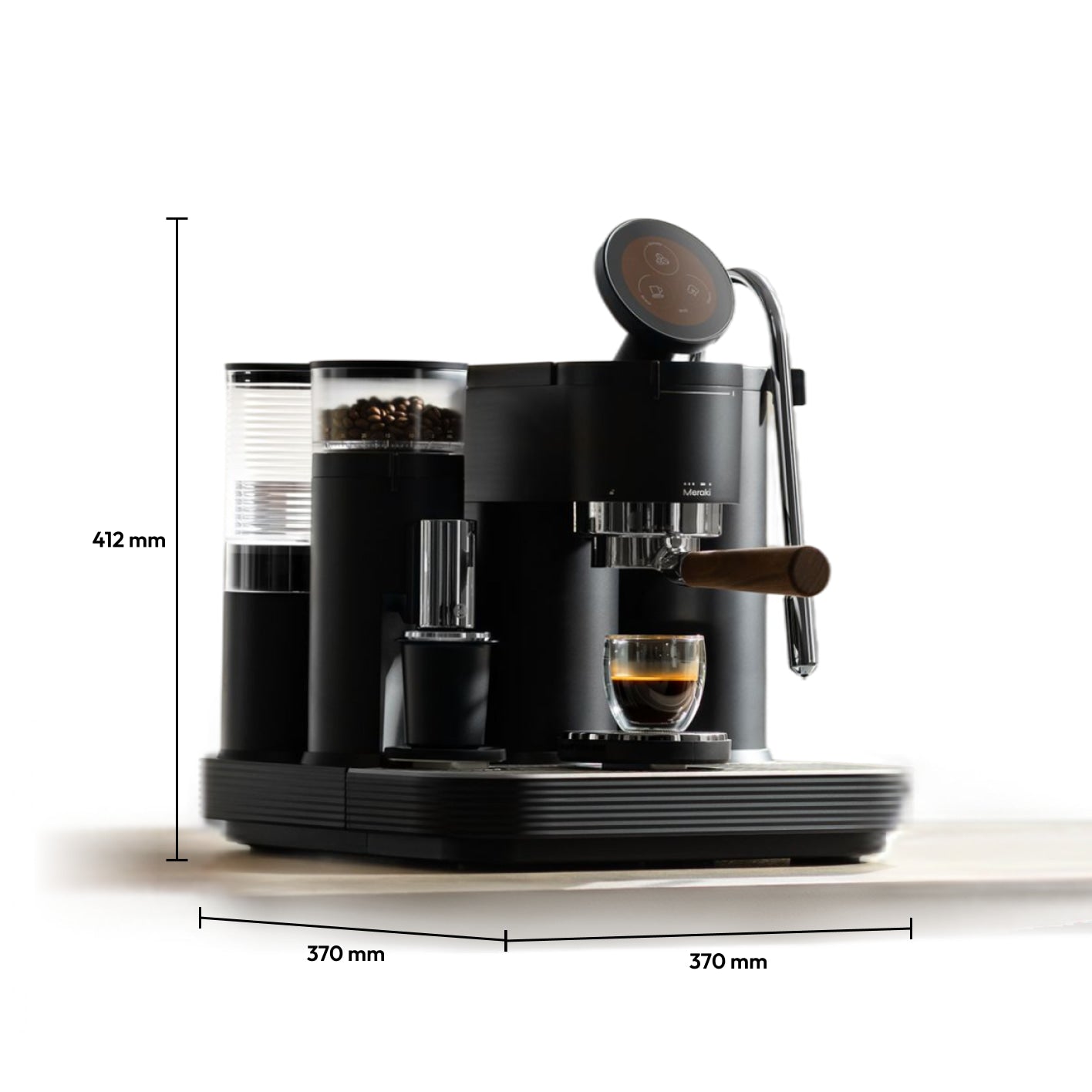
Meraki is not a programmable drip coffee maker. If your timer search is really a latte search, Meraki’s lane is measured espresso: TIMEMORE co-developed burr grinder, dual boilers, commercial rotary pump at a steady 9 bar, built-in dual scales (±0.2 g), and guided grind→brew→steam workflow. Disclosure: this article compares tool classes with Meraki as the espresso/all-in-one example, not a drip SKU ranking. See the Meraki espresso machine. Craft media: Perfect Daily Grind.
Mistakes to avoid
Overnight pre-ground as a default without tasting the aroma loss. Leaving glass carafes on keep-warm until the coffee tastes stewed. Buying programmable drip for latte art. Skipping descaling until flow slows to a trickle. Fast Q: worth it? When drip schedules match your life. Pre-ground delay? Convenience tax on flavor. Glass vs thermal? Match hold time. vs espresso for milk? Different sport. Descale? Per hardness and manual.
Presets, auto-off, and keep-warm discipline
Presets that remember brew strength or cup volume help households share one machine without renegotiating every morning. Auto-off is the quiet feature that prevents a glass carafe from tasting like roasted cardboard after a forgotten commute. If your model offers a short keep-warm window, treat it as a grace period, not a desk heater. Pair presets with a written bean dose so guests do not reinvent the recipe.
Ownership also includes filter inventory and a descaling calendar tied to your water hardness—not vibes. Soft water still leaves oils; hard water adds scale that slows flow and mutes sweetness. Keep a simple log: brew date, grind freshness, and whether delay start used pre-ground coffee. Patterns appear faster than memory.
All-in-one vs separate morning stacks (drip edition)
A programmable drip maker is already an all-in-one for filter coffee: reservoir, heater, basket, carafe. Adding a separate burr grinder raises flavor if you grind at start time. Adding a milk frother does not turn drip into espresso; it only heats milk for café au lait style drinks. When the household split is “one person wants lattes, one wants a pot,” plan two methods or one espresso-capable system rather than overloading a timer drip machine with expectations it cannot meet.
Delay-start rituals that protect flavor
If you insist on waking to a finished pot, measure beans into a sealed container the night before and grind at the last possible moment—even thirty seconds of grinding before brew beats eight hours of stale grounds in an open basket. Some households pre-fill the reservoir and basket with whole-bean readiness nearby; others accept flatter coffee for the sleep. Neither choice is moral failure; only silent oxidation is dishonest marketing.
Keep-warm plates are useful for ten to twenty minutes, not for an entire work-from-home morning. Thermal carafes on programmable chassis solve the same problem without baking. When your programmable coffee maker offers both carafe styles, buy for sip duration. When it offers only glass, commit to finishing pots or pouring into a separate thermos.
Descaling calendars belong on the same mental shelf as filter reorders. Hard water areas may need monthly attention; soft water areas still accumulate oils in baskets. A slow stream and muted sweetness are often scale stories, not sudden bean betrayals. Pair the timer convenience with maintenance boredom and the machine stays worth the counter space.
Conclusion
Buy a programmable coffee maker when timed drip is the drink; treat the timer as workflow, not magic; switch lanes when milk drinks and espresso control are the real morning goal.
If espresso milk drinks are the destination, explore the Meraki espresso machine, or keep comparing programmable espresso concepts in this machine guide.
FAQ
Is a programmable coffee maker worth it?
It is worth it when a delay-start timer reliably matches how you already brew—fresh grounds, correct carafe, auto-off—and you mainly drink black drip at a set time. It is less worth it if you want milk drinks, dialed espresso, or you leave pre-ground coffee oxidizing overnight every weekday.
Should I use the delay start with pre-ground coffee?
You can, but aroma fades while grounds sit in the basket. Better: grind just before brew, or accept that delay-start coffee tastes flatter than fresh-ground drip. Overnight pre-ground is convenience, not peak flavor.
Glass vs thermal carafe on a programmable machine?
Glass with a keep-warm plate shows the level and suits pots you finish soon; thermal carafes hold heat without baking on a plate. Pick the carafe for how long the pot sits, not for the timer alone.
Programmable drip vs espresso machine for lattes?
Programmable drip makes batch coffee; it does not pull pressurized espresso or texture microfoam. For lattes and cappuccinos, choose an espresso path with a real steam wand—or an all-in-one system—instead of hoping a drip timer will cover milk drinks.
How often should I descale a programmable coffee maker?
Follow the maker’s schedule and your water hardness. Hard water and daily use usually need more frequent descaling than soft water and occasional pots. Filters and carafe washing still matter between descales.


