


What a 600ml pitcher is sized to do
A 600 ml pitcher, about 20 US fluid ounces, is a large working jug, not a default for every home drink.
It is sized to hold enough milk for a generous latte, a tall cup, or two smaller milk drinks if you do not overfill — plus a little room to stretch foam. It is not automatically “more professional,” and it is not a better teacher of latte art than a jug that matches one everyday drink. Meraki already has a general pitcher-size guide; this page stays on when 600 ml is the right size and when it is too big.
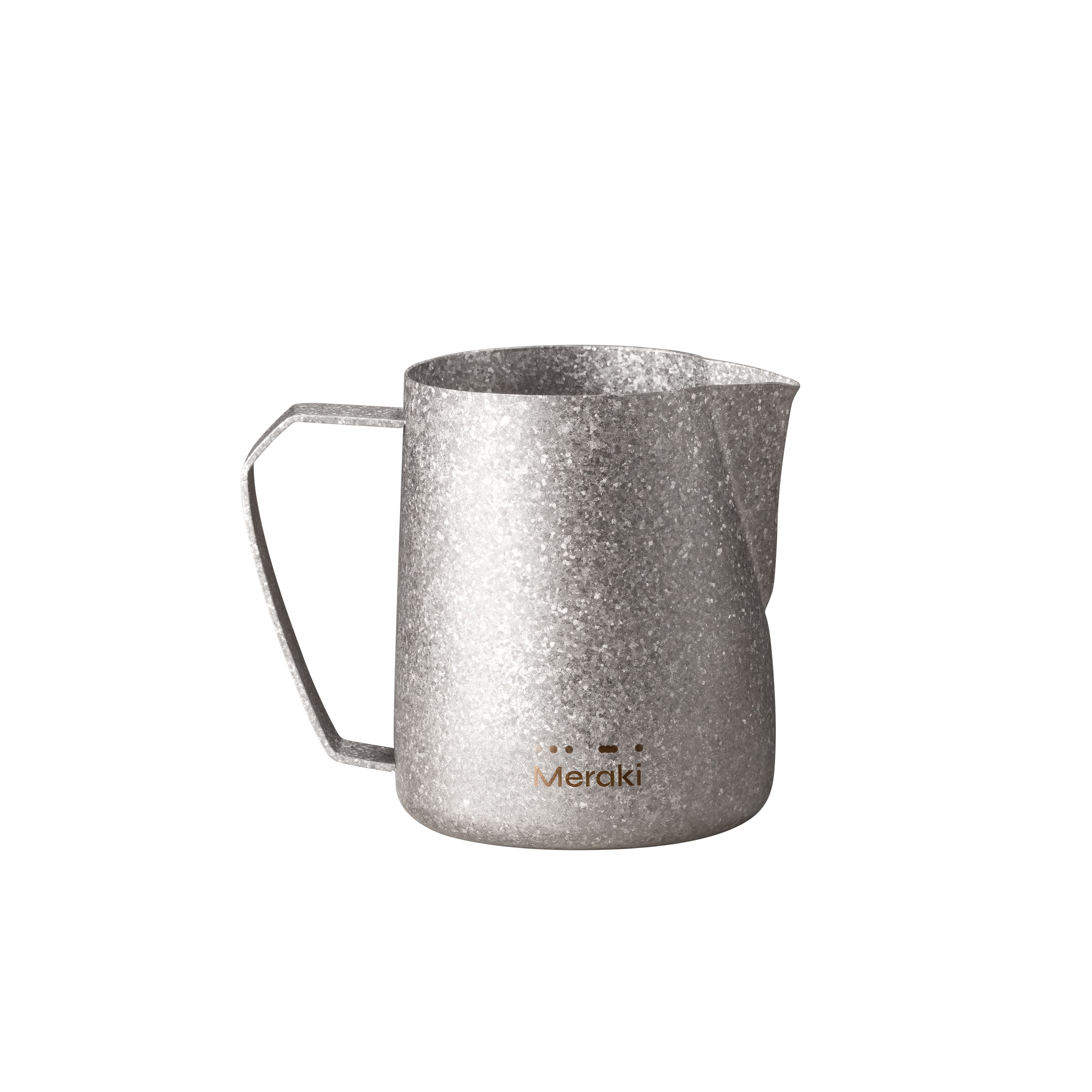
Meraki publishes this guide and also offers a 600ml titanium milk pitcher. That product is ours. This article is about volume, not alloy. Recheck the live listing on 23 November 2026 (Asia/Shanghai) or later for current details.
Stretching a larger volume without blowing the foam
More milk takes longer to stretch, and it is easier to inject too much air at the start.
Keep the wand tip shallow only for the brief stretch, then bury it and roll the milk until the pitcher is hot enough to stop. A large surface of milk can hide a rushed stretch: the top looks fine, the bottom is still cold and thin, or the whole jug is a stiff foam. Stop earlier than you think if the milk is already shiny and sweet. Overheated milk in a 600 ml pitcher is just a larger batch of dull milk.
If you only need a small drink, do not fill the jug to look “full.” A shallow layer in a tall pitcher is harder to roll than the same milk in a smaller jug. That is the usual way a 600 ml pitcher becomes too big.
You can also over-stretch a large batch because you are waiting for the whole jug to feel hot. Heat is not evenly distributed in the first seconds. Watch the surface of the milk, not only the handle. If the foam is already stiff and the body is still cold, you have added too much air too soon. Stop, pour off a practice glass if you need to, and start a smaller, cleaner pitcher the next time rather than “saving” a blown batch.
One drink versus a small queue of lattes
600 ml earns its place when you are steaming for more than one modest cup, or for one genuinely large drink.
A single cappuccino or a small flat white is often easier in a smaller pitcher. A large latte, a tall mug, or two drinks poured one after the other can justify 600 ml — if the milk quality still holds for the second cup. If the second drink would be tired, hot foam, steam two smaller batches instead of one oversized one.
Match the jug to the cups you actually pour into. A 240 ml cup and a barely filled 600 ml pitcher are a mismatch. A large mug and a 600 ml jug can be a fit.
| Situation | 600 ml is often a fit | 600 ml is often too big |
|---|---|---|
| One small cappuccino or cortado | Only if you fill just the milk you need and already like a large jug | Usually — a smaller pitcher is easier to roll and pour |
| One large latte or tall mug | Yes, if you leave room to stretch | If you fill it to the brim and cannot control the stream |
| Two smaller milk drinks | Yes, when you can keep the milk quality through both pours | If the second drink would be leftover, overheated foam |
| Learning latte art | After you already pour well with a smaller jug | As a first pitcher, when the extra weight and low fill fight you |
When a smaller pitcher is easier to control
Control comes from milk depth, wrist angle, and a spout you can see — not from maximum capacity.
A smaller jug keeps the milk closer to the spout, so the stream starts with less tilting. That is why many home routines start in the mid sizes and only step up when the drink actually needs more volume. If your patterns break because the stream surges, or you run out of wrist comfort before the design is done, try the smaller pitcher before you blame technique alone.
The general size-matching rule still lives on Meraki’s pitcher-size article. Use that page for the broader chart; use this page to decide whether 600 ml is the working volume you actually need.
Spout, weight, and wrist fatigue
A larger pitcher is heavier once it has milk in it, especially late in a long pour.
If your wrist tires, you may slow the pour or roll the spout off line. That is a size-and-fill problem as much as a strength problem. Filling 600 ml to the top makes it worse. Leaving a usable headspace, and stopping at the drink you planned, keeps the jug manageable. A pointed, clean spout still matters more than the printed capacity.
Latte-art context from the Specialty Coffee Association education hub and the National Coffee Association’s brewing overview will not size the jug for you. Your drinks will.
Material choices, including titanium and steel
Material changes feel in the hand. It does not change the volume math.
Stainless steel is the common home standard. Meraki’s live 600 ml pitcher is a titanium-alloy option; that is a weight-and-feel choice, not a reason to buy 600 ml if the size is wrong. This article will not invent metallurgy or purity claims, and it will not rewrite a material comparison. If you already know you want 600 ml, compare finishes on the live product page. If you do not yet know you want 600 ml, decide the size first.
A simple ‘fill line’ habit for consistent drinks
Pick a fill line for each drink you actually make, and repeat it.
Use the same cup, the same splash of milk, and a mark you can see — a change in the wall, a scratched line you added yourself, or simply “just above the spout weld.” Steam only that amount. The 600 ml number is the ceiling of the jug, not the target for a small cappuccino. If you need two drinks, decide whether one fill still tastes good at the second pour; if not, fill twice.
Household references such as NIST are only a reminder that 600 ml and 20 fl oz are near each other, not identical to the last drop. Your fill line should be visual and repeatable, not a laboratory volume.
When to own two sizes rather than one compromise
One 600 ml pitcher is a compromise if most of your drinks are small.
Own 600 ml as the large jug, and keep a smaller pitcher for everyday cappuccinos, if you regularly do both. One mid-size jug is enough if you almost never steam a large drink. Buying 600 ml “to grow into” often means months of fighting a half-empty pitcher. Household pages such as Energy.gov will not settle that cupboard decision.
If guests sometimes want a large latte and you mostly drink small cappuccinos, two pitchers sound extravagant until you count the wasted milk and broken pours from the wrong jug. Keep the large one dry until the drink needs it. The 600 ml pitcher should be a tool you reach for on purpose, not the only jug left on the drip tray.
On a Meraki espresso machine, learn the wand’s strength with a familiar fill first. Beans from Meraki’s coffee beans collection should be matched to the drink, not to the jug’s printed capacity. Broader coffee context from the National Coffee Association’s About Coffee site can help with the coffee; it will not pour the milk.
A size checklist
Decide with last week’s drinks, not with a catalogue photo.
- List the milk drinks you make most often, and the cup sizes you pour into.
- If that list is mostly one small drink, start smaller than 600 ml.
- Choose 600 ml when you regularly steam a large drink or two drinks that still taste good from one batch.
- Set a fill line so you never treat the rim as the target.
- If the jug feels heavy or the stream surges, reduce the fill or use a smaller pitcher — do not just pour faster.
- Add a second size only when one jug is clearly wrong for a drink you make often.
Conclusion
A 600 ml, about-20-ounce milk pitcher is the right size for larger drinks or a short queue, and too big when you are rolling a small amount of milk in a tall jug. Decide by the cups you already use, keep a repeatable fill line, and treat material as a secondary feel choice. Meraki’s live 600ml pitcher is one option at that volume; the general size guide remains the place for a full size chart.
FAQ
Is a 600ml milk pitcher the same as a 20 oz pitcher?
They are close. 600 ml is about 20 US fluid ounces, but the two markings are not identical to the last drop. Treat 600 ml / 20 oz as a large home size, and use a repeatable fill line rather than the rim.
When is a 600ml milk pitcher too big?
It is often too big for a single small cappuccino or cortado, especially if you underfill a tall jug and then struggle to roll the milk or control the stream. In that case, a smaller pitcher is usually easier.
Can I steam two lattes in a 600ml pitcher?
Yes, if the volume fits and the milk still tastes good for the second pour. If the second drink would be leftover, overheated foam, steam a smaller batch for each drink instead.
Should a beginner start with a 600ml pitcher?
Usually no, if most practice drinks are a single small or medium cup. Learn control in a smaller jug first, then step up to 600 ml when the drinks actually need that volume.
Does titanium make a 600ml pitcher pour better than steel?
Not by itself. Alloy can change weight and feel, but spout, fill level, and technique still do the pouring. Decide the size first, then compare materials on the live product page without invented metallurgy claims.


