


You already decided an all-in-one espresso machine with an integrated grinder might fit your kitchen — and the real risk is not “does it grind,” but whether the built-in mill can dial espresso, dose by weight, survive service, and match the warranty you think you bought.
This Meraki page is a pre-purchase checklist, not another pros-and-cons essay. For trade-offs and cost math you already have integrated grinder pros and cons, is a built-in grinder worth it, and machine-with-grinder vs separate grinder: the honest math. Use this page to interrogate the listing before you compare prices.

Adjustment range is a checklist item — confirm how many espresso-usable steps a listing actually documents, not just a marketing dial photo.
What “espresso machine with integrated grinder buyer checklist” really means for home buyers
A buyer checklist for an espresso machine with an integrated grinder is a pre-checkout filter: burr type, adjustment range, retention behavior, hopper vs single-dose path, serviceability, noise, scale/dose alignment, and whether the grinder is covered under the same warranty as the boilers.
It is not a roundup of “best all-in-ones,” and it is not a rematch of integrated vs separate setups. Those questions already have owners on this site. Here you assume you are leaning toward one chassis that grinds and brews, and you need a short list of questions that turn a glossy product card into a decision you can defend after delivery.
First-time all-in-one buyers usually under-check the mill: they compare steamer photos and pressure badges while the dial-in story stays vague. Treat the keyword as homework before the cart — burr geometry and dose control decide more morning cups than another boiler slogan.
Who this page is for (and who should skip it)
This page is for first-time all-in-one buyers who already lean toward a machine with a built-in burr grinder: apartment kitchens that hate a second tall appliance, milk-drink households that want one guided station, and gift buyers who need a risk list before they enter a card.
Skip it if you still need to decide whether integration beats a separate grinder at all. Start with which setup produces better espresso and Meraki’s controlled built-in vs external grinder comparison method. Also skip if your blocker is counter footprint alone — use compact all-in-ones: what to check first.
If your real question is measurable dose and yield inside one workflow, skim grinder and scale: a more measurable home espresso workflow, then return here for the purchase checklist.
Why this is a pre-purchase checklist (not another pros/cons essay)
Search for “espresso machine with integrated grinder” is crowded with pros/cons posts, worth-it essays, and “best of” roundups. Meraki already publishes several of those angles. The unique job of this page is a checklist angle: the questions you ask the listing before you compare sticker prices.
Disclosure: Meraki publishes this guide and sells the Meraki Espresso Machine, an all-in-one with a TIMEMORE® co-developed burr grinder, 45 grind settings, and grind-to-scale dosing on the live product page (verify current claims the day you buy). We will name Meraki specs only where they illustrate a checklist item. We will not invent competitor grinder specs or prices, and we will not link out to competitor stores. Score every brand — including ours — on the same questions.
Must-have checks before you compare prices
Price comparison without a grinder checklist produces fake savings. An incomplete “machine only” deal can look cheaper until you add a capable espresso mill, a scale that fits the station, and tools you still need week one.
Lock these checks before you open a spreadsheet of dollar amounts:
- Burr type is named — flat or conical burrs for espresso, not a vague “precision grinder” badge with no burr language.
- Adjustment range is documented — how many steps, and whether the brand claims espresso-usable range (Meraki documents 45 grind settings on the product page — re-check live).
- Dose path is clear — grind-by-time, grind-by-weight, or timed pulses only; if weight is claimed, how it aligns with a scale.
- Hopper vs single-dose story — sealed hopper capacity, bean-swap path, and whether single dosing is supported without fighting the chute.
- Retention language exists — or honest silence plus a path to purge/clean; silence plus “zero waste” marketing is a red flag.
- Service and warranty cover the grinder — motors, burrs, and chute issues are not quietly excluded.
Meraki’s current framing pairs an espresso-tailored burr grinder co-developed with TIMEMORE® with dual built-in scales that weigh dose and yield (product page: 1 kg scale capacity · ±0.2 g when checked). Confirm those lines on the live product page and the espresso machine with grinder landing page before you treat them as locked.
Promotional kits change. As of October 26, 2026, Meraki was promoting a current ~$210 gift / upgrader kit with the machine (current offer, not permanent pricing), with gifts that may ship separately. Confirm the live page the day you buy.
Specs that matter in the cup (and vanity specs to ignore)
In the cup, a short list beats brochure length. For integrated grinders, the high-signal specs are burr type, usable adjustment steps, how dose is measured into the basket, and whether retention forces you to purge stale grounds when you change beans.
Translate those into mornings: enough micro-steps to move shot time without jumping from gusher to choke; dose that lands on a scale instead of a scoop; a hopper that does not stale a week of beans overnight if you buy light roasts in small bags. Meraki’s product story emphasizes grind straight onto the built-in scale (auto-dose / grind-by-weight framing) and 45 labeled settings — useful only if you verify the live copy and then test during a trial.
Ignore vanity pressure numbers that never name the pump, award logos used instead of tasting, and “commercial grinder” claims with no burr or setting detail. Category education from the Specialty Coffee Association beats any single badge. For why retention matters when you swap beans, link out to Meraki’s low-retention espresso grinder explainer rather than re-deriving the physics here.
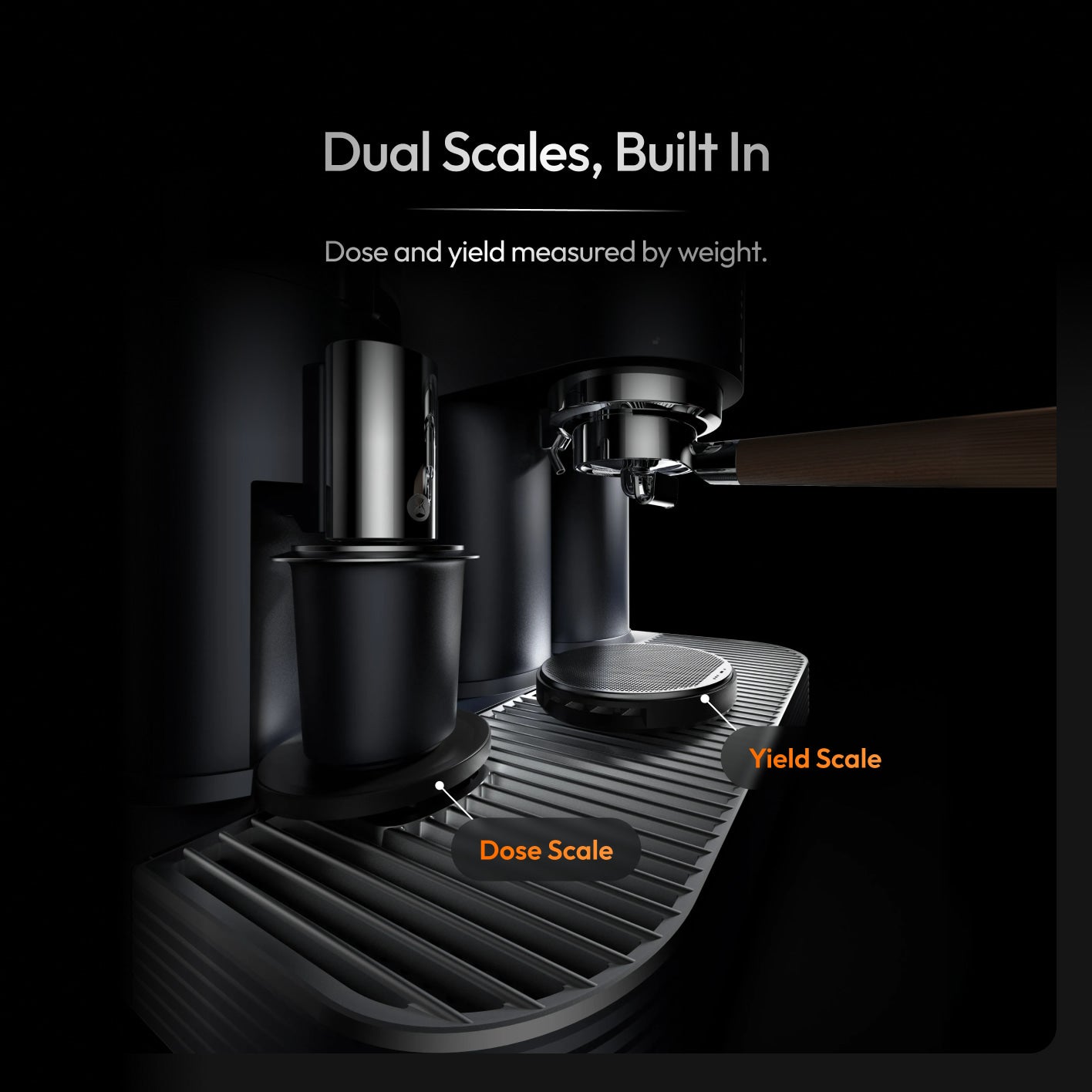
Scale alignment is a checklist item — confirm whether dose and yield are weighed in the machine or still need a separate mat scale.
Setup, shipping, trial, and warranty questions to ask
Ask ownership questions marketing pages bury — especially for a chassis where the grinder cannot be swapped like a separate mill.
Meraki’s shipping policy typically frames free shipping on orders over $200 (except remote / regional surcharges), processing within about three business days, and common delivery windows around 3–7 business days. Orders may split: gifts and accessories can ship separately. Meraki does not ship to PO Boxes. Re-read the live table before checkout.
The 30-day home trial starts on delivery; returns need approval, cleaning, accessories, and packaging. For approved non-DOA U.S. returns, the refund policy has listed a return shipping fee deducted from the refund (U.S. fee listed at $100 when checked October 26, 2026 — confirm the live table). Gifts may need to return with the machine for a full refund.
On warranty, ask three grinder-specific questions: Are burrs, motor, and chute covered under the same limited warranty as the boilers? Is coverage limited to the country of original purchase? Is repair shipping prepaid for approved claims? Meraki describes a 2-year limited warranty from delivery in the country of original purchase, with prepaid return shipping for approved claims — see warranty claim. Optional Seel purchase protection covers transit risk, not a longer grinder warranty. Support: +1 833 854 9555 (Mon–Fri, 9 AM–5 PM EST) via support.
Noise belongs on the checklist even when the pump is quiet: grinding is usually the loudest step in an apartment morning. Ask for honest owner patterns, not a lab dB badge you cannot verify. Meraki markets a commercial rotary pump that “stays quiet” as a vendor claim — treat pump quiet and grinder noise as separate lines.
Budget and total cost of ownership
Sticker price is a down payment on a coffee habit. For an integrated-grinder machine, TCO includes the chassis, any missing tools still required week one, beans, water care if your tap is hard, cleaner, electricity (modest next to beans — see energy.gov), dial-in time, and the exit cost if the mill cannot dial your favorite roast.
| Cost bucket | What to include | Why it changes the integrated-grinder buy |
|---|---|---|
| Machine + missing tools | Current offer; anything still required week one | “All-in-one” that still needs a scale is incomplete |
| Shipping / gifts | Free-shipping threshold; remote surcharges; split kits | Changes arrival timing and all-in math |
| Consumables / year | Beans × drink count; filters; cleaner | High-use homes amortize premiums faster |
| Risk / exit | Trial return fee; gift deductions; grinder downtime | Integrated mills are harder to swap than a separate unit |
| Time | Dial-in; chute wipe-down; bean swaps | Busy households pay in minutes |
As of October 26, 2026, Meraki listed $1,999 with a $1,799 offer on the U.S. product page — re-check before you treat those numbers as live. Same-day on-site signals: ~530 verified reviews, 4.9/5 on key pages, 20,000+ machines / units messaging. Useful social proof, not a substitute for your trial. Measurement near a tenth of a gram cuts wasted shots — NIST is a reminder that measurement earns trust; you need repeatable dose and yield, not a laboratory certificate.
Red flags in product listings and reviews
Watch for blade grinders sold as “espresso ready,” “15-bar” badges with no pump story, setting counts with no espresso range, and “zero retention” claims with no purge or clean path. Compare all-in-one prices only against complete separate stations (machine + espresso mill + scale + tools + terms), not against a bare dual boiler thumbnail.
Prefer review patterns over single glowing or furious posts — dial-in frustration, chute clogs, support response, and whether owners still weigh after week one. Meraki collects feedback on the reviews page. CoffeeGeek’s guides and SCA research help separate skill problems from hardware problems.
Be wary of no-name machines with no service path and no clear country-of-purchase warranty that covers the grinder. Home appliances are not “just metal and a motor” from a safety view — see UL. If a page hides return fees, grinder warranty exclusions, voltage/region, or inclusions, assume the missing line is your surprise cost.
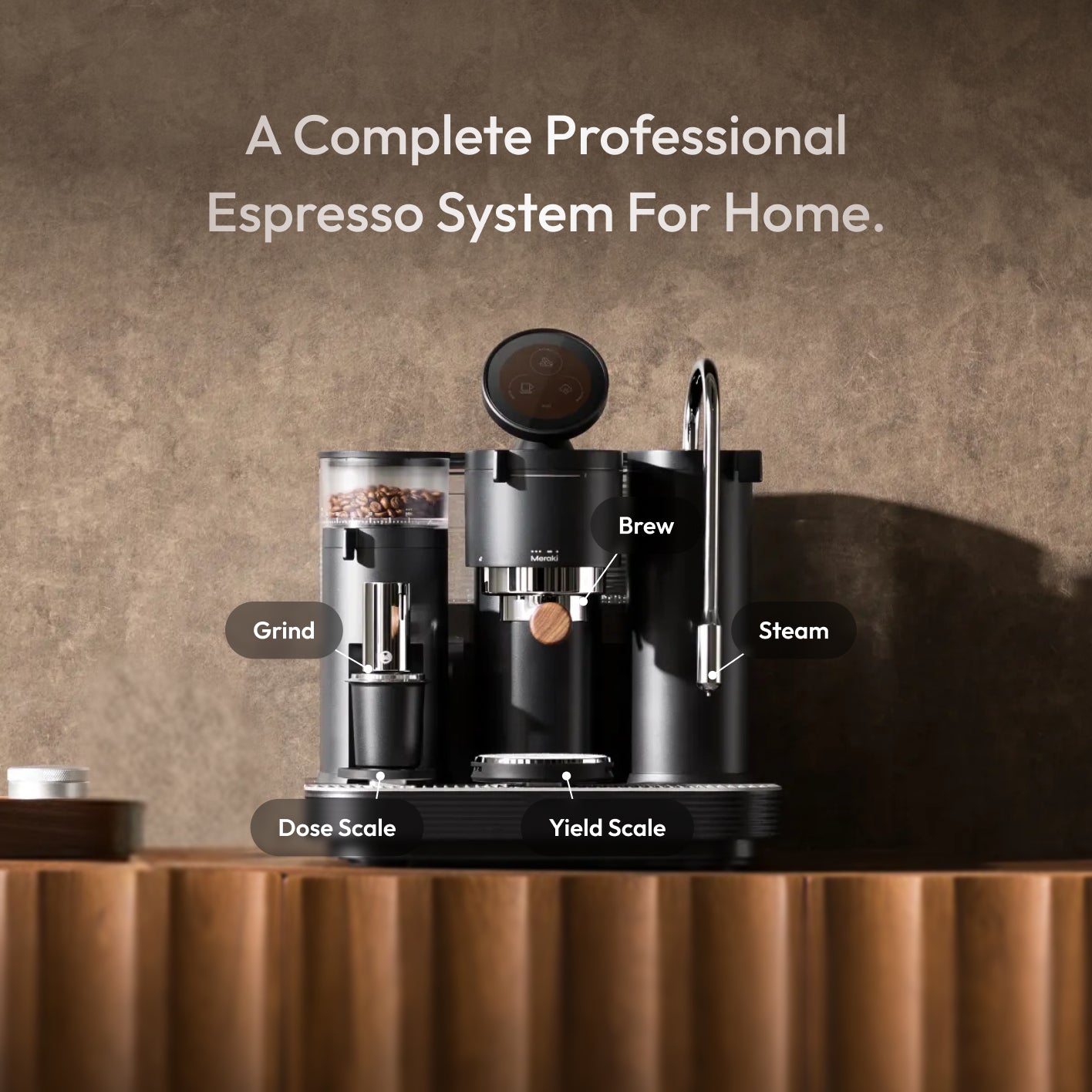
Judge the whole station — grinder, scales, brew, and steam — against a complete separate setup, not a bare chassis price.
A short buyer checklist you can save
Answer yes/no in your own words before checkout:
- I already chose the all-in-one path (if not, read the pros/cons and honest-math articles linked above first).
- The listing names burr type (not only “precision grinder”).
- Adjustment range is documented in numbers I can verify (Meraki example: 45 grind settings on the live product page).
- Dose method is clear: time, weight, or both — and I know whether a built-in scale is part of the story.
- Hopper vs single-dose path matches how I buy beans (small light-roast bags vs weekly hopper fills).
- I have a plan for retention / bean swaps (purge, clean path, or honest low-retention claims).
- Grinder serviceability and warranty coverage (burrs, motor, chute) are written, not implied.
- Noise expectations include grinding, not only the pump.
- My budget still has room for beans, water care, and cleaner — and I priced TCO including exit risk.
- I compared a complete separate station, not a bare machine against an all-in-one kit.
Seven or more clear “yes” answers usually means the integrated-grinder buy is operationally ready. Four or fewer means pause the cart — the missing answers are the real product, not the thumbnail.
Next step: verify on the product page
Open the live Meraki Espresso Machine product page and verify today’s grinder claims (TIMEMORE® co-development, 45 settings, grind-to-scale dosing), price, gift offer, trial language, and warranty highlights. Cross-check the espresso machine with grinder page and the policy pages above. For an independent magazine look at Meraki × TIMEMORE, see Barista Magazine’s test-drive — still not a substitute for your home trial. Broader iF program context (design awards are not dial-in proof): ifawards.com.
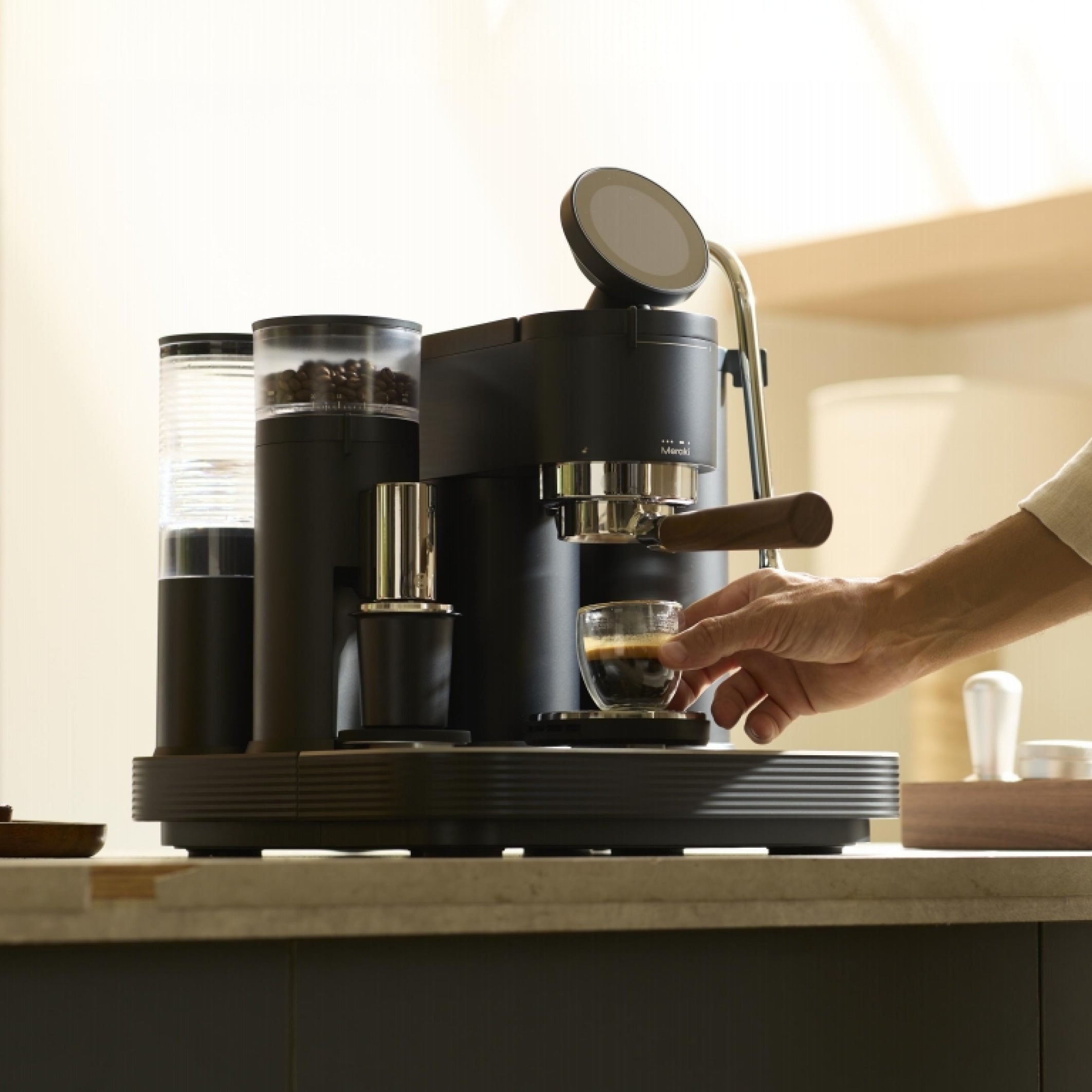
Black Meraki Espresso Machine — confirm finish, inclusions, and live grinder claims on the product page before you pay.
FAQ
FAQ
What should I check first on an espresso machine with an integrated grinder?
Start with burr type, documented adjustment range, and how dose is measured into the basket. Then confirm hopper vs single-dose fit, retention or purge guidance, and whether warranty language covers the grinder motor and burrs — not only the boilers. Price comparison comes after those answers are written on the listing or support pages.
Do I still need a separate scale if the machine has a built-in grinder?
Only if the machine does not weigh dose and yield for you. Some all-in-ones grind by time and still expect a mat scale; others grind onto a built-in dose scale and stop at target. Meraki’s product page describes dual built-in scales (±0.2 g when checked) with auto-dose framing — verify the live copy and decide whether a second scale still helps your workflow.
How many grind settings do I need for home espresso?
You need enough micro-steps in the espresso range to move shot time without jumping from fast and sour to choked. A large setting count with no espresso-usable range is vanity. Meraki documents 45 grind settings on the product page; treat that as a starting map, then dial with taste and time during a trial rather than chasing a magic number.
Is the grinder covered under the machine warranty?
Ask in writing. Some warranties cover the whole chassis; others exclude wear parts or limit motor coverage. Meraki describes a 2-year limited warranty from delivery in the country of original purchase — read the live warranty claim page for inclusions, exclusions, and prepaid repair shipping on approved claims before you assume the mill is covered the way you expect.
When should I buy a separate grinder instead?
Choose separate when you need frequent single-dosing across very different beans, plan to upgrade the mill independently, or want a workflow the integrated chute cannot support. Use Meraki’s honest-math and built-in vs external articles for that decision; this checklist is for buyers who already lean all-in-one and need fewer surprises at checkout.
Conclusion
Buy an espresso machine with an integrated grinder only after the listing answers burr type, adjustment range, dose measurement, hopper vs single-dose fit, retention, serviceability, noise, and grinder warranty in writing. If those lines are missing, you are not comparing products yet — you are comparing marketing photos.
When you are ready to verify Meraki’s own answers against today’s offer, open the Meraki Espresso Machine product page and walk the checklist with the live specs, trial, and warranty in front of you.


