


You open a product page that says all-in-one dual boiler, then another that says three-in-one, then a third that only means “espresso plus drip.” The label is doing marketing work. You need an all in one dual boiler coffee machine definition that states what should actually be included — grind, brew heat, steam heat, measurement, tools, and ownership terms — before the price looks like a bargain.
This Meraki page owns the definition of all-in-one for dual-boiler home machines: inclusion boundaries, compromises worth accepting, and red flags when sellers stretch the phrase. It is not a complete dual-boiler encyclopedia (use the complete home dual boiler guide). It is not Meraki’s dual-boiler-with-grinder purchase filter draft (A025) — that page assumes you already want dual boilers plus a mill and scores listings before price sorting. Soft lanes: A041 for mill-only checklist depth when live; A021–A024 for footprint, heat-up vs shot-ready, hand sequences, and independent-boiler mechanism.
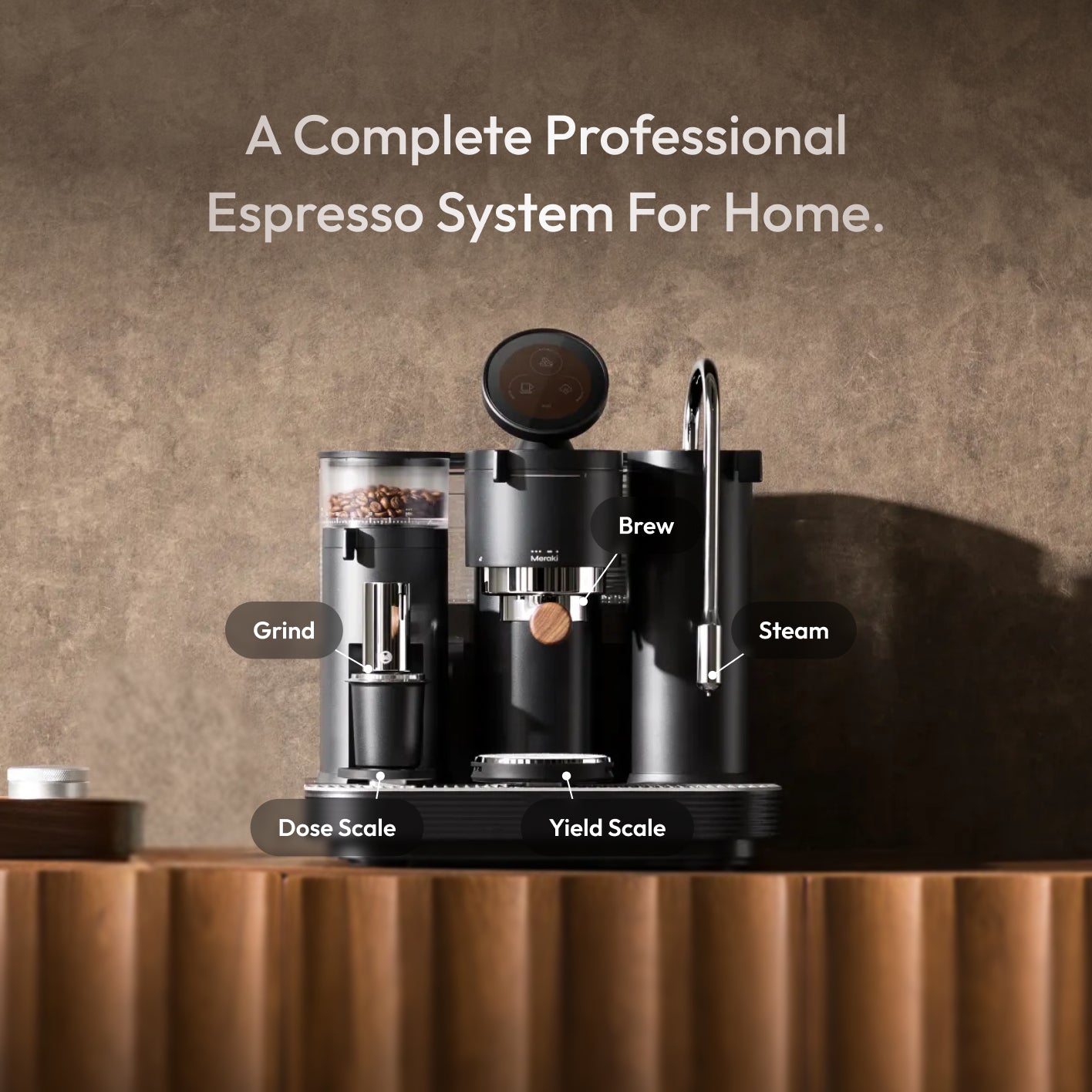
All-in-one dual boiler should mean grind, brew, and steam in one chassis with named heat independence — not a slogan on a shared-heat box.
What “all in one dual boiler coffee machine definition” really means for home buyers
All in one dual boiler coffee machine definition, for home buyers, means one chassis that includes espresso-capable grinding, independent brew and steam heat, usable milk steaming, and enough measurement or tooling to dial a weekday drink — not “two words on a banner.”
Search for the phrase often returns dual-vs-single boiler explainers, Oracle-style product launches, and “all-in-one” combination makers that brew drip coffee beside espresso on shared heat. Those pages define dual boiler or all-in-one separately. They rarely define what both words must include together when a listing wants your deposit. Treat the keyword as a label audit: Does this machine earn “all-in-one dual boiler,” or is it dual boiler without a mill, all-in-one without independent heat, or three-in-one marketing for grind-brew-steam with soft compromises?
Who this page is for (and who should skip it)
This page is for system shoppers comparing “all-in-one,” “three-in-one,” and “grind brew and steam” dual-boiler listings who need a shared definition before they trust a feature list.
Skip the dual-boiler primer — what is a dual boiler espresso machine. Skip full architecture shopping — complete home dual boiler guide and do you actually need a dual boiler. Skip heating-system tables — single boiler vs thermoblock vs dual boiler. Skip Meraki’s dual-boiler-with-grinder buyer filters draft (A025) once the label is already accepted. Skip A021–A024 for footprint, ready-state, hand sequence, and boiler mechanism. Come here when the question is still: what should “all-in-one dual boiler” include?
Why this is a definition of all-in-one (not another dual-boiler encyclopedia)
Dual-boiler guides already explain two tanks. Integrated-grinder pages already talk mills. Retail grids already shout “complete station.” Meraki’s nearest published complete guide owns breadth. A025 (when published) owns filters after you already want dual boilers with a grinder.
This page’s unique job is the definition / inclusion angle: which subsystems must be present for the phrase to mean something at home, which extras are nice but not definitional, and which compromises you accept on purpose. Disclosure: Meraki publishes this guide and sells the Meraki Espresso Machine, an all-in-one with independent dual boilers, a TIMEMORE® co-developed burr grinder, dual built-in scales, and a guided grind → brew → steam workflow. Live materials (October 26–27, 2026 snapshot) also frame a commercial rotary pump at steady 9 bar, heat-up about 3–4 minutes, 45 grind settings, scales near 1 kg / ±0.2 g, and brew/steam volumes 350 ml / 550 ml — vendor published claims; verify live. We name Meraki only to illustrate inclusion. We will not invent competitor inclusion lists, boiler volumes, grind settings, or street prices, and we will not link out to competitor stores. Score every brand — including ours — on the same definition.
What must be included to earn the label
“All-in-one dual boiler” is a bundle claim. If a required piece is missing, you are shopping a dual boiler that still needs a mill — or an all-in-one that still shares heat.
A meaningful home definition should include at least these:
- Independent brew and steam heat — two named heat jobs, not only “dual boiler” on a shared-path or vague “dual heating” box. Overlap language should say brew and steam when both sides are ready.
- Espresso-capable built-in grinding — burr type named for espresso, with a documented adjustment range. Blade mills and unnamed “precision grinder” badges do not earn the grind half of “grind brew and steam.”
- Usable steam for milk drinks — a wand or milk system that can texture the drinks you actually make.
- Dose and/or yield measurement path — grind-by-time, grind-by-weight, built-in scales, or a clear note that a mat scale is still required.
- Day-one tools or an honest “what’s missing” list — portafilter, baskets, tamper story, and whether pitcher or gifts ship separately.
- One ownership story for heat and mill — trial, returns, and warranty covering boilers and the grinder in the country of purchase.
Meraki’s product page pairs independent dual boilers with TIMEMORE® co-developed burrs, grind-onto-scale dosing, and dual scales (snapshot: 45 settings · ±0.2 g). Confirm on the live product page and the espresso machine with grinder landing page. As of October 26–27, 2026, Meraki promoted a current ~$210 gift / upgrader kit (current offer; gifts may ship separately) — confirm live.
Optional but not definitional: rotary vs vibration pump, touchscreen menus, award logos, apps. They can improve ownership; they do not replace the six lines above. Specialty Coffee Association literacy beats any “pro all-in-one” badge that never names heat independence or burr type.
Specs that matter in the cup (and vanity specs to ignore)
In the cup, inclusion shows up as heat you can use twice, a grind you can dial, and a dose you can repeat — not brochure length.
High-signal specs: independent brew and steam heat, steam usable while brew heat stays usable, espresso-usable grind steps, how dose lands in the basket, and whether yield weighing is built in or still expected on a mat. Independent boilers matter for stacked milk drinks. Micro-steps matter when shot time jumps from gusher to choke. Dose-by-weight matters when dual-boiler speed outruns scoop guessing. Meraki emphasizes grind onto the built-in scale and dual scales for dose and yield — verify live, then test in a trial.
Ignore vanity bar badges with no pump story, award logos used instead of tasting, “commercial grinder” claims with no burr detail, and “all-in-one” photos that hide a missing mill. Ignore heat-up minutes that never define “ready” for brew and steam — clock-versus-stability is A022’s lane; your definition check is whether the listing defines ready for both, or only power-on.
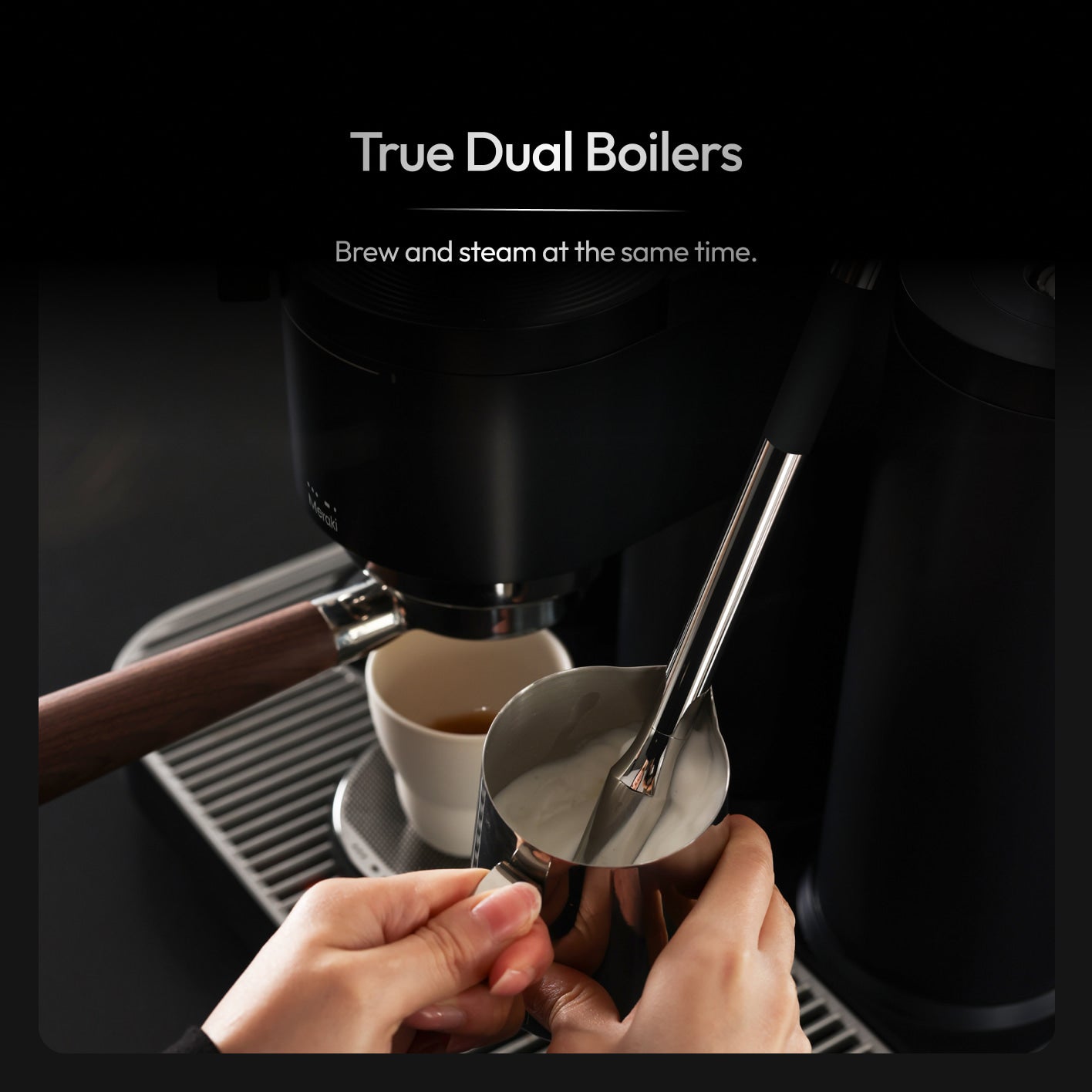
Independent brew and steam heat is the dual-boiler half of the definition — “all-in-one” still needs a real mill and a measurement path.
Setup, shipping, trial, and warranty questions to ask
Ownership terms are part of what is “included.” Incomplete tools, a grinder excluded from warranty, or hidden return fees make the station incomplete even when the metal looks complete.
Meraki’s shipping policy typically frames free shipping on orders over $200 (except remote / regional surcharges), processing within about three business days, and common delivery around 3–7 business days. Orders may split; Meraki does not ship to PO Boxes. Re-read the live table before checkout.
The 30-day home trial starts on delivery; returns need approval, cleaning, accessories, and packaging. For approved non-DOA U.S. returns, the refund policy has listed a return shipping fee deducted from the refund (U.S. fee listed at $100 when checked October 26, 2026 — confirm live). Gifts may need to return with the machine for a full refund. Use the trial as a definition proof week: two milk drinks back to back, one bean swap, and one morning without babysitting temperature lights.
Ask: Do brew boiler, steam boiler, and grinder (motor/burrs/chute) share the same limited warranty? Is coverage limited to the country of original purchase? Is repair shipping prepaid for approved claims? Meraki describes a 2-year limited warranty from delivery in the country of original purchase, with prepaid return shipping for approved claims — see warranty claim. Optional Seel purchase protection covers transit risk, not a longer mill warranty. Support: +1 833 854 9555 (Mon–Fri, 9 AM–5 PM EST) via support. Pump quiet and grinder noise are separate apartment lines; compact-counter depth belongs in A021’s lane.
Budget and total cost of ownership
Sticker price is a down payment. For an all-in-one dual boiler, TCO includes the chassis, anything still missing week one, beans, water care, cleaner, electricity (usually modest next to beans — see energy.gov), dial-in time, and exit cost if the mill or a boiler claim fails.
| Cost bucket | What “included” should cover | What buyers still pay |
|---|---|---|
| Machine + tools | Chassis + day-one tools named on the listing | Anything the “all-in-one” photo hid |
| Shipping / gifts | Free-shipping threshold; whether gifts ship separately | Remote surcharges; delayed kits |
| Consumables / year | Plan beans × drinks, cleaner, water treatment | High-use milk homes amortize dual-boiler premiums faster |
| Risk / exit | Trial, return fees, warranty for boilers and mill | Integrated heat + mill are harder to swap piecemeal |
| Time | Guided workflow or clear manuals | Dial-in; chute wipe-down; soft “dual” waits |
Compromises to accept on purpose: hopper retention vs a separate upgradeable mill; grind-plus-pump noise in one chassis; fewer aftermarket mill choices. Missing independent heat, a blade mill sold as espresso-ready, or a warranty that excludes the grinder break the definition — they are not “normal compromises.”
As of October 26–27, 2026, Meraki listed $1,999 with a $1,799 offer on the U.S. product page — re-check live. Same-window signals: ~530 verified reviews, 4.9/5, 20,000+ machines messaging — social proof, not a trial substitute. Measurement near a tenth of a gram cuts wasted shots (NIST literacy: repeatable dose and yield). Compare all-in prices only against a complete separate station (dual boiler + espresso mill + scale + tools + terms). CoffeeGeek’s guides help separate skill problems from hardware problems in owner reviews.
Red flags when sellers misuse the all-in-one dual boiler label
Watch for “all-in-one dual boiler” that means dual heat without a mill, or a mill without independent brew and steam. Watch for “dual heating system” on drip-plus-espresso boxes sold as dual boiler. Watch for “three-in-one” that never names burr type, steam capacity, or whether grind, brew, and steam can overlap when ready.
Prefer review patterns — dial-in frustration, soft steam after the second latte, chute clogs, support response — over single glowing or furious posts. Meraki collects feedback on the reviews page. SCA research helps extraction literacy; it is not a storefront ranking.
Be wary of no-name machines with no service path and no clear country-of-purchase warranty covering boilers and the grinder. Home appliances are not “just metal and a motor” from a safety view — see UL. Hidden return fees, grinder exclusions, voltage/region, or gift-return rules usually mean the label was marketing fluff.
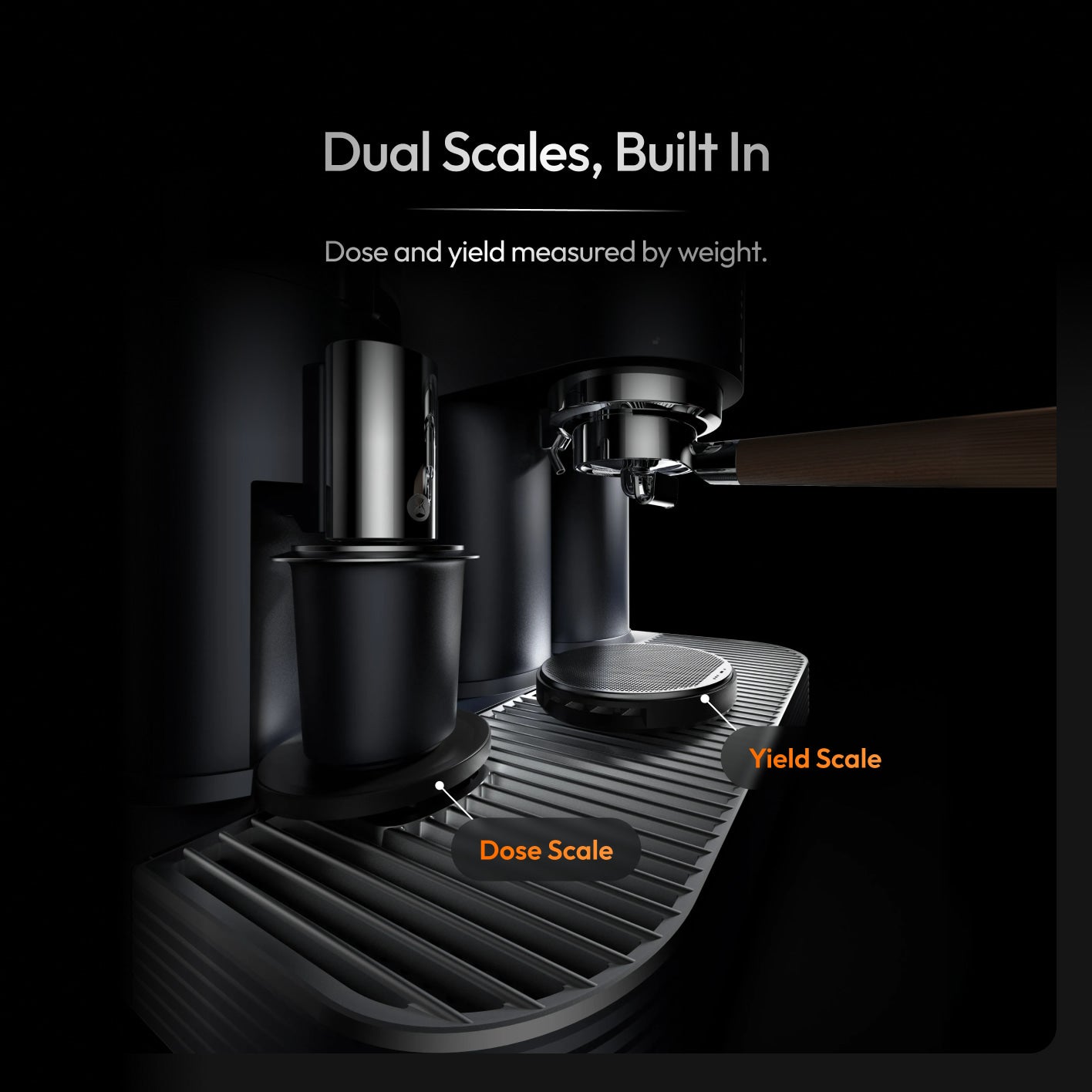
Measurement belongs in a serious all-in-one definition — if dose and yield are undefined, the chassis is incomplete for weekday dial-in.
A short inclusion checklist you can save
Answer yes/no before you trust the label:
- The listing claims all-in-one (or grind + brew + steam) and dual boiler in the same chassis.
- Brew and steam heat are named as independent — not only “dual heating.”
- Overlap / simultaneous language is clear about readiness, not magic.
- The grinder names burr type and documents espresso-usable adjustment (Meraki example: 45 grind settings live).
- Dose method is clear: time, weight, or both — and whether a built-in scale is part of the story.
- Day-one tools are listed, or missing tools are stated plainly.
- Trial, return fees, and gift-return rules are written.
- Warranty covers boilers and grinder (motor, burrs, chute) in my purchase country.
- I accept integration compromises (upgrade path, noise, retention) on purpose — not as surprises.
- TCO still has room for beans, water care, and cleaner — compared against a complete separate dual-boiler station.
Seven or more “yes” answers usually means the label is earned. Four or fewer means pause — missing answers mean you are still shopping marketing photos, not an all-in-one dual boiler.
Next step: verify on the product page
Open the live Meraki Espresso Machine product page and verify today’s inclusion claims (independent boilers, TIMEMORE® co-development, 45 settings, grind-to-scale dosing, dual scales, heat-up framing, what’s in the box), price, gift offer, trial, and warranty. Cross-check the espresso machine with grinder page, the dual boiler espresso machine landing page, and the policy pages above. For an independent magazine look at Meraki × TIMEMORE, see Barista Magazine’s test-drive — not a substitute for your home trial.
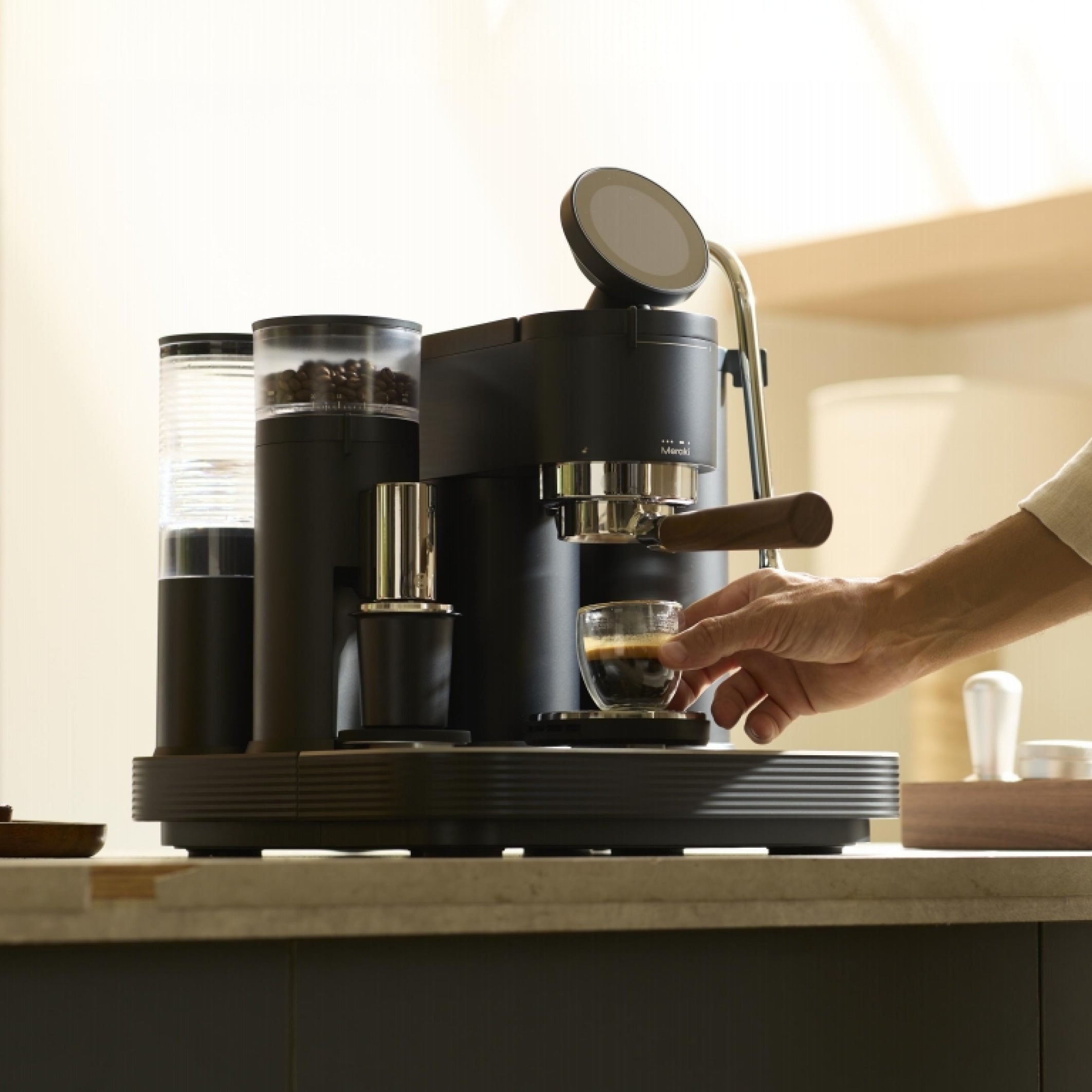
Black Meraki Espresso Machine — walk this inclusion definition against today’s live specs, trial, and warranty before you pay.
What does dual boiler mean in a coffee machine?
Two separate boilers for brew and steam.
A dual boiler keeps espresso water and milk steam on different heat jobs, so you can brew and steam without waiting for one tank to climb and fall — when both sides are ready.
That is the dual-boiler half of this definition. “All-in-one” still needs a real mill, a measurement path, and ownership terms covering heat and grinding. Primer: what is a dual boiler. Mechanism depth sits in Meraki’s independent-boilers lane (A024).
Is it better to have a manual or automatic coffee machine?
It depends on control vs convenience.
Manual or semi-automatic machines give more shot control; more automatic machines reduce steps. Neither type automatically includes dual boilers or a good mill — check inclusion, not the “auto” badge.
For an all-in-one dual boiler, automation is secondary to heat independence, grind quality, and measurement. A guided touchscreen can still earn the label if the metal does. A capsule “all-in-one” is a different category. Match automation to how much dial-in you want, then re-run the inclusion checklist.
FAQ
FAQ
What should an all-in-one dual boiler coffee machine include?
At minimum: independent brew and steam heat, an espresso-capable burr grinder with documented adjustment, usable steam for your milk drinks, a clear dose/yield measurement path, day-one tools or an honest missing-tools list, and trial/warranty language that covers boilers and the grinder in your purchase country. Rotary pumps, screens, and awards can help — they do not replace those inclusion lines.
Is “three-in-one” the same as all-in-one dual boiler?
Only if grind, brew, and steam sit in one chassis *and* brew/steam heat are truly independent. Many “three-in-one” or combination makers mean drip-plus-espresso or shared-heat workflows. Ask for named dual boilers, burr type, and whether brew and steam can overlap when ready before you treat the slogan as a dual-boiler all-in-one.
Does all-in-one dual boiler always include a built-in grinder?
In a meaningful home definition, yes — “all-in-one” without grinding is usually a dual boiler that still needs a separate mill. Some sellers misuse the phrase for machines that only combine brew and steam. If the hopper and burrs are missing, you are not buying a grind-brew-steam all-in-one, even if dual boilers are real.
What compromises are normal with an all-in-one dual boiler?
Expect harder independent mill upgrades, possible hopper retention, and grind-plus-pump noise in one footprint. Those are integration trade-offs. Soft steam after a second latte, a blade mill, undefined “dual heating,” or a warranty that excludes the grinder are not normal compromises — they fail the definition.
How is this different from a dual-boiler-with-grinder buying filter list?
This page decides whether a listing earns the all-in-one dual boiler label (inclusion and misuse red flags). A buyer-filter page assumes you already want dual boilers plus a mill and scores pass/fail checks before price sorting. Use definition first; use filters once the label is honest.
Conclusion
Trust “all-in-one dual boiler” only when the listing includes independent brew and steam heat, espresso-capable grinding, usable steam, a measurement path, honest day-one tools, and ownership terms that cover boilers and the mill. Missing lines mean the phrase is marketing, not a complete home station.
When you are ready, open the Meraki Espresso Machine product page and walk this inclusion definition against today’s live specs, trial, and warranty.


