


You are not comparing logos. You are asking whether a Meraki vs La Marzocco Linea Mini reality check still favors a café-heritage chassis once you price the apartment counter, the separate grinder, and the scale you will actually use on weekday mornings.
This page is a Linea Mini–specific home reality check — space and grinder-integration first. For a broader Meraki vs La Marzocco brand fit, use Home Espresso Compared. For Linea Micra philosophy (prosumer power vs guided all-in-one), use the Micra guide. Use this page when the Mini is the SKU in your cart and the kitchen is not a café.
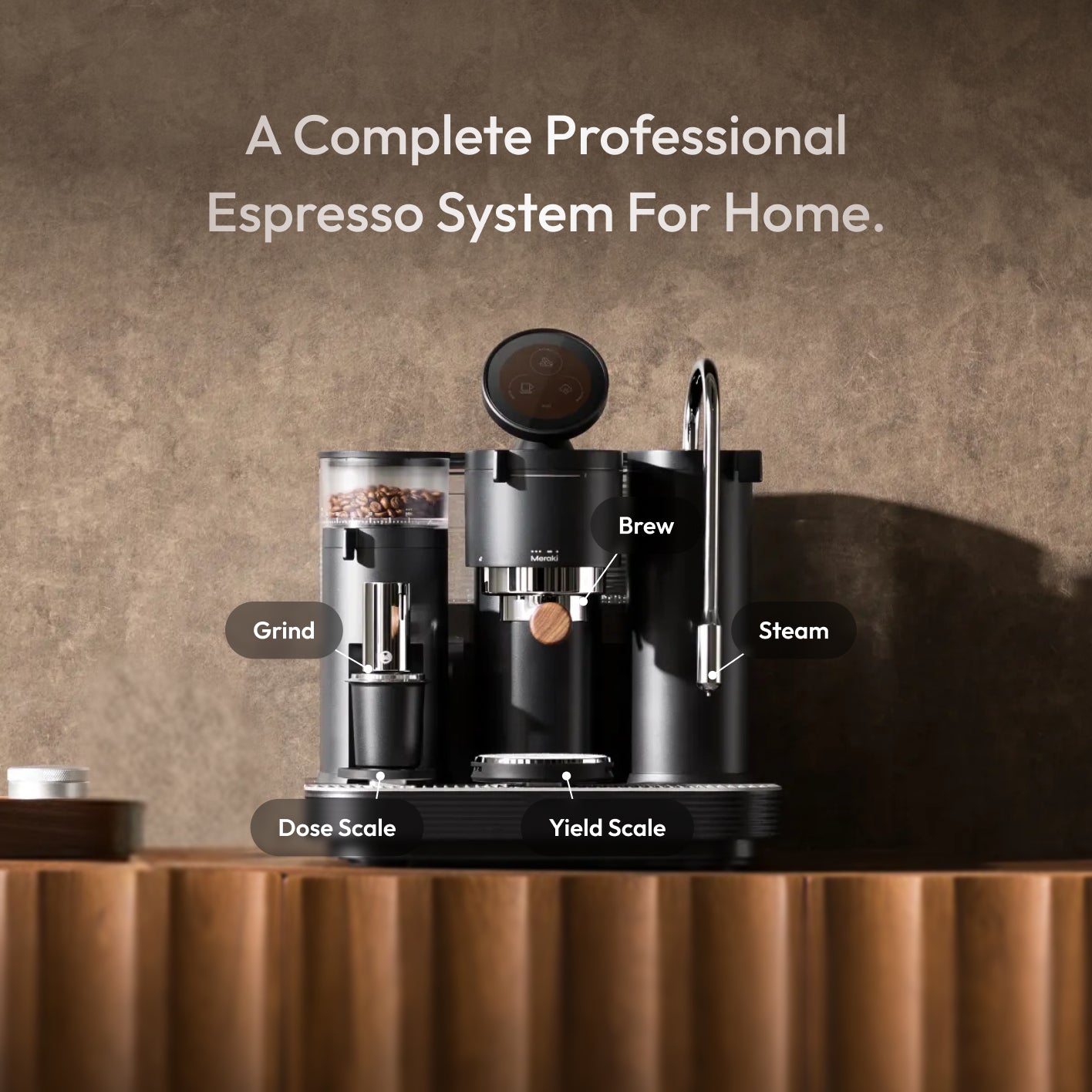
Home reality starts with one station vs a chassis-plus-grinder bar — not the badge on the panel.
What “Meraki vs La Marzocco Linea Mini reality check” really means for home buyers
“Meraki vs La Marzocco Linea Mini reality check” usually means: Will this Mini setup fit my counter, budget, and weekday friction — or am I buying the badge and hoping the accessories fall into place?
Linea Mini sits in La Marzocco’s home / light-commercial heritage lane: a serious dual-boiler chassis many aspirational buyers want for steam, build feel, and brand story. Meraki’s current framing is a guided all-in-one dual-boiler station with a TIMEMORE® co-developed burr grinder and built-in dual scales (±0.2 g) in one footprint. Confirm Meraki on the live product page. Confirm any Linea Mini listing — price, dimensions, heat-up, inclusions — on the official La Marzocco channel or authorized seller you will actually pay. We do not invent Mini MSRP, mm footprint, boiler sizes, or warranty years here.
Treat the keyword as a filter on complete home stations, not a heritage essay contest.
Who this page is for (and who should skip it)
This page is for aspirational home buyers shortlisting Linea Mini who still need an honest apartment / small-kitchen pass: counter depth, under-cabinet clearance, separate-grinder budget, scale habits, and daily heat-up friction — plus a fair “when Mini is still enough” section.
Skip a brand-wide Meraki vs La Marzocco overview — use Home Espresso Compared. Skip Linea Micra as the SKU — use the Micra prosumer vs guided page. Skip Meraki-vs-Breville dual-boiler criteria — that is a different guide. Also skip any premium Mini cart if beans, water care, and a capable espresso grinder would vanish after the chassis lands.
Why this is a space and grinder-integration reality check (not another brand essay)
Search results for Meraki vs La Marzocco Linea Mini lean toward community threads, “is it worth it” chats, and heritage praise. Those pages rarely force the same space + grinder + scale ownership math across both paths.
The unique job here is a home reality table: one integrated footprint vs a Mini chassis plus separate espresso grinder (and usually a tray scale), plus weekday heat-up / milk pacing, maintenance habits, and what you give up when you choose either badge. Meraki facts below come from Meraki’s live product and policy framing (checked October 26–27, 2026). Linea Mini details stay qualitative / typical-home-setup level — verify contested numbers on La Marzocco’s site or your seller listing the day you buy. We do not link out to competitor stores.
Disclosure: Meraki publishes this guide and sells the Meraki Espresso Machine. Score every path — including ours — on the same home-reality questions.
Decision criteria that change the outcome
Five criteria decide most Meraki vs La Marzocco Linea Mini outcomes in real kitchens. The badge only helps after these are honest.
| Criterion | What to ask yourself | Why it changes the call |
|---|---|---|
| Counter & clearance | Will one chassis + tools fit — or chassis + grinder + scale + knock box? | Apartments lose to width first |
| Grinder integration | Do you already own a great espresso grinder, or will you buy one next? | Mini-class chassis setups typically need a separate grinder |
| Measurement habit | Will dose and yield weighing stay in the daily sequence? | Optional tray scales get skipped on busy mornings |
| Heat-up & milk pacing | Dual-boiler mornings — how long will you wait, how often do you steam? | Weekday friction beats brochure steam |
| Learning & service | Guided measured workflow vs modular prosumer hobby — and who services what? | Wrong curve = unused machine |
If you already own a premium espresso grinder, have counter depth to spare, and treat dial-in as the hobby, a Linea Mini–class modular bar can still be rational. If you want one guided footprint that forces grind-to-scale and brew-by-weight habits, integration wins — even when the café badge feels louder in search.
Category education from the Specialty Coffee Association still beats any single badge. Meraki’s iF Gold Design Award 2025 claim (site claim) signals design intent, not day-one dial-in — see ifawards.com for program context.
Side-by-side feature and workflow comparison
A fair Meraki vs La Marzocco Linea Mini reality check compares stations, not a bare Mini chassis against an all-in-one. Meraki’s current framing is a connected dual-boiler system with a commercial rotary pump held near a steady 9 bar, built-in dual scales (±0.2 g) for dose and yield, a TIMEMORE® co-developed burr grinder, and a guided touchscreen workflow (grind → brew → steam → serve). Confirm the live product page. For “commercial-grade at home” framing Meraki uses elsewhere, see the professional espresso machine for home landing page.
Typical Linea Mini home setups (public / category-level — verify your exact SKU) are dual-boiler, prosumer-leaning machines sold without an integrated grinder. Owners usually add a separate espresso grinder, often a tray scale, and tools. Exact boiler volumes, pump type, dimensions, heat-up, app features, and street price vary by Mini generation, region, and seller package — compare the listing you will actually buy, not a remembered forum MSRP.
| Workflow step | Meraki (verified framing) | Typical Linea Mini home station (category — verify SKU) |
|---|---|---|
| Dose | Built-in dose scale (±0.2 g) | Usually a separate scale (or timed grind habits) |
| Grind | Integrated TIMEMORE® co-developed burr grinder | Separate espresso grinder (budget + counter width) |
| Brew | Dual boilers; rotary pump ~steady 9 bar | Dual-boiler prosumer chassis — confirm architecture on the listing |
| Yield | Built-in yield scale; measured stops | Often volumetric / timed stops + tray scale habits |
| Steam | Pro steam wand; brew + steam together | Dual-boiler steam while brewing — feel varies by trim / practice |
| Guidance | Touchscreen sequence | Traditional / prosumer controls; less “guided all-in-one” by design |
| Footprint math | One all-in-one chassis (~370 × 370 × 415 mm listed) | Chassis + grinder + scale + tools — measure the full bar |
Measurement near a tenth of a gram is about repeatable cups, not a lab — NIST is a reminder that measurement earns trust. For heritage and brand-level trade-offs Meraki already published, return to Home Espresso Compared rather than rewriting that essay here.
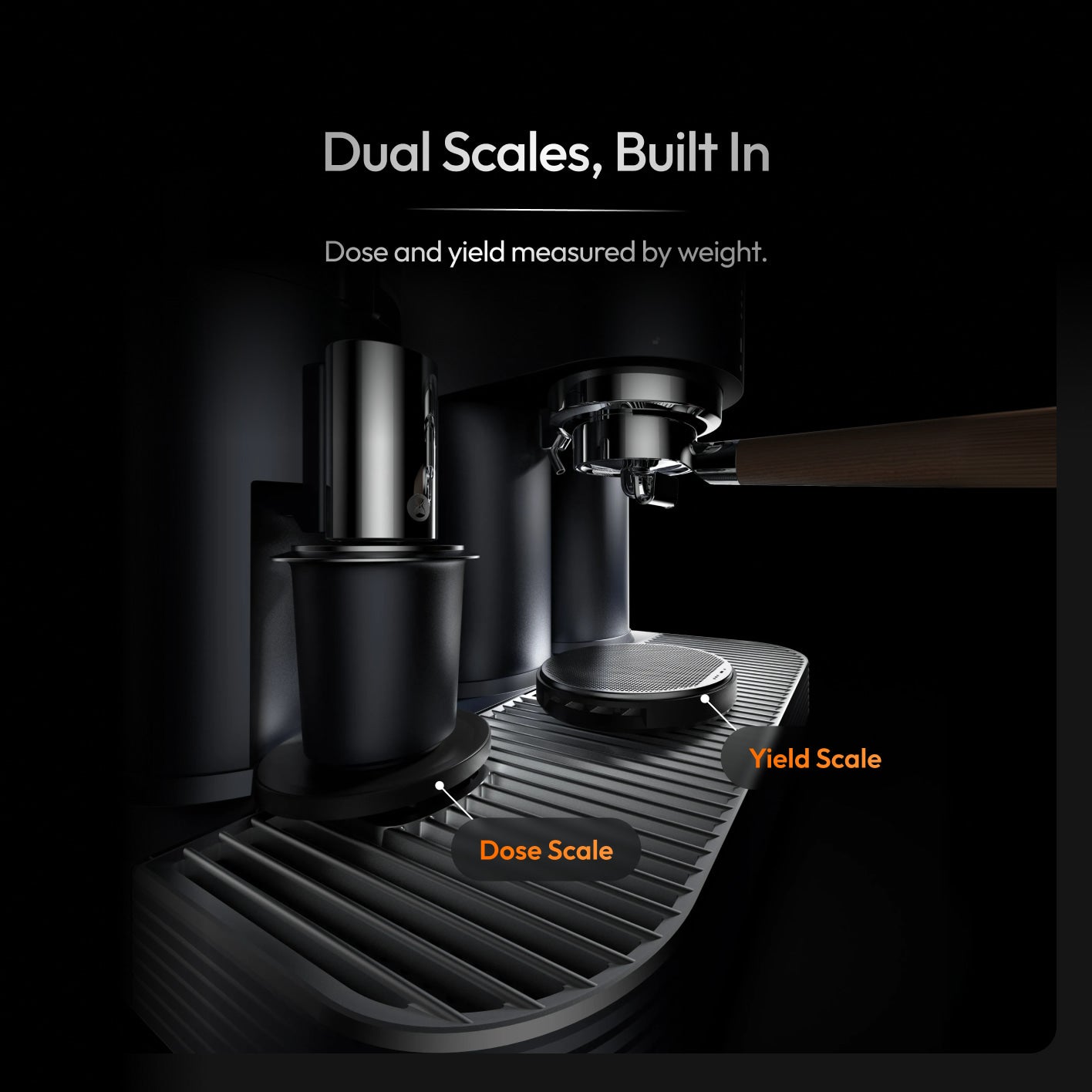
Built-in dual scales — dose and yield in the workflow, not another device hunting for counter space.
Milk drinks, noise, and heat-up: daily-life differences
Milk drinks expose home reality faster than straight espresso. If lattes and cappuccinos are weekday defaults, brew-and-steam-together pacing matters more than a café logo. Meraki’s dual boilers are framed for simultaneous brew and steam; heat-up is listed at about 3–4 minutes on the product FAQ. Re-check the live page the day you buy.
Linea Mini dual-boiler steam reputation is a major shortlist reason — treat it as community and brand expectation, then verify heat-up and steam feel on official materials or a dealer demo for your SKU. We will not invent PSI charts, tip counts, or factory temperature presets.
Noise matters in apartments with thin floors or early alarms. Meraki describes a commercial rotary pump as café-steady and quieter in its marketing framing — directional; judge during a trial. Modular bars add grinder noise as a second chassis. Prefer review patterns after week one. Meraki collects owner feedback on the reviews page; CoffeeGeek’s guides and SCA research help separate skill from hardware.
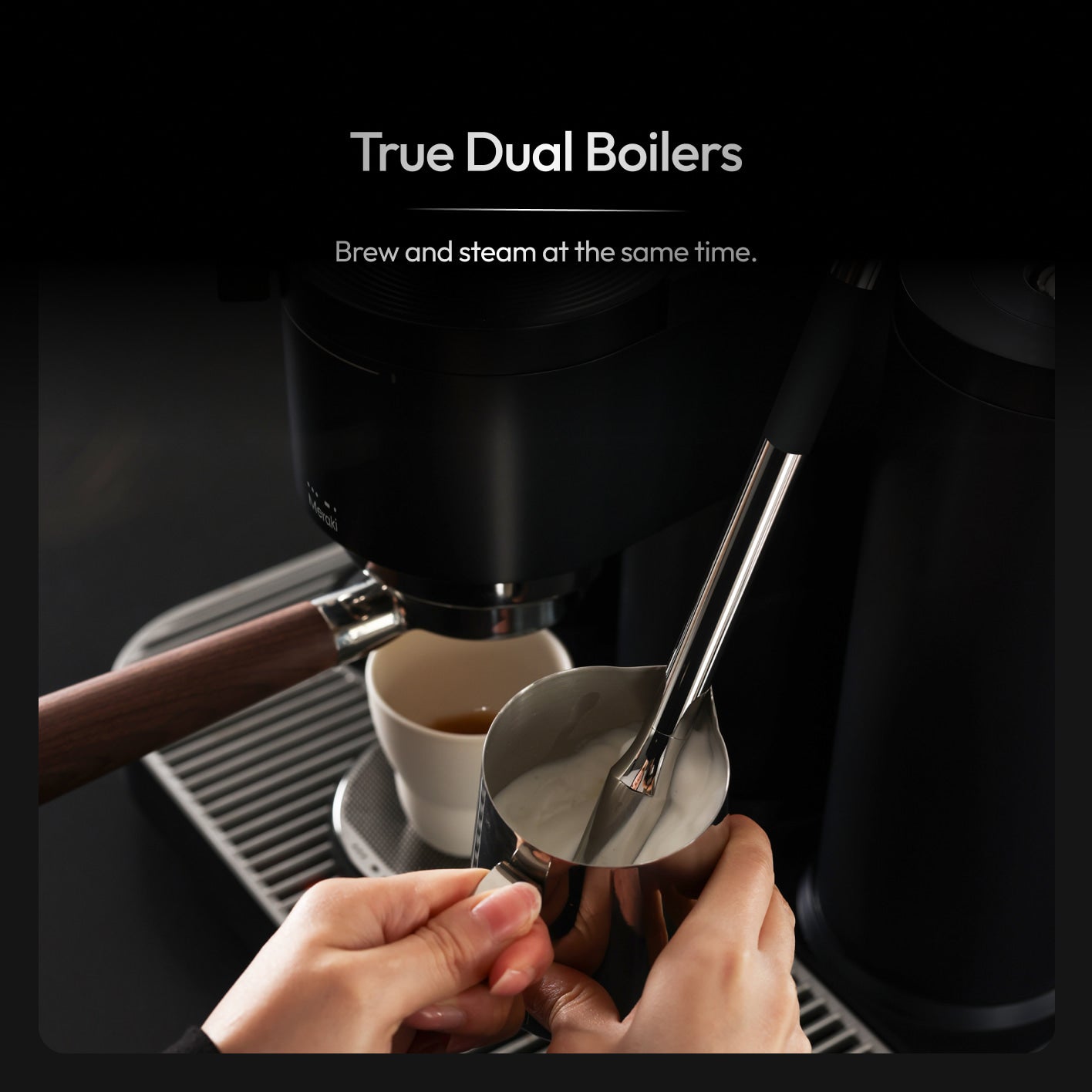
Brew and steam in one sequence — weekday milk pacing beats brochure heritage.
Space, maintenance, and learning curve
Counter space is the Linea Mini reality check most aspirational buyers underestimate. Meraki lists a compact all-in-one footprint around 370 × 370 × 415 mm (about 14.6 × 14.6 × 16.3 in) and 1600 W rated power on the current product page — measure under-cabinet clearance and outlet path yourself. A Mini chassis can look “home-sized” in photos and still grow into a full bar once the separate grinder, scale, knock box, and pitcher land beside it. We will not invent Mini mm dimensions; tape-measure the SKU page or a showroom unit before you commit.
Maintenance is habit, not mythology. Dual boilers still need wipe-downs, water care in hard-water homes, and periodic cleaning. An integrated grinder adds chute and burr hygiene on one chassis; a separate grinder adds a second device to clean and store. Neither path is maintenance-free. Home appliances deserve a safety-minded buy — see UL for general product-safety context — and a service path you can actually use.
Learning curve splits buyers cleanly. Meraki leans guided: touchscreen steps plus built-in weighing to shorten the path to repeatable shots. A Linea Mini–class modular station rewards owners who enjoy dial-in as a hobby and already know (or want) a preferred separate grinder. If you want full push-button automation with minimal hands-on work, neither guided semi-auto nor classic prosumer Mini may be the right category — say that early and stop.
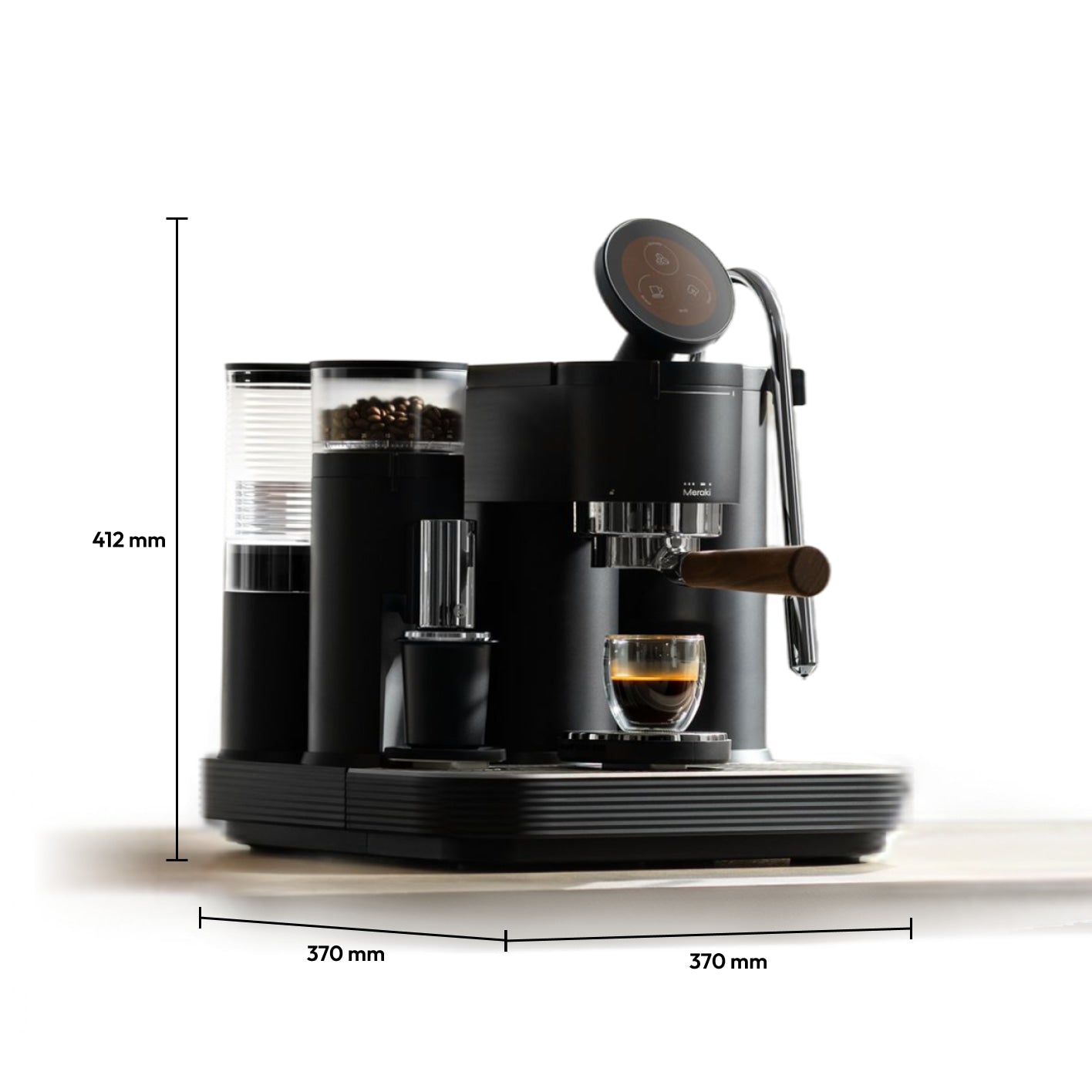
Measure the counter you have — one footprint vs chassis-plus-grinder width is the apartment test.
When Meraki is the better fit
Meraki tends to win this Meraki vs La Marzocco Linea Mini reality check when you want one footprint that includes grind, dose weighing, brew, and yield weighing — without buying a second tall chassis for grinding.
It also fits when apartment clearance is tight, when you do not already own a premium espresso grinder you refuse to replace, and when a 30-day home trial plus clear warranty geography lowers risk enough to try the system. As of October 26–27, 2026, Meraki listed $1,999 with a $1,799 offer on the U.S. product page, plus a current ~$210 upgrader / gift kit (current offer, not permanent pricing; gifts may ship separately). Same-window on-site signals included ~530 verified reviews, 4.9/5 on key pages, and 20,000+ machines / users messaging — useful proof, not a substitute for your space-and-grinder table. Re-check shipping, refund, and warranty before you treat those terms as locked.
For Meraki-specific “is it worth it” math, use the value breakdown. A magazine look at Meraki × TIMEMORE: Barista Magazine’s test-drive — still not a substitute for your trial.
When the alternative is enough
A Linea Mini–class modular path is often enough when the La Marzocco badge and dual-boiler steam feel are the point of the purchase — and you already budgeted a capable separate espresso grinder plus scale as non-negotiable.
Stay — or buy Mini — when you have the counter width, when dial-in is the hobby rather than weekday friction, when you prefer modular tools over one chassis, or when you want a prosumer bar you can upgrade piece by piece. “Enough” is not an insult. A Mini station you use daily beats a guided all-in-one that sits idle.
We will not invent a Linea Mini street price to “prove” Meraki cheaper or pricier. Price the complete station (Mini chassis + grinder + scale + tools + ownership terms) against Meraki’s live inclusions the same day. Electricity is usually modest next to beans — see energy.gov — so consumables, counter reality, and exit risk usually matter more than wattage.
A practical choose-in-10-minutes checklist
Answer yes/no in your own words before checkout:
- I measured under-cabinet clearance for the full station I will own — not only the main chassis photo.
- I either already own a great espresso grinder I will keep, or I accept buying one as part of a Mini-class budget.
- I want dose and yield weighing inside the daily sequence — not as an optional tray scale I might skip.
- Milk drinks or back-to-back espresso are frequent enough that dual-boiler pacing changes my mornings.
- I prefer one guided all-in-one footprint or I deliberately want a modular La Marzocco Mini bar.
- My budget still has room for beans, water care, and cleaner after the machine (and grinder, if separate).
- I have read live shipping, trial, return-fee, and warranty geography for the storefront I will use.
- I am choosing Linea Mini specifically — not confusing it with Micra or a generic “any La Marzocco” essay.
Five or more clear “yes” answers toward integration usually means Meraki is the better home fit for you. Three or fewer — especially if you already love a modular Mini bar and own the grinder — usually means the alternative is enough. Support if you need a human check: +1 833 854 9555 (Mon–Fri, 9 AM–5 PM EST) via support.
Is the Breville Barista Pro worth it?
Worth it depends on your starting point — not on this Linea Mini page.
Barista Pro–class machines sit in a different price and automation lane than Linea Mini or Meraki’s dual-boiler all-in-one framing. They can be “worth it” as a first serious home step when budget and learning curve matter more than café-heritage chassis. They are the wrong comparison if you already shortlisted Mini-level steam and build. For Meraki vs Breville dual-boiler criteria, use Meraki’s separate Breville guide — do not force Barista Pro into this Mini reality check. Disclosure: Meraki sells Meraki; we are not ranking Barista Pro against Mini with invented scores.
Does Starbucks still use La Marzocco?
Do not treat café contracts as your kitchen shopping guide.
La Marzocco has a long commercial history, and Starbucks / café equipment stories change by market, era, and store program. Whether a chain “still uses” a brand this month does not decide whether Linea Mini fits your apartment counter or whether you need a separate grinder. For Micra-era brand FAQs Meraki already published, see the Micra page FAQ; this page stays on Mini home reality — space, grinder, and weekday friction.
FAQ
How do you switch on a La Marzocco home machine? Follow the model manual for your SKU: power, water fill, boiler warm-up, and any standby or app steps vary by generation. We will not invent a universal Mini power sequence here. If you are comparing Meraki instead, Meraki’s guided touchscreen path is documented on the live product materials — still read the unboxing guide that ships with the unit.
What is the Rolls Royce of coffee machines? There is no official “Rolls Royce” ranking. People use the phrase as shorthand for luxury heritage, build prestige, or café lineage — often attaching it to brands like La Marzocco in casual talk. That metaphor does not measure apartment clearance, separate-grinder cost, or whether you will weigh shots on Tuesday. Choose by the reality checklist above, not by metaphor.
Does Linea Mini include a grinder? Typical Linea Mini home purchases are chassis-focused: plan on a separate espresso grinder unless your seller bundle explicitly includes one. Always verify the current package on the official listing. Meraki’s framing includes a TIMEMORE® co-developed burr grinder on the same machine — confirm inclusions on the product page the day you buy.
How should I compare prices without inventing Mini numbers? Compare complete stations and complete ownership terms on the same day. For Meraki, re-check today’s offer price, gift kit, and inclusions on the product page; confirm free-shipping thresholds, trial start, return shipping fees, and warranty geography on the policy pages. For Linea Mini, use the authorized price and package you will actually pay — do not rely on remembered MSRP from a forum thread. Incomplete “deals” that force a second cart for grinder and scale are usually worse value than they look.
What return and warranty points should Mini shortlisters confirm on Meraki? For Meraki, the 30-day home trial starts on delivery; approved non-DOA U.S. returns have used a return shipping fee deducted from the refund (U.S. fee listed at $100 when checked October 26, 2026 — confirm the live refund policy). Meraki describes a 2-year limited warranty from delivery in the country of original purchase — see warranty claim. For any Linea Mini purchase, read that seller’s trial, freight, and country-of-purchase warranty in writing before you assume parity.
If your space-and-grinder table still points to a guided dual-boiler all-in-one — and the ownership terms fit your risk tolerance — confirm today’s inclusions and fees on the Meraki Espresso Machine product page, then decide with your own counter tape measure, not a search-result badge.
More on this topic: Meraki vs Other Espresso Machines.


