


You bought a dual boiler so milk drinks would stop feeling like a relay race — then weekday mornings still turn into “shot first, wait, steam later.” Hardware that can brew and steam together only helps if your hands follow a clear sequence.
This Meraki guide is a weekday espresso machine brew and steam simultaneously workflow: prep → sequence → targets → mistakes → one-week practice. It is not a rewrite of why brew-and-steam temperature control matters. Use that page for heat architecture; use this page when you already own (or are about to own) a dual boiler and need the drink order to stick on a workday.

Brew and steam in one sequence — the weekday win is timing hands with two ready heat systems, not another temperature essay.
What “espresso machine brew and steam simultaneously workflow” really means for home buyers
“Brew and steam simultaneously” in search results often means a marketing badge: two boilers, no long wait between espresso and milk. For home buyers it means something narrower — a repeatable hand sequence that uses both boilers while the shot is still alive and the milk still glossy.
Simultaneous is not “press every button at once and hope.” It is mise en place first, then overlapping brew and steam so the espresso does not sit cooling while you chase foam, and the milk does not overheat while you hunt for a cup. Dual boilers remove the single-boiler temperature swing; they do not replace a landing zone for pitcher, cups, and portafilter.
Treat the keyword as a workflow problem first and a hardware brochure second. Architecture explains why simultaneous is possible; this page owns how you run it on a weekday.
Who this page is for (and who should skip it)
This page is for milk-drink makers — latte, cappuccino, flat white households — who want two drinks (or one milk drink fast) without a café-length queue at home.
Skip it if you still need “what is a dual boiler” literacy — start with what is a dual boiler espresso machine or Meraki’s dual boiler espresso machine hub. Skip a pure milk-texture lesson — use how to steam and texture milk. Skip a general “faster mornings” checklist that is not dual-boiler-specific — Meraki already publishes a repeatable busy-morning checklist and a fast home espresso workflow guide. Come here when simultaneous brew + steam is the missing piece.
Why this is a step workflow (not a temperature-control rewrite)
Meraki’s nearest published page already owns the why of separate brew and steam heat — temperature stability when you stop waiting for one boiler to flip roles. Search results also lean toward multi-boiler capacity explainers, brand FAQs, and forum threads about machines that “steam and pour at once.”
The unique job here is the step-by-step weekday workflow: what to stage before you touch the group, which order keeps espresso and milk usable together, which ranges keep you out of rabbit holes, which mistakes burn the first week, and how to practice for seven days without turning breakfast into a lab.
Disclosure: Meraki publishes this guide and sells the Meraki Espresso Machine, a dual-boiler all-in-one with a professional steam wand and built-in dual scales. Meraki examples below illustrate one verified dual-boiler path. The sequence stays useful for other dual-boiler owners — always verify setpoints and prompts on your machine’s manual and screen.
Tools and settings to prepare first
Simultaneous workflow fails before the pump starts when tools are still in a drawer. Stage the station the night before or while the machine warms: clean portafilter and basket, dry pitcher, cold milk from the fridge, cups warmed or at least ready, knock box open, cloth for the wand, and a clear strip of counter for the shot glass or cup under the group.
On Meraki’s current framing (product page checked for this project’s October 26, 2026 snapshot), dual boilers heat in about 3–4 minutes, with a guided path from grind → brew → steam → serve. Confirm warm-up language on the live product page. If your dual boiler uses a separate grinder and scale, put those in the same “ready before brew” bucket — the sequence below still holds; only the weighing step moves to your tray scale.
Pick one weekday drink recipe and stick to it for the practice week (for example one double espresso into milk). Meraki’s café menu framing lists guided milk ratios such as latte about 1:3, cappuccino about 1:2, and flat white about 1:2 with microfoam — treat those as starting menus on Meraki, not universal laws. Dial beans once; do not invent a new recipe every morning.
Water and hygiene matter more than gadgets. Fresh beans, a rinsed wand tip, and a wiped group gasket prevent “mystery sour” that you will wrongly blame on simultaneous timing. Category literacy from the Specialty Coffee Association beats any viral tip that skips a clean station.
Step-by-step weekday brew-and-steam sequence
The weekday win is overlapping work without losing either side. Use this order as the default; adjust only after it feels boringly reliable.
- Power and wait for ready. Let both brew and steam sides reach ready on your machine’s indicators. On Meraki’s FAQ framing that is about 3–4 minutes — re-check your model. Do not start grinding into a cold group “to save time.”
- Dose and distribute. Grind to your weekday dose. If you have built-in dual scales (±0.2 g on Meraki’s specs table) or a tray scale, lock the dose before you chase steam. Distribution and a level tamp beat fancy flourishes when the clock is running.
- Lock in and stage milk. Lock the portafilter. Pour cold milk into the pitcher to your usual weekday fill line before you start the shot — empty-handed steaming is how espresso dies on the drip tray.
- Start the shot, then take the wand. Begin extraction. When flow is established and steady, open steam and texture milk while the shot continues. Dual boilers exist for this overlap — that is the simultaneous moment.
- Watch both clocks with eyes, not panic. Glance at yield (built-in brew scale or your cup marks) and at milk pitch / temperature cues. Stop steam when milk is glossy and at a drinkable heat for you; stop brew at your target yield. Meraki frames milk-temperature sensing and auto-stop behaviors on the product page — use them if present, but still learn visual cues for days the sensor is not your only guide.
- Combine immediately. Swirl milk, wipe and purge the wand, pour. Espresso that sits five minutes while you plate toast is no longer a simultaneous win.
- Thirty-second reset. Knock the puck, rinse the basket face, wipe the station. Tomorrow’s speed starts with today’s reset.
If you are making two milk drinks back to back, keep the same order: dose → lock → milk staged → brew + steam → pour → quick reset → repeat. Do not invent a second “guest workflow” until the first one is muscle memory. For pour ratios and latte structure beyond this sequence, Meraki’s how to make a latte at home guide owns the cup math.
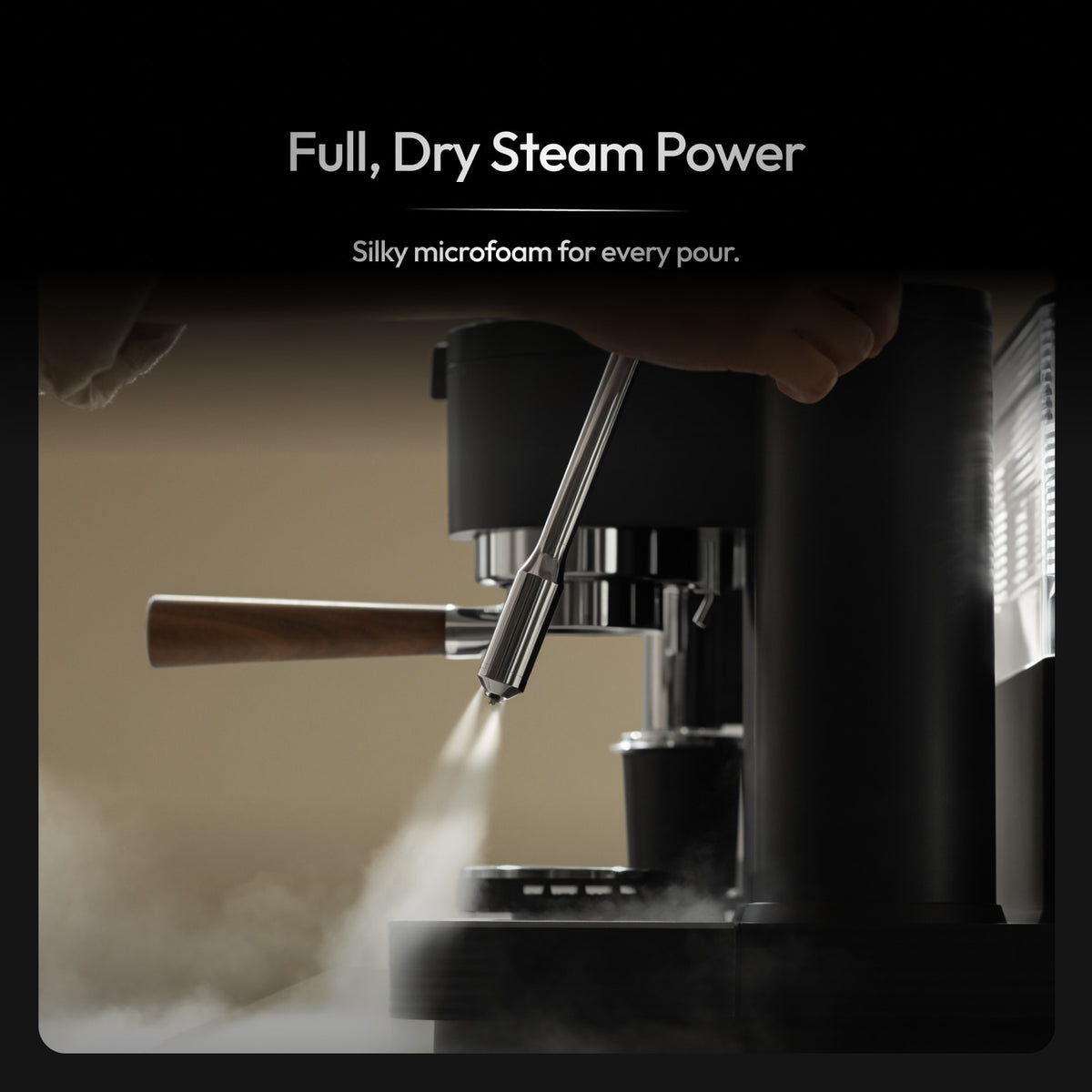
Steam while the shot runs — stage cold milk before you start brew so the wand is not waiting on an empty pitcher.
Targets and ranges that keep you out of rabbit holes
Targets exist to stop endless tweaking, not to invent fake laboratory precision. Prefer one weekday recipe with a dose, a yield goal, and a milk volume you can pour half-asleep. Write those three numbers on a sticky note near the machine for seven days.
Use ranges, not invented absolute setpoints. Home espresso often starts near a traditional brew-temperature band and a roughly mid-twenty-second to low-thirty-second shot window as a rough timing habit — not a physics law and not an SCA commandment that every good shot ends on second thirty. Taste and ratio beat the stopwatch. Meraki lists a commercial rotary pump held near a steady 9 bar and dual scales to ±0.2 g — those support repeatability; they are not a license to chase hundredths of a gram before breakfast. Verify any on-screen temperature or steam prompts in your manual rather than copying a forum’s favorite number into this article.
Milk targets are sensory first: cold start, stretching then texturing to glossy paint-like microfoam, stop before the pitcher is painfully hot. Exact steam-boiler pressure in bars varies by machine design — Meraki markets powerful dry steam with temperature stop framing; we will not invent a bar rating that the brief does not state. For independent technique reading, CoffeeGeek’s guides and SCA research help separate skill from hardware.
Measurement earns trust when it is honest about uncertainty — NIST is a reminder that a scale is a tool, not a personality. If CoffeeSense™ NFC bean guidance appears on your Meraki extras list, treat it as optional recipe help after the hand sequence works, not as a substitute for staging milk and locking the portafilter.
Common mistakes and quick fixes
Most “my dual boiler doesn’t feel simultaneous” complaints are sequence errors, not broken boilers.
| Mistake | What you feel | Quick fix |
|---|---|---|
| Steam before milk is poured | Wand sputtering; shot finished alone | Fill pitcher before brew starts |
| Grind while boilers are still cold | Sour or thin first shot | Wait for ready lights; prep tools during warm-up |
| Shot sits while you text | Flat espresso under good foam | Pour within moments of stopping brew and steam |
| Chasing a new grind every day | Never a stable baseline | Lock one weekday recipe for seven days |
| Skipping wand wipe/purge | Milk smell; weak next steam | Wipe and purge every drink |
| Empty counter / no landing zone | Spilled milk; rushed tamp | Stage cups and knock box the night before |
| Treating simultaneous as “two people required” | You avoid dual-boiler use | Practice the one-person overlap above |
If steam is weak after a long idle, purge water from the wand and confirm the steam side is truly ready — then revisit technique on Meraki’s steaming guide rather than rewriting it here. If shots race or crawl, change grind or dose once, taste, and stop. Forum threads about “machines that steam and pour at the same time” often debate hardware; weekday pain is usually mise en place.
How to taste and decide what to change next
Change one variable per day after you can run the sequence without thinking. Day-to-day tasting questions are simple: Is the espresso bitter-harsh or sour-thin under the milk? Is the foam dry and stiff or glossy and pourable? Did the drink cool because you hesitated between steps?
If espresso tastes off but milk looks right, fix dose, grind, or yield — not steam pressure fantasies. If espresso tastes fine but milk is foam-bath texture, fix pitcher angle, tip depth, and stop time — link out to the steaming skill page instead of inventing a new tutorial here. If both sides are “fine” but the drink is lukewarm, your overlap timing slipped: start steam earlier once flow is established, or pour sooner.
Keep a three-line note: date, what you changed, one taste word. That beats a spreadsheet. Independent magazine context on Meraki’s guided all-in-one path exists in places like Barista Magazine; still judge your weekday cup, not a reviewer’s photo.
A one-week practice or habit plan
A week is enough to install muscle memory without turning coffee into homework. Keep the same beans and the same drink.
- Day 1–2 — Sequence only. Ignore latte art. Run prep → brew+steam overlap → pour → reset. Goal: no empty pitcher when the shot starts.
- Day 3–4 — Lock numbers. Same dose and yield each morning. Write them down. Taste for gross errors only.
- Day 5 — Two drinks. Back-to-back milk drinks with the same sequence. Notice where the station fights you; move the knock box or cups once.
- Day 6 — Guest pace. Make drinks for two people without narration. If you stall, the sticky note is incomplete.
- Day 7 — Keep or cut. Keep the sequence that felt boring. Cut any flourish that added time without taste.
Energy use for a home dual boiler is usually modest next to beans and milk — see energy.gov for general home energy literacy — so do not “save power” by skipping warm-up and sabotaging the first shot. Warm once, brew well, shut down when the morning queue is done.
When to stop tweaking and just drink
Stop tweaking when the sequence is automatic, the weekday cup tastes like your baseline, and changes would only serve curiosity. Simultaneous workflow is a reliability tool for milk mornings, not a forever science fair.
If you mainly drink straight espresso with long gaps, you may not need simultaneous practice every day — dual boilers still help guests and weekend lattes. If milk drinks are daily life, protect the sticky-note recipe and the seven-step order. Architecture pages can wait for a quiet evening; the temperature-control dual-boiler guide is there when you want the why again.
FAQ
Can every dual boiler brew and steam at the same time? Most true dual-boiler designs are built so brew and steam heat can run together — that is the point of two boilers. Always confirm on your model’s manual and ready lights. Meraki’s product FAQ states two independent boilers let you pull a shot and steam milk at once; other brands vary in recovery, wand power, and prompts. Simultaneous capability still needs the hand sequence above.
What should I do first — start the shot or start steam? Start the shot once the portafilter is locked and milk is already in the pitcher, then open steam when extraction flow looks established. Starting steam with an empty pitcher, or delaying milk until the shot finishes, is how “dual boiler” mornings feel single-boiler again.
Do I need built-in scales for a simultaneous workflow? No — a tray scale works. Built-in dual scales (Meraki lists ±0.2 g capacity framing) remove one object from a crowded pad and make dose/yield easier to repeat under time pressure. The workflow still fails without staged milk and a clean wand, scales or not.
How is this different from Meraki’s temperature-control dual-boiler article? That article explains why separate brew and steam heat matters. This page is the weekday step workflow: prep, overlap sequence, ranges, mistakes, and a one-week practice plan. Link the temperature piece for theory; keep this tab open beside the machine.
What if my milk always finishes before the shot (or the reverse)? Adjust overlap timing before you redesign the recipe. Start steam a few seconds earlier or later once flow is stable; reduce milk volume if you only need one small drink; confirm both boilers show ready. If wand power or technique is the limit, use Meraki’s steaming skill guide rather than blaming dual-boiler architecture.
If your weekday goal is milk drinks without the relay-race pause, run the sequence above on a dual boiler — and confirm today’s Meraki dual-boiler, scales, and steam framing on the Meraki Espresso Machine product page when you want the guided all-in-one path. Support: Meraki Support (+1 833 854 9555, Mon–Fri 9 AM–5 PM EST).


