


Which Espresso Machine Is Best Under $2000 for Home Use?
Disclosure: Published by Meraki using public manufacturer and authorized-retailer information checked August 8, 2026. This is a fit-based buying guide, not an independent hands-on test. Prices and availability can change.
The short answer
The best espresso machine under $2,000 depends on whether your budget covers only the machine or the complete setup. Among serious home espresso machines, that distinction can change the value of the purchase completely.
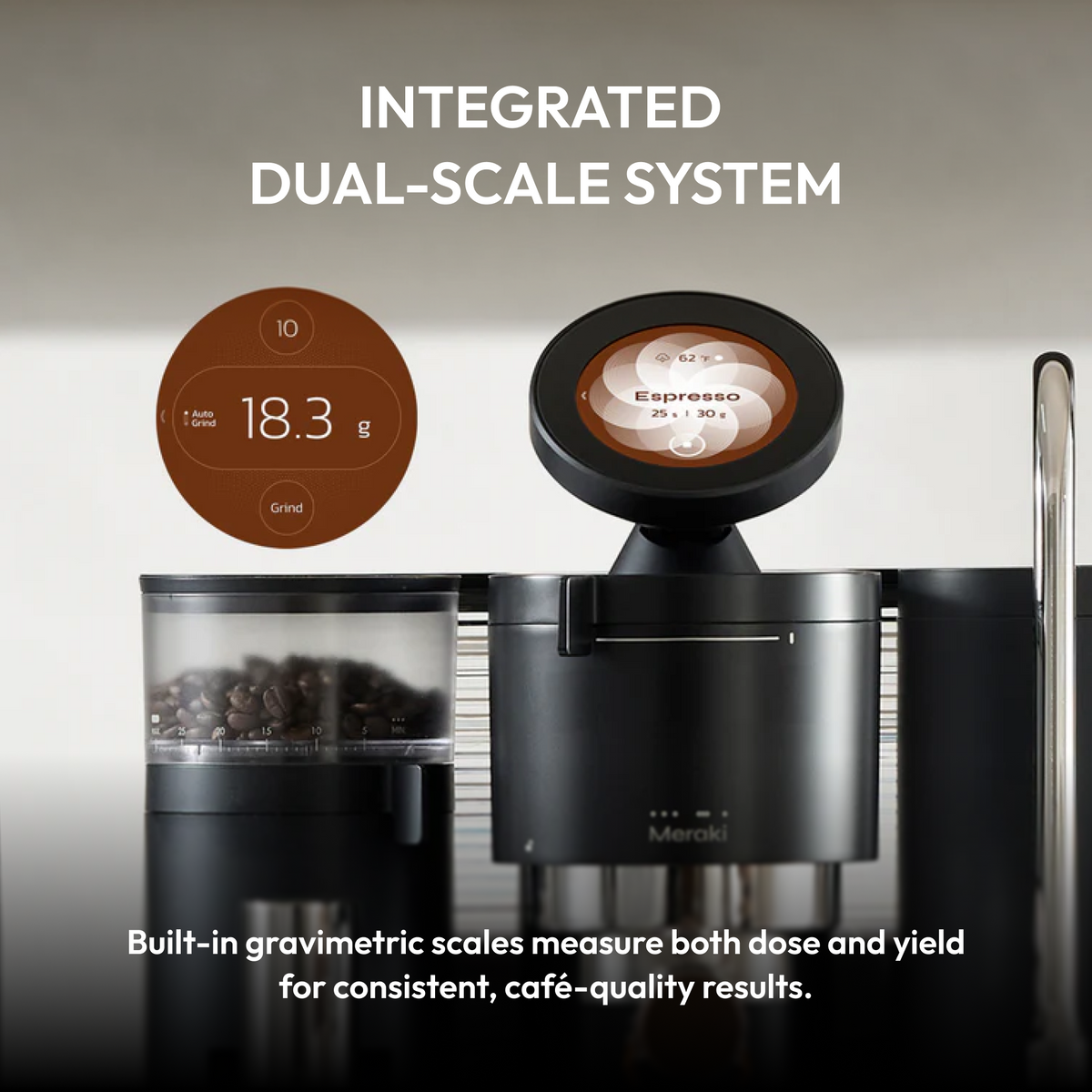
Choose Meraki at $1,799 if you want a dual-boiler espresso machine, espresso-tailored grinder and two weight scales engineered as one system. It is the strongest fit here for buyers who want measured dose and yield without assembling a separate grinder-and-scale station.
Choose the Breville Dual Boiler at $1,599.95 if you already own a capable grinder and want a traditional machine-only setup with dual boilers, PID temperature control and hands-on shot adjustments.
Choose the Lelit Elizabeth at $1,799.95 if you want a compact machine-only dual boiler with programmable controls and you are comfortable budgeting separately for a grinder and scale.
The important distinction is simple: all three machines are priced below $2,000, but only Meraki includes the grinder and dose-and-yield scales in that price.
Explore the complete Meraki espresso system

Quick comparison of espresso machines under $2,000
| Decision point | Meraki Espresso Machine | Breville Dual Boiler | Lelit Elizabeth |
|---|---|---|---|
| Published US price* | $1,799 | $1,599.95 | $1,799.95 |
| Heating | Separate brew and steam boilers | Dual boilers and heated group head | Separate coffee and steam boilers |
| Grinder | Built in; 45 espresso-focused settings | Sold separately | Sold separately |
| Dose measurement | Built-in grind-by-weight scale | External scale needed | External scale needed |
| Yield measurement | Built-in brew-by-weight scale | External scale recommended | External scale recommended |
| Pump approach | Commercial-style rotary pump | 15-bar Italian pump with 9-bar extraction | Machine-only traditional platform |
| Workflow | Guided, adjustable and integrated | Hands-on and modular | Compact, hands-on and programmable |
| Best fit | Complete measured setup | Buyer who already owns a grinder | Compact traditional dual boiler |
*Prices checked August 8, 2026. Promotions, stock and retailer pricing can change.
Start with the real budget: machine or complete setup?
A $2,000 machine budget is not always a $2,000 espresso budget.
Traditional and manual espresso machines need a grinder capable of producing small, repeatable grind adjustments. You will usually also want a scale that can measure dose and espresso yield in grams. Those tools affect the shot as directly as the machine itself.
That makes two comparisons useful:
- Machine price: what the brewer alone costs.
- Working setup price: the brewer, grinder, scale and daily accessories needed to make repeatable espresso.
Breville and Lelit leave the grinder choice open. That flexibility is valuable if you already own a grinder or want to upgrade components independently. If you are starting from scratch, however, adding a serious grinder and scale can move the complete setup beyond $2,000.
Meraki takes the opposite approach. The grinder, dose scale, brew scale, dual boilers and controls are designed as one workflow. The value is not that it is a low-cost all-in-one machine. It is that a premium home espresso system is already assembled and measured.
Why Meraki is the strongest complete system under $2,000
Meraki is a semi-automatic espresso machine: you still prepare the portafilter and decide how you want the coffee to taste. Unlike fully automatic espresso machines, it keeps the user involved in the recipe. The machine then connects the parts of the process that are often split across several devices.
That distinction matters. Meraki is not trying to remove the home barista from the process. It reduces the handoffs between grinding, weighing, brewing and steaming so the same recipe is easier to repeat.
1. A built-in grinder tailored to espresso
Espresso reacts to very small changes in grind size. A setting that worked yesterday may run faster after the beans age or the room becomes more humid.
Meraki's built-in grinder provides 45 espresso-focused settings. The range is designed around dialing in espresso rather than covering every possible brewing method.
The practical benefit is a more direct morning routine:
- Select the target dose.
- Adjust grind size as the shot requires.
- Grind directly for the portafilter workflow.
- Let the scale stop the grinder at the target weight.
This is different from grinders that dispense only by time. Time can approximate dose, but weight tells you how much coffee actually reached the basket.
Read the broader espresso machine with grinder guide if you are deciding between an integrated and separate grinder.

2. Grind by weight controls the dry dose
Dry coffee dose is one side of a brew ratio. If the dose moves from 18 grams to 19 grams while every other setting stays the same, the shot will not behave the same way.
Meraki places a scale in the grinding workflow. It stops at the selected dose instead of asking you to transfer the portafilter to a separate scale and correct the amount after grinding.
This does not eliminate dialing in. It makes the variable visible and repeatable.
For a busy household, that can mean fewer discarded doses and less counter movement. For a newer home barista, it also makes it easier to understand why one shot differs from another.
3. Brew by weight controls liquid yield
The second built-in scale measures espresso in the cup. Set a target yield and the machine can stop the shot at that weight.
Suppose your recipe uses 18 grams of ground coffee and a 36-gram espresso yield. Meraki measures both sides of that ratio inside the machine. You can still change temperature, grind size, dose or yield, but you are not relying on cup volume or reaction time to stop the shot.
The benefit is consistency, not automation for its own sake. A repeatable yield gives you a stable reference when you adjust flavor.
4. Dual boilers keep brewing and steaming independent
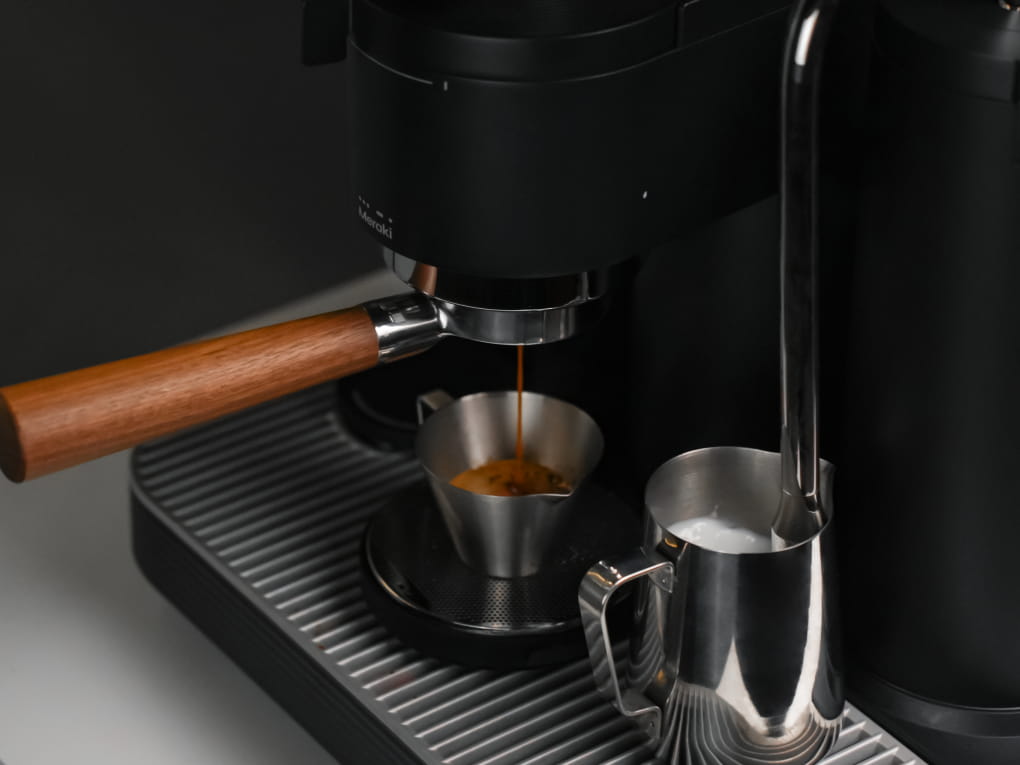
Milk drinks expose the limits of a single boiler quickly. A single-boiler machine often needs to change temperature between extracting espresso and producing steam. That creates waiting and makes back-to-back drinks slower.
Meraki uses separate brew and steam boilers. Each system can hold the temperature needed for its job, and brewing and steaming can happen at the same time. PID temperature control helps manage brew temperature while the dedicated steam boiler supports the milk workflow.
This is most useful when you make lattes or cappuccinos for more than one person. The espresso does not need to sit while the machine changes modes. The steam wand also provides milk-temperature feedback, helping you repeat milk texture while you develop manual latte-art technique.
Our dual boiler espresso machine guide explains the heating architecture in more detail.
5. The rotary pump supports stable pressure with a calmer mechanical character
Meraki uses a commercial-style rotary pump and publishes 9-bar extraction from the beginning to the end of the shot.
Rotary pumps are generally associated with smooth pressure delivery and a quieter mechanical character than common vibration pumps. That can make the machine feel more composed during a daily routine, especially in an open kitchen.
This is not a decibel claim. Directly comparable laboratory noise data is not published for the three machines in this guide, so it would be misleading to promise a specific sound difference.
The more important point is how the pump fits the whole system: stable pressure works alongside controlled brew temperature, measured dose and measured yield.

6. The touchscreen connects the workflow without removing control
Integrated should not mean locked down.
Meraki's touchscreen keeps grind size, dose, yield, brew temperature and steaming choices in one place. A guided recipe can give a new user a reliable starting point, while adjustable settings let an experienced user refine the result.
This helps two people use the same machine differently. One can follow a saved recipe; the other can change the variables for a new coffee.
7. About four minutes to warm up on the US model
The US 100-120V Meraki model warms up in about four minutes. The 220-240V version sold in higher-voltage markets warms up in about three minutes.
That is a short wait for a dual-boiler platform. It also reduces the need to leave the machine powered for a long period before the first drink.
8. Build quality, accessories and purchase protection
Meraki's US product page currently lists:
- A 2-year warranty.
- A 30-day home trial, subject to the return policy.
- Free shipping on orders over $200.
- A 58 mm portafilter and the core preparation accessories shown in the box.
The machine has also received the iF Gold Award. Design awards do not prove espresso quality, but they are relevant to build quality, ergonomics and the experience of keeping the machine visible on a kitchen counter every day.
What are the tradeoffs with Meraki?
A fair buying guide should explain who may prefer something else.
Meraki is an integrated system, so it is less modular than a machine paired with a separate grinder. If you already own a premium grinder you love, paying for another grinder inside the machine may not be the best use of your budget.
The system also contains more integrated components than a basic single-boiler machine. A buyer who wants the simplest possible mechanical platform may prefer a more traditional setup. As with any premium espresso machine, plan regular cleaning of the group head, steam wand, water reservoir and drip tray.
Choose Meraki when you value a coordinated workflow, measured dose and yield, fast dual-boiler operation and fewer separate tools. Choose a modular machine when independent component upgrades are part of the experience you want.
Two strong machine-only alternatives
The following machines are credible alternatives when your $2,000 limit applies to the brewer and you already have a grinder and scale.
Breville Dual Boiler: best for hands-on control with an existing grinder
Breville lists the Dual Boiler at $1,599.95. It uses separate boilers for espresso and steam, PID temperature control, a heated group head, a 58 mm portafilter, pressure information and low-pressure pre-infusion followed by 9-bar extraction.
It is a strong fit if you want a well-established machine-only platform and prefer to choose the grinder separately.
Compared with Meraki, the tradeoff is workflow integration. The Breville does not include an espresso grinder or built-in dose-and-yield scales. Buyers starting from zero should add those costs before comparing total value.
Lelit Elizabeth: best for a compact traditional dual boiler
Lelit's official product information describes separate coffee and steam boilers, its LCC electronic control system, programmable pre-infusion, a pressure gauge and a commercial 58 mm group. US authorized retailers currently list it at $1,799.95.
The Elizabeth suits someone who wants a compact, machine-only dual boiler and enjoys managing the grinder, scale and shot workflow as separate pieces.
Like the Breville, it can be an excellent choice when a capable grinder is already on the counter. A complete new setup will cost more than the machine price.
Which machine should you choose?
Choose Meraki if most of these statements sound like you:
- You are building a complete setup, not replacing only the brewer.
- You want grind by weight and brew by weight built in.
- You make milk drinks and want simultaneous brewing and steaming.
- You value the stable, typically quieter character of a rotary pump.
- You want guidance without giving up recipe control.
- You prefer one coordinated system over several countertop devices.
Choose the Breville Dual Boiler if you already own a grinder and want a traditional dual-boiler machine with hands-on controls.
Choose the Lelit Elizabeth if a compact traditional machine, programmable pre-infusion and a modular grinder-and-scale setup matter most.
If you are still comparing broader categories, use the best espresso machine guide or see what makes a professional espresso machine for home.
See Meraki features, current price and availability
Frequently asked questions
Is $2,000 enough for a serious home espresso machine?
Yes. This budget reaches dual-boiler machines with PID temperature control and strong steaming performance. The key is to decide whether $2,000 covers the brewer only or the grinder and scale as well.
Is Meraki automatic or semi-automatic?
Meraki is semi-automatic. You prepare the portafilter and control the recipe. The built-in grinder, scales, touchscreen and milk-temperature feedback measure and connect the workflow.
Do I need a dual boiler?
Not everyone does. A single boiler can make excellent straight espresso. A dual boiler becomes more valuable when you prepare milk drinks, make several drinks in a row or want brewing and steaming temperatures controlled independently.
Is an integrated grinder always worse than a separate grinder?
No. Grinder design and adjustment range matter more than whether the grinder shares the machine housing. Meraki uses 45 espresso-focused settings and grinds to a target weight. A separate grinder remains the better fit if you want to swap grinders or specialize across multiple brewing methods.
Why do dose and yield both matter?
Dose is the dry coffee entering the basket. Yield is the liquid espresso in the cup. Measuring both gives you a brew ratio that can be repeated and adjusted intentionally.
What is the best espresso machine under $2,000 for a complete setup?
Meraki is the strongest fit in this guide for a complete measured setup because the $1,799 price includes the espresso-tailored grinder, dose scale, brew scale, dual boilers and rotary pump. Breville Dual Boiler and Lelit Elizabeth are stronger fits for buyers who already own a grinder and prefer a modular setup.