


You saw TIMEMORE on an espresso-machine listing — and the next question is not “who makes nice hand grinders,” but what a TIMEMORE grinder espresso machine collaboration actually changes for you as a buyer.
This Meraki page explains collaboration meaning: who TIMEMORE is in coffee gear, what “co-developed” usually covers versus marketing fluff, what Meraki publicly claims (and does not prove), how to verify those lines on a listing, and how to avoid confusing Meraki’s integrated mill with TIMEMORE hand grinders that dominate community search results. It is not a rewrite of espresso machine with grinder, integrated grinder pros and cons, is a built-in grinder worth it, Meraki built-in vs external grinder, 45 Setting Espresso Grinder: Is More Always Better?, or Meraki’s roaster collaborations essay (beans and roasting partners, not mill co-engineering).
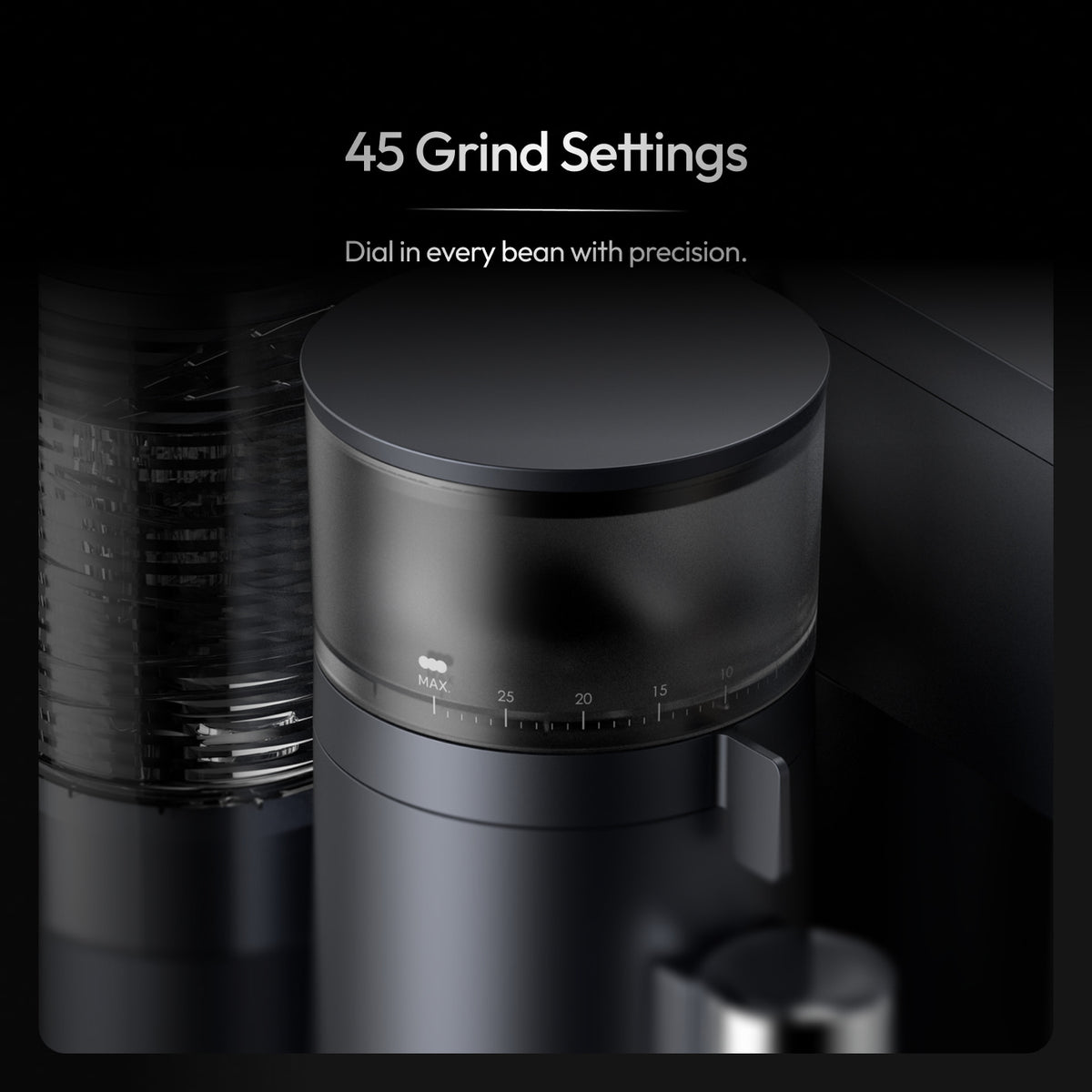
A collaboration claim is only useful if the listing also documents the grind dial, dose path, and scale story you will live with on weekday mornings.
What “TIMEMORE grinder espresso machine collaboration angle” really means for home buyers
“TIMEMORE grinder espresso machine collaboration angle” in search usually returns hand-grinder click guides, C3 vs C5 forum threads, YouTube reviews of manual mills, and marketplace listings — not a calm explanation of what a machine-integrated co-development claim is supposed to buy you.
For a home buyer evaluating Meraki (or any brand that names TIMEMORE on an espresso chassis), the phrase means: Does this partnership claim change grind quality, dial-in, dose control, or warranty expectations — or is it a logo bump with no verifiable product consequence?
In plain language, Meraki’s live product story (homepage and product framing checked for this project’s 2026-10-26 snapshot) describes a true burr grinder co-developed with TIMEMORE® that grinds straight onto the built-in scale, with 45 grind settings documented on the product page. That is the public claim set this article interrogates. It is not a certificate that every TIMEMORE hand grinder you saw on Reddit is the same mill inside Meraki.
Treat the keyword as collaboration literacy first. Pros/cons, worth-it math, and settings myths already have owners on this site. This page owns what the partnership language should (and should not) mean before you trust it.
Who this page is for (and who should skip it)
This page is for brand researchers, second-machine shoppers, and careful gift buyers who saw “TIMEMORE” on an espresso-machine card and want to separate co-development from logo theater — without inventing partnership lore, awards, or unstated specs.
Skip it if you still need the general integrated-grinder decision (pros/cons, cost math, cup-quality setup comparison). Start with pros and cons, worth it, and built-in vs external. Skip if your question is whether more settings equal better espresso — that is Is More Always Better?. Skip if you came for roaster bean partnerships — use why espresso brands partner with coffee roasters. Come here when the question is: what does a TIMEMORE co-developed integrated grinder collaboration mean for my buy?
Why this is collaboration meaning (not invented partnership lore)
Search for TIMEMORE + espresso is community-heavy: click charts, hand-grinder shootouts, and marketplace SKUs. Meraki already publishes integrated-grinder decision pages and a settings-count myth page. Roaster-collaboration content already owns bean partnerships.
The unique job of this page is collaboration meaning with zero invented claims: define co-development as a buyer-facing claim class, show what Meraki states publicly, mark what that does not prove, give a listing verification checklist, and answer brand-origin questions from verifiable public sources only. Disclosure: Meraki publishes this guide and sells the Meraki Espresso Machine. We name Meraki specs only where they illustrate the collaboration claim. We will not invent partnership timelines, co-founder stories, secret burr geometries, lab particle charts, or competitor “TIMEMORE inside” claims we cannot verify.
Core idea in plain language
Co-development, in honest product language, usually means the espresso brand and a grinder specialist worked together on the mill that ships inside the machine — burr choice, geometry for espresso-range particles, motor/drive fit, and how grounds exit into the portafilter path — rather than bolting a random consumer mill into a box and pasting a partner logo on the brochure.
What it does not automatically mean: that the integrated mill is identical to a named TIMEMORE hand grinder you already own; that every click on a C-series manual dial maps to Meraki’s 45 labeled settings; that particle distribution was third-party certified on your exact serial; or that the collaboration covers boilers, pump, steam wand, or touchscreen recipes. Meraki’s public wording focuses the TIMEMORE® relationship on the burr grinder and the grind-to-scale / grind-onto-built-in-scale dosing path — not on “TIMEMORE designed the whole espresso machine.”
Category literacy from the Specialty Coffee Association still beats any logo: espresso needs a capable burr path and a dose you can repeat. A named collaborator is a signal to investigate, not a substitute for weighing dose and tasting.
How it shows up in a weekday workflow
On a weekday, collaboration value shows up as fewer moving parts between beans and puck — not as a story you retell at brunch.
Meraki’s guided station story is grind → dose → brew → steam in one chassis. The TIMEMORE® co-developed mill claim matters when (1) you can choose a grind step for the beans you bought, (2) the machine doses by weight onto the built-in grind scale instead of scooping, and (3) the same morning you can brew and steam without babysitting a second tall appliance. Product specs (2026-10-26 snapshot) list 45 grind settings, dual scales 1 kg cap · ±0.2 g, dual boilers, and a rotary pump framed at steady 9 bar. Those lines are the weekday mechanics; the brand name on the mill is the pedigree claim sitting beside them.
CoffeeSense™ NFC — listed on Meraki’s product and FAQ pages as a way to swipe Meraki NFC bean bags for suggested grind/extraction parameters — is a Meraki workflow feature, not a TIMEMORE co-development claim. Keep those stories separate when you read a listing.
If your weekday pain is already solved by a separate espresso mill you trust, collaboration branding on an all-in-one will not outrank fit, footprint, and service. If your pain is “I hate buying and matching a grinder,” the co-developed integrated path is the claim to verify — then test during a trial.
What to verify on the machine or listing
Open the live product page and treat every collaboration sentence as a claim to check, not a vibe to absorb.
Verify these lines before you treat them as locked:
- Named collaborator + role — Meraki states a true burr grinder co-developed with TIMEMORE® (homepage / product framing). Prefer “co-developed / co-engineered grinder” over a vague “powered by” badge with no mill detail.
- Adjustment range in numbers — Meraki documents 45 grind settings (“find the right grind for different beans”). A photo of a dial without a count is weaker evidence.
- Dose path — grind straight onto the built-in scale / auto-dose / grind-by-weight language should appear in the same story as the mill, not in a buried footnote.
- Scale precision — dual scales with ±0.2 g (and 1 kg capacity) on Meraki’s specs table when checked — re-read live.
- What is not claimed — do not invent that TIMEMORE designed dual boilers, rotary pump, or CoffeeSense™ unless the listing says so.
- Independent press context — Barista Magazine’s Meraki Tech × TIMEMORE test-drive discusses the machine as co-engineered with TIMEMORE and reviews the all-in-one package. Press is context, not your home trial.
- Warranty and service — confirm the grinder path (burrs, motor, chute) sits under the same limited warranty story as the rest of the chassis on Meraki’s warranty claim page.
Cross-check the espresso machine with grinder landing page against the product page the day you buy. Offers and copy change.
Tradeoffs and limits
A co-developed integrated mill buys convenience and a matched dose story. It also locks you into that mill’s service path, retention behavior, and adjustment philosophy until you exit the chassis.
Tradeoffs to accept honestly:
- You cannot swap the mill like a separate TIMEMORE hand grinder. Community love for C-series manuals does not transfer as a parts catalog for Meraki’s built-in unit.
- Collaboration ≠ particle lab report. Meraki publishes settings count and grind-to-scale workflow; it does not (in the claims we are using here) publish a third-party particle-size certificate tied to the TIMEMORE name.
- Logo confusion is real. SERP results for “TIMEMORE grinder” skew hand-grinders. Expect friends to ask which hand model you bought. Answer with “integrated espresso mill co-developed with TIMEMORE®,” not a C3 click chart.
- Roaster collaborations are a different program. Bean partners and mill co-development answer different questions — see Meraki’s roaster collaborations page for beans.
Limits of this article: we will not invent a co-development contract summary, shared IP list, or “exclusive forever” exclusivity claim. If Meraki has not published it, it does not belong in a buyer explainer.
Mistakes that waste time
These mistakes burn mornings and return labels:
- Treating a TIMEMORE hand-grinder review as a Meraki mill review. Different products, different retention, different dials.
- Copying Baratza Encore / Chemex click charts into an espresso dial-in. Pour-over charts answer pour-over. Espresso needs its own fine range and taste loop — see category guides from CoffeeGeek and NCA brewing education, not a mismatched chart.
- Assuming “TIMEMORE” replaces weighing. Meraki’s own story pairs the mill with built-in scales near a tenth of a gram — NIST is a reminder that measurement earns trust; a logo does not.
- Reading CoffeeSense™ as proof of TIMEMORE co-development. NFC bean suggestions and mill co-engineering are separate Meraki claims.
- Skipping trial because press liked the partnership. Barista Magazine and other coverage can inform you; your beans, water, and taste still need a home test. Meraki’s 30-day home trial from delivery (confirm live refund policy) exists for that reason.
- Ignoring exit cost. Approved non-DOA U.S. returns have listed a return shipping fee deducted from the refund (U.S. fee listed at $100 when checked October 26, 2026 — confirm the live table). Collaboration pride does not erase logistics.
A simple decision or setup checklist
Use this yes/no list before you treat the collaboration as a reason to buy:
| Check | Pass looks like | Fail looks like |
|---|---|---|
| Collaborator named + role | “Burr grinder co-developed with TIMEMORE®” (or equally specific) | Logo only; no mill role |
| Settings documented | Numeric range (Meraki example: 45) | Dial photo, no count |
| Dose path clear | Grind-to-scale / onto built-in scale language | Time-only grind with no weight story |
| Scale story present | Dual scales with stated precision (Meraki: ±0.2 g) | “Precision” with no scale |
| Scope honesty | Claims limited to the grinder (+ dose path) | Implies TIMEMORE designed boilers/pump without saying so |
| Hand-grinder confusion cleared | You know this is not a C-series manual | You planned to use hand-grinder click charts as gospel |
| Exit plan | Trial + return fee + warranty read | “Press said it’s good” as only risk plan |
Five or more clear passes usually means the collaboration claim is operationally ready to evaluate in a trial. Two or fewer means pause — you are buying a logo, not a verified mill story.
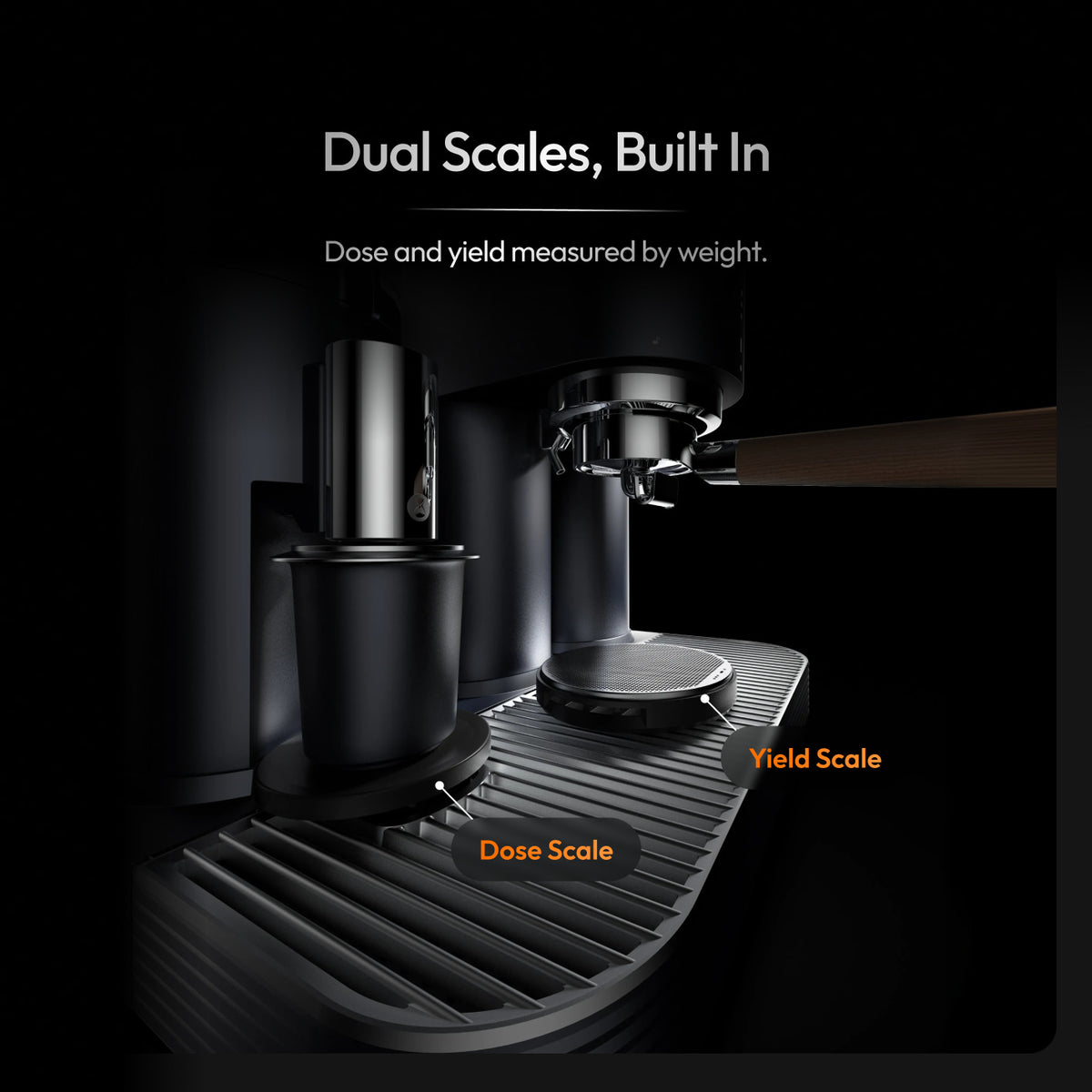
Co-development claims earn trust when grind and dose are weighed in the same station — verify the live scale and settings copy, not only the partner name.
How this connects to Meraki’s dual-boiler system
The mill collaboration and the dual-boiler system answer different mornings. TIMEMORE® co-development is about particle preparation and dose into the basket. Dual boilers are about brew temperature stability and simultaneous steam so milk drinks do not wait on a single boiler’s recovery.
They connect in workflow, not in branding: a co-developed grind-to-scale path feeds a puck; dual boilers and a rotary pump framed at steady 9 bar extract and texture milk while you stay in one guided sequence. Meraki’s product framing pairs espresso-tailored grinding with dual boilers, rotary pump, and dual scales as one station — see the live product page. Do not collapse that into “TIMEMORE made the boilers.” Keep credit where the listing puts it.
Electricity and warm-up still matter less than beans for most homes — see energy.gov for general appliance context — but a dual-boiler warm-up window (Meraki FAQ framing often cites roughly 3–4 minutes; confirm live) is part of the weekday contract the mill alone cannot fix.
What type of grinder is best for grinding espresso?
A burr grinder sized and adjusted for espresso-fine particles — not a blade mill — is the right type for espresso.
Blade grinders chop unevenly and fight dial-in. Burr grinders (flat or conical families) crush toward a narrower particle distribution and give you a usable adjustment path. “Best” then depends on your setup: a dedicated espresso mill next to a bare dual boiler, or an integrated espresso-tailored burr mill inside an all-in-one. Meraki’s claim set is the second path: true burr, TIMEMORE® co-developed, 45 settings, grind onto built-in scale. That can be “best for you” when you want one station and a matched dose story; it is not a universal winner against every separate commercial mill. For SCA-aligned category education, start at sca.coffee and SCA research rather than a single forum chart.
America’s Test Kitchen and similar roundups answer their test set and date — they are not a Baratza-to-Meraki conversion table. Read the method; do not paste their “best” label onto a different chassis.
Is Timemore a Chinese brand?
Yes — TIMEMORE presents itself as a Chinese-origin specialty coffee equipment brand, based on its own public materials and widely cited company reporting.
TIMEMORE’s public About / brand pages describe an original coffee equipment brand founded in 2012 by product developers; Chinese-language and English brand materials identify Shanghai TIMEMORE Coffee Equipment Co., Ltd. as the company entity, and public reporting has described TIMEMORE among China’s independently designed coffee-equipment brands (including a later headquarters move to Xiamen). Prefer TIMEMORE’s own About and brand summary pages over forum guesses when you need origin facts.
What we will not invent here: private ownership charts, “Singapore vs China HQ” debates as courtroom truth, or a claim that every press article agrees on geography. Barista Magazine’s Meraki test-drive has described TIMEMORE with a Singapore-based label in passing — treat that as press wording, then verify against TIMEMORE’s own site. Meraki’s About story separately states Meraki’s journey began in Shenzhen, China, with offices claimed in Hong Kong, the UK, and the US — that is Meraki’s origin claim, not a rewrite of TIMEMORE’s.
FAQ
Does a TIMEMORE collaboration guarantee better espresso than a separate grinder? No. It guarantees a named co-development claim on Meraki’s integrated burr path — verify settings, dose-by-weight, and service — not a cup trophy against every separate mill. Taste during a trial; compare complete stations, not logos.
Is Meraki’s built-in mill the same as a TIMEMORE C3 / C5 hand grinder? Meraki does not publish a claim that the integrated mill is a renamed C3/C5. Treat them as different products. Do not copy hand-grinder click guides onto Meraki’s 45 settings dial.
What should I ask about co-developed grinders before I buy? Ask: Who is named? What role (burrs / mill / whole machine)? How many settings? How is dose measured? Are burrs/motor under the same warranty? What does the brand explicitly not claim? If answers are vague, the collaboration is marketing, not hardware literacy.
What setting should I use on a Baratza Encore for Chemex? That is a pour-over question for a Baratza Encore, not a Meraki espresso dial-in answer. Use Encore/Chemex guidance from the grinder maker or pour-over educators; do not treat it as an espresso starting click on a TIMEMORE® co-developed integrated mill.
How does CoffeeSense™ relate to the TIMEMORE collaboration? CoffeeSense™ NFC (Meraki FAQ: swipe Meraki NFC bean bags for suggested grind/extraction parameters, with dual scales auto-stopping grind and brew at targets) is a Meraki feature. It is separate from the TIMEMORE® co-developed grinder claim. Verify both on live pages if both matter to you.
Next step
If collaboration meaning was your blocker, open the live Meraki Espresso Machine product page and re-check today’s TIMEMORE® co-development line, 45 settings, grind-to-scale dosing, dual-scale ±0.2 g specs, dual-boiler / rotary framing, trial, and warranty language. For press context, read Barista Magazine’s Meraki × TIMEMORE test-drive. For TIMEMORE’s own brand framing, see timemore.com About. Questions on service: +1 833 854 9555 (Mon–Fri, 9 AM–5 PM EST) via support.
When the partner name, the settings count, and the scale story all survive a cold read — then a home trial can test the cup. That is what the collaboration is for.


