


It is 6:10 a.m. Your kitchen shares a wall with someone who did not order a flat white. You are not hunting another generic rotary pump vs vibration pump hardware essay. You are deciding whether vibration-pump buzz through thin walls is a weekday problem — and whether a quieter rotary profile is worth the upgrade, plumbing expectations, and price step.
This page is a noise/neighbor decision guide for rotary pump vs vibration pump at home in apartments and multi-unit buildings. Meraki already publishes a home-system comparison at why prosumer machines use rotary pumps (pressure delivery, size, and integration). Use that page for architecture literacy. Use this page when shared walls, early mornings, and neighbor risk decide the pump call.

Pump type changes brew-stage character for neighbors — it does not erase grinder noise, steam hiss, or vibration that travels through thin floors.
What “rotary pump vs vibration pump at home” really means for home buyers
“Rotary pump vs vibration pump at home” in search usually returns shot-feel debates, price-gap threads, and prosumer tables. For an apartment buyer it means something narrower: Will the buzz of a vibration pump travel through shared walls at the hours I actually brew — and does a rotary pump’s calmer profile change that social risk enough to justify cost, size, and water/setup expectations?
In plain buyer language, a vibration (vibratory) pump uses an electromagnetic coil to drive a piston rapidly; many home machines use it because it is compact and economical. A rotary vane pump uses a motor-driven rotor and sliding vanes to move water more continuously; café and many prosumer machines use it for steadier flow capacity and a typically softer operating character. Neither pump “makes espresso better” by itself — grind, dose, yield, temperature, and puck prep still write the cup. Category literacy from the Specialty Coffee Association and practical home reading from CoffeeGeek’s guides beat any listing that treats pump type as a flavor badge.
Treat the keyword as an apartment neighbor-noise decision first. Full system integration around a rotary pump already lives on Meraki’s why prosumer machines use rotary pumps guide. Broader noise/pressure/price homework: rotary vs vibratory (noise, pressure, price).
Who this page is for (and who should skip it)
This page is for apartment dwellers, studio and loft renters, early-shift households, and anyone comparing pump types because neighbors, roommates, or thin floors sit in the next room.
Skip the home-system / prosumer architecture comparison — why prosumer machines use rotary pumps. Skip pump category homework on noise, pressure, and price as a hardware table — rotary vs vibratory and what home machines actually need. Skip apartment quiet-rotary buying and setup expectations (placement pads, lease quiet hours, “quiet” listing checklist as a product-use guide) — that lane belongs to Meraki’s quiet-rotary apartment draft (A032) and the published realistic noise expectations page. Skip general “how much noise is normal” literacy — quiet espresso machines. Come here when the question is: for my shared walls, when does vibration buzz matter — and when is rotary the better neighbor call?
Why this is a noise/neighbor decision (not another why-rotary rewrite)
Search results for rotary pump vs vibration pump at home already cover shot taste myths, price gaps, and “why cafés use rotary.” Meraki’s own nearest page owns pressure delivery, size, and measured-workflow integration. Forums already argue whether rotary “tastes better.” What apartment shoppers still under-get is a neighbor-risk decision frame: when buzz through drywall matters, what rotary actually softens, what water-line and maintenance expectations change, and who should still buy vibration without apology.
The unique job here is apartment-social: early mornings, shared walls and floors, honest separation of pump buzz vs grinder vs steam, reservoir vs plumbed water expectations on many rotary chassis, and a fair “when vibration is enough” verdict. Disclosure: Meraki publishes this guide and sells the Meraki Espresso Machine, which uses a commercial rotary pump held near a steady 9 bar on current product framing (checked October 26–27, 2026), with marketing lines such as “Steady extraction. Quieter mornings.” Those are vendor marketing claims, not third-party lab decibel certificates. We will not invent dB charts for Meraki or for vibration-pump machines.
Decision criteria that change the outcome
Five criteria decide most rotary pump vs vibration pump at home outcomes in apartments. The badge only helps after these are honest.
| Criterion | What to ask yourself | Why it changes the call |
|---|---|---|
| Neighbor path | Who shares walls/floors, and when do they sleep? | Same pump, different social risk by building and schedule |
| Brew-stage character | Harsh buzz vs calmer rotary profile during extraction | Thin walls punish buzz more than many demos show |
| Whole morning map | Pump only — or pump + grinder + steam on the same pad? | Grinder minutes often outshout the brew pump |
| Water / install | Reservoir-only vs optional direct water line (model-dependent) | Many rotary machines can plumb; not all home SKUs do |
| Exit cost | Trial, return shipping, warranty geography if sound fails | Noise fit is hard to know from a silent product video |
If you brew mid-morning in a concrete mid-rise, rarely pull milk drinks before 8 a.m., and already accept a vibration pump’s character, staying vibration can be rational. If pre-dawn espresso is non-negotiable and drywall transmits buzz, rotary’s calmer brew-stage profile becomes a real filter — still incomplete without a grind plan. Public-health explainers such as NIDCD on noise and CDC/NIOSH noise topics are reminders that loudness is context-dependent — not that home espresso is industrial noise.
Side-by-side feature and workflow comparison
A fair rotary pump vs vibration pump at home comparison compares heard mornings and install expectations, not marketing adjectives. Meraki’s current framing is a guided dual-boiler all-in-one with a commercial rotary pump near steady 9 bar, a TIMEMORE® co-developed burr grinder, built-in dual scales (±0.2 g), and a water tank (reservoir) on the published specs table — confirm the live product page and the rotary pump for home landing page.
Typical vibration-pump home path (category-level — verify SKU): compact chassis, reservoir-fed, intermittent pump duty well suited to domestic use, and a familiar buzz during brew. Typical rotary prosumer path (category-level): steadier flow capacity, often a calmer brew-stage character, sometimes larger footprint or weight, and — on some models — optional direct water-line (plumbing) support. Meraki’s published specs list a water tank, not a plumbed install requirement; do not assume every rotary machine needs a plumber.
| Decision layer | Vibration-pump path (category — verify SKU) | Rotary-pump path (category / Meraki framing — verify) |
|---|---|---|
| Brew-stage sound | Often a sharper buzz / rattle character | Often calmer, less buzz-like (vendor/category claim — not a lab dB chart) |
| Neighbor risk | Higher when thin walls + early brew windows | Lower for brew stage when walls punish buzz — grind still matters |
| Pressure story | Can reach espresso pressures; delivery character differs | Meraki: rotary near steady 9 bar (site framing) |
| Water | Usually reservoir | Reservoir common; some rotary SKUs offer plumbing — Meraki lists water tank |
| Size / cost | Often smaller and less expensive at entry | Often a step up in price/weight; model-dependent |
| Station noise | Chassis + separate grinder on many bars | Same rule if grinder is separate; Meraki integrates grind on one pad |
| Maintenance | Wipe-downs, water care, intermittent duty habits | Water care still critical; plumbing adds install/service if equipped |
Measurement near a tenth of a gram cuts wasted re-pulls — and re-pulls are extra neighbor minutes. NIST is a reminder that measurement earns trust; your walls still write the social score.

In apartments, judge the whole pad — chassis, shared walls, and where grinding happens — not only the pump label.
Milk drinks, noise, and heat-up: daily-life differences
Milk drinks stretch the morning map. Steam hiss is its own chapter on either pump type. Dual boilers (Meraki framing: brew and steam together; heat-up about 3–4 minutes on the product FAQ — re-check live) change pacing, not pump physics. A vibration-pump dual boiler can still buzz during extraction while you steam; a rotary dual boiler can calm the brew chapter while steam remains audible. We will not invent flush charts or comparative dB tables.
Noise is where this apartment page earns its keep. Meraki describes a commercial rotary pump as café-steady and quieter in marketing framing — directional vendor language, not a third-party lab certificate. Vibration pumps remain a rational choice for buyers who brew later, live in concrete buildings, or prioritize compact price. Prefer review patterns after week one on Meraki’s reviews page, and listen during any trial. For apartment expectation contracts (pads, quiet-hour checklists), use realistic noise expectations rather than asking this comparison to republish that guide.
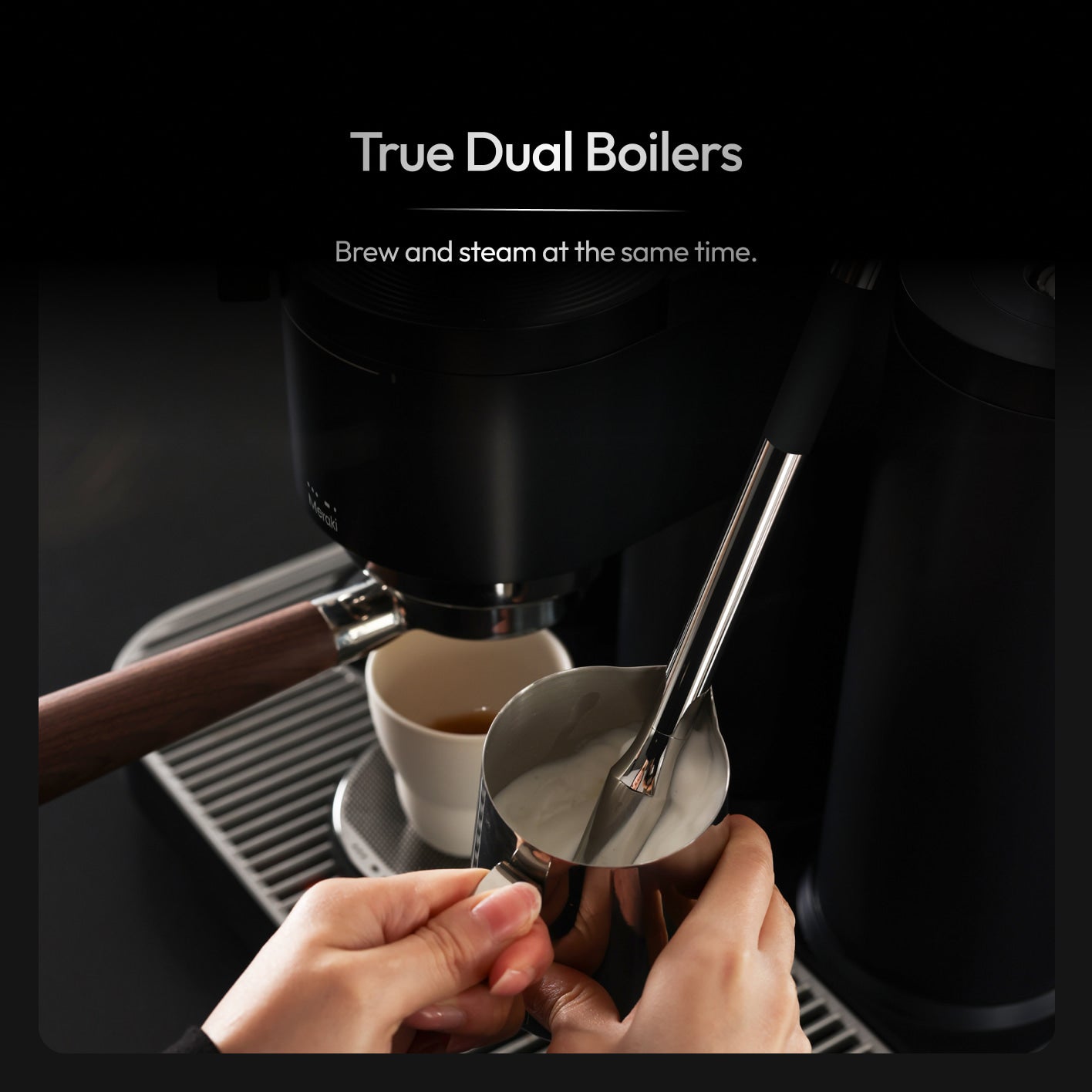
Dual boilers help milk pacing — pump character and grind placement decide how the morning sounds through a shared wall.
Space, maintenance, and learning curve
Space shapes pump upgrades more than buyers admit. Rotary vane assemblies can sit in larger chassis; vibration pumps often win when every inch and every pound matter. Meraki lists about 370 × 370 × 415 mm (about 14.6 × 14.6 × 16.3 in) and 1600 W on the current product page — measure under-cabinet clearance yourself. A “compact vibration dual boiler” can still grow once a separate grinder lands beside it.
Maintenance is habit on both paths: wipe-downs, water quality, descaling or filtration as your water demands, and cleaning. Rotary machines that support a direct water line add install complexity, leak risk awareness, and sometimes different service paths — verify your SKU. Meraki’s published specs emphasize a water tank (reservoir) workflow: refill habits matter; a plumber is not assumed. See UL for general product-safety context, and pick a service path you can actually use. Electricity is usually modest next to beans — see energy.gov.
Learning curve splits buyers cleanly. Vibration-pump machines teach familiar home-barista habits at a lower entry. Rotary systems reward buyers who value steadier delivery and calmer brew-stage character — and who will still dial grind. Meraki leans guided: touchscreen steps plus built-in weighing around its rotary foundation. If you want full push-button automation with minimal hands-on work, neither pump type alone solves that — say so early and stop.
When Meraki is the better fit
Meraki tends to win this rotary pump vs vibration pump at home choice when you want a calmer rotary brew stage and dual-boiler milk pacing and grind-to-scale habits in one apartment footprint — without a second loud grinder chassis fighting the same thin wall.
It also fits when early mornings are non-negotiable, when you do not already own a premium espresso grinder you refuse to replace, when reservoir refill fits your kitchen better than a plumbed install, and when a 30-day home trial lowers risk enough to test neighbor reality. As of October 26–27, 2026, Meraki listed $1,999 with a $1,799 offer on the U.S. product page, plus a current ~$210 upgrader / gift kit (current offer; gifts may ship separately). Same-window signals included ~530 verified reviews, 4.9/5 on key pages, and 20,000+ machines / users messaging — directional proof, not a substitute for listening in your building. Re-check shipping, refund, and warranty. Rotary product framing: rotary pump espresso machine for home. Press context: Barista Magazine’s Meraki × TIMEMORE test-drive.
When the alternative is enough
A vibration-pump machine is often enough when your building damps buzz, your brew window is mid-morning, budget prioritizes beans and a great separate grinder, or you already like your current vibration dual boiler’s cups.
Stay — or buy vibration — when chassis size and price matter more than brew-stage calm; neighbors are not a real constraint; you accept intermittent pump character; or a dealer demo proved the sound story for your apartment. “Enough” is not an insult. A vibration machine you use daily without neighbor conflict beats a rotary chassis that sits idle because plumbing or price scared you off. We will not invent competitor dB or street-price tables to force a Meraki win.
A practical choose-in-10-minutes checklist
Answer yes/no before checkout:
- I am deciding noise/neighbor risk — not rewriting Meraki’s why-prosumer rotary integration essay.
- I know who shares walls/floors with my coffee pad and when they sleep.
- I understand rotary mainly softens brew-stage character; grind and steam still count.
- The listing names pump type (rotary vs vibration/vibratory), not only “quiet.”
- I verified water setup: reservoir refill vs optional plumbing on this SKU (Meraki lists a water tank).
- I compared a complete station (all-in-one vs machine + separate grinder), not pump marketing alone.
- Budget still covers beans, water care, and cleaner.
- I know trial start, return shipping fee, and warranty geography if the sound story fails after delivery.
- I read realistic noise expectations for apartment expectation literacy — and I am not asking this page to republish it.
Five or more clear “yes” answers toward rotary usually means a quieter brew-stage path is the better apartment fit. Three or fewer — especially if vibration already works socially — usually means the alternative is enough. Support: +1 833 854 9555 (Mon–Fri, 9 AM–5 PM EST) via support.
Is a rotary pump better than a vibratory pump?
Better for apartment brew-stage calm — not automatically better coffee.
A rotary pump is often the better neighbor choice when thin walls punish vibration buzz during extraction, and when you value steadier flow capacity in a prosumer or café-style chassis. A vibratory pump is often better when size, price, and intermittent home duty matter more, and when your building and schedule do not amplify buzz. Cup quality still depends on grind, dose, yield, temperature, and puck prep — see Meraki’s why prosumer machines use rotary pumps for the system view. We will not invent a universal “rotary tastes better” claim or a dB winner chart.
What are the disadvantages of rotary vane pumps?
Higher cost, size/weight, and sometimes install complexity — not worse espresso by default.
Common trade-offs versus vibration pumps: a step up in machine price; potentially larger or heavier chassis; and, on models that support a direct water line, plumbing and leak-awareness expectations you may not want in a rental. Rotary vane pumps also need appropriate water quality and service paths like any espresso hydraulic system. Meraki’s published home framing uses a water tank with a commercial rotary near 9 bar — so “must plumb” is not Meraki’s default story; always verify the SKU. Disadvantages are ownership costs and fit, not a rule that vibration always pulls better shots.
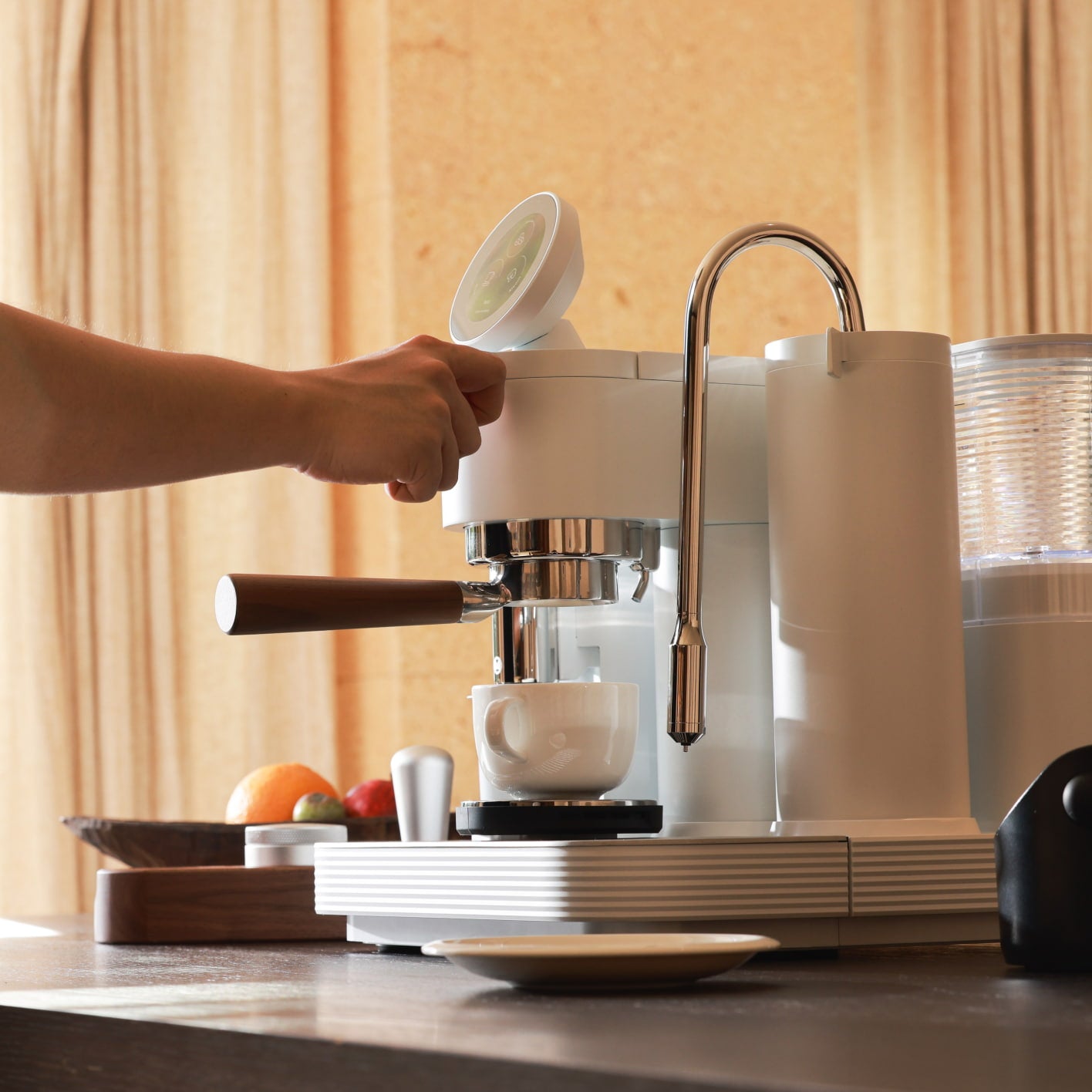
White Meraki Espresso Machine — same rotary-pump architecture; confirm finish, claims, and terms on the live page before you order for an apartment kitchen.
FAQ
What is the main difference between a rotary pump and a centrifugal pump? For home espresso shopping, the useful contrast is usually rotary vane vs vibration (vibratory) pumps inside espresso machines — not rotary vs centrifugal. Centrifugal pumps move fluid with an impeller and are common in many other appliances and industrial loops; espresso machines typically rely on vibration piston pumps or rotary vane pumps to reach and hold brew pressures. If a listing says “centrifugal,” verify the actual espresso pump type before you assume neighbor or pressure behavior. Stay on this page for apartment rotary-vs-vibration decisions; use Meraki’s why-prosumer rotary guide for system integration.
What is the best pump for an espresso machine? The best pump is the one that fits your walls, schedule, budget, and water setup — not a single winner badge. Prefer rotary when early mornings and thin shared walls make vibration buzz a real social cost, and when you accept the usual price/size step. Prefer vibration when compact cost wins and neighbors are not the filter. Pair either path with an honest grind plan. Disclosure: Meraki sells a rotary-pump machine; score it on the same neighbor criteria as any other listing.
Does a rotary pump need a water line at home? Not always. Some rotary machines support reservoir or direct-plumb configurations (model-dependent). Meraki’s published specs list a water tank — plan on reservoir refill habits unless a future SKU explicitly offers plumbing. Never assume “rotary = plumber required.” Confirm install notes on the listing you will pay, especially in rentals where drilling is restricted.
Will switching to rotary fix downstairs neighbor complaints? It can soften the brew chapter; it cannot promise silence. Grinder bursts, steam, cup noise, and structure-borne vibration through hollow floors still travel. Use realistic noise expectations for apartment expectation literacy, and treat any trial as a neighbor test — not only a taste test. Meraki’s 30-day home trial starts on delivery; approved non-DOA U.S. returns have listed a return shipping fee deducted from the refund (U.S. fee listed at $100 when checked October 26, 2026 — confirm the live refund policy).
Is this the same article as Meraki’s other rotary guides? No. Why prosumer machines use rotary pumps owns home-system pressure, size, and integration. Rotary vs vibratory (noise, pressure, price) owns category hardware trade-offs. Realistic noise expectations owns morning noise-map literacy. This page owns the apartment noise/neighbor decision — when vibration buzz matters through shared walls, who still buys vibration, and what water/maintenance expectations change.
If your neighbor-risk table still points to a quieter rotary brew stage — and reservoir workflow plus ownership terms fit your rental — confirm today’s inclusions and fees on the Meraki Espresso Machine product page, then decide with your own walls and schedule, not a silent demo video.
More on this topic: Espresso Machine Boilers, Pumps & Controls.


