


Why an island or cart is not the same as a back-counter
An island is a stage in the middle of the room, not a wall-backed counter.
People walk around it, sit at it, and bump it. A cart adds wheels and a higher chance that the surface moves while you are locking in a portafilter. This page is about that stability, cord routing, and splash problem. It is not a second guide to small-kitchen clearance under cabinets. For alcove height and ventilation distances, use Espresso Machine Clearance and Ventilation: How Much Space?.
A back-counter usually gives you a wall, a backsplash, and an outlet planned for a kitchen appliance. An island may have seating on one side, a narrower top, and a receptacle in an awkward knee space. A cart may have none of those things until you invent them. Start with whether the surface can hold still.
Weight, depth, and a portafilter that can hang off the edge
The footprint is larger than the chassis once the portafilter is in play.
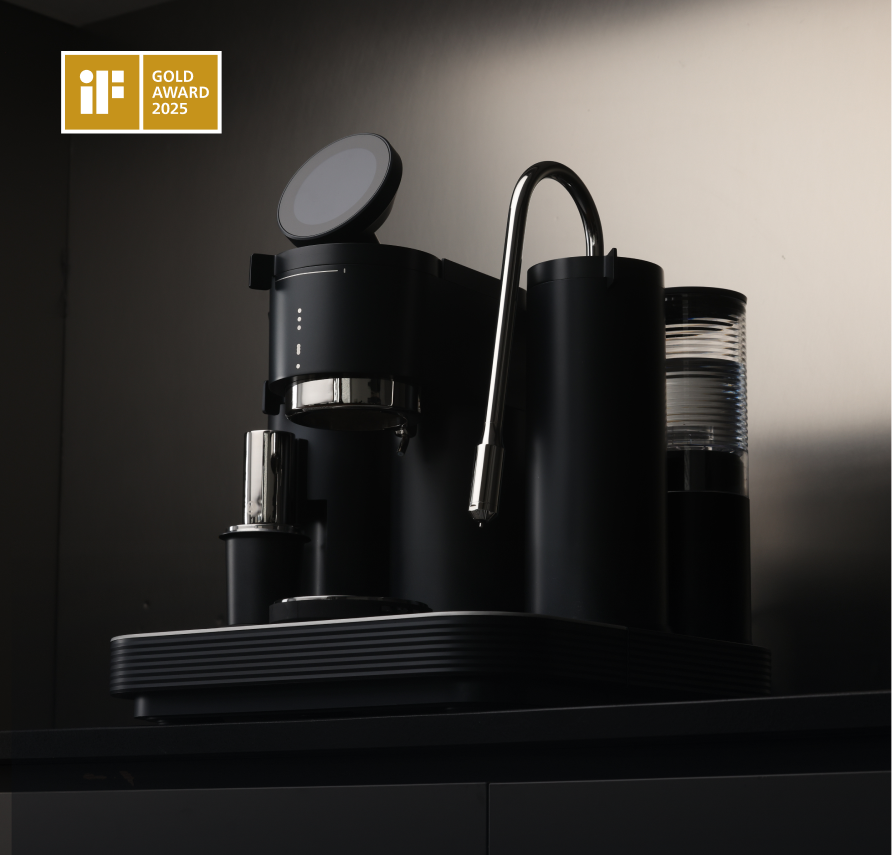
You need depth for the machine, plus space to insert and remove the handle without hanging a heavy portafilter in mid-air. You also need a surface that will not flex. The live Meraki espresso machine product page listed a weight of 14.5 kg and dimensions of 370 × 370 × 415 mm on 23 November 2026 (Asia/Shanghai). Recheck those figures. Add water in the tank, the portafilter, and the force you apply when you lock in, and a light cart starts to look less like a counter.
If the top is narrower than the machine plus a safe handle swing, the island is already the wrong station. Measure the actual work surface, not the island’s overall length including the overhang people sit under.
A paper template helps: outline the official width and depth, then add the handle swing and a small landing zone for a cup. If that paper no longer fits inside the usable top, the island is already too small, no matter how long the island looks from the living room.
Wheels, locks, and vibration
Unlocked wheels turn a routine tamping motion into a rolling workstation.
If you use a cart, the casters must lock, and they must actually hold on your floor. A pump and a tamp send vibration into the frame. A wobbly shelf will walk toward the edge of a rug. Test the cart with the machine unplugged: lock the wheels, lock in a portafilter, and lean the way you would when you tidy a puck. If the cart moves, it is not a coffee station yet.
Islands usually do not roll, but a lightweight island on a slick floor, or a table you are only using as an island, can still shift. If the surface flexes visibly, stop. Ready.gov’s home fire guidance and the NFPA home fire safety pages are general reminders that unstable or badly powered appliances do not belong in a walkway; they are not a cart-shopping list.
Power and water: cords you should not stretch
The cord should reach a proper outlet without becoming a trip line.
Islands often hide a receptacle on the side or in a seating overhang, or they have no outlet at all. Stretching a light-duty extension cord across a walkway is a poor fix. So is running a cord under a rug or over a sink path. If the island cannot host a short, dry, official-length power cord, the machine belongs on a counter that can, or you need a licensed electrician to add a suitable receptacle. Building professionals use documents from organizations such as the International Code Council; that is a reason to hire an electrician, not a DIY wiring project. Occupational overviews such as OSHA’s electrical topic page are written for workplaces, but they still support a conservative home rule: keep cords dry, short, and out of traffic.
Water is the other half. A reservoir machine still has to be filled and emptied. Carrying a full tank across a room, or dripping on a hardwood walkway, is part of the island plan. Meraki is a tank machine on the current product page; you are not plumbing an island unless a different model officially supports a line. For product questions, use Meraki support rather than improvising a feed.
Splash, steam, and nearby seating
Guests at the island are sitting inside the splash zone.
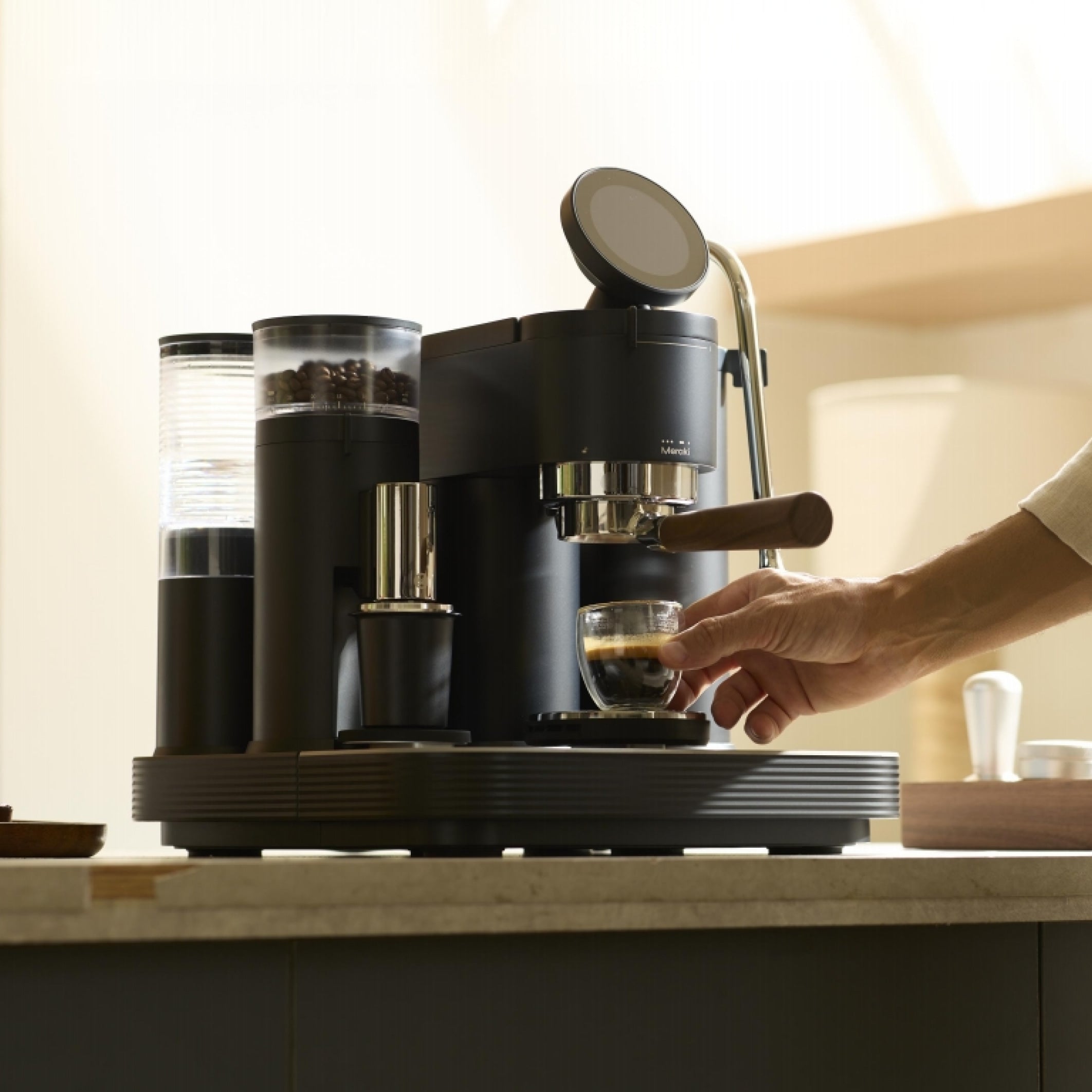
Steam wands, rinse water, and the occasional over-filled cup belong behind a backsplash on a regular counter. On an island they face stools, laptops, and elbows. Leave a buffer on the seating side, point the wand away from faces, and keep towels and a drip tray you will actually empty. A glossy island top also shows every ring of water; that is cosmetic, but a wet floor next to a walkway is not.
Household fire and kitchen-safety overviews such as the Red Cross fire safety page are not espresso manuals, but they support a conservative placement: keep heat, water, and cords out of traffic. Energy.gov is likewise general background, not a license to hide a cord in a cabinet gap.
A setup that can be rolled away, and one that should not be
A cart is only portable if you unplug it and drain it before it moves.
Rolling a plugged-in, water-filled machine to “tuck it away” is how cords snag and tanks slosh. If you need the cart to leave the room, treat that as a shutdown: power off, unplug, empty or stabilize the tank and drip tray, then move. If you cannot do that every time, the cart should stay parked and locked in one place, which means it is really a movable table, not a traveling bar.
An island should not be treated as portable at all. Once the machine lives there, the outlet, the water routine, and the seating plan have to work every morning.
Storage for cups, a knock box, and beans
The station is unfinished if the tools have nowhere to sit.
You will need a stable place for cups, a knock box, and a bean container that does not rattle off a cart shelf. If the island is already tight, use a nearby drawer or a dedicated caddy rather than stacking loose tools at the edge. Practical knock-box notes live in Knock Boxes: Size, Material, and Daily Use. For trays, pitchers, and other tools, browse the live espresso accessories collection rather than inventing a packing list here.

| Check | Island | Cart |
|---|---|---|
| Surface stays still while you lock in a portafilter | Usually, if the top is rigid and deep enough | Only if casters lock and the frame does not flex |
| Portafilter handle has room | Measure the usable top, not the seating overhang | Same measurement; watch the handle past the shelf edge |
| Power | A short cord to a proper island or nearby receptacle | Do not roll the machine while it is plugged in |
| Splash and seating | Leave a buffer on the stool side | Keep the cart out of a main walkway |
| Moving the station | Treat it as fixed | Unplug and stabilize water first, or do not move it |
A stability-and-safety checklist
Walk the list once with the machine still in the carton if you can.
If any answer is no, use a fixed counter instead of hoping the cart will “settle in.”
- The worktop is level, rigid, and deeper than the machine plus a safe portafilter swing.
- The surface can hold the official machine weight plus water and normal locking force.
- Cart wheels lock, and a lock-in test does not roll or flex the frame.
- The power cord reaches a suitable outlet without crossing a walkway or a wet path.
- Seating, laptops, and elbows sit outside the steam and splash zone.
- Cups, a knock box, and beans have a still place that is not the edge of the top.
When a fixed counter is still the better home
Choose a back-counter when the island or cart fails the mechanical test.
That is the honest result if the top is too shallow, the only power is an extension cord, guests sit in the steam path, or the cart moves when you tamp. A pretty island is not a reason to ignore those constraints. You can still keep cups and beans on the island and brew on a back-counter if that split is safer.
Small-kitchen placement questions — which wall, which cabinet run, how tight the alcove is — belong in the existing small-kitchen guide, not here. This page only asks whether the island or the cart can behave like a counter.
Conclusion
An espresso machine can live on an island or a cart only if the surface stays still, the portafilter has room, the cord is short and dry, and the splash zone does not include someone’s lap. Lock the wheels or do not use a cart. If those tests fail, put the machine on a fixed counter and use the island for serving. Confirm current weight and dimensions on the live Meraki espresso machine product page before you buy a cart to fit it.
FAQ
Can I put an espresso machine on a kitchen island?
Yes, if the top is rigid and deep enough, the cord reaches a proper outlet, and seating sits outside the steam and splash zone. If any of those conditions fail, use a fixed back-counter instead.
Is a rolling cart safe for an espresso machine?
Only if the cart is rated for the weight, the casters lock, and the frame does not move when you lock in a portafilter. Unplug and stabilize water before you roll it. If it walks or flexes, do not use it.
How much space does an espresso machine need on an island?
You need the machine’s official footprint plus room to insert and remove the portafilter, plus a buffer from seating. Measure the usable top, not the island’s full length including the overhang.
Can I use an extension cord for an espresso machine on an island?
Treat that as a last resort you should try to avoid. A stretched or light-duty cord in a walkway is a poor setup. Use a suitable receptacle, or place the machine where one already exists.
Where should I put a knock box on a cart or island?
Give it a still, level patch that is not at the edge and not on a shelf that rattles. If the top is already tight, use a nearby drawer or a caddy rather than balancing the box beside the machine.


