


You already like the idea of a compact dual boiler espresso machine for small counters — then you notice the cabinet overhang, the outlet behind the toaster, and the portafilter handle that needs room to swing. Brochure “compact” rarely matches a tape measure.
This Meraki guide is a measurement checklist, not another compact dual-boiler explainer. For architecture and taste framing, use what to know about compact dual boilers and full-size taste in a smaller footprint. Use this page to prove the machine fits your counter before you compare prices.
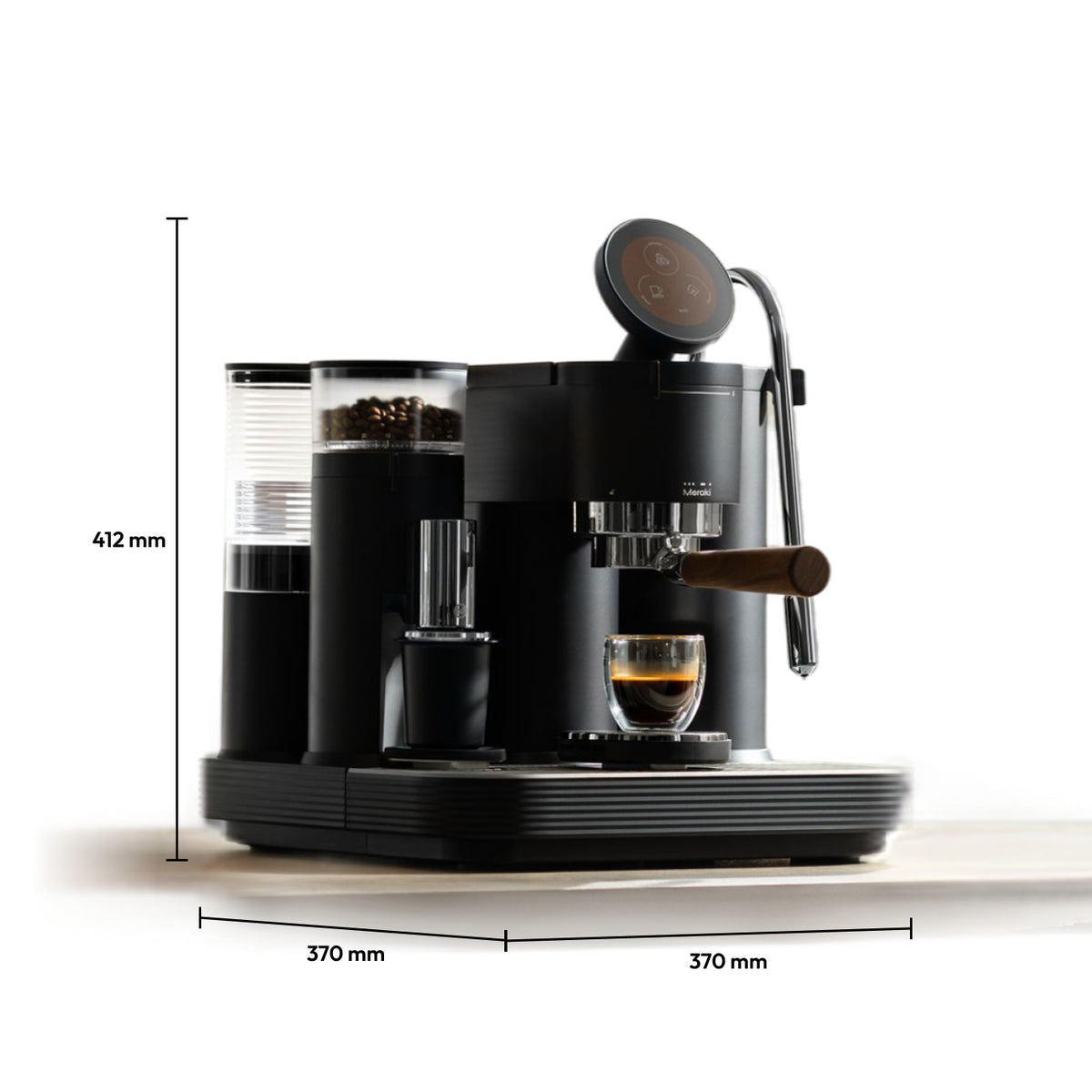
Measure chassis W × D × H, then add cup clearance, portafilter swing, hopper lid travel, and ventilation — not only the box footprint.
What “compact dual boiler espresso machine for small counters” really means for home buyers
“Compact dual boiler” in search results often means a shopping card with a short width claim. For a small-counter buyer it means something narrower: Will brew and steam still work in one morning sequence after the machine is parked under a cabinet, beside a wall, and in front of one outlet?
Home dual boilers still need real depth for the portafilter, a landing zone for a pitcher, and airflow so heat does not bake into a backsplash. A chassis that looks small in a hero photo can fail when the hopper lid will not open, the group sits under a shelf, or the only outlet is behind the machine.
Treat the keyword as a fit problem first and a feature list second. Dual boilers are the heat architecture; small counters are the geometry problem. You need both answers before checkout.
Who this page is for (and who should skip it)
This page is for apartment kitchens, galley counters, and shared coffee stations where every inch is already claimed — buyers who want dual-boiler milk drinks without building a café island.
Skip it if you still need layout inspiration rather than numbers. Use eight compact setups that work and space-saving espresso for a compact kitchen first. Also skip a dual-boiler buy if your real constraint is budget for beans and water care, not width — a machine that fits but never gets dialed in is still a bad fit.
Why this is a measurement checklist (not another compact explainer)
Search and Meraki’s own cluster already cover “what compact dual boilers are,” “pro quality in less space,” and “all-in-one with built-in grinder what to check.” Those pages own education and setup ideas. This page owns the tape measure.
The unique job here is a pre-buy measurement workflow: W × D × H, cup clearance, portafilter swing, hopper / hood clearance, ventilation, weight, and outlet access — plus the soft landing space a dual-boiler morning actually uses. Specs appear only when they change whether the machine fits and works in a tight kitchen.
Disclosure: Meraki publishes this guide and sells the Meraki Espresso Machine, an all-in-one dual-boiler system. We will cite Meraki’s published dimensions as one worked example. We will not invent competitor footprints, and we will not link out to competitor stores. Score every brand — including ours — on the same measurement questions.
Must-have checks before you compare prices
Price comparison without a measured pad produces fake winners. A cheaper dual boiler that needs a separate grinder can grow wider than an all-in-one once tools land beside it. Compare complete stations on a drawn rectangle, not thumbnails.
Before you compare dollar amounts, lock seven measurements on paper or in your phone notes: (1) free counter width and usable depth; (2) under-cabinet or shelf height above the pad; (3) wall / appliance clearance on both sides; (4) portafilter swing arc toward the room; (5) hopper or lid travel upward / rearward; (6) outlet location and cord path; (7) where the knock box, pitcher, and cups will live without blocking a walkway.
Meraki’s current product page lists chassis dimensions of 370 × 370 × 415 mm (about 14.6 × 14.6 × 16.3 in) and weight 14.5 kg (about 32 lb) — verify the live product page the day you buy. Treat those as the box footprint only; add your own swing and lid clearances. For built-in-grinder trade-offs beyond size, see compact all-in-one machines with built-in grinder: what to check.
Specs that matter in the cup (and vanity specs to ignore)
In the cup, dual boilers still matter for milk-drink mornings: brew and steam can run without a long temperature swing. A rotary pump held near a steady 9 bar is about pressure stability, not a higher marketing number. Built-in dual scales near ±0.2 g matter because dose and yield errors waste beans you paid for.
On a small counter, the specs that change daily life are quieter: depth with the portafilter locked in, cup clearance under the group and under cabinets, hopper access without moving the whole chassis, and whether the drip tray and water tank pull forward without a wall collision. Meraki frames an all-in-one path — dual boilers, commercial rotary pump, TIMEMORE® co-developed grinder, dual scales — so one pad replaces a machine + grinder + scale triangle. Confirm that framing on the live product page, not from this paragraph alone.
Ignore vanity “20 bar” badges and award logos used instead of fit photos. Meraki’s iF Gold Design Award 2025 claim (site claim) signals design intent, not under-cabinet clearance. Category literacy from the Specialty Coffee Association beats any single badge when you are judging extraction goals — then return here for geometry.
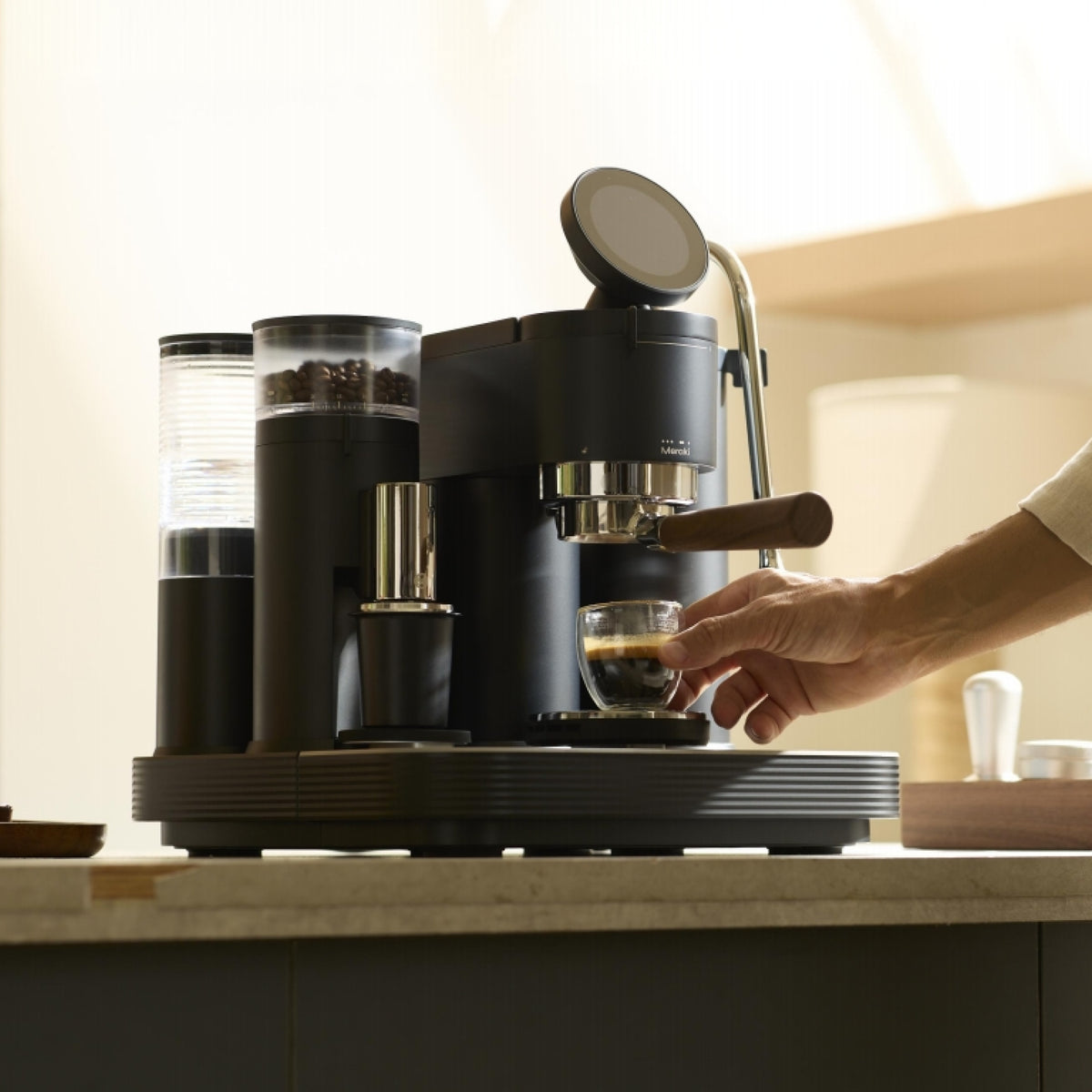
Black Meraki Espresso Machine on a counter — measure the real pad, including handle swing and cup height, not only the chassis photo.
Setup, shipping, trial, and warranty questions to ask
Ask ownership questions that marketing pages bury after the hero shot. Meraki’s shipping policy frames free shipping on orders over $200 except where remote or regional surcharges apply, with typical processing and delivery windows that can stretch for some addresses. Orders may split — gifts and accessories can arrive separately from the machine. Meraki does not ship to PO Boxes.
The 30-day home trial starts on delivery; returns need approval, cleaning, accessories, and packaging. For approved non-DOA U.S. returns, the refund policy has listed a return shipping fee deducted from the refund (U.S. fee listed at $100 when checked October 26, 2026 — confirm the live table). That fee matters on a tight counter: if fit is uncertain, price the exit before you celebrate the width claim.
Meraki describes a 2-year limited warranty from delivery in the country of original purchase — see warranty claim. Confirm you are on the regional storefront that matches where the machine will live (US default, Canada, Australia, and others). Support: +1 833 854 9555 (Mon–Fri, 9 AM–5 PM EST) via support. For dual-boiler landing context beyond size, Meraki also publishes a dual boiler espresso machine hub page.
Budget and total cost of ownership
Sticker price is only the deposit on a small-kitchen coffee habit. Compact dual-boiler TCO usually includes the machine and any tools still missing; beans; water filtration if your tap is hard; cleaner; electricity (modest next to beans — see energy.gov); dial-in time; and the exit cost if the chassis does not fit after unboxing.
| Cost / fit bucket | What to include | Why small counters care |
|---|---|---|
| Chassis pad | Published W × D × H + your measured free rectangle | Thumbnail width ≠ usable pad |
| Soft clearances | Cup height, portafilter swing, hopper lid, ventilation | Failures show up after delivery |
| Station sprawl | Knock box, pitcher, cups, scale if separate | Separate tools can erase “compact” |
| Shipping / trial | Free-shipping threshold; return fee; split gifts | Exit cost if fit fails |
| Consumables / year | Beans × drink count; filters; cleaner | High use amortizes premium faster |
| Time | Wipe-down; moving a heavy unit to clean | Weight and outlet path matter |
As of October 26, 2026, Meraki listed $1,999 with a $1,799 offer on the U.S. product page — re-check before you treat those numbers as live. Same-day on-site signals included a current promotional gift kit framing (~$210 when checked; current offer, not permanent pricing) and strong review / install messaging on key pages. Useful context, not a substitute for measuring your cabinet. Measurement near a tenth of a gram still cuts wasted shots — NIST is a reminder that measurement earns trust; you need repeatable dose and yield and a pad that does not force daily rearranging.
Red flags in product listings and reviews
Watch for “compact” claims with no W × D × H, photos shot from above that hide depth, and all-in-one prices compared to bare dual boilers that still need a grinder beside them. “Fits any kitchen” without under-cabinet height is marketing, not a fit guide.
Prefer review patterns that mention steaming beside walls, hopper refills under shelves, noise in studios, and whether owners still use a scale after week one. CoffeeGeek’s guides and SCA research help separate skill problems from hardware or space problems.
Be wary of no-name machines with no service path and no clear country-of-purchase warranty. Home appliances are not “just metal and a boiler” from a safety view — see UL. If a listing hides dimensions, weight, return fees, or inclusions, assume the missing line is your surprise cost after the courier leaves.
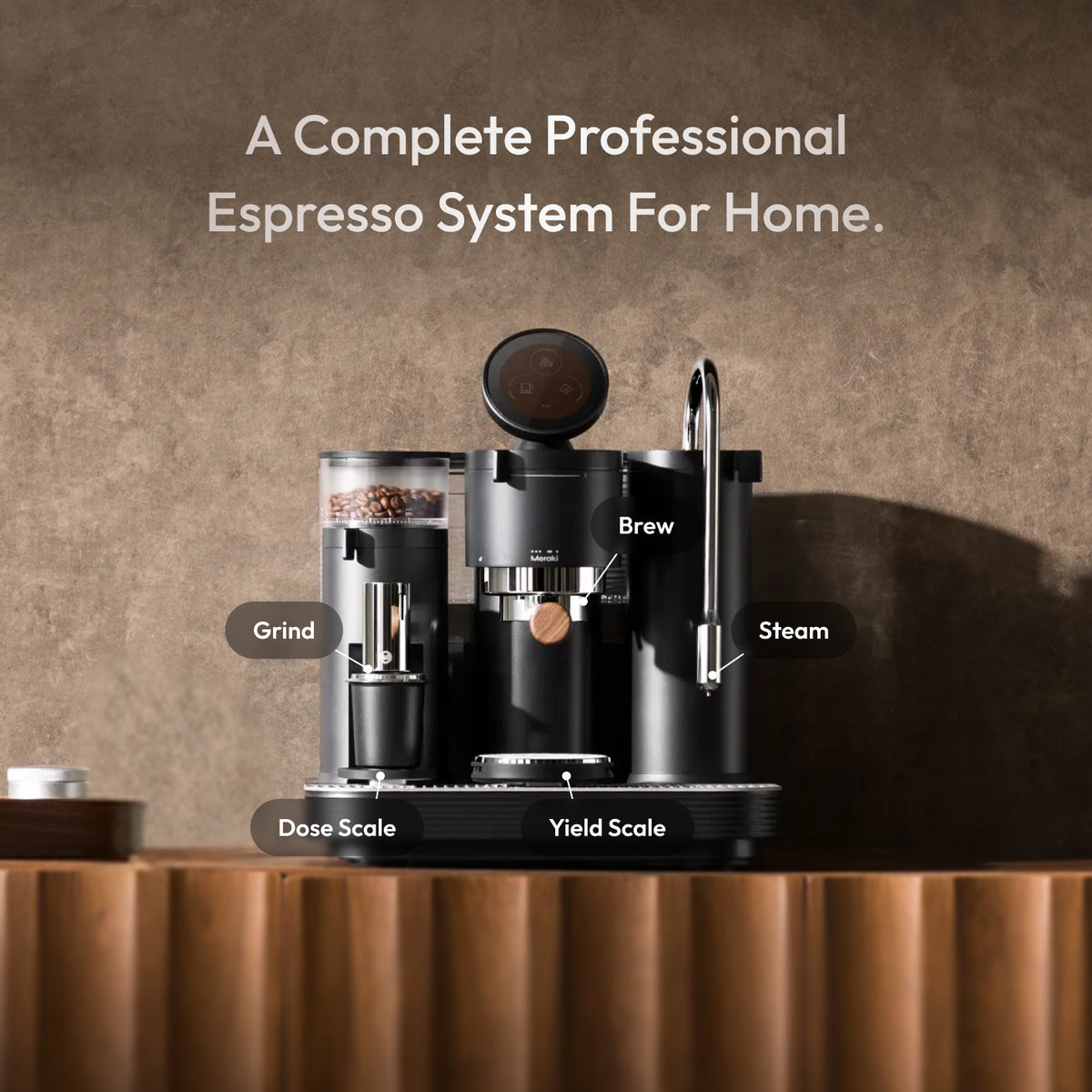
All-in-one dual-boiler layout — one pad can replace a machine + grinder + scale triangle, but only if hopper and cup clearances clear your cabinets.
A short buyer checklist you can save
Answer yes/no in your own words before checkout:
- I measured free width and usable depth where the machine will actually live (not an empty stretch of island).
- Under-cabinet / shelf height clears the chassis plus cup clearance under the group and any hopper / lid travel.
- Portafilter can lock and unlock without hitting a wall, backsplash edge, or neighboring appliance.
- There is a planned landing zone for pitcher, cups, and knock box that does not block a walkway.
- Rear / side ventilation space matches the maker’s guidance (do not seal a dual boiler into a closed cubby).
- Weight is acceptable for the shelf or counter, and I can move the unit far enough to clean behind it.
- Outlet access works without dangling a cord across a wet drip-tray zone; I am on the correct regional storefront.
- I compared a complete station footprint (all-in-one vs machine + grinder + scale), not chassis width alone.
- I know trial start, return shipping fee, and warranty geography if the fit fails after unboxing.
Five or more clear “yes” answers usually means the compact dual-boiler buy is geometrically ready. Three or fewer means pause — architecture is not the blocker; the pad is.
Next step: verify on the product page
Open the live Meraki Espresso Machine product page and verify today’s dimensions, weight, price, gift offer, trial language, and warranty highlights, then re-check fee tables on the policy pages above. For a magazine look at Meraki × TIMEMORE, see Barista Magazine’s test-drive — still not a substitute for your tape measure or trial. Broader iF program context: ifawards.com.
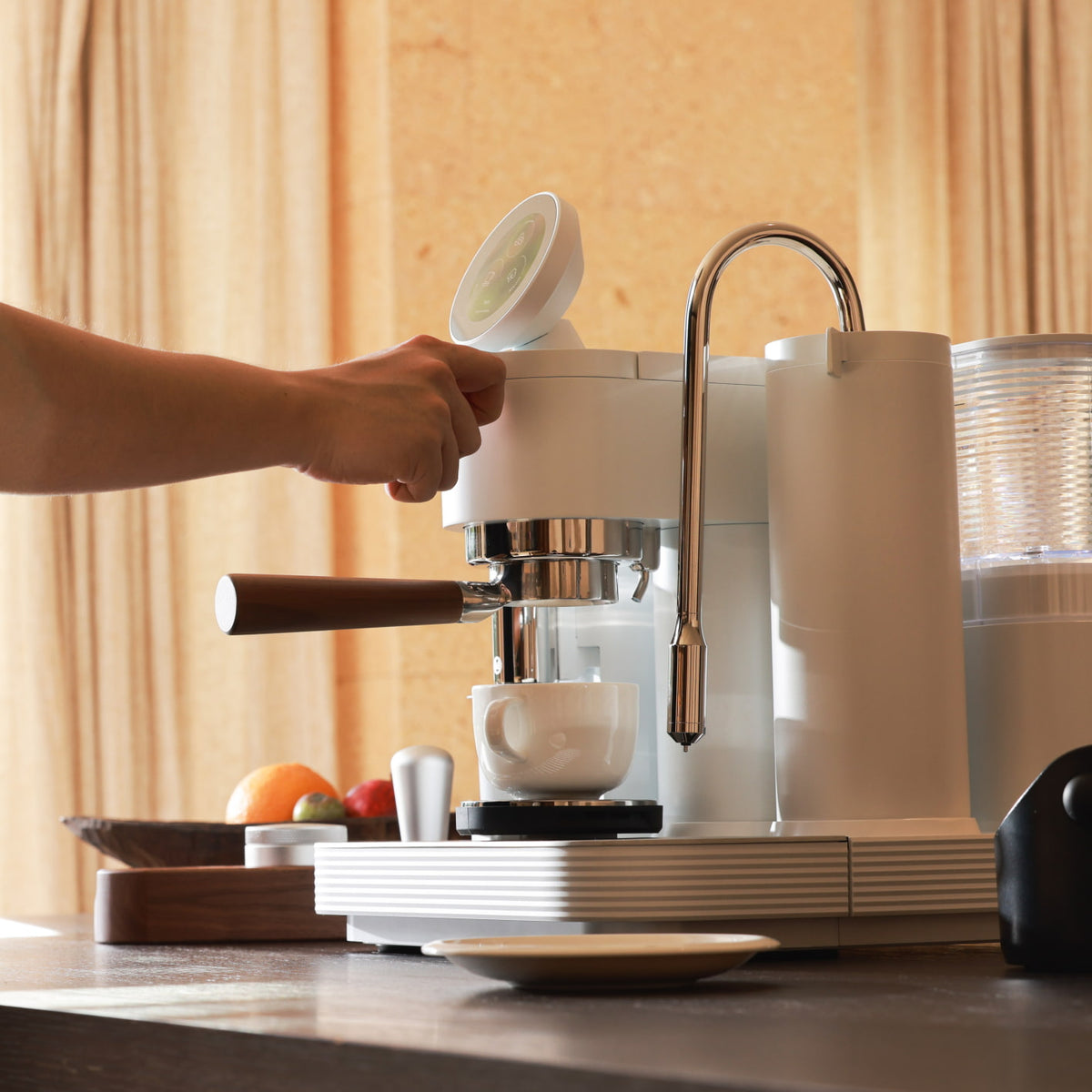
White Meraki Espresso Machine — same dual-boiler architecture; confirm finish, dimensions, and terms on the live page before you order.
Do I really need a dual boiler espresso machine?
Only if milk drinks or back-to-back shots are routine.
If you mostly pull single espressos with long gaps, a well-set-up single boiler can still be honest — and sometimes easier to place on a tiny pad. Dual boilers earn their keep when brew and steam must happen together without a long temperature swing: lattes, cappuccinos, and household queues.
This measurement page does not re-run that decision. Use Meraki’s do you actually need a dual boiler self-test. Come back here only after “need dual boiler” is already a yes — then the remaining risk is fit and ownership terms, not architecture.
What is the 30 second rule for espresso?
It is a rough timing habit — not a physics law.
Home guides often repeat a “~25–30 second” shot window as a starting point for traditional espresso recipes. That range can help beginners notice gross grind errors, but it is not a Specialty Coffee Association commandment that every good shot must finish on the thirtieth second. Dose, yield ratio, grind, temperature, and taste matter more than a stopwatch alone.
Treat time as one feedback loop among several. If a shot races in 15 seconds or crawls past a minute, your grind or dose likely needs work — then taste. For literacy beyond myths, use SCA research and practical CoffeeGeek guides, then dial in on your beans during a home trial rather than chasing a viral “rule.”
FAQ
What should I measure beyond width for a compact dual boiler? Measure usable depth, under-cabinet height, portafilter swing, hopper or lid travel, rear/side ventilation, weight, and outlet path — then sketch where pitcher, cups, and knock box will sit. Chassis W × D × H is only the starting rectangle. Soft clearances are what turn a “compact” listing into a daily fight with a cabinet lip.
What are Meraki’s published dimensions and weight? On the Meraki Espresso Machine product page specs (verified against the 2026-10-26 scrape / live page framing used for this guide), dimensions are listed as 370 × 370 × 415 mm (about 14.6 × 14.6 × 16.3 in) and weight 14.5 kg (about 32 lb). Re-check the live page before you buy; gallery alt text has also described height near 412 mm, so treat the specs table as primary and measure your own clearances either way.
What is the best and smallest coffee machine for a tiny kitchen? “Best and smallest” depends on drink type, not a single winner. Capsule or ultra-narrow single-boiler machines can win pure width; a compact dual boiler wins when milk drinks need simultaneous brew and steam and you measured the pad. Meraki publishes this page and sells an all-in-one dual-boiler system — we are not ranking every brand. Measure first, then compare complete stations on the same rectangle.
Can I put a dual boiler in a closed cabinet or cubby? Usually no. Dual boilers produce heat and need manufacturer-recommended airflow; sealing one into a closed cubby risks heat soak, noise, and service headaches. Prefer an open counter pad with rear/side clearance, and never block vents to “hide” the machine.
Does an all-in-one with a built-in grinder always save space? Often yes on total station width, because you avoid a second chassis — but hopper lid travel and bean-refill access can demand more vertical clearance than a low machine-only box. Compare all-in-one height and lid travel against a machine + separate grinder footprint using the same tape measure.
If your checklist still points to a dual-boiler workflow and the measured pad clears swing, lids, and airflow, confirm today’s dimensions and terms on the Meraki Espresso Machine product page — then decide with your kitchen, not a search-result thumbnail.
More on this topic: Espresso Machine Boilers, Pumps & Controls.


