


A home espresso machine can be worth it, but not simply because homemade coffee costs less than a café drink. The better question is whether the complete setup fits the drinks you make, the time you want to spend and the quality you expect.
The real cost includes more than the machine. A grinder, scales, accessories, coffee beans, milk, water treatment, cleaning supplies and possible service all belong in the decision. Your time and willingness to learn matter too.
For some households, espresso becomes a valuable daily ritual and can replace frequent café purchases. For others, an expensive machine becomes counter space they rarely use. This guide helps you model your own answer instead of promising a universal payback date.

Quick answer: is an espresso machine worth it?
An espresso machine is more likely to be worth it when you:
- make espresso or milk drinks several times each week;
- want more control over coffee, dose, yield and milk texture;
- will use fresh coffee beans and maintain the equipment;
- value convenience at home as well as potential savings;
- choose a workflow that matches your skill and available time.
It is less likely to be worth it when you only drink espresso occasionally, prefer a fully automatic push-button routine, dislike cleaning, or are buying mainly because a machine looks impressive.
The short version: Calculate the complete setup and recurring costs, then judge the workflow. A machine is worth owning when you will use its capability consistently—not when a generic calculator says it should pay for itself.
What does a home espresso setup really cost?
Separate one-time costs from recurring costs. Mixing them together makes an affordable machine look cheaper than the complete setup and makes a premium integrated system look more expensive than the tools it replaces.
| Cost category | What to include | Why it changes the answer |
|---|---|---|
| Espresso machine | Purchase price, tax and any required installation | The largest one-time cost, but not the whole setup |
| Grinder | Built-in or separate espresso-capable grinder | Grind adjustment and repeatable dosing directly affect the workflow |
| Measurement tools | Dosing scale, espresso scale and timer if not integrated | These help repeat dry dose and brewed yield |
| Preparation tools | Tamper, distribution tools, knock box, milk pitcher and cups | Some may be included; others become additional purchases |
| Water | Filtered water, cartridges or treatment appropriate to local water | Water affects taste and mineral buildup |
| Coffee and milk | Beans, milk or alternatives, plus dial-in and remake waste | Usually the largest recurring ingredient cost |
| Cleaning | Detergent, cleaning tablets, brushes, cloths and replacement filters | Routine care is part of ownership, not an optional extra |
| Electricity | Warm-up and active use based on the machine and local rate | Usually smaller than ingredients, but varies by usage and location |
| Service and wear | Gaskets, burrs, seals, labor and shipping not covered by warranty | Timing and cost vary widely by machine and maintenance history |
The safest budget is therefore not “machine price plus beans.” It is the complete equipment cost, followed by a monthly operating estimate based on your own drinks.
A simple break-even calculator that does not overpromise
Do not compare the machine with every drink you consume. Count only the café drinks you expect to replace. If you continue buying weekend coffee out, leave those purchases in the café budget.
Step 1: calculate the total setup investment
Add the machine, grinder, required scales, accessories, tax and any initial water-treatment equipment.
If the machine already integrates a grinder or scales, do not add those items again. If you already own suitable equipment, use its remaining value rather than pretending it was free.
Step 2: calculate monthly café spending replaced
Use this formula:
Café spending replaced = café drink price × number of café drinks genuinely replaced each month
Use your actual receipts. Café prices and habits vary too much for one national assumption to be useful.
Step 3: calculate monthly at-home variable cost
Include the coffee used in successful drinks, dial-in waste, milk, water filters, cleaning products and estimated electricity. The U.S. Energy Information Administration publishes current electricity price information, but your own utility bill is the better input.
Step 4: estimate net monthly savings
Net monthly savings = café spending replaced − monthly at-home variable cost
If the result is zero or negative, the machine has no financial break-even under that scenario. It may still be worth owning for quality, control, convenience or enjoyment—but call that value what it is.
Step 5: estimate a cautious break-even period
Break-even months = total setup investment ÷ net monthly savings
Run at least three scenarios: conservative, expected and high usage. Add a maintenance reserve rather than assuming nothing will ever need service.
This is a planning model, not a guarantee. Coffee habits change, ingredient prices move and some owners enjoy making more drinks once the machine is at home.
The hidden costs buyers often miss
The grinder can be as important as the machine
Espresso requires controlled adjustment around a narrow grind range. A machine without a suitable grinder may create a second major purchase and a frustrating early experience.
If you are comparing separate equipment, budget for an espresso-capable grinder and a repeatable dosing method. Our espresso grinder vs coffee grinder guide explains why a general-purpose grinder may or may not work.
Dial-in and remake waste
Different coffee beans can require different grind settings. The first recipe may need adjustment, and occasional shots will not taste as intended. Treat a reasonable amount of coffee waste as part of learning rather than claiming every gram becomes a perfect drink.
Better measurement can reduce guesswork, but it cannot replace tasting. Roast date, coffee density, humidity, preparation and recipe all influence the result.
Water treatment and scale management
Local water can affect both flavor and equipment. The U.S. Geological Survey explains that heating hard water can form calcium-carbonate deposits and that mineral buildup can occur in coffee makers. Review your machine manufacturer's water guidance before choosing a filter or descaling routine; do not assume one treatment suits every water source.
Read the USGS hard-water explanation and follow the maintenance instructions for your specific machine.
Cleaning and maintenance time
Espresso creates coffee oils, fine grounds and milk residue. The portafilter, basket, steam wand and drip tray require regular attention, while deeper cleaning follows the manufacturer's schedule.
Cleaning is not a reason to avoid espresso, but it belongs in the routine. Our espresso machine cleaning guide provides a practical overview; the product manual remains the final instruction for a specific model.
Warranty coverage is not the same as zero service cost
A warranty can lower ownership risk, but buyers should read its duration, exclusions, claims process and responsibility for shipping or labor. The U.S. Federal Trade Commission recommends checking what a written warranty covers and what the company will do if the product fails.
The FTC warranty guide is a useful pre-purchase checklist. Keep the purchase receipt and a copy of the warranty terms that applied when you bought the machine.
Time, learning and counter space
A semi-automatic espresso machine asks you to prepare the coffee bed, start the extraction, assess the result and texture milk. Some people value that craft; others experience it as friction.
Separate machines and scales also require counter space, outlets and movement between tools. A compact integrated system can reduce that footprint, while a separate setup offers more independent upgrade flexibility.
Why are some espresso machines so expensive?
Price alone does not prove quality. A higher price can reflect more capable brew hardware, stronger steam performance, better temperature control, quieter components, integrated measurement, materials, service infrastructure or design. It can also reflect features you will never use.
Judge a premium machine by the complete workflow:
- Can the grinder make controlled changes for espresso?
- Can you repeat both the dry dose and brewed yield?
- Can the machine maintain the brewing and steaming workflow you need?
- How long does it take to become ready in your market?
- What cleaning and service access is provided?
- What does the written warranty cover?
- Does the system reduce tools, steps or uncertainty you actually care about?
The best espresso machine for home guide gives a broader buying framework. For professional-style hardware and workflow, use the professional espresso machine for home guide.
Where Meraki changes the total-cost equation
Meraki is not positioned as a cheap all-in-one coffee machine. It is a semi-automatic espresso system that brings the grinder, measurement, brew hardware and milk workflow into one coordinated platform.
Its value is not that every separate setup costs more. The value is that several tools and decisions are integrated without turning espresso into a one-touch beverage.

An espresso-tailored grinder is already part of the system
Meraki includes an espresso-tailored grinder with 45 settings across its working range. For a buyer starting from zero, this means the budget does not need a second espresso grinder.
That integration trades away some independent upgrade flexibility. A separate grinder can be replaced or changed on its own; Meraki is designed as one coordinated system. The right choice depends on whether you value modular experimentation or a cleaner measured workflow.
For more detail, see how to choose an espresso machine with a grinder.
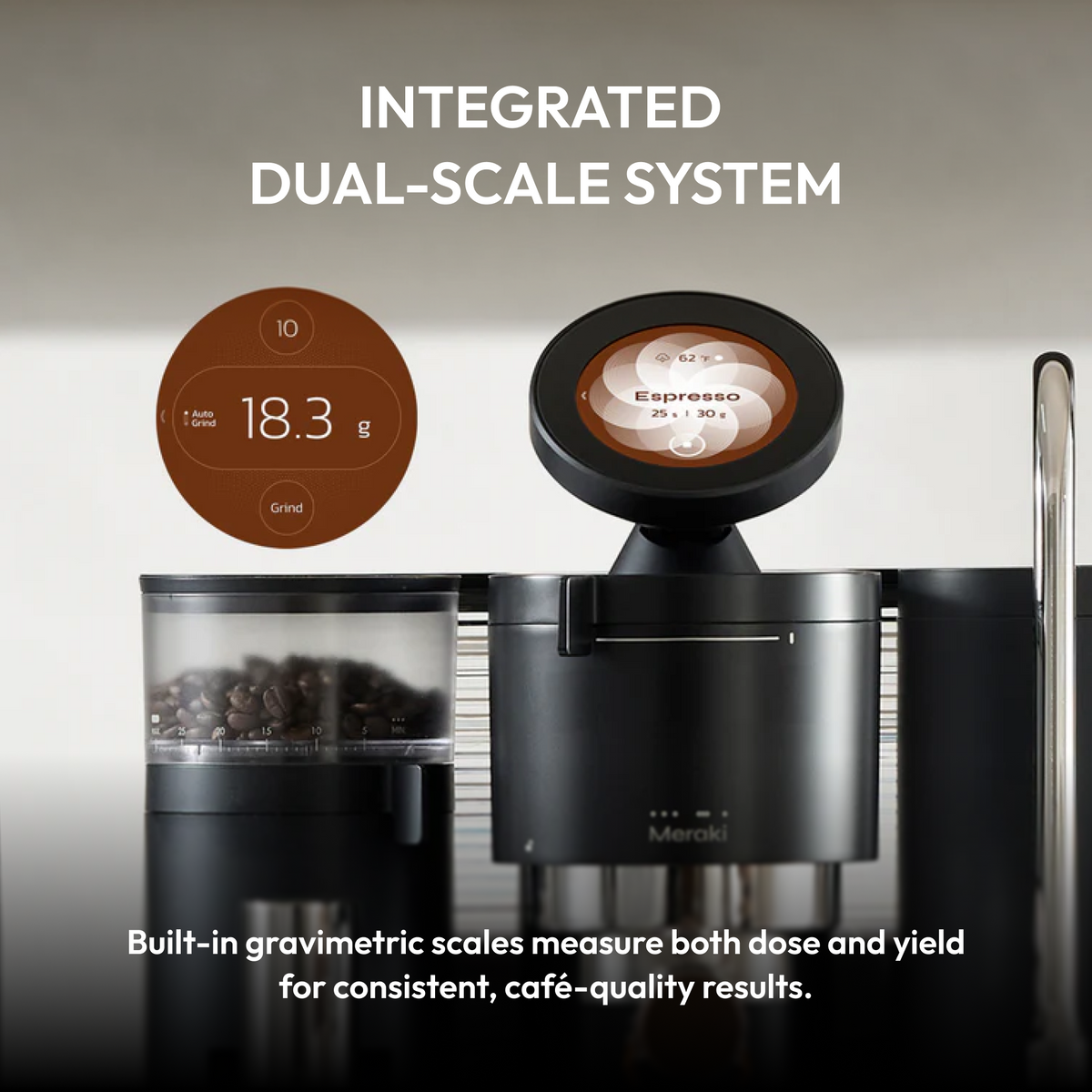
Grind by weight and brew by weight replace two separate measurements
The built-in dosing scale stops grinding at the selected dry-coffee weight. The brew scale measures espresso yield and can stop the shot at the target output.
These features do not make every recipe correct automatically. They make dose and yield visible and repeatable, reducing the need for separate scales and helping you change one variable at a time.
For a new setup, include the price and counter space of separate measurement tools when comparing systems. For an experienced owner who already has preferred scales, that saving may be less important.

Dual boilers support a faster milk-drink workflow
Meraki uses separate brew and steam boilers, allowing espresso extraction and milk steaming to operate independently. That matters most for households making lattes, cappuccinos or several drinks together.
A single-boiler machine can still make excellent espresso. The cost question is whether waiting between brewing and steaming would affect your daily use. If milk drinks are rare, dual boilers may not be the feature that justifies the investment. Read the dual boiler espresso machine guide for the trade-offs.

The rotary pump adds stability and a quieter experience
Meraki's rotary pump supports stable brew pressure with a quieter operating character than the buzzing many users associate with vibration-pump machines. Noise does not change the ingredient cost, but it can change how pleasant an early-morning machine is to use.
The pump is one part of the brew system. It does not correct the grind, dose or puck preparation; those remain separate variables.
Quick warm-up lowers everyday friction
The U.S. 120V Meraki model is designed to be ready in about four minutes. A shorter wait can matter more than a theoretical feature if it determines whether you use the machine on a workday.
Warm-up time varies by model and electrical market, so compare the exact regional version you plan to buy.
Warranty and returns reduce part of the purchase risk
Meraki currently provides a two-year warranty and a 30-day returns policy for the U.S. product. Read the live terms before purchase, because coverage and policies can change.
These protections do not eliminate maintenance, misuse exclusions or every possible cost. They do make the claims process and return policy part of the value comparison rather than an afterthought.
What Meraki does not remove
You still need fresh coffee, milk or alternatives, suitable water, cleaning supplies and time to learn. You still distribute and tamp the coffee, start the extraction, taste the result and texture milk.
Meraki's case is professional-style hardware with fewer disconnected tools—not espresso without participation.
Explore current configuration, price and policies on the Meraki Espresso Machine product page.
Which type of buyer gets the most value?
Meraki is likely worth considering if you want
- espresso to be a regular part of your week;
- a serious semi-automatic workflow rather than push-button coffee;
- an espresso-tailored grinder without buying a separate unit;
- dose and yield measured by weight inside the machine;
- dual boilers for frequent milk drinks or back-to-back service;
- a rotary-pump platform with a quieter home experience;
- fewer devices, cables and transfers on the counter;
- guidance and repeatability while keeping the craft hands-on.
A separate prosumer setup may be better if you want
- to choose and upgrade every component independently;
- a dedicated single-dose grinder or several burr platforms;
- an espresso machine paired with equipment you already own;
- maximum flexibility even if the counter and workflow are more complex.
A simpler machine may be better if you want
- occasional espresso rather than a regular ritual;
- the lowest upfront commitment;
- mostly black coffee from another brewing method;
- a fully automatic drink with minimal preparation;
- very limited counter space and no interest in learning espresso variables.
Five questions to answer before buying
- How many café drinks will the machine genuinely replace each month?
- Do you enjoy adjusting and tasting espresso, or do you want one-button coffee?
- What equipment do you already own, and what would a complete new setup require?
- Are milk drinks common enough to make steam power and dual boilers valuable?
- Will cleaning, water care and maintenance fit your normal routine?
Write the answers down. If the use case is clear, the machine's value becomes much easier to judge.
Frequently asked questions
Is a home espresso machine cheaper than buying coffee?
It can be for someone who replaces frequent café purchases, but not automatically. Compare the complete setup with only the café drinks you expect to replace, then subtract beans, milk, water, cleaning, electricity and maintenance. If the remaining monthly saving is positive, divide the setup investment by that amount.
How long does an espresso machine take to pay for itself?
There is no universal answer. It depends on setup cost, local café prices, drinks replaced, ingredients, maintenance and how consistently the machine is used. Run conservative, expected and high-use scenarios rather than relying on a one-year promise.
What are the biggest hidden costs of an espresso machine?
The most commonly missed costs are an espresso-capable grinder, scales, preparation accessories, dial-in waste, water treatment, cleaning supplies, maintenance and time. An integrated system may include some equipment, but recurring ingredients and care still remain.
Is an expensive espresso machine worth it for a beginner?
It can be if the beginner is committed to the workflow and the machine reduces friction while preserving room to learn. A high price does not create skill or guarantee good espresso. Beginners should prioritize usable controls, clear guidance, repeatable measurement, maintenance support and a workflow they will practice.
Is a built-in grinder better than a separate grinder?
Neither is universally better. A separate grinder offers independent upgrades and broader specialization. A capable built-in grinder can save counter space, reduce transfers and integrate measurement. Judge adjustment range, dosing method, cleaning access and the total system—not the label alone.
Does Meraki make espresso automatically?
Meraki can stop grinding at a selected dose and stop brewing at a target yield, but it remains a semi-automatic portafilter machine. The user prepares the coffee bed, starts the shot, evaluates taste and textures milk.
The final decision
A home espresso machine is worth it when its complete workflow matches your real life. Financial savings can support the decision, but quality, control, convenience and enjoyment may be equally important.
Use your own numbers, include the hidden costs and choose the system you will actually use. Meraki is designed for buyers who want espresso-tailored grinding, weight-based dose and yield, dual-boiler performance and a rotary-pump platform inside one measured home system.
Sources
Put Ownership Cost in the Full Price Picture
Compare purchase price with maintenance, coffee, accessories, and long-term value in our espresso machine price and value guide. For costs that are easy to miss before purchase, also review the hidden costs of traditional prosumer espresso.
Connect Ownership Cost to Daily Use
Purchase price, beans, water, cleaning, maintenance, energy, and repairs all depend on how the machine fits your routine. Compare the complete experience in our daily-use home espresso machine guide.
Connect Ownership Cost With the Purchase Package
Total ownership includes more than the initial machine price, but the starting package determines which equipment and capabilities are already included. Review the Meraki Espresso Machine price and what you get alongside long-term operating considerations.

