


You are not shopping for a different espresso recipe when you compare Meraki black vs white. You are choosing how a large appliance will live on your counter — what light hits it at 7 a.m., what stains you will notice next to the steam wand, and which finish still feels calm after a weekday wipe.
This Meraki espresso machine color choice guide is an aesthetic + care decision page. It is not a rewrite of the single-finish notes Meraki in black: what to know or Meraki in white: what to know, and it is not a where to buy checkout walkthrough. Use those pages for finish deep-dives or purchase channels; use this page to decide black vs white for the kitchen you actually have.
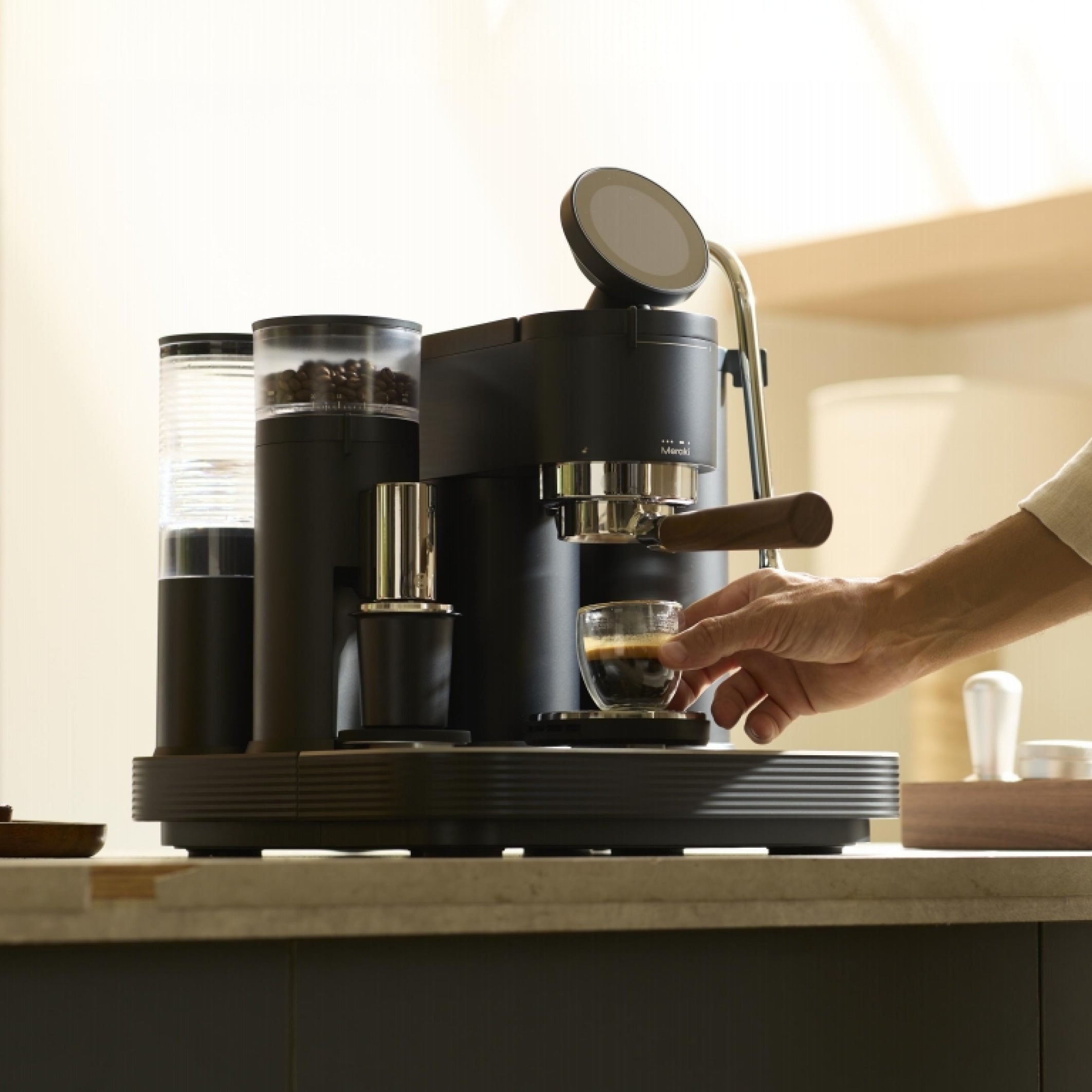
Gen2-Black Meraki Espresso Machine — same internals as white; the finish choice is about light, stains, and how the station reads on your counter.
What “Meraki espresso machine color choice” really means for home buyers
“Meraki espresso machine color choice” is not a performance upgrade path. On the live U.S. product page (checked October 26–27, 2026), Meraki offers two verified finish options for the current machine: Gen2-Black (SKU Gen2-MEM03B) and Gen2-White (SKU Gen2-MEM03W). Same dual-boiler station, same guided workflow, same ownership framing — different how the chassis shows dust, fingerprints, coffee mist, and kitchen light.
For design-conscious buyers, the keyword usually means three practical questions: Will this finish disappear into my cabinets or stand as a statement piece? Will daily steam and drip-tray messes look worse on this color in my lighting? Do my accessories and cups visually match the chassis I am about to live with for years?
Treat the search as a counter decision. You are not picking a hotter boiler or a quieter pump by switching black and white — you are picking what you will see every morning.
Who this page is for (and who should skip it)
This page is for design-conscious home buyers who have already leaned toward Meraki (or an all-in-one dual-boiler station like it) and are stuck on finish: pale Scandinavian counters vs dark stone, open shelves vs closed cabinets, households that wipe obsessively vs households that wipe when something looks dirty.
Skip it if you still need a black-only or white-only finish essay — open black: what to know or white: what to know. Skip a purchase-channel walkthrough — use where to buy the Meraki. Skip a full “is Meraki worth it” value breakdown if that is your real blocker — that job belongs to a dedicated worth-it page, not a color comparison.
Why this is an aesthetic + care decision (not another single-finish note)
Search results for Meraki color lean toward Pinterest mood boards, short review clips, Reddit finish threads about espresso machines in general, and Meraki’s own single-color finish guides. Those pages rarely force a shared decision table for both finishes against the same kitchen realities.
The unique job here is an aesthetic + care comparison: lighting and counter contrast, stain and fingerprint visibility (not invented cleaning chemistry), accessory visual match, honest “color does not change heat” myths, and a choose-in-10-minutes checklist. Specs that stay identical stay in one short table — then we move on. We will not invent a third finish, a matte-vs-gloss marketing label Meraki does not publish, or thermal properties for paint.
Disclosure: Meraki publishes this guide and sells the Meraki Espresso Machine. We will name Meraki finishes where they answer the decision. Score black and white on the same care and kitchen criteria.
Decision criteria that change the outcome
Five criteria decide most Meraki black vs white outcomes for home kitchens. Price does not — both Gen2 finishes listed the same offer price when checked.
| Criterion | What to ask yourself | Why it changes the call |
|---|---|---|
| Counter & cabinet contrast | Does the machine need to recede or become a focal object? | Dark counters hide black; pale kitchens often “want” white |
| Lighting | Is the station under bright LEDs, a window, or softer under-cabinet light? | Bright light reveals dust on black and water marks on white differently |
| Stain & fingerprint visibility | Do you wipe when you see mess — or on a fixed schedule? | Visibility changes when you feel the machine looks dirty |
| Accessory visual match | Will wood handles, chrome, steel tools, and cups sit beside the chassis all day? | The station is a set, not a lone box |
| Resale / household taste | Will a partner, roommate, or future buyer prefer a common dark finish or a light aesthetic? | Taste risk is real; performance risk is not |
If you already wipe on a schedule and your lighting is soft, either finish can look intentional. If you only wipe when smudges shout at you, visibility becomes the criterion that wins — even when the product photos look equally polished.
Design awards signal industrial design intent, not which color hides espresso mist better — Meraki’s iF Gold Design Award 2025 claim (site claim) is context via ifawards.com, not a finish tie-breaker. Cup quality still comes from habits and measurement — see the Specialty Coffee Association.
Side-by-side: black vs white on the counter
A fair Meraki black vs white comparison starts with what is the same, then isolates what the finish actually changes. On Meraki’s current framing, both Gen2-Black and Gen2-White are the same connected dual-boiler system: commercial rotary pump near a steady 9 bar, built-in dual scales (±0.2 g), TIMEMORE® co-developed burr grinder, guided touchscreen workflow, and the same approximate footprint (about 370 × 370 × 415 mm / 14.6 × 14.6 × 16.3 in on product materials). Confirm live on the product page.
| Dimension | Gen2-Black | Gen2-White |
|---|---|---|
| Verified option / SKU | Gen2-Black · Gen2-MEM03B | Gen2-White · Gen2-MEM03W |
| Espresso hardware | Same dual boilers, rotary pump framing, scales, grinder, steam wand | Same |
| Typical kitchen read | Recedes on dark stone / dark cabinets; “prosumer” silhouette | Brightens pale / Scandinavian counters; appliance-forward clean look |
| Fingerprints & coffee smudges | Often less obvious between wipes | More obvious until wiped — wipe results look very clean |
| Dust & fine grounds in bright light | Often more visible | Often less obvious than on black |
| Water marks near steam / drip tray | Usually quieter visually | Usually louder visually |
| Offer price (U.S., Oct 26–27, 2026 snapshot) | Same listing as white ($1,999 / $1,799 offer when checked) | Same listing as black |
Color is surface and perception — not a cooler-running chassis. For black-only or white-only kitchen tours, keep the black finish guide and white finish guide.
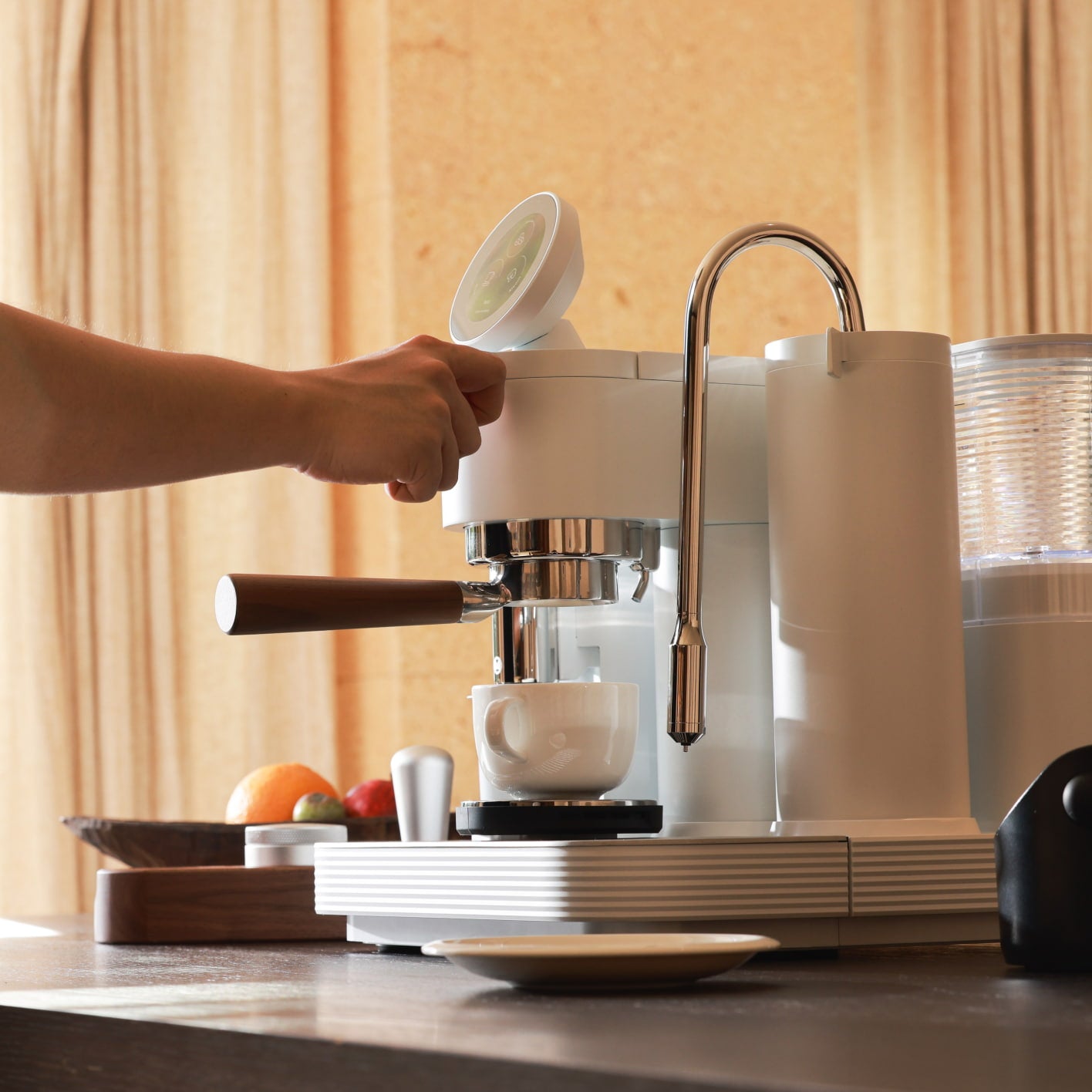
Gen2-White Meraki Espresso Machine — same guided station; pale kitchens often read white as intentional, not loud.
What color does NOT change: milk, noise, and heat-up
Color does not change brew temperature, steam power, pump sound, or warm-up time. If a forum post claims black “runs hotter” or white “hides heat better,” treat that as kitchen folklore unless you have a thermometer log — Meraki does not publish finish-specific thermal specs, and this page will not invent them.
Milk drinks still expose dual-boiler value the same way on either finish. Meraki lists heat-up in about the 3–4 minute range on product FAQ framing — re-check live. Noise is a rotary-pump / kitchen-acoustics question, not paint. Judge both in a 30-day home trial if wait time or sound matters.
What does change near milk work is visibility. Steam mist, pitcher drips, and drip-tray rings sit next to a light or dark chassis. White often makes those marks the reason you wipe; black often lets them wait until the next intentional clean — a care rhythm difference, not a steam-wand difference. Prefer review patterns on milk texture after week one; see Meraki reviews, CoffeeGeek’s guides, and SCA research.
Space, wipe habits, and accessory visual match
Footprint does not change with color. Measure under-cabinet clearance and outlet path for the dimensions on the live product materials either way. What changes is how large the machine feels: black can visually shrink against dark cabinetry; white can visually expand a light counter into a “café corner.”
Wipe habits matter more than marketing adjectives. Neither color changes the cleaning routine — only what you notice. Daily wipers often like white’s visible feedback; twice-a-week wipers often prefer black looking “fine” between cleans — until bright light shows grounds on the top panel.
Accessory visual match is underrated. Walnut handles, chrome, steel pitchers, and dosing tools sit in the frame every day. Meraki’s accessories collection includes items photographed in black (for example, dosing-cup imagery) that read as one dark set beside Gen2-Black; wood and stainless still work beside white. Do not invent “white kit SKUs” Meraki does not list — match what you can buy, then decide blend vs contrast.
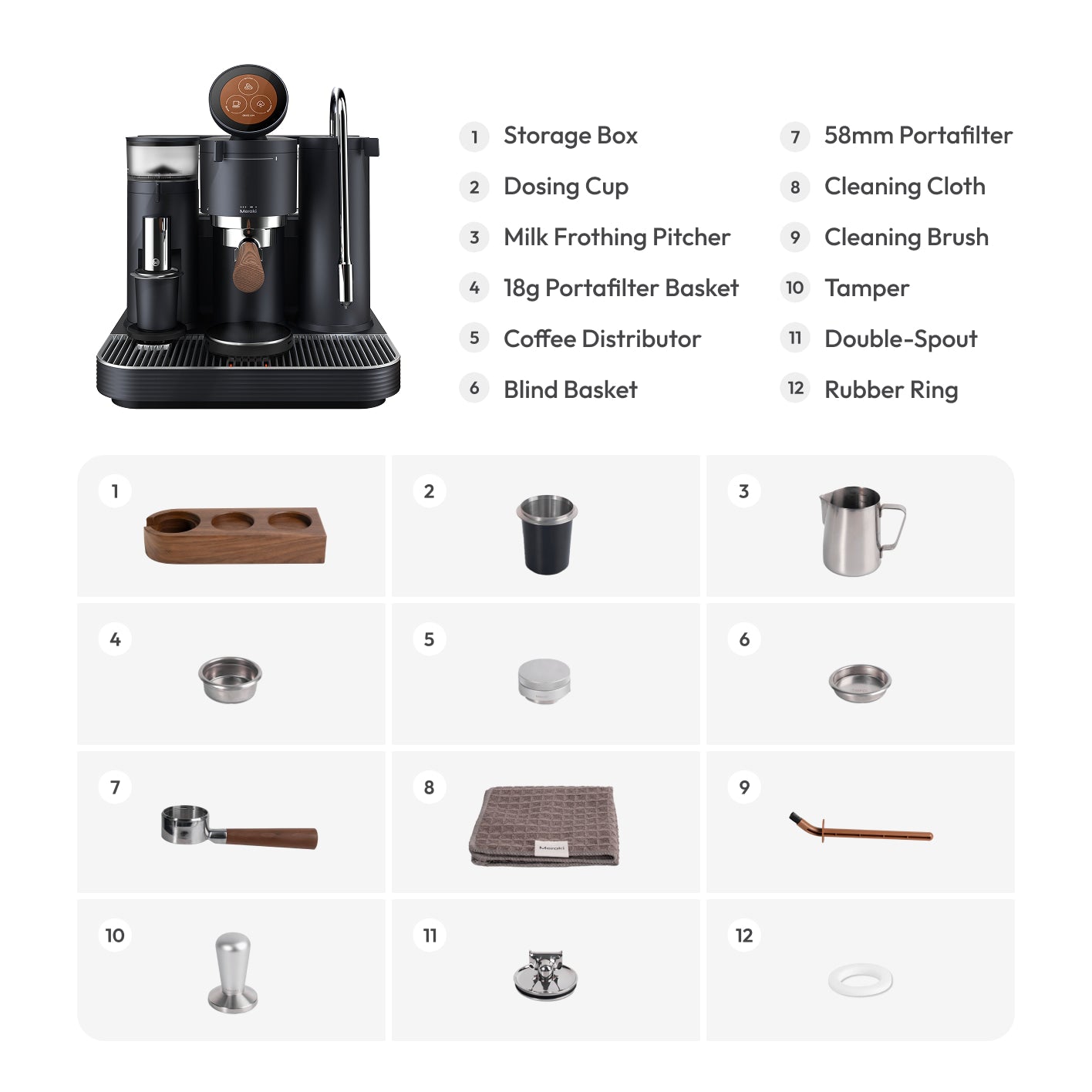
What’s in the box and on the counter — finish choice should survive wood handles, steel tools, and daily cups, not only a hero photo.
Home appliances still deserve a safety-minded buy — see UL and CPSC for general product-safety context — and a service path you can use. Color does not change warranty geography or trial clocks; those stay on policy pages.
When black is the better fit
Black tends to win the Meraki espresso machine color choice when your counters or cabinets are already dark, when you want the machine to recede so the workflow (not the appliance) dominates photos, or when you dislike seeing every fingerprint between scheduled cleans.
It also fits “prosumer café” aesthetics — dark stone, matte cabinets, stainless accents — and buyers who prefer the common dark look in enthusiast gear (resale taste is preference, not a guarantee). As of October 26–27, 2026, Gen2-Black (SKU Gen2-MEM03B) listed available at the same U.S. offer as white ($1,999 / $1,799 when checked; current ~$210 upgrader / gift kit as a current offer). Re-check stock the day you buy. For a longer black-only tour, open the black finish guide.
When white is the better fit
White tends to win when your kitchen is already light — pale quartz, white or soft-wood cabinets, Scandinavian or “airy café” styling — and you want the machine to look intentional rather than heavy.
It also fits buyers who like visible maintenance as a nudge: smudges show, so a wipe leaves an obviously tidy station. White often shows dust and fine grounds less dramatically than black under bright window or LED light. Gen2-White (SKU Gen2-MEM03W) listed available at the same offer price on the same check window — confirm live. For “who white suits,” use the white finish guide; this page ends when you know which visibility trade you prefer.
A practical choose-in-10-minutes checklist
Answer yes/no in your own words before you tap a color swatch:
- My counters/cabinets are mostly dark — I want the machine to recede (leans black).
- My counters/cabinets are mostly light — I want a clean, airy appliance read (leans white).
- I wipe when I see mess more than on a fixed schedule (leans toward the finish that matches how loud you want that signal — often white if you want the nudge, black if you want quieter visuals).
- My espresso corner gets strong daylight or bright LEDs (picture dust on black vs water marks on white before you choose).
- My everyday accessories (wood handle, steel pitcher, cups) will sit beside the chassis all day — I have pictured the full set, not only the hero shot.
- I am not choosing color to “fix” heat-up, steam power, or pump noise — those are the same station.
- I have confirmed the live variant I want is Gen2-Black or Gen2-White on the product page — no invented third finish.
- I have calendared the 30-day home trial from delivery so I can judge finish in my light, not only in product photography.
Five or more clear answers pointing one direction usually means you can stop researching color. Split answers usually mean take a photo of your empty counter at morning light, drop both product images beside it, and pick the one you would still like in month three. Support if you need a human check: +1 833 854 9555 (Mon–Fri, 9 AM–5 PM EST) via support.
How to select an espresso machine?
Pick the workflow first, then the finish.
Start with drink type (milk vs straight espresso), whether you want dual boilers and measured dose/yield, counter footprint, and ownership terms (trial, warranty geography, return fees). Only after those are honest should you choose Meraki black vs white — color does not rescue a mismatched machine category. For a broader home-station layout, Meraki’s 2026 home espresso setup guide is a better hub than a finish page. Capsule-color catalogs (including many Nespresso lines) answer a different product class; do not treat capsule finish charts as dual-boiler buying criteria.
Is the Meraki espresso machine actually good?
“Good” depends on whether guided, weighed, dual-boiler all-in-one workflow matches your mornings — not on Gen2-Black vs Gen2-White.
Meraki’s current framing combines dual boilers, a rotary pump near steady 9 bar, ±0.2 g dual scales, a TIMEMORE® co-developed grinder, guided touchscreen workflow, a 30-day home trial, and a 2-year limited warranty — confirm live pages. Same-window signals included ~530 product-page reviews and 4.9/5 / 20,000+ users messaging — useful proof, not a lab certificate. Disclosure: Meraki publishes this page and sells Meraki. For value math, use a dedicated worth-it page; Barista Magazine’s Meraki × TIMEMORE test-drive is still not your trial.
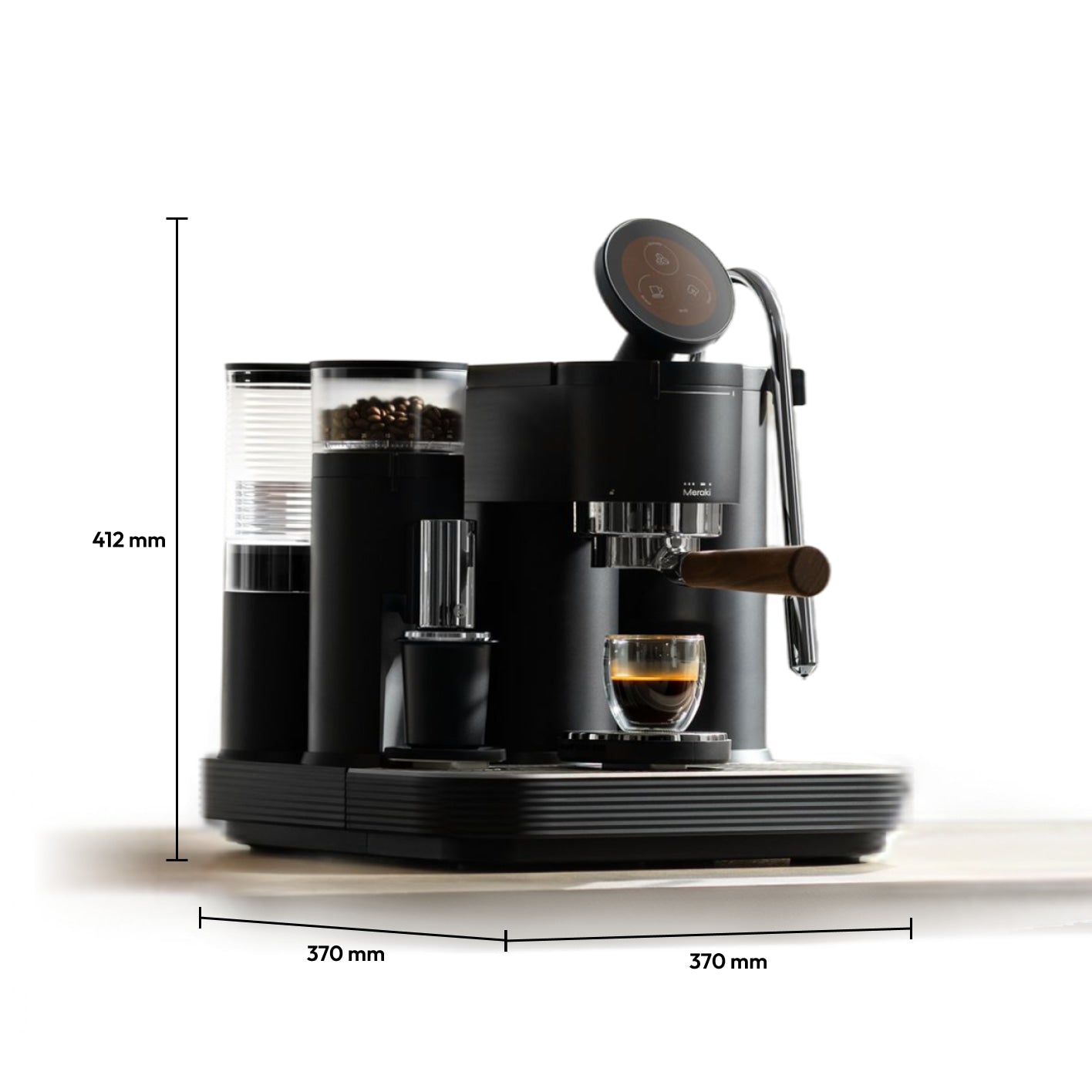
Measure the clearance you have — black and white share the same footprint; only the visual weight changes.
FAQ
What colors does the Meraki espresso machine come in? As of the October 26–27, 2026 product check, Meraki lists two finish options on the U.S. machine product: Gen2-Black (SKU Gen2-MEM03B) and Gen2-White (SKU Gen2-MEM03W). Do not assume older campaign photos imply a third retail finish. Confirm availability on the live product page the day you buy — stock can change even when both options remain in the catalog.
What colors do Nespresso machines come in? Many Nespresso models historically ship in multiple shell colors, but that catalog is a capsule ecosystem, not Meraki’s dual-boiler all-in-one class. Use Nespresso’s own model pages if you are buying capsules; do not import those color charts into a Meraki black vs white counter decision. Workflow, beans vs capsules, and milk system matter more than matching a capsule machine’s palette.
Does the Breville Barista Express come in different colors? Breville / Sage Barista Express-class machines have appeared in more than one finish depending on market and year, but exact SKUs change. We will not invent a current Breville color list or link a competitor store. If you are comparing ecosystems, decide workflow first (modular vs guided all-in-one), then verify the finish on the exact listing you will pay — and use this page only for Meraki Gen2-Black vs Gen2-White.
Does Meraki color affect heat, fingerprints, or cleaning chemistry? Heat-up, steam, and pump behavior are not published as finish-specific. Fingerprint and stain visibility does change: black often hides smudges longer and can show dust/grounds in bright light; white often shows water marks and fingerprints sooner and looks obviously tidy after a wipe. The wipe routine itself is the same — neither finish invents a special cleaner. Measurement habit still saves more wasted shots than paint choice; NIST is a reminder that trust comes from repeatable dose and yield.
Will accessories match both finishes? Wood handles, chrome, and stainless tools sit beside either chassis. Some Meraki accessories are photographed in black (for example, dosing-cup collection imagery) and read naturally next to Gen2-Black; the same steel/wood pieces can contrast cleanly with Gen2-White if you want a light café corner. Browse the live accessories collection rather than assuming every tool has a color twin. Electricity and consumables usually dwarf finish anxiety — see energy.gov for appliance energy context in general.
If your counter photo and wipe habits already point clearly to Gen2-Black or Gen2-White — and the ownership terms fit — confirm today’s stock and inclusions on the Meraki Espresso Machine product page, then choose the finish you will still like under your morning light.
More on this topic: Meraki Espresso Machine Guides.


