


What Is a 58mm Portafilter and Why Does It Matter?
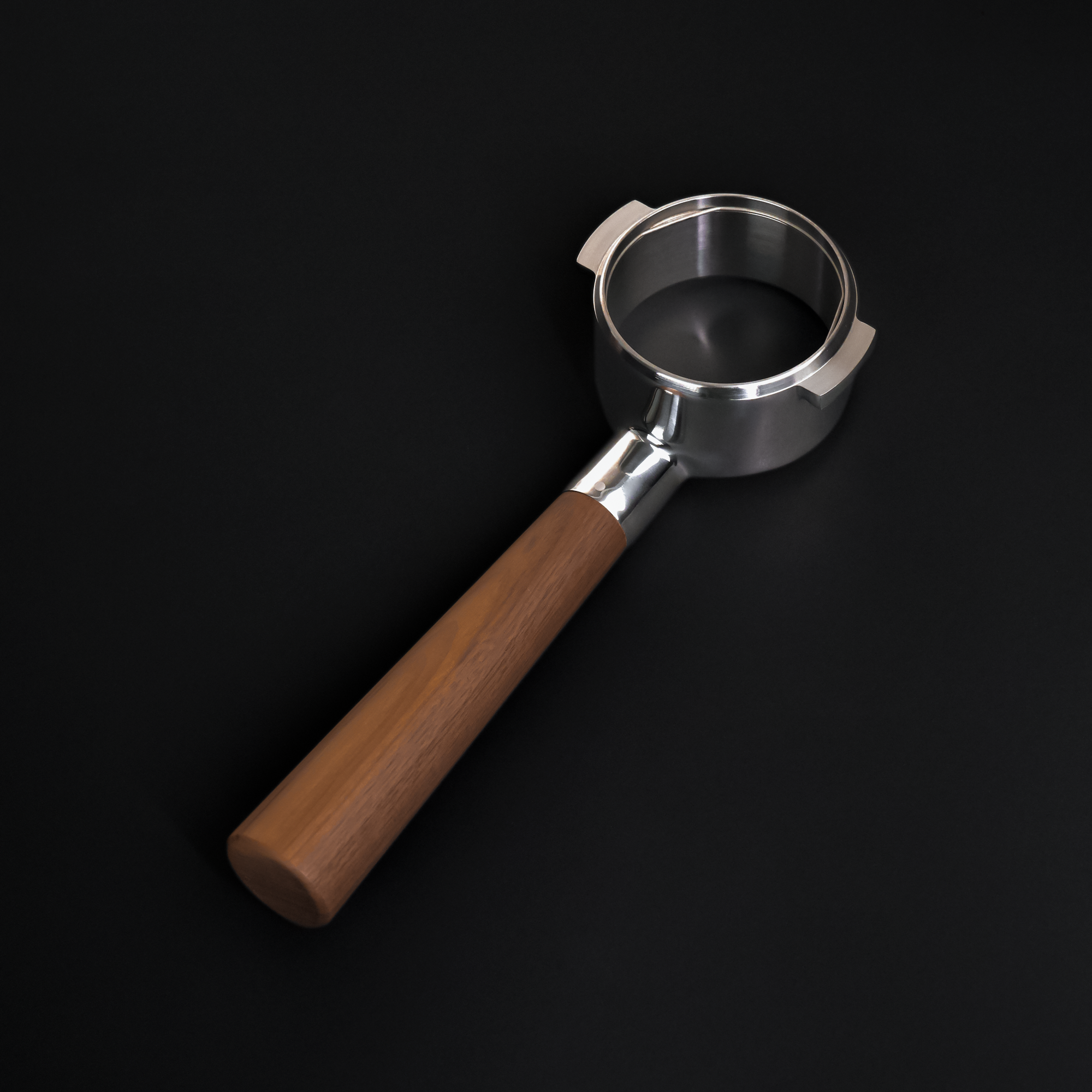
The portafilter holds the filter basket and locks into the machine's group. During brewing, water passes through the prepared coffee puck inside that basket. The quality of the shot depends on the complete system: grinder, coffee, dose, basket, distribution, tamp, water temperature, pressure delivery, beverage yield, and machine condition.
What does 58mm mean on a portafilter?
The number describes the nominal basket and group format. It is useful for narrowing the accessory search, but it is not a complete engineering specification. A portafilter also has locking ears, a body depth, an insertion angle, a handle position, and clearances that must match the group.
The basket adds another layer of fit. Baskets sold under the same nominal diameter can differ in height, taper, ridge, hole pattern, and intended dose. A tamper, dosing funnel, puck screen, or distributor must fit the basket actually being used, not only the number printed on the machine.
Why do home baristas choose a 58mm portafilter?
Broad accessory availability
The format is supported by many basket and puck-preparation tool makers. This can make it easier to replace a basket or find a correctly sized tamper, funnel, dosing cup, distributor, or cleaning accessory.
A familiar commercial-style workflow
Many cafe machines use a similar nominal format. A home user who trains on a 58mm system can learn a routine that feels familiar when working with other commercial-style equipment: dose, distribute, tamp, lock in, brew, knock out, rinse, and wipe.
Choice of baskets for different recipes
Different baskets may be designed around different coffee doses or extraction styles. Use the basket maker's recommended range as a starting point. A basket that is too full can contact the shower screen; one that is underfilled can leave excessive headspace and change puck behavior.
These are workflow advantages, not proof that diameter alone improves flavor. Our separate guide to 58mm espresso machines explains why stability and measurement remain more important than size by itself.
Bottomless vs spouted portafilters
| Type | Main advantage | Tradeoff | Best use |
|---|---|---|---|
| Bottomless | Lets the user observe flow from the basket directly and provides more cup clearance | Poor puck preparation can spray and create mess | Diagnosing distribution and practicing technique |
| Single-spout | Directs espresso toward one cup | Hides the underside of the basket during extraction | Clean, simple service into one cup |
| Double-spout | Can divide the stream between two cups | Split volume may not be perfectly equal | Serving two small cups from one extraction |
A bottomless portafilter is a diagnostic window, not an automatic quality upgrade. Centered flow can indicate a well-prepared puck, while spraying can reveal an uneven path. However, appearance alone does not replace tasting or tracking the dose, yield, and time.
How to check portafilter compatibility
- Confirm the exact machine generation. Model family and nominal size are not enough when the manufacturer lists separate variants.
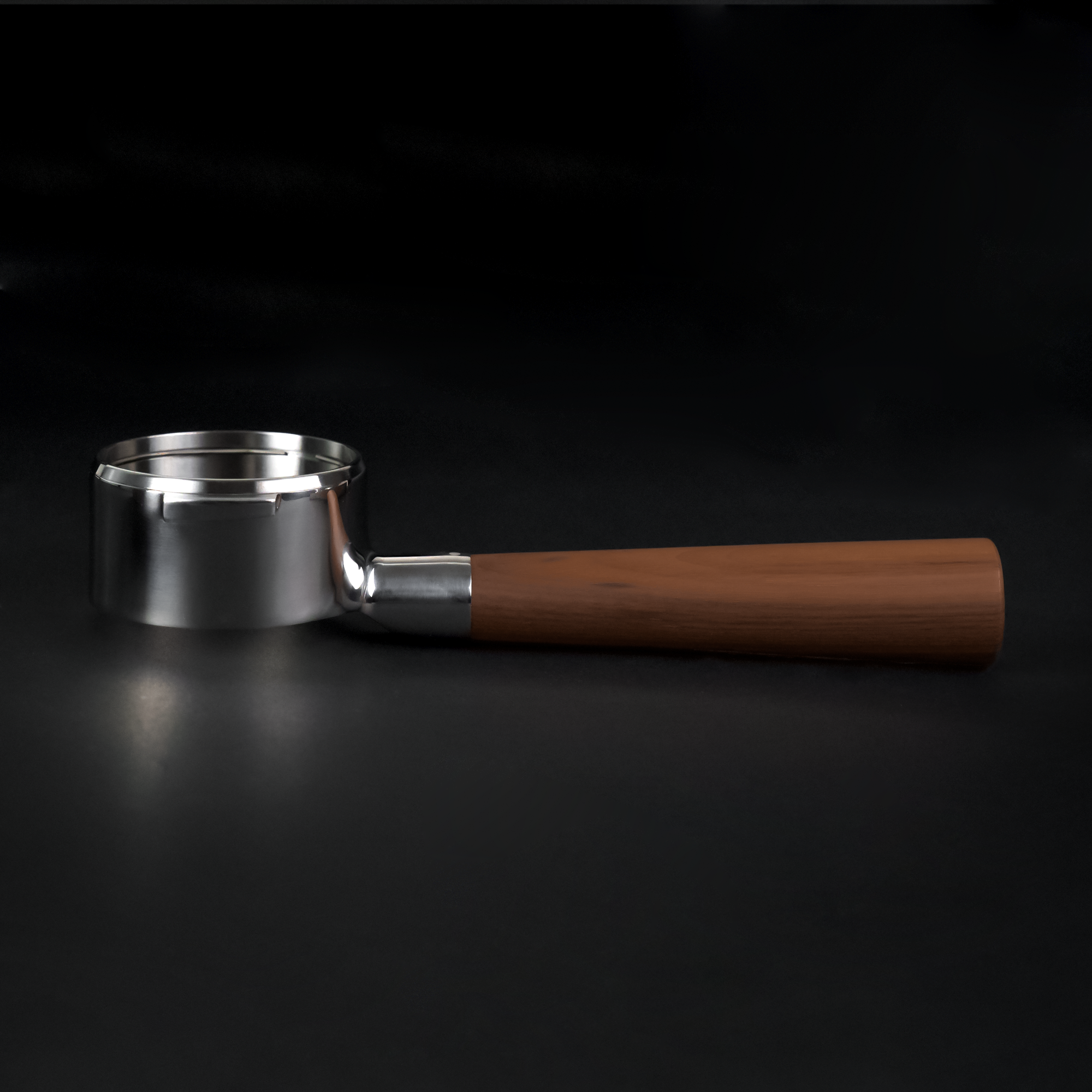
- Match the locking ears. Their number, width, thickness, and position affect whether the portafilter enters and seals.
- Check body and basket depth. The group, gasket, basket, and shower screen need appropriate clearance.
- Check handle position. When locked, the handle should reach the intended position without excessive force.
- Verify accessory fit to the basket. Tampers, funnels, distributors, puck screens, and dosing cups interact with the basket interior or rim.
- Use the manufacturer fit list. If compatibility is not stated, ask before purchasing rather than forcing the part into the group.
The active Meraki 58mm Portafilter page lets owners select the Gen 1 Compatible or Gen 2 Compatible version. That distinction is more reliable than assuming any third-party 58mm handle will lock and seal correctly.
How the Meraki 58mm workflow supports repeatability
Meraki combines its 58mm portafilter with an espresso-tailored grinder and built-in grind-by-weight measurement. This helps control the mass of coffee entering the basket. After distribution and tamping, the second built-in scale tracks beverage yield in the cup.
The dual boilers support brewing and steaming without waiting for one heater to switch jobs. The commercial rotary pump delivers quiet, stable operation at the machine's fixed 9-bar brew pressure. Brew pressure is not user-adjustable; pre-infusion pressure can be set to 3 or 4 bar, and pre-infusion duration is adjustable.
The portafilter is therefore one part of a measured system. Its commercial-style size gives the user familiar preparation tools, while grind by weight and brew by weight make the dose and yield easier to repeat.
How to clean and care for a portafilter
- Knock out the puck after brewing and rinse the basket before coffee oils dry.
- Wipe the basket rim so grounds do not interfere with the group gasket.
- Remove the basket periodically for cleaning according to the machine and accessory instructions.
- Do not use an abrasive tool on polished sealing surfaces.
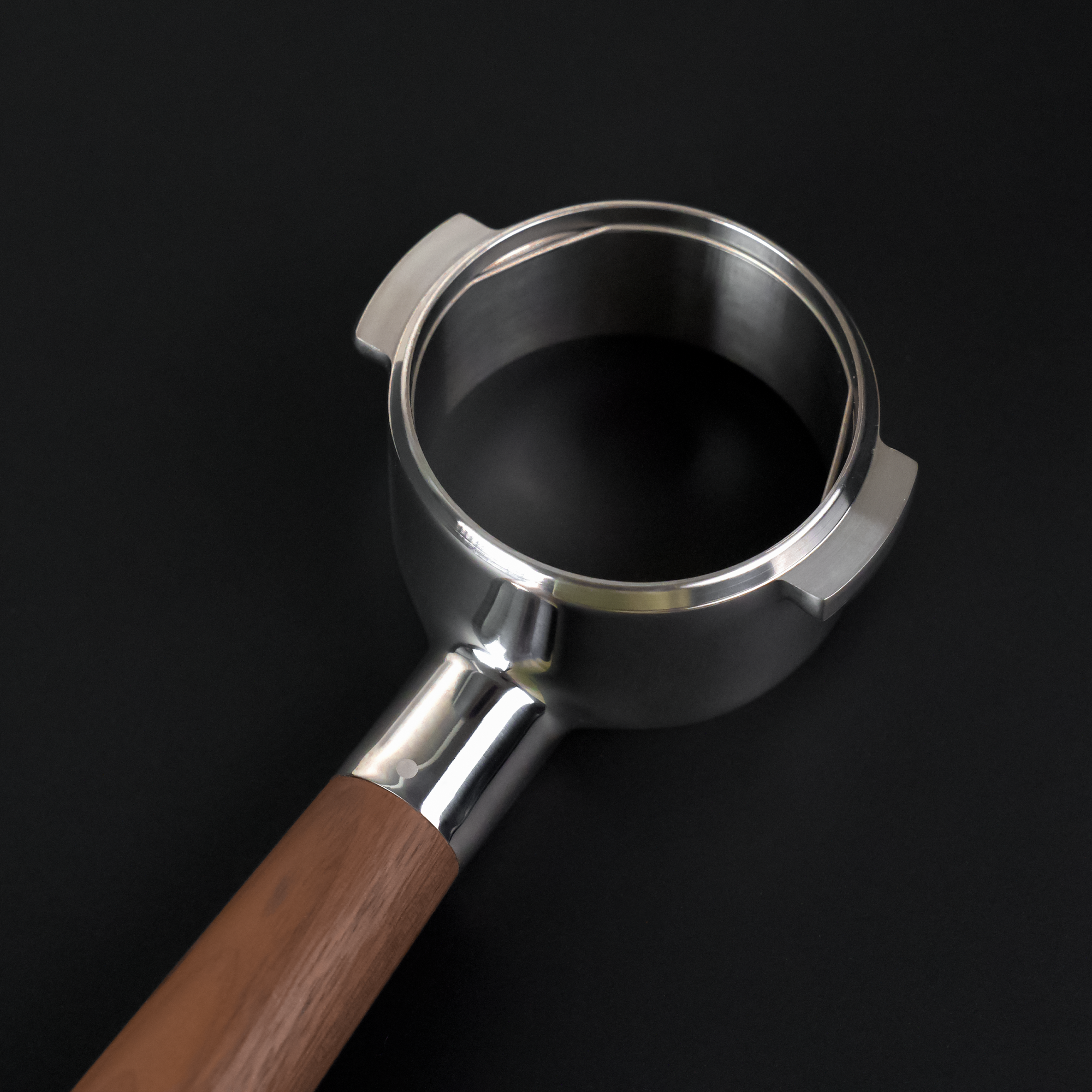
- Keep wooden handles out of prolonged soaking unless the manufacturer explicitly allows it.
- Replace a damaged basket or portafilter rather than using a part that no longer locks or seals correctly.
Cleaning frequency depends on use. The goal is to prevent stale oils and loose grounds from affecting flavor or the seal, not to follow a universal calendar. Follow the current Product Manual and accessory care instructions.
Frequently asked questions
What size portafilter does the Meraki Espresso Machine use?
Meraki uses a 58mm commercial-style portafilter. The official replacement product has separate Gen 1 Compatible and Gen 2 Compatible variants, so select the correct generation.
Are all 58mm portafilters interchangeable?
No. Locking ears, body depth, handle position, basket geometry, and group design can differ even when the nominal size is the same.
Does a 58mm portafilter make better espresso?
Not automatically. It provides a common format and broad accessory choice. Espresso quality still depends on the coffee, grinder, recipe, puck preparation, temperature, pressure delivery, yield, and machine condition.
Can I use a dosing cup with a 58mm portafilter?
Yes, if the cup lip and basket are designed to work together. See the dosing cup guide for fit and transfer considerations.
Is a bottomless portafilter better than a spouted one?
It is better for observing extraction and learning from spray or uneven flow. A spouted version can be cleaner and more convenient for routine service. Neither fixes puck preparation by itself.
Choose the exact fit, then evaluate the full workflow.
Explore the official Meraki 58mm Portafilter, or see how the portafilter, espresso-tailored grinder, dual scales, dual boilers, and rotary pump work together on the Meraki Espresso Machine page.