


Yesterday's recipe worked, but today's shot runs differently and the kitchen feels muggy. A humidity espresso grind setting check should start with the actual shot, not an automatic turn of the dial. Room conditions can belong in your notes, but they do not tell you how much moisture is inside the beans or exactly which adjustment your grinder needs.
Humidity espresso grind setting checks: observe before adjusting
Keep the established recipe as your starting point and verify what changed. A weather shift is a possible context, not a confirmed cause. Compare the dry coffee dose, beverage yield, shot behavior, and taste before changing the grind.
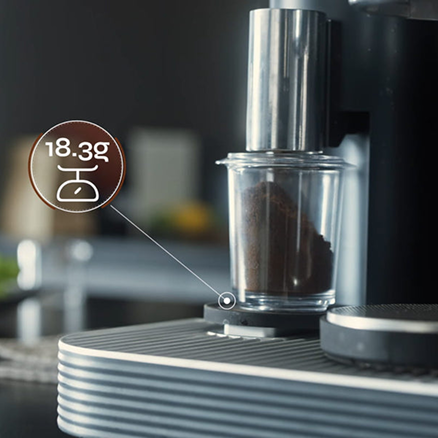
If your coffee delivery changed, the resulting puck is no longer the same comparison. If the beverage yield changed, the tasting result also needs that context. Correct those differences before treating the grinder setting as the only variable.
The espresso grind-size guide covers general adjustment principles. This article focuses on deciding whether an environmental change deserves attention and avoiding a weather-based rule that overrides your actual brewing evidence.
Record one clear observation instead of a conclusion: the same dose and yield took longer, or the delivered grounds weighed less. Those notes let you investigate the relevant change without writing humidity caused it before the comparison supports that claim.
Is room humidity the same as bean moisture?
No; they describe different measurements.
A room reading describes the surrounding air, while bean moisture concerns water within the coffee; packaging, exposure history, and temperature prevent one reading from directly establishing the other.
Relative humidity, usually shown as RH, expresses moisture relative to saturation at the air's temperature. The National Weather Service's humidity definition makes that temperature dependence clear. A percentage is not a direct measurement of water in your coffee.
The abstract of research on roasted-coffee moisture adsorption describes equilibrium-moisture models for whole beans and two ground-coffee sizes, using water activity and temperatures of 25, 35, and 45°C. Those stated measurements are not a humidity-to-grinder-setting conversion. Do not use them to assign an espresso setting from today's outdoor weather report.
Use an indoor reading as contextual information, with temperature and sampling location attached. Do not infer that sealed beans immediately match the room's conditions or that a short-lived humidity change requires an immediate recipe correction.

Look at exposure history rather than today's forecast alone
Ask where the coffee has actually been. A sealed reserve, a bag repeatedly opened beside steam, and beans left in a hopper have different exposure histories. A single room reading cannot reconstruct those histories.
The National Coffee Association's storage guidance identifies moisture, air, heat, and light as concerns for roasted coffee. For this troubleshooting task, the useful implication is to keep storage and handling consistent rather than deliberately conditioning beans to match the weather.
Note any recent changes: a new container, a different storage location, or a much longer time in the hopper. Keep the ordinary reserve closed and follow the equipment's instructions for bean handling.
Do not attempt to prove a moisture hypothesis by leaving coffee exposed overnight. That adds an uncontrolled storage intervention. If the recipe has shifted, assess the dry supply you intend to use and improve the record before experimenting with the coffee's environment.
Separate static-related delivery from water-flow behavior
Grounds sticking to the cup and a slower espresso are different observations. Static can influence how particles scatter or aggregate, but visible mess does not tell you how the finished puck will behave. The site's static-control guide covers that workflow; here, distinguish the observation from the weather explanation.
Research on charge mitigation during grinding used an EK43 and tested water addition and other discharge methods. Its espresso tests used a Black Eagle; darker and lighter samples did not respond identically. The intervention was not a comparison of weather-driven grind adjustments, so its results cannot prescribe a grind direction from room RH.
If the delivered dose differs, restore the intended dry-coffee amount using the approved workflow and repeat the comparison. If the dose is stable but shot behavior changes, examine the remaining recipe variables rather than treating scattered grounds as the explanation.
Keep RDT separate from this check. Do not add water to an unapproved grinder in response to a humidity reading. Introducing another technique at the same time makes the original environmental question harder to assess.
Check temperature and recipe drift before blaming humidity
A humid day may also be warmer, or it may coincide with a different brewing routine. Note temperature and equipment preparation as well as RH. The useful question is whether your comparison holds the relevant conditions steady.
The Uman and colleagues grinding-temperature study measured particle-size changes after controlled bean cooling on an EK43 with Turkish burrs. It did not test ordinary kitchen humidity or establish a weather-based adjustment rule. Bean temperature is a separate variable, not evidence that a muggy day caused your shot to change.
Also check whether the bag, roast age, basket, dose, or target yield changed. A familiar grinder number does not make a new coffee identical to the previous one. Nor does an unchanged room reading prove that every brewing variable remained fixed.
If several factors changed, return to a workable baseline and address them individually. You do not need a laboratory to improve the shot, but you should avoid attributing a multi-variable change to one weather measurement with more confidence than the evidence supports.
Adjust from comparable shots, not a humidity conversion chart
Once dose, yield, and preparation are consistent, make a small permitted grind adjustment if the actual shot needs it. Use your grinder's instructions for adjustment and operation. Do not apply an invented number of clicks per percentage point of RH.
If a comparable shot reaches the target yield too quickly, a finer setting may be a reasonable test. If it is excessively restricted, a coarser setting may be appropriate. Those are responses to the shot, not predictions from the weather.
Keep the other recipe variables steady for the next comparison and judge taste as well as timing. Follow any model-specific procedure needed after changing the setting rather than assuming every grinder presents the new adjustment identically.
If the equipment behaves abnormally or adjustments do not produce an understandable response, use Meraki's contact page for the relevant support question. Persistent inconsistency should not be dismissed as a humid-day problem without further assessment.
Keep a useful weather note, not a weather-dependent ritual
Record indoor temperature and humidity alongside the coffee, dose, yield, setting, and result when you suspect a repeatable pattern. Compare several occasions before deciding that the pattern is useful. Treat a correlation as a clue, not proof of a single cause.
Your decision is straightforward: keep the successful recipe when the shot still works, and adjust when a comparable shot needs correction. Do not change the dial in advance simply because rain arrived or an app reports a different outdoor percentage.
A good record can help you anticipate a check without prescribing the answer. That is a more useful habit than chasing the room's humidity with every drink or adding equipment that cannot establish what changed in the beans.
Building a measured home routine? Explore the Meraki Espresso Machine and keep environmental notes secondary to the espresso you actually brew.
FAQ
Should I copy yesterday's setting when the humidity matches?
Use yesterday's successful recipe as a starting point, not as a guarantee. Matching room humidity does not mean the coffee age, dose delivery, equipment condition, or preparation is identical. Check the resulting shot before deciding whether an adjustment is needed. A saved setting is useful because it reduces unnecessary changes, but the final decision should still come from comparable brewing observations and taste. Keep the coffee identity with the note so a weather match does not hide a different bag.
Would a humidifier solve an inconsistent espresso recipe?
Do not buy or use a humidifier solely to chase a grinder setting. A room-humidity intervention changes another variable without identifying why the shots differ, and it does not establish the moisture content of the beans. First check the recipe, dose delivery, storage, and equipment operation. Manage your living environment for its appropriate household purposes, separately from espresso troubleshooting. If a repeatable brewing issue remains, investigate that issue rather than assigning an unverified target humidity to the entire room.
Should I dry damp beans in the oven before grinding?
No. Do not improvise an oven-drying treatment to rescue beans with unexplained moisture. Heating introduces another change and does not establish that the coffee is suitable or that contamination has been resolved. Keep visibly damp or suspect beans out of the grinder and assess the storage problem separately. For ordinary recipe drift without visible moisture, use dry, properly stored coffee and the normal adjustment process. Do not turn a weather observation into permission to heat, wet, or otherwise condition the beans.


