


An espresso grinder is a coffee grinder, but not every coffee grinder gives you the control espresso demands. The practical difference is whether it can make small, repeatable changes inside the espresso range and deliver a consistent dose as the recipe changes.
Espresso is sensitive to the resistance of the coffee bed. Grind too coarse and water can move too quickly; grind too fine and flow may slow dramatically or become uneven. The useful grinder lets you move between those outcomes in controlled steps.
The broader choice is between one grinder for several brewing methods, a separate espresso-focused grinder within an independently upgradeable espresso setup, and a coordinated system such as Meraki that connects grinding, dose, brewed yield and extraction.

Quick answer: espresso grinder vs coffee grinder
Choose an espresso-focused grinder if espresso is your main brewing method and you want precise adjustment around a narrow working range.
Choose a multipurpose coffee grinder if you regularly switch between drip coffee, filter brewing, French press and espresso—and you are comfortable moving between settings or recalibrating the grinder.
Choose an integrated espresso system such as Meraki if you want the grinder, grind-by-weight dosing, brew-by-weight stopping and espresso machine to work as one measured workflow. Meraki keeps the process hands-on, but reduces the number of separate tools and disconnected measurements between beans and cup.
The short version: “Espresso grinder” describes capability, not a completely different category of appliance. Look for usable adjustment resolution, repeatable dosing and a workflow that matches how you actually make coffee.
Espresso grinder vs coffee grinder at a glance
| Decision factor | Espresso-focused grinder | Multipurpose coffee grinder | Meraki integrated system |
|---|---|---|---|
| Primary strength | Fine control within the espresso range | Wider range across brewing methods | Espresso grinding, weight-based dosing and brewing in one workflow |
| Adjustment | Small, practical changes for dialing in | May prioritize range over resolution at the fine end | 45 settings across Meraki’s espresso-tailored range |
| Dosing | Timer, manual weighing or an external scale, depending on model | Varies widely by grinder | Built-in grind-by-weight scale |
| Brew measurement | Separate espresso scale normally required | Separate espresso scale normally required | Built-in brew-by-weight scale and target-yield stopping |
| Upgrade path | Grinder can be replaced independently | Grinder can be replaced independently | Grinder and machine remain one coordinated system |
| Best fit | Espresso-first setups and enthusiasts choosing each component | Households switching frequently among brew methods | Home users who want serious espresso capability with fewer separate steps |

Why espresso asks more from a grinder
Pressure makes flow sensitive to grind changes
Espresso water moves through a compact bed of ground coffee under pressure. This high-pressure brewing method makes flow especially sensitive to grind size, so a small movement on the dial can noticeably change the shot. A grinder may look “fine enough” yet still be frustrating if one setting runs quickly and the next slows the shot too far. What matters is controlled movement around the setting your coffee needs.
Consistency is more than making every particle identical
Grind consistency does not mean producing identical particles. Coffee grounds contain a distribution of particle sizes, including smaller particles called fines. A 2024 Scientific Reports study found that both median particle size and the share of fines influence espresso flow; more fines reduced permeability and increased extraction time within the conditions tested.
That does not make “fewer fines” universally better. Particle distribution changes how water moves through the bed, while the useful setting still depends on coffee, basket, dose, target yield and taste.
Small changes need to be repeatable
An espresso grinder should let you return to a useful setting and make micro adjustments as coffee beans age or a new specialty coffee behaves differently. Stepless grinders provide continuous movement; stepped grinders can also work when their steps are close enough in the espresso range. More settings do not guarantee better coffee, but usable resolution makes dialing in less abrupt.
What a multipurpose coffee grinder does well
One grinder can serve several brewing methods
A multipurpose grinder suits a kitchen that moves from espresso to pour-over or French press. Some burr grinders span espresso-fine to cold-brew-coarse settings, so a general coffee grinder can be espresso-capable. Burr types and burr design influence the result, but neither label alone guarantees balanced flavor or consistent grinds.
Separate equipment preserves upgrade flexibility
A standalone grinder preserves independent upgrades and a dedicated single-dose workflow. The tradeoff is a more fragmented setup with a grinder, scale and more counter space. Repeatedly switching between filter and espresso may also require recalibration.
What to look for in an espresso-focused grinder
Useful adjustment inside the espresso range
Ignore broad setting counts until you know how many are practical for espresso. Look for controlled movement near your normal setting, a clear way to track changes and a dial that stays where you put it.
Repeatable dose control
Grind size controls particle distribution; dose controls how much coffee sits in the basket. Both affect resistance and the final recipe. Accurate dosing therefore matters alongside grind consistency: the grinder should repeat the dry dose while you make small adjustments.
Standalone grinders may dose manually, by time or by weight. Manual and timed dosing can work well, but many home baristas still confirm the result on a separate scale. Grind-by-weight removes one transfer between grinding and measurement.
Retention, static and cleaning access
Retention is coffee that remains in the grind path; static can scatter grounds or make them cling. Results vary with coffee, humidity, dose and test method, so look for an accessible path, sensible anti-static control and manufacturer-supplied maintenance instructions rather than a generic schedule copied from another grinder. For step-by-step grinder, group-head, steam-wand, and descaling care, use the complete espresso machine cleaning guide.
How Meraki approaches the grinder decision
Meraki is not a one-touch bean-to-cup machine. It is a semi-automatic espresso system that integrates the grinder and measurement tools while keeping portafilter preparation, tamping and milk texturing in the user’s hands.
Its value is not simply that the grinder sits inside the same body. Grind size, dry dose, brewed yield, brew temperature and milk temperature can be managed in one connected workflow.
1. An espresso-tailored grinder, not a generic add-on
Meraki provides 45 grind settings across an espresso-tailored range. That focus avoids spending most of the dial on coarse filter settings that an espresso-first household may rarely use.
The grinder is designed for the machine’s portafilter workflow, with anti-static dosing and a short path intended to keep the station cleaner. It still requires dialing in: different beans and recipes need different settings, and no grinder can choose flavor for you.
2. Grind by weight controls the dry dose
Meraki’s built-in grind-by-weight system stops at the selected coffee weight. Instead of grinding for a fixed number of seconds and hoping the output is unchanged, the system measures the dose delivered for that recipe.
That matters because a grind adjustment can also change how quickly coffee leaves a timed grinder. Weight-based dosing separates the target dose from grind duration, reducing one common source of variation.
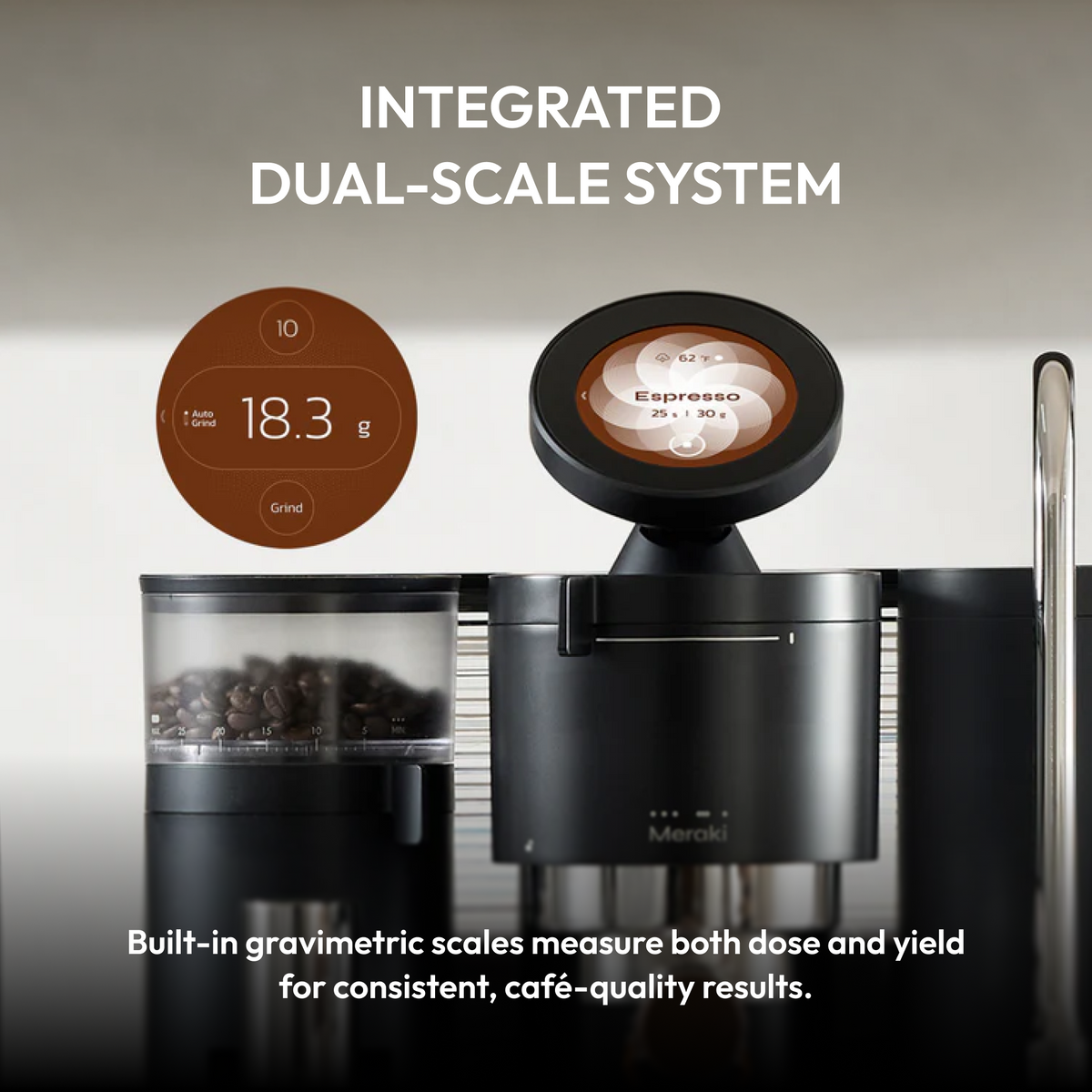
3. Brew by weight measures the liquid yield
The second built-in scale measures espresso in the cup and can stop the shot at the selected yield. Dose and yield can therefore be defined by weight without placing a separate scale on the drip tray.
This creates a clearer recipe loop: choose a dose, choose a target yield, observe flow and taste, then adjust grind size while keeping the other targets visible. The scales do not replace judgment; they make the judgment easier to repeat.
4. The brew system remains independent of the grinder
Grinder quality does not create stable brew temperature or pressure. Meraki treats those as separate jobs. Dedicated brew and steam boilers allow extraction and milk steaming to operate independently, while the rotary pump supports the brew circuit.
The old idea of “factory-calibrated synergy between burrs and pump” overstates the relationship. The grinder prepares the coffee bed; the brew system controls water, temperature and pressure. Meraki’s advantage is that both capable subsystems sit inside one workflow—not that the pump corrects the grind.

5. Fewer tools without removing the craft
A separate grinder-and-machine setup can produce excellent espresso. Meraki’s case is fewer cables, no separate dosing or cup scale, and one interface for the recipe variables.
You still distribute and tamp the grounds, lock in the portafilter, evaluate the espresso and texture milk. The system measures more of the workflow without turning it into a push-button drink.

Integrated grinder or standalone grinder: which fits you?
Choose Meraki if you want
- Espresso to be the main purpose of the grinder.
- Grind-by-weight and brew-by-weight without separate scales.
- Dual boilers for brewing and steaming at the same time.
- A rotary-pump espresso platform in a coordinated home system.
- A guided interface while retaining hands-on portafilter preparation.
- A cleaner counter with fewer separate devices and cables.
Explore the complete system on the Meraki Espresso Machine product page, or use the professional espresso machine for home guide for a broader explanation of the hardware.
Choose a separate grinder if you want
- One grinder that frequently switches between espresso and filter methods.
- Freedom to change burr platforms or upgrade the grinder independently.
- A single-dose workflow built around weighing beans before every grind.
- The ability to pair a preferred grinder with an espresso machine you already own.
- Multiple grinders for different coffees or brewing styles.
Neither route is universally better. Choose the workflow and upgrade path you will actually use.
A practical grinder buying checklist
Before making a grinder choice, ask:
- Is espresso the grinder’s primary job, or will I switch methods every day?
- Can I make small changes near the espresso setting I normally use?
- How will I repeat the dry dose: manually, by time or by weight?
- How will I measure brewed yield?
- How much counter space do the grinder, machine and scales require together?
- Can I access the areas the manufacturer says require cleaning?
- Do I want independent upgrade flexibility or one coordinated system?
- Does the complete workflow fit the way I make drinks on a busy morning?
For a deeper look at integrated systems, read How to Choose an Espresso Machine With a Grinder. If you are comparing complete machines, continue with the best espresso machine guide.
How to dial in without relying on grind-size myths
Start with a defined dose and yield
Use a dose and beverage yield appropriate for the basket and coffee, then keep those targets consistent while evaluating grind changes.
Change one variable at a time
If water moves too quickly and the espresso tastes thin or sharply underdeveloped, move finer in a small step. If flow is severely restricted, move coarser. Taste should guide the decision; shot time is evidence, not a universal pass-or-fail number.
Do not chase a powdered-sugar texture
Espresso grounds do not have one correct visual texture for every coffee. “Powdered sugar” can encourage users to grind unnecessarily fine. The research on fines also shows why finer is not automatically more efficient: particle distribution changes permeability and flow in more complex ways.
Frequently asked questions
Can a regular coffee grinder grind for espresso?
Yes, if it reaches the espresso range with enough adjustment resolution and produces repeatable doses. Some multipurpose burr grinders do this well; others make jumps that are too large near their finest settings.
Is an espresso grinder always stepless?
No. Stepless adjustment offers continuous movement, but a stepped grinder can work well when the steps are sufficiently close in the espresso range. Judge the usable resolution, not the label alone.
Are flat burrs better than conical burrs for espresso?
Not universally. Burr geometry, alignment, rotational speed, particle distribution, coffee and recipe all affect the result. Flat versus conical is not a reliable shortcut to overall quality.
Is a bigger burr always better?
No. Burr size can influence speed and grinder design, but it does not by itself prove consistency, flavor or workflow quality. Adjustment, alignment, retention, dosing and the complete design still matter.
Does an integrated grinder compromise espresso quality?
Some integrated machines prioritize convenience over control, but integration itself does not determine quality. Evaluate the grinder’s adjustment range, dosing method and the espresso machine’s brew hardware. Meraki combines an espresso-tailored grinder with weight-based dose and yield measurement, dual boilers and a rotary pump.
Does Meraki grind and brew automatically?
Meraki can stop grinding at a target dose and stop brewing at a target yield, but it remains a semi-automatic portafilter machine. You prepare and tamp the coffee, start the extraction, assess the result and texture milk.
What is the biggest advantage of grind by weight?
It repeats the amount of ground coffee directly instead of using grind time as a proxy. This is especially useful when changing grind size or coffee, because the target dose remains visible even when the grinder’s output rate changes.
The final decision
The meaningful difference is control where espresso needs it. A wide range suits multiple brewing methods; fine adjustment and repeatable dosing matter more for an espresso-first setup.
Choose separate equipment for independent upgrades. Choose Meraki when you want an espresso-tailored grinder, grind-by-weight, brew-by-weight and capable brew hardware in one measured system. The goal is to make grind, dose, yield, temperature and taste easier to repeat—not to remove your decisions.
Sources
- Smrke, S., Eiermann, A. & Yeretzian, C. The role of fines in espresso extraction dynamics. Scientific Reports 14, 5612 (2024).
- Baratza. Encore ESP Pro: manufacturer description of a multipurpose stepless grinder spanning espresso to coarse brewing.
- Specialty Coffee Association. Fellow Opus 2 Conical Burr Grinder: an example of a multipurpose grinder designed across brewing methods.
Put the Grinder Into a Complete Espresso Workflow
After choosing the right grinder format, use our home espresso shot guide to connect grind adjustments with dose, yield, shot time and flavor.
Place Grinder Type in the Complete Machine Workflow
After comparing grinder designs, evaluate adjustment, dosing, retention, integration, and daily usability in our guide to choosing an espresso machine with a grinder.

